888 résultats
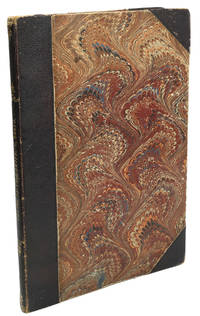
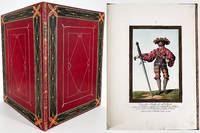
17901485Basel: C. de Mechel 1790. First Edition. Fine. Chrétien de Mechel after Hans Holbein. Folio 14 1/8 x 10 1/2 inches 360 x 263 mm; hand-colored aquatint title and 12 etchings & aquatint plates with hand-colroing in watercolor by Chrétien de Méchel after Hans Holbein the Younger. Handsome contemporary mosaic binding in red morocco inlaid dark green border with red and yellow dots and yellow corner piece designs gilt board edges and turn-ins gilt designs on spine and green label with gilt title spine a little rubbed marbled endpapers a.e.g.; preserved in a slipcase with marbled paper and red morocco profiles a little rubbed and faded. <br /> <br /> Cohen / deRicci 493; Colas 1462; Rahir Bibliothèque de l'Amateur p. 661; Brunet III 251-252; Cicognara 2044; Bobins 490; Vinet 2177. Housed in a stunning mosaic binding this rare folio contains a complete suite of 12 magnificently-colored plates the third part of a series of 4 comprising Holbein's oeuvre published in Basel by Chrétien de Méchel from 1780 to 1792 and usually found in uncolored state. The Swiss civil and military costumes originally drawn by Hans Holbein the Younger 1497 - 1543 and housed in the Basel Public Library. Chrétien de Méchel renders these drawings in a robust and precise manner for this edition featuring 6 women and 6 men some in military costume. More commonly encountered lacking the hand-coloring en bistre each of these scarce engravings appears fresh and in superb condition with excellent saturation and extensive bright coloration. An excellent exemplar of this rare hand-colored volume.<br /> A copy can be found in the Robert Wylie Lloyd collection at the British Museum inv. 1958.0712.3056.1-12. C. de Mechel unknown
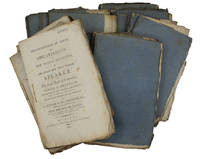
1789AQVBF8<p>8vo. 51 volumes. Preserved in the original states; the vast majority stitched as issued many uncut and in the original plain paper wrappers.</p><p>A remarkably fresh collection of pamphlets relating to Ireland and - largely - the proposed and later completed political union between Ireland and Great Britain dating from the final decade of the eighteenth- and first decade of the nineteenth- centuries. Included are historical and literary works references to the 1798 Irish Rebellion and numerous speeches made by Irish and British politicians during the long debates in both Houses of Parliament.</p><p>Highlights include:</p><p>- AN INDEPENDENT OBSERVER REDFOORD Archibald. Union necessary to security. Addressed to the loyal inhabitants of ireland. Dublin. Printed for J. Archer 1800.</p><p>8vo. 2 106pp. Uncut and partially unopened in original publisher's powder blue wrappers. Occasional inked corrections to text some dampstaining to margins.</p><p>Presentation copy inked inscription to head of title: 'For William Smith Esq. / from his sincere friend / The Author'.</p><p>ESTC T194733.</p><p>- AN OFFICER. TAYLOR Sir Herbert. Impartial relation of the military operations which took place in Ireland in consequence of the landing of a body of French troops under general Humbert in august 1798. Dublin. Printed for J. Milliken 1799.</p><p>8vo. 2 69pp 1. With two engraved folding plates and a folding table. Uncut and partially unopened in original publisher's marbled wrappers. ESTC T114958.</p><p>- A REAL FRIEND. A letter to the people of Ireland which they all can understand and ought to read. Dublin. Printed for J. Milliken 1799.</p><p>8vo. 3 6-33pp 1. In this edition the text ends on p.34 with 'I am your real friend. Finis'. Uncut and unopened in original publisher's powder blue wrappers. Foxed.</p><p>ESTC records a single copy of this edition in North America Missouri and none elsewhere.</p><p>From the collection - recently dispersed - of the Marquesses of Lothian who also held the Earldom of Ancram at Newbattle Abbey; many were presumably acquired by William Kerr 5th Marquess of Lothian 1737-1815 British soldier and peer.</p><p>A full list of the contents of this collection is available on request.</p> [vs.].
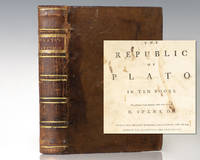
1763138322Glasgow: Printed by Robert and Andrew Foulis 1763. First edition in English of Plato's Republic marking the first appearance in the English language of Plato's profoundly influential dialogue concerning the nature of justice. Quarto bound in full polished calf with raised gilt bands to the spine morocco spine label lettered in gilt all edges speckled red. Harry Spens was a minister at the parish of Wemyss in Fife and respected classicist. In his introduction he professes his intent in his translation is: "To give the English Reader a view of Plato's sentiments and manner of writing and to stir up the youth to the study of the Ancients." Richard Garnett in his own introduction of the Everyman's Library reprint of this translation laments the relative lack of critical attention paid to it writing: "On the whole Spens's version should not be lightly esteemed. It is clearly the work of a scholar and a man of considerable literary ability." The brothers Robert and Andrew Foulis were renowned printers of classical works in their time sometimes referred to as 'the Elzevirs of Britain.' Their works mostly intended for scholars were "much sought after as admirable specimens of typography and are noticeable for their severely plain elegance" DNB 7: 514. In very good condition. Rare and desirable. "Its setting and its characters are full of political meaning. Its arguments are tantalizing and its fables fascinating… Plato's utopia is alarming and his metaphysics are intoxicating" Levi 348. The Republic "has reinforced dedication awakened vocations to leadership and strengthened the morale of those modest and competent souls who are always in reality the guardians of society" Rexroth 79. Printed by Robert and Andrew Foulis unknown
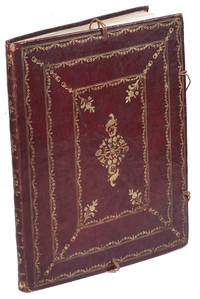
1800ABC_48443The Netherlands 1800. Splendid late 18th-century ca. 1790 gold-tooled red morocco sewn on 4 supports with a smooth spine bound by the so-called Second Dissertation Bindery Leiden ca. 1780-ca. 1794; Storm van Leeuwen IIA pp. 350-358 with 4 closing loops on the front board 1 top edge 2 fore-edge 1 bottom edge connecting to 4 closing knotted buttons on the back board. Both boards show 3 gold-tooled floral frames built up from 2 different rolls with small corner pieces in between the inner frame with 4 larger floral corner pieces and a large lozenge shaped centrepiece built up from multiple impressions of 5 different floral and animal stamps. Further with a gold-tooled spine and board edges gilt edges and marbled endpapers. Large 4to. With 162 signatures on 160 vellum or paper cuttings mostly vellum including 2 cuttings with 2 signatures each mostly from the 17th century some from the 18th century and a few from the early 19th century. Further with one large printed coat of arms of the Wassenaer family on the verso of the title-page an engraving ca. 9.5 x 7 cm showing the house of Jacob Cats on the verso of leaf 34 and with 19 printed coats of arms on the versos of several leaves 16 depicting a coat of arms with the name of the family below and 3 blank shields. The title page headings and captions all in a very neat late-18th-century or early 19th-century cursive script written in Dutch using brown ink. Remarkable collection of 162 signatures of mainly 17th-century 16th- to early 19th century Dutch and international prominent people - from statesmen like Stadtholder Maurice of Orange Count of Nassau etc. and Grand Pensionary of Holland Johan de Witt 1625-1672 royals like King Philip II of Spain 1527-1598 and William III of Orange Stadtholder of the Dutch Republic and later King of England Scotland and Ireland 1650-1702 and government officials like "Griffier" to the States General François Fagel 1629-1746 the most important clerk of the Dutch Republic's government to authors poets and scholars like P.C. Hooft 1581-1627 and Nicolaas Tulp 1593-1674. For each individual mentioned in the present work their signature - on a separate vellum or paper cutting mounted on the recto of the leaf - appears next to a short biographical description. Some biographical descriptions are more extensive than others but two names appear without any further information. The first is Caspar Clotterbooke leaf 30 who is listed as a secretary for the council of the States of Holland in the 18th century 1778. He was born in The Hague in 1720 held several high positions in the councils of Haarlem and the States of Holland as a representative of that city and died childless in 1817. The second is Hendrik Nobel who is listed in the second part among royals statesmen military commanders scholars and others. He lived from 1568 to 1649 and was appointed as "bewindvoerder" administrator or governor of the Rotterdam Chamber of the Dutch East India Company VOC. In two cases one cutting contains two signatures - those of Johan van Hoorn and Abraham van Riebeek appear together as well as those of Adriaan Valkenier and Johannes Thedens; all four were Governor General of the Dutch East Indies resp. from 1704-9 1709-13 1737-41 and 1741-43. In the case of William III two signatures are included for one single individual - the first is his signature as Prince of Orange and the second is his signature as King of England Scotland and Ireland "William R.". The work was bound by the so-called Second Dissertation Bindery in Leiden which was active at the end of the 18th-century between ca. 1780-1794 Storm van Leeuwen. The work was most likely produced as an album with blank leaves to be used as a notebook or scrapbook album of some sort at a later date. The paper used in the album is clearly watermarked throughout for example a lion within a crowned medallion pro patria eiusque libertate countermarked J. Honig & Zoonen. The firm Honig or Honigh Zaandam the Netherlands was active from the late 17th century until the late 19th century but was known as J. Honig & Zoonen during the 18th century. The paper is most likely contemporary to the binding. While several of the cuttings containing signatures are also dated - as part of the signature itself or separately added - these dates represent the exact or otherwise approximate date the particular signature was produced. The majority of the signatures can be traced back to the 17th century but were probably cut from official hence the vellum documents to be sold as collector's items around the beginning of the 19th century.The present work was part of the collection of A.M. van den Broek 1932-1995 an antiquarian book print and art collector from Haarlem. His collection mainly contained works focussed on Haarlem and its surroundings. The present work includes 7 signatures from prominent Haarlem representatives in the "Commons" the council of the States of Holland during the 17th- and 18th centuries.The binding shows very slight signs of wear two scratches on the front board some rubbing along the spine and closing knotted buttons on the back board the gutter of the first and second front flyleaves is slightly exposed without affecting the integrity of the binding. Further with some minor offsetting on the blank versos of the leaves from the signature cuttings. Otherwise in very good condition. A remarkable collection of signatures from mainly 17th century prominent Dutch and international statesmen and other famous people.l Cf. for the binding: Storm van Leeuwen IIA pp. 350-358. hardcover
18000008<p><strong>printed leaf</strong> <strong>10 lines in Ottoman Turkish</strong>. Undated and without place of printing but apparently printed at the <strong>Imprimerie Nationale Cairo</strong> during the <strong>French Expedition to Egypt</strong>.</p><p>The document is a <strong>proclamation</strong> concerning <strong>Napoleon Bonaparte's reply</strong> to a letter from the Ottoman Sultan <strong>Selim III</strong> stating that <strong>Napoleon and Selim are allies</strong> that <strong>no force can disturb their alliance</strong> and that <strong>all victories on both sides are the result of this alliance</strong>.</p> Divan du Caire (the Napoleonic committee in Cairo)
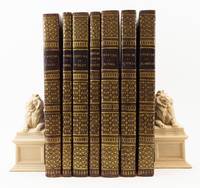
1800ST17757London: William Miller; T. M'Lean; William Bulmer 1800-18. 370 x 270 mm. 14 1/2 x 10 1/2". Seven volumes. <br/> Uniformly bound in stately contemporary dark burgundy straight-grain morocco covers with gilt palmette-and-wheat-sheaf border inner frame of blind-stamped grapevine raised bands spine compartments densely gilt with repeating botanical tools gilt lettering gilt-rolled turn-ins all edges gilt. Two engraved titles with hand-colored vignettes not included in plate count and 356 FULL-PAGE HAND-COLORED PLATES FEATURING COSTUMES OCCUPATIONS AND SOCIAL INTERACTION OF VARIOUS NATIONS. Volume I-III V and VI with text in French as well as English. Front pastedown with armorial bookplate of Edward Gordon Douglas-Pennant 1st Baron Penrhyn. Abbey Life 430; Abbey Travel 71 244 370 373 532 533. Joints and extremities lightly rubbed one board with a couple of faint scratches two rear boards with neat older repairs to short tears at tail edge but the bindings quite sound and most attractive on the shelf. Flyleaves a little foxed minor offsetting from plates to text leaves occasionally more pronounced but never offensive isolated minor marginal foxing to plates otherwise very fine WITH CLEAN BRIGHT PLATES.<br/> <br/> This is a collection of major early 19th century color plate books with well-drawn and richly-colored engravings in bindings that make a handsome appearance on the shelf. All of these works have appealing plates where the costumes of the various social strata are carefully and colorfully delineated. And two of the volumes--those showing British costumes and the book on Chinese punishments--contain in addition a good deal of diverting background detail that serves as a revealing context for each of the costumes depicted. The content of each of the volumes is worth noting. With a few exceptions the plates in the "Costumes of China" portray ordinary working-class men and women toiling at their trades. We see a bookseller with his wares spread out on a mat women sewing and embroidering a butcher a fisher a barber a man with a "magic lantern" show and a "man striking a small gong during an eclipse" an ancient ritual that the author tells us he was privileged to witness on 17 November 1789. The "Punishments of China" volume is filled with almost gleefully painful depictions of all degrees of disciplinary action from the relatively minor twisting of the ears or chaining to an iron pole to the humiliating ordeal of the wooden collar to methods of execution by beheading or by crucifixion using a cord. The opulent and brightly colored costumes in Dalvimart's volume on Turkey are mostly those of the ruling classes although also represented is a wide variety of native dress from the many regions of the vast Turkish empire of the day which included Bosnia Albania Syria Egypt and parts of Greece. It is particularly interesting to contrast the clothing of the very heavily veiled Turkish and Egyptian women with the much more relaxed style of the Greek women and the nearly immodest garb of the female Bedouin. We also are shown a eunuch an odalisque from the harem a grand vizier various royal functionaries and government officials all splendidly attired. The Russian costumes based on engravings done by C. W. Müller at the request of Empress Catherine the Great are focused on the ethnic dress of the empire's many holdings. The Laplanders and Finns wear clothing that would look familiar to most Europeans but the Mongols in their Oriental dress would be quite exotic. The clothing of the northern tribes such as the Kamchatkans Aleutians Koriaks and Tungoosi will impress the modern reader with their similarity to the traditional dress of Native American and First Nation peoples. The Tchutski woman is even depicted naked to display her tattoos. Bertrand de Moleville's Austrian costumes also illustrate the native dress of the empire's citizens but the illustrations here are less fashion plates than romanticized scenes: peasant couples are shown courting and dancing; Croatian women gossip beside a stream; and a wild-haired Bohemian gypsy whose "profession is not hard to guess" from her state of "déshabillé" flees with her naked and no doubt illegitimate child. Pyne's "Costumes of Great Britain" is one of the most highly praised works in this set and for good reason: the simple working men and women of Britain it depicts are always shown going about their daily tasks in the midst of a well-realized scene. The woman selling "salop" a hot morning beverage is seated at her cart with its urn judiciously located by the watchman's stall surrounded by customers including soldiers and a woman with her market basket. A fireman with an ax and a torch hurries toward his engine company while they unwrap their hose. The potter is at his wheel the tanner is cleaning skins and the bill-sticker posts the winning lottery numbers. The clothing while carefully detailed is almost secondary to the depictions of everyday life. The "Military Costumes of Turkey" illustrates the official regalia "uniform" is much too drab a word for these outfits worn by officers in various regions of the empire. Perhaps the most intriguing plate here is that of the Ladle Bearer a post that was also illustrated in "Costumes of Turkey." What appears to be a man with a giant spoon is in fact the holder of an important military position equivalent to the color-bearer in a western army. We are told that the loss of its ladles is the greatest disgrace that can befall a Turkish regiment: if the two great ladles the size of a grown man that are borne into battle at the head of the troops are captured the regiment must be disbanded and formed anew. Former owner Edward Gordon Douglas-Pennant 1st Baron Penrhyn 1800-86 was a leading figure in the Welsh slate industry; he owned the Penrhyn Quarry the largest slate quarry in the world at the end of the 19th century. He was known for his paternalistic attitude to his employees creating the "model village" of Llandegai to house the quarry workers. It was notable for having "no corrupting alehouse." He was ruthless enough to fire 80 men in 1868 because they did not vote for his son George who was running for a seat in Parliament. Single volumes from this set appear with frequency in the marketplace; full sets show up much less often; sets as handsome and well preserved as the present are rarely seen. William Miller; T. M'Lean; William Bulmer unknown
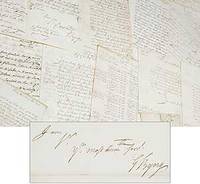
17183874591718. Unbound. Near Fine. A remarkable archive of 24 letters from Admiral of the Fleet George Byng sent to Rear Admiral George Delaval who commanded the Blue Squadron under Byng’s command along with associated documents from George Saunders and Josiah Burchett Secretary of the Admiralty relating to the British naval campaign of 1718 in the Mediterranean culminating in the Battle of Cape Passaro Sicily on the 11th August. A mix of quarto and folio sheet with many folded once to form four pages. Each letter is Signed by Byng with one signed twice. Despite their age the letters are near fine or better with only light wear and housed in a custom cloth chemise with printed labels.<br /> <br /> The Battle of Cape Passaro resulted in the defeat of the Spanish by the British Fleet under Sir George Byng four months before the War of the Quadruple Alliance. The Spanish refused to re-embark their army from the Sicilian mainland. Despite war not having been formally declared Byng correctly anticipated approval from home and attacked and routed the Spanish fleet thwarting their ambitions to take Italy and Sicily.<br /> <br /> The subject matter of the letters is concerned with supplies day-to-day naval matters and continuing hostilities against the Spanish and includes details of several rendezvous for meeting up in the event of separation owing to bad weather. Common problems are mentioned such as desertion and shortage of food and more particularly wine. The earliest is dated May 17th concerning the mobilization of troops and pressed men for the campaign. The letter of May 29th regards the Line of Battle detailing ships ordnance and men commanders and formation and pennants and the signals to be used. On July 3rd Byng gives orders to oppose the landing of the Spanish in Italy with a warrant order of operations to “take sink burn or destroy†the King of Spain’s ships; the last of the series dates from the December 9th from the Admiralty office not by Byng congratulating Delaval on his safe arrival at Spithead and requesting him to escort the fireship Griffin to Deptford. Byng sent mail from on board his ship the Barfleur whilst at sea and also from the Admiralty office in London.<br /> <br /> Byng was sent on subsequent diplomatic missions on behalf of England to negotiate with Italian princes and states and was instrumental in the acceptance of the terms of the Quadruple Alliance by Spain. In 1718 Byng was already a respected member of the establishment having supported the accession of William and Mary at the Glorious Revolution contributed to the burning of the French fleet at Vigo and leading the bombardment squadron during the capture of Gibraltar. He was rewarded with a knighthood and a regular promotion. After the success of 1718 this included membership in the Privy Council admittance to the Order of the Bath and the title of Viscount Torrington which his descendants still bear today. In 1727 Byng was made First Lord of the Admiralty and the Royal Naval College at Portsmouth was founded in his memory.<br /> <br /> Delaval also had a distinguished naval and diplomatic career from a young age with victory at the Battle of Malaga in 1704 and missions to Spain and Portugal as well as his promotion to Rear Admiral and leadership of The Blue Squadron. He is perhaps best known for rebuilding his ancestral seat the celebrated Seaton Delaval Hall in Northumberland now a National Trust property with architect Sir John Vanbrugh.<br /> <br /> It is important to note that Admiral George Byng should not be confused with his fourth son John Byng also present at the Battle of Cape Passaro as a 13 years old who built a respectable career as a naval officer and became an Admiral but was court-martialed and shot by firing squad on 14 March 1757.<br /> <br /> A remarkable collection of letters from the First Lord of the Admiralty during the reign of King George II. <br /> <br /> A detailed list of the correspondence is available upon request. unknown
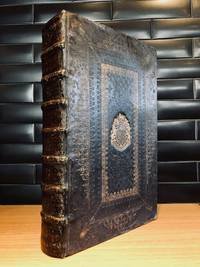
17177186Oxford: John Baskett 1717. First Edition Thus. Royal binding in full morocco. Very Good. John Sturt. Two volumes in one. Large stout folio. Double column with columns separated by double rule. Text ruled in red and title pages printed in red and black. Engraved vignette title pages for Old and New Testaments the latter dated 1716. With the engraved additional general title page by cartographer and renowned illustrator John Sturt 1658–1730. With striking copper-engraved vignette head- and tail-pieces and many engraved historiated initials. Complete with Apocrypha.<p>Marbled endpapers. All edges gilt. Bound in contemporary full black morocco rebacked with original elaborate gilt-tooled spine neatly laid-down gilt-tooled arms of King George II featuring the motto "Most Noble Order of the Garter" as centerpieces and his monogram in spine compartments raised bands and gilt-decorated borders. Only moderate wear to the splendidly complete royal binding. First edition of the monumental illustrated "Vinegar Bible" with additional title page engraved by John Sturt including the vignette of a church interior featuring the figures of Moses Aaron et al. per Darlow and Moule. According to the DNB Sturt "specialized in miniature work and it was said that he could engrave the creed on a silver penny but could also work on a large scale and in 1692 he produced a notable engraving of Britannia the royal first capital ship of England printed on four sheets". Presented in a handsome King George II armorial binding. Carter notes that " . Bibles with the royal arms may have come from one of the Royal Chapels - but they may equally have come from any loyal parish church" ABC p. 157. That said a limited print run coupled with the high cost of Baskett's elaborate opus would suggest the former.<p>In 1709 printer John Baskett secured the exclusive royal patent to print Bibles in England. Of those he and his family published this is the most magnificent being a triumph of legible elegant type that contributes to an easy readability accessible today. Alas a typographical error in the running head of Luke XX among other typos rendered the parable of the vineyard as the "parable of the vinegar" overshadowing Baskett's magnificent achievement.<p>A scarce and stately copy of a high spot in 18th-century printing. DARLOW & MOULE 736-B "the engravings differ considerably from those in A". John Baskett unknown
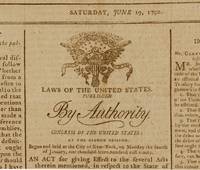
179052510New York: John Fenno no. 41 Broad-Street near the Exchange 1790. First edtion. Softcover. Fine. Two leaves folio 16.25 by 10 in. Edges slightly trimmed; a touch of mild foxing else a fine crisp copy. Housed in linen clamshell box with gilt paper label at spine and previous owner's dediction pasted to inside cover.<br /> <br /> The first known published appearance of Jewish support for the newly elected president of the United States George Washington. One week after Washinton's inauguration Levi Sheftall on behalf of the newly reorganized Savannah Hebrew Congregation wrote him an elegant and effusive letter of congratulation. This letter along with Washington's reply was published for the first time by the United States Gazette:<br /> <br /> "Sir We have long been anxious of congratulating you on your appointment. and of testifying our unbounded confidence in your integrity and unblemished virtue. Your unexampled liberality and extensive philanthropy have dispelled that cloud of bigotry and superstition which has long as a veil shaded religion -- unrivetted the fetters of enthusiasm -- enfranchised us with all the privileges and immunities of free citizens and initiated us into the grand mass of legislative mechanism. May the great Author of worlds grant you all happiness and a continuance of guardianship to that freedom which under the auspices of heaven your magnanimity and wisdom have given these States."<br /> <br /> Washington's reply is undated but addressed "To the Hebrew Congregation of the City of Savannah." After accepting their congratulations he extends this hope: "May the same wonder-working Deity who long since delivering the Hebrews from their Egyptian Oppressors planted them in the promised land -- whose providential agency has lately been conspicuous in established these United States as an independent nation -- still continue to water them with the dews of Heaven and to make the inhabitants of every denomination participate in the temporal and spiritual blessings of that people whose God is Jehovah. George Washington." <br /> <br /> Provenance: old entry of . Hopkins at top margin first leaf trimmed. Six weeks later <br /> <br /> References: Enc. Jud. first ed. 1972 vol. 16; Evans Amer. Bibl. vol. 8; From the Ends of the Earth Judaica Treasures of the Library of Congress. John Fenno, no. 41 Broad-Street, near the Exchange unknown
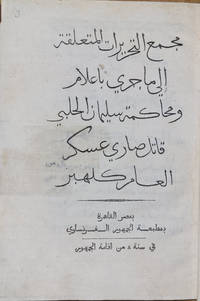
1800000228<p><strong>EGYPT – NAPOLEONIC PERIOD – ARABIC PRINTING</strong> <em>A Compilation of the Decisions Relating to the Condemned Criminal and the Judgments Passed upon Him the Killer of the Commander-in-Chief the Renowned Kléber</em></p><p>Cairo: <strong>مطبعة الجمهور الÙرنساوي</strong> Press of the French Republic <strong>Year 8 of the Republic</strong> 1800–1801.</p><p>Rare and historically significant <strong>Arabic imprint produced during the French occupation of Egypt</strong> documenting the <strong>trial judgment and execution of SulaymÄn al-ḤalabÄ«</strong> the assassin of <strong>General Jean-Baptiste Kléber</strong> Commander-in-Chief of French forces in Egypt.</p><p>This work constitutes the <strong>official Arabic-language publication of judicial decrees and legal decisions</strong> issued by the French military authorities in Cairo following the assassination of Kléber in June 1800. It was intended for circulation among the Arabic-speaking population serving both as a legal record and as an instrument of political communication and authority.</p><p>Printed at the <strong>Press of the French Republic in Cairo</strong> one of the earliest European-operated printing presses in Egypt the book forms part of the pioneering Napoleonic effort to employ <strong>Arabic typography for governance law and propaganda</strong>. The text reflects the adaptation of French revolutionary legal concepts into Arabic juridical language making it a landmark in the history of <strong>Arabic legal printing</strong>.</p><p>The publication corresponds to a French counterpart titled <em>Traduction Arabe des pièces relatives à la procédure et au jugement de Soleyman el-Haleby</em> confirming its role within a bilingual documentary corpus produced by the occupation authorities.</p><p><strong>Historical Significance</strong></p><ul><li>Primary source for the <strong>assassination of Kléber</strong> one of the most consequential events of the Egyptian Expedition</li><li>Early example of <strong>state-sponsored Arabic printing</strong> under European colonial rule</li><li>Key document in the history of <strong>Franco-Arabic legal translation</strong></li><li>Important witness to the emergence of <strong>modern political and legal Arabic print culture</strong></li></ul><p><strong>Rarity</strong></p><p>Extremely scarce. Arabic imprints from the <strong>French Egyptian press 1798–1801</strong> are notably rare and judicial publications relating specifically to the Kléber assassination are seldom encountered on the market. Examples are held in a small number of institutional collections; private ownership is exceptional.</p><p><strong>References</strong></p><p>Cf. Galland <em>Imprimerie arabe du Caire</em>; Napoleon in Egypt bibliographies; WorldCat records under variant French and Arabic titles.</p> Press of the French Republic hardcover
1796ABC_49403Various places including Saudi Arabia and Yemen 1796. Contemporary or slightly later half black morocco marbled boards. Small folio ca. 19 x 30.5 cm. English manuscript on watermarked paper. With a loosely inserted manuscript map titled A Chart shewing the Track of HMS Ship Myrtle of the Bay of Biscay and Portugal and a hand-coloured manuscript signal chart. A detailed description of the voyage of the East India company vessel the Swift from 1794-1795 featuring visits to both Saudi Arabia and Yemen. Twelve pages of observations are dedicated to Jeddah alone witnessed at the height of the influx of pilgrims during the Hajj followed by a description of Mocha also Mokha in Yemen. Other ports visited include those of Brazil South Africa India the Nicobar Islands Malaysia and Sri Lanka.Jeddah the author says "has a very pleasant appearance as you approach it from the sea . The houses are all of stone of the coral kind." However as the Swift had arrived in the midst of the Hajj and its crew found provisions difficult to acquire as thousands of pilgrims poured into Jeddah: "It is astonishing the number of Mahometans arriving from all parts of the world to attend the yearly ceremony at Mecca called Hadgi from thence to Medina." Several accounts are given of particular Muslim practices through occasionally somewhat confused British eyes: "When near Geddah all the Pilgrims going their first journey altered their dress assuming what is called the Ihhram a piece of linnen ! which is wrapped round the loins leaving the rest of the body naked in this state they proceed through the rest of the pilgrimage till they have visited the Kaaba at Mecca; the other garment they are then suffered to wear is a cloth of linen over their shoulders. . Some of them carry a trade of muslins and some other little articles which if they are not robbed by the Bedouins wild Arabs they make out tolerably well . The landing of the pilgrims with their wives and household utensils would have been an excellent view for the inimitable Hogarth."The Swift appears to be one of the ships which accompanied the Suffolk a 64-gun ship to escort a convoy to India under the command of Captain Peter Rainier 1741-1808 later Admiral of the Blue and namesake of Mount Rainier. This particular voyage was in itself notable as a trial for the implementation of a citrus diet for sailors to ward off scurvy which was ultimately successful and became Admiralty policy the following year. On the first page of the account we find the following: "The beer being expended ordered the Company to be served wine mixed with 1oz of sugar and oz of lemon juice to every pint it was very nice tipple."The boards show mild traces of use. With a few small smudges on some of the leaves. Otherwise in excellent condition. hardcover
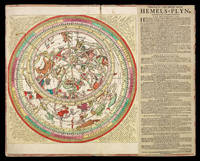
17221992Amsterdam: Jochem Hasebroek c1722. 500 by 630mm. 19.75 by 24.75 inches. Large engraved celestial chart by Stampioen with a rotating printed paper ring volvelle or rete on an off-centre axis to indicate the part of the sky visible at any date and time and to make a variety of celestial calculations all for the Netherlands' latitude of 52 degrees. With letterpress instructions by Calman on a separate slip at the right. The sky image 33 cm in diameter; the whole chart with the letterpress slip as mounted 49 x 61.5 cm. A string with a bead serves as a pointer for aligning the scales in the stationary and rotating parts. Coloured by a contemporary hand and mounted on contemporary boards covered with marbled paper apparently by the publisher so that it can be folded in half for carrying. The chart is here in its third state but we have located no complete example of any earlier version. The Boerhaave Museum in Leiden has the chart without volvelle or instructional text published by Doncker but the 1664 edition described in Doncker's advertisement clearly included the volvelle and instructional text. Perhaps the surviving chart is the 1684 version mentioned but not seen by Bierens de Haan who provides neither a detailed description nor a source for his information. They and the present version printed from Doncker's plate c1722 seem to have appeared only as separate publications hence their great rarity. The circular border around the sky image and the outer part of the volvelle include scales with several kinds of data so that the chart can be used for various purposes. One can use the string to align the time in the volvelle with the date in the border of the chart so that the part of the sky visible at that moment appears inside the volvelle. The chart with its volvelle scales and string can also be used to calculate times for the rising and setting of constellations at various dates or to calculate the present time based on the position of the stars. Fifty-three constellations are numbered quarter by quarter 15 9 14 and 15 with a Dutch key identifying them in each corner. Calman's instructional text printed letterpress on a separate slip 495 by 185 cm and mounted to the right of the chart itself describes the different scales etc. then presents nine "proposals" giving examples of the use of the chart. If the volvelle is turned with 12 midnight to the right the boards can be folded to each other like a portfolio protecting the chart and making it easier to carry. It may have been published in this form for the only other copy located at the Adler Planetarium in Chicago is similarly mounted. The marbled paper covering the portfolio similar to Wolfe 33-35 was common in the Netherlands in the late seventeenth and early eighteenth centuries. In the plate of the star chart itself is engraved "Auct. J. Stampioen. 't Amsterdam by Iochem Hasebroek" but Hasebroek's name is larger and in a different style than the rest of the lettering and one can see traces of an earlier name under it. Although the older name cannot be deciphered one can see that "Hendrick Doncker" would fit with traces of the h and Do and marks where the ascenders to the d k and k would have been making it clear that the present chart is printed from Doncker's original plate. Calman advertised his Amsterdam boarding school for calligraphy mathematics etc. in 1722 and Hasebroek 1682- 1756 is recorded as a sea chart publisher and instrument maker from 1714 to 1743. Koeman IV p. 5 no location noted; cf. p. 153; Warner Sky Explored p. 260 no. 1c no location noted; cf. p. 247; Alder Planetarium on-line database A-259; cf. Bierens de Haan 4516 1684 ed. not seen: see his Bouwstoffen II pp. 386 & 429 note 5; E.O. van Keulen et al. "In de Gekroonde Lootsman" item 4 & illustration between pp. 64 & 65 1680/1696 Vooght/Van Keulen ed.; not in BMC Printed Maps; Zinner Astron. Instrumente; NCC/Picarta; OCLC WorldCat. Jochem Hasebroek, hardcover
171548763Augsburg.: Jeremias Wolff. c.1715. Full contemporary blond calf boards with elaborate neo-classical decorative borders composed of rules foliate floral and rope-work tools vase tools at head and foot and mask corner tools all to surround a central lozenge with a decorative composition of floral foliate and mask tools later banded spine with elaborate decorative tooling in gilt in seven compartments turn-ins tooled in gilt red speckled edges. Folio. 554 x 423 mm. Engraved allegorical title with Latin and German text leaf with letterpress text in German in double columns and 56 engraved allegorical plates all after the Deckers by various engravers see below. Sheet size: 435 x 560 mm. An exceptional copy of Decker’s very rare suite of engravings – here in-plano and with exceptional additional colouring and highlighting in gilt by hand – illustrating the battles of the War of the Spanish Succession.Decker’s suite depicts the battles of the complex series of engagements that became known as the War of the Spanish Succession 1701–1714. Prompted by the death of the last of the Spanish Habsburg Kings the childless Charles II and with a shifting group of alliances and a field of warfare that included not only Continental Europe and the Mediterranean but also the Caribbean and North America the War of the Spanish Succession has a case to be a true world war. In part an attempt to check French hegemony the war featured a number of outstanding victories for the Duke of Marlborough and Prince Eugene of Savoy including Blenheim although the war was ultimately at best indecisive.Each of Decker’s magnificent plates features a single engagement depicted in the central portion of the plate the whole image surrounded with a decorative border composed of architectural allegorical and armorial symbols and motifs in the Baroque manner and a descriptive text concerning the battle. Many of the plates feature an additional small vignette of the battlefield keyed to the descriptive text and illustrating the placement of the armies and the most significant figures involved.The colouring and highlighting by hand of the present copy is remarkable. The painstaking detailing and the additional ornamentation in liquid gold is lavish and in combination with the binding suggests this copy was important and worthy of presentation. The printed text 'Kurze Beschreibung des Spanisch Successions-Krieg . &c.' here and unusually in German gives a detailed outline of the origins and history of the conflict and concludes with the list of plates and the engagements they depict. The text appears in other copies in other languages suggesting a commercial flexibility of distribution.It is a measure of the importance attached to Decker’s suite that the painter Ignaz Preissler used Decker’s plates as the basis for the decoration of an important tea service and garniture now at least partly in the collection of the Metropolitan Museum in New York see ‘Repraesentatio Belli ob successionem in Regno Hispanico . A Tea Service and Garniture by the Schwarzlot Decorator Ignaz Preissler’ by Maureen Cassidy-Geiger.‘Such commemorative series were considered works of art as well as encapsulations of recent events and were highly valued by collectors of the period who acquired them for their libraries or print cabinets.’ Maureen Cassidy-Geiger.Decker’s suite is very rare outside Germany: COPAC lists copies at the British Library and V & A only while KVK lists copies at the Polish National Library the Bibliothèque Nationale and the Université de Charles de Gaulle Lille in France and the Rijksmuseum Amsterdam; the only traceable copy in North America is at Brown University. We can locate no other copies with contemporary colouring or highlighting by handBerlin 103 incomplete; Bobins III 1165; Brunet V 626 for the French edition. Jeremias Wolff. hardcover