888 résultats
17853000564London: John Fielding 1785. Book. Good. Full-Leather. 16mo - over 5¾" - 6¾" tall. pp 1 1 3 240 Internally very good subject to slight browning binding a little strained but holding cover could be later but not recent has moderate wear with a little loss to the top of the spine no labels. Uncommon. John Fielding Hardcover
17643000612London: " Printed for the author and sold by J.Worrall " 1764. Book. Good/Very Good. Half-Leather. 8vo - over 7¾" - 9¾" tall. pp xiii 154 xi 31 Internally very good subject to moderate browning. Binding firm . Cover later but not recent could be late 19th century sound with moderate wear and some fading to the buckram boards. " Printed for the author, and sold by J.Worrall " Hardcover
17353300156London: J Roberts 1735. Book. Very Good. Quarter Leather. 8vo - over 7¾" - 9¾" tall. pp 1 161 The author was John Andrews D.D. Internally very good ink reference on title page neat old hand small owners bookplate on inside front cover binding firm cover later very good. Uncommon in original edition. J Roberts hardcover
17233000489London: The Author 1723. Book. Good. Full-Leather. 8vo - over 7¾" - 9¾" tall. pp title 355 293/294 utilised twice Although this appears to be a stand-alone title we believe it to the first of a series of five volumes that appeared in 1723-5 ; the definitions are for topics prefixed A to C. Text-block in very good condition binding firm cover somewhat worn no label. The Author Hardcover
175147143London: Printed for T. Osborne 1751. Leather bumped rubbed and scratched with some minor staining to boards and minor chipping to spine. Hinges/joints cracked. Small period ink notation to corner of front pastedown. Occasional foxing and browning throughout otherwise textblock clean and solid. Second Edition. Full Leather. Good/No Jacket. Folio. Printed for T. Osborne Hardcover
1734502633London: Printed for G. Straban W. Mears S. Ballad F. Clay J. Stag D. Browne B. Motte R. Williamson J. Clarke A. Wilde J. Brotherton J. Hazard W. Meadows T. Cox W. Hinchcliffe W. Bickerton T. Astley S. Austen L. Gilliver and R. Willock 1734. Book. Rare. Full Leather. A beautiful set of 8 volumes bound in full brown leather. Five raised bands to spines. Decorative gilt motifs to edges in some instances faded and to spines. Title labels missing on 6 of the 8 volumes. Owner's name to front free end page and bookplate to front paste down in all volumes save for vol. 5. One instance of notes in margin in vol. 8. On most volumes joints cracked but solid. Some wear and chipping to spine extremities. Vol. 2 bears bookworm holes towards bottom of the page from start to finish. Vol. 3 where joint is cracked leather is peeling away from spine. Corners rubbed and some corners lightly bumped. Overall in remarkable condition. Our rating system: 1. Fine; 2. Near Fine; 3. Very Good; 4. Good; 5. Fair. Price is for the complete set of 8 volumes. Printed for G. Straban, W. Mears, S. Ballad, F. Clay, J. Stag, D. Browne, B. Motte, R. Williamson, J. Clarke, A. Wilde, J. Broth Hardcover
174257800London: Printed for J. Osborn and C. Davis in Pater-noster Row; and J. Hodges at the Looking-Glass over-against St. Magnus Church London Bridge MDCCXLII 1742. Second Edition. Hardcover. Very Good. This is an ex-library copy with a blind stamp on the corner of the title page. 16mo 6 7/8" tall engraved frontispiece vi and leaf removed 359 pages; fore-edges reddened 5 banded spine gilt spine titles and piping full calf with cover edges tooled. This is a good copy overall interior very good with significant shelf wear and rubbing to the spine and chipping to the top and bottom edges fore-corner tips through to boards cover edges worn binding solid paper light to moderately yellowed minor foxing primarily to front-matter but scattered throughout with apparent damp-staining at the margins of the endpapers which is not visible in the interior. This is: "The Second Edition carefully revised and greatly enlarged in every chapter by the Author; who has now first added an appendix containing many curious pieces in both prose and verse relating to the character of the Lord-Protector. London: Printed for J. Osborn and C. Davis, in Pater-noster Row; and J. Hodges, at the Looking-Glass, over-against St. Magnus Ch hardcover
1747045257Henry Lintot Assignee of Edward Sayer Esq for J Stephens et al 1747. Hardcover. Very Good. 8vo - over 7¾ - 9¾" tall. '.From the Second of King James I to Trinity Term the Twenty-first of King george II 1747 inclusive. Examined by the Originals. To which are now added many useful RULES of Court omitted in former Collections and a Translation in Opposite Columns of the Rules heretofore Printed in Latin: Together with large Notes Remarks and References shewing the antiant and present Practice of the said Court: and a new Alphabetical Table to the Whole. The Second edition with additions. Bound with Rules and Orders and Notices in the Court of Common Pleasat Westminster from the Thirty-Fifth of King Henry VI. Second edition. and a Table to the Rules of Practice in the Court of Common Pleas. Fully bound in leather. 5 raised bands to spine. '1' on spine. Remains of hand-written library sticker to spine. .'No. 30' written in ink to front endpaper. <br/> <br/> Henry Lintot (Assignee of Edward Sayer Esq) for J Stephens et al hardcover
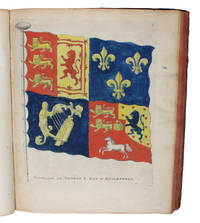
171951669Amsterdam David Mortier 1719-18. 4to. Contemp. full calf. Spine defective lacking leather at upper and lower compartment and frontcover detached from spine. Front free endpaper gone. The first two title-pages printed in red/black and both with an engraved vignette with a portrait of Erasmus. 482;294;22412 pp. Vol I: 1 large folded engraved plate and 1 textengraving. - Vol. II: 34 textengravings 1/2-page a. full-page 21 engraved plates 4 large and folded. - "Les Pavillons": 90 engraved plates of flags. The first flag "Pavillon de George I" is handcoloured. Last printed leaf numbered 101 because the 90 engraved plates is counted as pages !. Complete. Light marginal browning a few leaves with small closed tears. <br/><br/><em>A classic on shipbuilding finely illustrated with construction drawings and nautical instruments and equipment. It is the first edition in French of Allard's "Nieuwe Hollandse Scheeps-bouw" first published in 1695. Polak notes that though known as 'L'Allard français' it was more than a straightforward translation being augmented with chapters by Witsen and van Eyk and with plates representing vessels and nautical instruments as well as the flags of the maritime nations. </em> hardcover
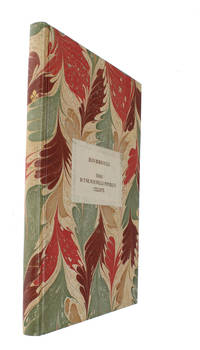
173542459Paris Imprimerie Royale 1735. 4to. Fine recent marbled boards. Printed titlelabel on frontcover. 6144 pp. and 1 double-page folded engraved plate. Johann B's paper: pp. 1- 91. - Daniel B's papers: pp. 93- 122 and pp. 123-144. A few marginal brownspots. <br/><br/><em>First edition of these prize winning papers by father Jean and son Daniel. - Both papers deals with the cause of the inclination of the planetary orbits relative to the solar equator. - In Daniel's paper he put foreward the hypothesis of the existence of an atmosphere resempling air and rotating around the solar axis resulting in an increasing inclination of the planetary orbits toward the equator of the sun. Daniel was the first importent Newtonian outside Great Britain. The problems faced here by Daniel are treated in Newtonian manner.The publication of these papers by father and son resulted in a controversy between the two forcing Daniel to leave his fathers house. - Poggendorff I:161. </em> hardcover
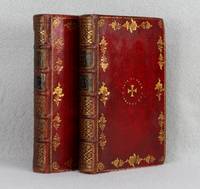
1779ST12581London: Sold by Dodsley 1779. 165 x 102 mm. 6 1/2 x 4". Complete with usual jump in pagination in volume II. Two volumes. <br/> Pleasant contemporary crimson morocco BOUND FOR JONAS HANWAY BY HIS SECOND BINDER covers gilt with twining border enclosing a frame of roses with sunburst cornerpieces upper cover with Greek cross at center encircled by the motto "O save us from ourselves" lower cover with winged hourglass and the motto "Revere the appointment of Nature"; raised bands spine compartments gilt in a checkerboard pattern punctuated by daisies one olive and one black morocco label gilt turn-ins marbled endpapers all edges gilt. Engraved title pages with emblem depicting Death hovering over socializing persons with a lutist in the background. A Large Paper Copy. Verso of front free endpapers with armorial bookplate from which the name has been excised. ◆Spines a bit darkened with muted gilt leather on covers varying in color from fading or soiling but the bindings entirely solid and with only trivial wear to the joints. Leaves with a hint of offsetting and isolated soiling faint dampstain to lower fore edge of one gathering otherwise extremely pleasing internally the text clean fresh and bright and with vast margins.<br/> <br/> These bindings were specially crafted for Jonas Hanway 1712-86 an eccentric philanthropist and prolific pamphleteer who designed custom bindings for edifying works usually his own which he often presented to libraries friends and even the king; our binding was in fact probably intended for presentation though the recipient is unknown. In his "English Bindings in the Library of J. R. Abbey" G. D. Hobson has done a census of 26 Hanway bindings but the present one is not listed there. Hobson states that Hanway has been unjustly overlooked whereas another 18th century eccentric "who took an interest in the art of decorating bookcovers Thomas Hollis has appeared in every account of English binding" after J. A. Arnett's "The Books of the Ancients" appeared in 1837. "The bindings executed for Hanway are of better material" says Hobson "and the tools which decorate them are more amusing than those of his contemporary; perhaps they have been neglected because they are comparatively rare." Hanway employed two different binders to translate his ideas into leather and the present volumes represent the work of his second binder who entered his employ in 1765. This binder has not been identified by name but his work is known as here by the appearance of a small number of tools used in various combinations. For example our winged hourglass rose ornaments twining roll sunburst and checkerboard design on the spine also appear on Hobson's "Abbey" #91 and on item #155 in Maggs Catalogue 1212. An enthusiastic and effective philanthropist concerned with child welfare Hanway founded schools to teach boys farming trades and seamanship. He also wrote some 150 books and pamphlets and perhaps his reputation as an eccentric derived from his being the first male in London to use an umbrella. Nixon notes in "Oldaker Collection" that he was "a highly estimable character but one of the greatest bores of his day." An advocate of such practices as the consumption of whole wheat bread and abstinence from tea drinking he inveighs in the present work against "nocturnal diversions" and the keeping of late hours. Midnight should be the signal to end dancing music and other amusements if one wishes to preserve one's health and virtue. Thankfully the author's bindings remain more interesting than the written works he produced. Sold by Dodsley unknown
17642747901764. First Edition. Trade Paperback. 95 pages. Timothy Breckneck 1719-1786 was a controversial lawyer and writer who was executed for conspiracy to commit murder in 1786. This work which brought him national attention was described in the House of Lords as a “pestilent treatise†that was “Jacobitical†in nature. despite mild dissent from the Jacobite peer Hugh Hume-Campbell 3rd Earl of Marchmont Droit le Roy was ordered to be burned outside the gates of Westminster in 1764. First edition first printing. Very good copy rebound in brown paper covers. The top of the pages were trimmed for binding sometimes cutting a small portion of the page headings. Pencil marks in margins from prior owner. Inscription from prior owner at top of title page partially trimmed. WorldCat locates 2 copies.<br> paperback
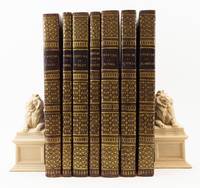
1800ST17757London: William Miller; T. M'Lean; William Bulmer 1800-18. 370 x 270 mm. 14 1/2 x 10 1/2". Seven volumes. <br/> Uniformly bound in stately contemporary dark burgundy straight-grain morocco covers with gilt palmette-and-wheat-sheaf border inner frame of blind-stamped grapevine raised bands spine compartments densely gilt with repeating botanical tools gilt lettering gilt-rolled turn-ins all edges gilt. Two engraved titles with hand-colored vignettes not included in plate count and 356 FULL-PAGE HAND-COLORED PLATES FEATURING COSTUMES OCCUPATIONS AND SOCIAL INTERACTION OF VARIOUS NATIONS. Volume I-III V and VI with text in French as well as English. Front pastedown with armorial bookplate of Edward Gordon Douglas-Pennant 1st Baron Penrhyn. Abbey Life 430; Abbey Travel 71 244 370 373 532 533. Joints and extremities lightly rubbed one board with a couple of faint scratches two rear boards with neat older repairs to short tears at tail edge but the bindings quite sound and most attractive on the shelf. Flyleaves a little foxed minor offsetting from plates to text leaves occasionally more pronounced but never offensive isolated minor marginal foxing to plates otherwise very fine WITH CLEAN BRIGHT PLATES.<br/> <br/> This is a collection of major early 19th century color plate books with well-drawn and richly-colored engravings in bindings that make a handsome appearance on the shelf. All of these works have appealing plates where the costumes of the various social strata are carefully and colorfully delineated. And two of the volumes--those showing British costumes and the book on Chinese punishments--contain in addition a good deal of diverting background detail that serves as a revealing context for each of the costumes depicted. The content of each of the volumes is worth noting. With a few exceptions the plates in the "Costumes of China" portray ordinary working-class men and women toiling at their trades. We see a bookseller with his wares spread out on a mat women sewing and embroidering a butcher a fisher a barber a man with a "magic lantern" show and a "man striking a small gong during an eclipse" an ancient ritual that the author tells us he was privileged to witness on 17 November 1789. The "Punishments of China" volume is filled with almost gleefully painful depictions of all degrees of disciplinary action from the relatively minor twisting of the ears or chaining to an iron pole to the humiliating ordeal of the wooden collar to methods of execution by beheading or by crucifixion using a cord. The opulent and brightly colored costumes in Dalvimart's volume on Turkey are mostly those of the ruling classes although also represented is a wide variety of native dress from the many regions of the vast Turkish empire of the day which included Bosnia Albania Syria Egypt and parts of Greece. It is particularly interesting to contrast the clothing of the very heavily veiled Turkish and Egyptian women with the much more relaxed style of the Greek women and the nearly immodest garb of the female Bedouin. We also are shown a eunuch an odalisque from the harem a grand vizier various royal functionaries and government officials all splendidly attired. The Russian costumes based on engravings done by C. W. Müller at the request of Empress Catherine the Great are focused on the ethnic dress of the empire's many holdings. The Laplanders and Finns wear clothing that would look familiar to most Europeans but the Mongols in their Oriental dress would be quite exotic. The clothing of the northern tribes such as the Kamchatkans Aleutians Koriaks and Tungoosi will impress the modern reader with their similarity to the traditional dress of Native American and First Nation peoples. The Tchutski woman is even depicted naked to display her tattoos. Bertrand de Moleville's Austrian costumes also illustrate the native dress of the empire's citizens but the illustrations here are less fashion plates than romanticized scenes: peasant couples are shown courting and dancing; Croatian women gossip beside a stream; and a wild-haired Bohemian gypsy whose "profession is not hard to guess" from her state of "déshabillé" flees with her naked and no doubt illegitimate child. Pyne's "Costumes of Great Britain" is one of the most highly praised works in this set and for good reason: the simple working men and women of Britain it depicts are always shown going about their daily tasks in the midst of a well-realized scene. The woman selling "salop" a hot morning beverage is seated at her cart with its urn judiciously located by the watchman's stall surrounded by customers including soldiers and a woman with her market basket. A fireman with an ax and a torch hurries toward his engine company while they unwrap their hose. The potter is at his wheel the tanner is cleaning skins and the bill-sticker posts the winning lottery numbers. The clothing while carefully detailed is almost secondary to the depictions of everyday life. The "Military Costumes of Turkey" illustrates the official regalia "uniform" is much too drab a word for these outfits worn by officers in various regions of the empire. Perhaps the most intriguing plate here is that of the Ladle Bearer a post that was also illustrated in "Costumes of Turkey." What appears to be a man with a giant spoon is in fact the holder of an important military position equivalent to the color-bearer in a western army. We are told that the loss of its ladles is the greatest disgrace that can befall a Turkish regiment: if the two great ladles the size of a grown man that are borne into battle at the head of the troops are captured the regiment must be disbanded and formed anew. Former owner Edward Gordon Douglas-Pennant 1st Baron Penrhyn 1800-86 was a leading figure in the Welsh slate industry; he owned the Penrhyn Quarry the largest slate quarry in the world at the end of the 19th century. He was known for his paternalistic attitude to his employees creating the "model village" of Llandegai to house the quarry workers. It was notable for having "no corrupting alehouse." He was ruthless enough to fire 80 men in 1868 because they did not vote for his son George who was running for a seat in Parliament. Single volumes from this set appear with frequency in the marketplace; full sets show up much less often; sets as handsome and well preserved as the present are rarely seen. William Miller; T. M'Lean; William Bulmer unknown
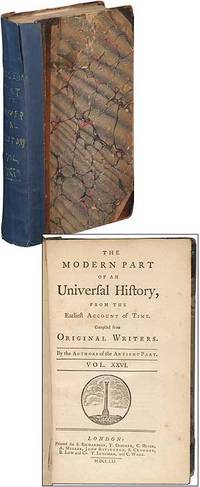
1761230010London: S. Richardson et al. 1761. Hardcover. Good. Volume 26 only of 44. Octavo. 4 503pp. Three quarter calf and marbled paper covered boards. The binding is worn and dry with the front board detached and blue tape to the spine else good or better with moderate toning to the text pages. This volume covers the history of Italy. S. Richardson, [et al.] hardcover
1793315883London: Printed by W. Brown and A. O'Neil 1793. Second edition with additions. Engraved frontispiece 29 copper engraved plates after Shearer and Hepplewhite. xvi 266 pp 24 leaves of letterpress tables printed on one side only. 1 vols. 4to. Old quarter calf and boards. Spine rubbed lower board detached several plates trimmed just inside plate line with loss of numeral in one plate otherwise clean internally. Second edition with additions. Engraved frontispiece 29 copper engraved plates after Shearer and Hepplewhite. xvi 266 pp 24 leaves of letterpress tables printed on one side only. 1 vols. 4to. Second edition with 9 additional plates. Provenance: J. Thomas Cabinet Maker and Upholsterer Ock St Abingdon ink stamp in lower margin of title. Kress 15605; ESTC T120479 Printed by W. Brown and A. O'Neil unknown
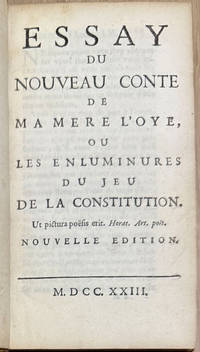
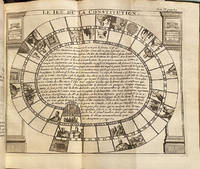
1723Debonnaire1723<p>GAME OF THE GOOSE Essay du nouveau conte de ma Mère l'Oye ou les enluminures du jeu de la Constitution by Louis Debonnaire. No imprint 1723. 8vo xiii xviii 176pp; early leather boards with original spine laid down.</p><p>Despite the claim that this is a new edition it is nonetheless an UNCOMMON IMITATION of the traditional "Game of the Goose" a rhymed pastiche as if spoken by Mother Goose written by a Jansenist priest Abbot wherein one must win the formation of a new Council here referred to as a Constitution. It introduced what became a familiar catchphrase "LIBERTY EQUALITY FRATERNITY" condemned in 1725 as anti-Rome. Barber III 880</p> No imprint hardcover
1724BB_88102Game of the Goose<br /><b><i>Poesies sur la Constitution Unigenitus</i></b>. Recueillies par le Chevalier de G. Officier de Regiment de Champagne. Villefranche i.e. Amsterdam: Chez Philalete Belhumeur 1724. Two volumes. Illustrated with duplicate frontispieces title-vignettes and many decorative woodcut head- and tail-pieces. 8vo. i i xxiv 317 pp. – i i 389 pp.; uniform polished tree-calf extra-gilt all edges gilt covers with armorial gilt stamp.<br />First edition thus greatly revised and expanded from an earlier version with essays letters poems reviews and songs with political Constitution religious Pope Clement XI and literary interest. Most important this work includes an essay titled <i>"Essai du Nouveau Conte de Ma Mere L'Oye"</i> NewTales of Mother Goose showing the influence of Perrault's tales barely twenty years after his death AND a handsome folding-out engraved board game titled <i><b>"Le Jeu de la Constitution" </b></i>designed in a race-game format.<br /><p>As a notable compilation of pro-Jansenist writings of an often satirical nature with the aforementioned board game and its five pages of rules on a folding plate. Selections include: "Les 101 propositions de la constitution Unigenitus exprimées en cent et un couplets"; "Ode pindarique sur la destruction du monastère de Port-Royal-des-Champs"; "Adieu d'une dame janséniste qui se refugie en Hollande". Brunet 4: 755. Weller 2: 88. Willaert 2: 9370. For the game see Phillippa Plock & Adrian Seville "Rothschild Collection of Printed Board Games at Waddesdon Manor" in: Of Boards and Men: Board Games Investigated Proceedings of the XIIIth Board Game Studies Colloquium Paris 14-17 April 2010 pp. 101-103: "B3 2669.2.25 Le Jeu de la Constitution - 1721/22 or to give its the full title Le Jeu / De la Constitution / Sur l'air du branle de Mets sic is <b>one of the most controversial games ever devised on the pattern of the game of Goose and perhaps may be regarded as the first polemical variant </b>Girard and Quétel 1982: 58 and 73. It dates from about 1721 but is associated with a book that appeared a year later the Essay Essai du Nouveau Conte de ma Mère l'Oye ou Les Enluminures de la Constitution. This book contains a folding plate of the game in smaller format and with some omission of text. It also contains 18 enluminures in rhymed couplets which explain the game in detail. The claimed author is given in the subtitle: 'Poesies sur la Constitution Unigenitus recuellies par le Chevalier de G. Officier du Regiment de Champagne'. The publisher is given as Philalete Belhumeur "Good Humour" Villefranche. These publication details are of course wholly fictitious as is the claimed author who in reality was the Abbe é Louis de Bonnaire 1680-1752; the book was published in Amsterdam the full-sheet game probably in Paris. De Bonnaire was a supporter of the Jansenist heresy named for Cornelius Jansen 1585-1638: this theology emphasised a particular reading of Augustine's idea of efficacious grace which stressed that only a certain portion of humanity were predestined to be saved. Though the Jansenists were strongly Catholic Jesuits and the papacy were suspicious of their beliefs which seemed to limit free will and the ability to choose to do good or evil. Despite condemnation by Pope Innocent X in 1655 the movement gained strong support in the Church. The Jansenist position as included in 101 of the propositions of Pasquier Quesnel Jansenist theologian b1634 d1719 in his Épitomé des Morales des Évangélistes of 1671 was finally condemned by Pope Clement XI's Unigenitus bull of 1713 but even this condemnation did little to diminish the enthusiasm of adherents. Indeed in 1717 four French Bishops attempted to appeal Unigenitus to a General Council a move that received considerable support from other clergy and the parlements though the majority of clergy stood by the Pope: Clement responded in the next year by excommunicating all those who had called for a General Council. Even so it was not until 1728 that the death of Jansenism was marked by the submission to the Pope's authority of Cardinal Noailles Archbishop of Paris who had originally approved Quesnel's book and was reluctant to support Unigenitus arguing that many of the 101 propositions were in fact orthodox.<br /><br />The point of the game and of De Bonnaire's book is to challenge and mock the authority of the Church and in particular that of the Pope and of his bull. For example the columns on either side are each headed by a cartoon depicting the Pope in council all present being represented by geese wearing mitres. Below the lefthand cartoon is the Latin phrase "Non ego cum Gruibus simul Anseribusque sedebo in Synodis - S. Greg. Nazianz Carm. 10" I shall not sit in Synod with cranes and geese. This refers to a dictum of Gregory of Nazianzus c329-390 Archbishop of Constantinople who compared the rowdy Council of Constantinople 381 AD to the loud cackling of a flock of geese.<br /><br />The 'good' spaces show the Apostles 'equal in number to that of the geese which they replace': there are thirteen including St Paul and they occupy the traditional spaces. The traditional hazards are likewise replaced or given special significance and others are added. The usual entry arch appears as Noah's Ark at space 1 symbolising the Church as it is tossed about on the waters of Unigenitus. The bridge of explanations at the expected space 6 shows bishops falling into the water marking their error in taking the wrong sense of the 101 propositions: it leads to space 12 acceptance where a young woman blindfolded is shown as accepting Unigenitus through ignorance. At space 15 there is the torn robe symbolising schism of the Church. The labyrinth here at space 16 symbolises error into which fall those who subscribe to the condemnation of the 101 propositions. The inn at space 19 is here the cabaret and represents the 'accommodation' accommodement or submission of the Jansenists to the bull. The Tower of Babel at space 24 represents the confusion of language into which the bull has fallen. At space 26 is the first appeal of 1717 represented by a notice on the Vatican door. At space 33 we find the avertissemens or pronouncements of the Archbishop of Soissons Jean-Joseph Languet de Gergy 1677-1753 a notorious anti-Jansenist and vehement defender of Unigenitus. He has an oboe a horn and a trumpet the three instruments symbolising 'his three avertissements and their different tones': a special rule refers to moving forward with the 'small dice' and with 'the other' when going back. Next is the prison at space 40 where the player must wait until a throw of 5 which multiplied by 3 will lead to Louis XV and deliverance. The well space 49 symbolises the body of doctrine in which the truth is hidden. At space 51 are the re-appealing Bishops the second appeal being at space 53. At space 55 is the portrait of Louis XV - enluminere XV in the book makes clear that he was seen as a force for change and re-unifying the Church. The death space at 58 shows the skeleton of Pope Clement XI sitting in an armchair wearing his papal tiara and raising his bony hand to bless an infant at his feet which represents the Unigenitus bull. Cardinal Noailles appears at the penultimate space 62 from which point 'one may only go backward'. The explanatory text in the centre of the game claims that it 'presages the day that the constitution of the Church will no longer be nothing but un Conte de ma Mère l'Oye' - a Mother Goose tale here used as a figure of speech for something unbelievable and ridiculous. The winning space at 63 shows that this result is to be achieved by a General Council in reference to that called for in 1717. De Bonnaire's book was condemned at Arras in 1726. Although his anonymity as author seems to have been effective in protecting him the publishers father and son were thrown into the Bastille. Even today the game has the power to shock by the force of its imagery.</p> Philalete Belhumeur hardcover
178420089London: Printed for J. Walker 1784. 92 pp. 8vo. Stitched as issued. Stitching lacking loosening gatherings some light spotting or soiling of front and back leaves and general edgewear else a very good copy. A contemporary owner has annotated and underlined several sections in the Tea Act. 92 pp. 8vo. These acts passed that years were seen by the author as being the most pertinent and so included in this work the rest of the acts of Parliament were to be released shortly thereafter in a second part.<br /> <br /> The acts abstracted were the 1 Tea and Window repealing the several Duties and for granting other duties in lieu and duties on coffee and cocoa nuts Act 2 The Game Act hunting license 3 The Horse Act granting duties on riding and carriage horses 4 The Postage Act increasing postage rates 5 The Pawn Broker's Act trying to reduce the handling of stolen goods 6 The Soap and Starch Act requiring the licensing of makers of starch and instilling new laws on soapmakers 7 The Cotton and Linen Act placing duties 8 The Hatter's Act requiring licenses laying additional duties on imported hats 9 The Excise Goods Act laying duties upon licences to be taken out by the makers and delers in exciseable commodities 10 The Candle Act cancelling the duty on wax candles made in Britain 11 The Distillery Act trying to discourage home distillation by discontinuing the duties uon low wines and spirits for home consumption. 12 The Hackney Coach Act increasing the charge for Hackey license 13 The Smuggling Act trying to prevent 14 Brick and Tile Act placing duties on brick and tile made in Great Britain and additional duties on those imported 15 Wax Candle Act placing additional duties on all candles except wax and spermaceti candles. Printed for J. Walker unknown
179951120Leipzig Johann Benjamin Georg Fleischer 1799. Contemp. hcalf. Gilt spine. Titlelabel with gilt lettering. A paperlabel pasted on top of spine. Stamps on title-page. XX172 pp. and 4 large folded plates. A few brownspots to the first few leaves. <br/><br/><em>Scarce first edition. Here Lehmann standardized the Hachure Representation. Hachures are an older mode of representing relief. They show orientation of slope and by their thickness and overall density they provide a general sense of steepness. Being non-numeric they are less useful to a scientific survey than contours but can successfully communicate quite specific shapes of terrain. They are a form of shading although different from the one used in shaded maps. - Poggendorffr I 1410. </em> unknown
1765250737Nuremburg 1765. 1 vols. c. 14" x 9 ". Fine. 1 vols. c. 14" x 9 " Great Flower Books p.75; Women of Flowers p. 73. Great Flower Books p.75; Women of Flowers p. 73 <br/><br/> unknown
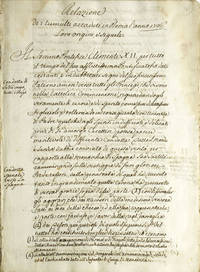
1736257005Rome 1736. 59 pp. in all on laid paper. 4to all with one exception approx. 27 x 20 cm. Provenance: Frederick North 5th Earl of Guilford 1766-1827; library of Sir Thomas Phillipps ex Ms. 7544; with H.P. Kraus. 59 pp. in all on laid paper. 4to all with one exception approx. 27 x 20 cm. Following the acquisition of the Kingdom of Naples and the Two Sicilies by the Bourbons of Spain in 1736 the conquering Spanish troops returning through Rome and Papal States provoked anti-Spanish riots in March of 1736. The following 6 manuscripts each in a different contemporary hand all from the collection of Sir Thomas Phillips and comprising Phillips Ms. 7544 relate to those events. They are as follows:<br /> <br /> 1 CONTI Antonio attributed to. "Relazione dei tumulti accaduti on Roma l'anno 1736. Loro origine e sequele." 13 pp. on 7 leaves.<br /> 2 "Sopra il tumulto populare seguito in Roma il 13 Marzo 1736." 6 2 blank pp. on rectos of 7 leaves. <br /> 3 "Se domanda se un Popolo si solleva tumultiamente nel Domnio altrui contro una nazione con offesa del Sovrano di essa ottenuto il perdona generale ." 4pp. on two leaves.<br /> 4 Same text as above with minor differences e.g. "amnistà" for "perdona". 4 pp. 21.5 x 15 cm.<br /> 5 Manuscript Letter fair copy headed "Sigl. Mio" 2 Giuglio 1736" beginning: "Non potevate far cosa pui grata all mia amicizia che commnicarmi la lettera trasmessa da Roma ."12 4 blank pp. Docketed on final page: "Relazione dei tumulti seguiti in Roma l'anno 1736 per i scrivi Austrici contro i Spagnuoli"<br /> 6 Manuscript Letter fair copy headed "Sigl. Mio". 15 pp. N.p. n.d. <br /> <br /> From the collection of Thomas Phillips 1792-1872. "His collection of over 60000 manuscripts was an outstanding achievement in the annals of bibliophily" ODNB and such was the scale that over 100 years passed after his death until the last tranche of the papers were finally sold in 1977 to H.P. Kraus.<br /> <br /> The attribution would seem to be based on a manuscript of the same title in the University of Chicago Special Collections Library v. OCLC: 154339939. unknown
179051008Rome: Ex Typographia Puccinelliana 1790. Hardcover. 12mo. Full dark brown calf. 24pp 374pp. Full-page engraving unnumbered p. 24 historiated initials tailpieces decorative endpapers. Good only. Binding is quite edgeworn and scuffed mainly at spine and corners yet strong-hinged; original decorative pastedown portions of endpapers present and nice with front/rear flyleaf portions lacking; most of text block tight and attractive with first half dozen numbered leaves showing early paper mends to bottom and outer margins; lacks eight leaves 1-2 15-16 19-20 21-22 23-24 25-26 27-28 29-30; 19th c. bookplate of Dominican academy on front pastedown and miniscule inkstamped convent at bottom of title page. A decent and quite handleable copy entirely in Latin and printed in black and red of this roughly translated "Office of the Blessed Virgin Mary According to the Rite of the Sacred Order of the Friars Preachers" -- a Catholic devotional book devoted to Mary and shorter version of the "Divine Office" with daily prayers scripture psalms hymns and other readings. This particular version is connected to Baltasar de Quiñones 1733-98 a Dominican cleric from Spain named Master of the Order of Preachers 1777-98. Despite flaws a presentable example in original binding. Ex Typographia Puccinelliana hardcover
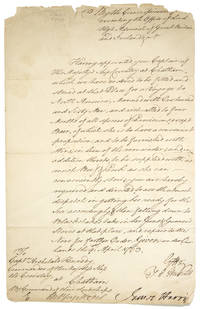
176323620Chatham 1763. 1 vols. Folio. To Captain Archibald Kennedy. Two leaves docketed on the verso of the second folded and creased tears in margins and along folds affecting a few letters or words but not legibility some browning else very good. 1 vols. Folio. Kennedy was the Commander of H. M. S. "Coventry." Document instructing him that his ship was being outfitted to be sent to North America and requiring "utmost despatch in getting her ready for the Sea." <br /> Following the end of the French and Indian War the British sent ships and troops to deal with the problems of the Indians insurrections primarily Indians of New France who did not agree with the surrender. Although Sir William Johnson attempted to allay the problems in the spring of 1763 the Indians under the central direction of Pontiac chief of the Ottawa attacked British posts from Niagara and Fort Pitt to Mackinac and St. Joseph as well as settlements many of the forts and settlements falling to the Indians in "Pontiac's Rebellion or War." <br /> Captain Archibald Kennedy later eleventh Earl of Cassillis was the son and heir of Archibald Kennedy the British colonial official in New York who was expecially noted for having bought Bedlow's Island in New York Harbor for one hundred pounds in 1746 and sold it to New York for a thousand pounds twelve years later. The father wrote several pamphlets relating to the British interests in America and lived in America from 1710 on. He was infirm and ill the time of this document and died the 14th of June 1763. <br /> James Harris 1709-1780 is best known as the author of "Hermes". PR 1b unknown
1799248375Germantown Pennsylvania: Michael Billmeyer 1799. Woodcut Frontispiece music in text. 6 148 8 585 9 26 pp. 1 vols. 8vo. Contemporary sheep with metal clasps. Front hinge starting else Very Good. Woodcut Frontispiece music in text. 6 148 8 585 9 26 pp. 1 vols. 8vo. Michael Billmeyer unknown
177536879Moscow: Meisto Pechati first piece 1775. 2; 6 2 blank. 1 vols. Folio. The two pieces loosely stitched together. Some stains not affecting legibility stitchmarks light soiling else very good. 2; 6 2 blank. 1 vols. Folio. Decrees relating to the military issued by Catherine II. These were issued the year following the end of the Russo-Turkish wars and the treaty of Kuchuk Kainarji signed the 21st July 1774 and after the Cossack rebellion lead by Ymelyan Pugachev who claimed to be Peter III and who was finally captured and executed at Moscow the 11th of January 1775. As a result of the wars and the rebellion in 1775 Catherine seriously reformed the provincial and urban administrations giving greater control to the central government. The first decree lists eight numbered points perhaps officers for promotion or commendation it has the Royal titles as a caption title and commences citing the decree of 3 August 1744. The second piece bears no caption title or heading but lists 47 separately numbered points each a short paragraph imprint on final leaf of text. Meisto Pechati [first piece] unknown