76 résultats
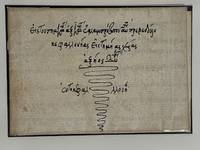
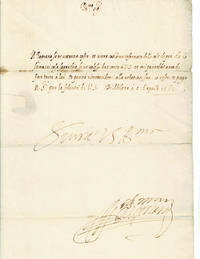
156298780Milan 1562. 1562. - Folio 12 inches high by 8-1/2 inches wide. 1-page on bifolium with a red paper seal. On the 4th leaf with the seal the letter is addressed "APRmo 5 Mons : Vescovo di Cremona". The letter realized in a secretarial hand is dated April 5 1562 from Milan and is boldly signed by Francesco Fernando dÁvalos d'Aquino d'Aragona.<p>Philip II King of Spain and Duke of Milan chose Francesco Fernando dÁvalos to be his envoy at the Council of Trent. He arrived in Trent on March 14 1562 and attended the sessions of the council. He pressed the Spaniards to not offer up anything against the interests of the Holy See. Upon his return to Milan he charged his secretary Ercole Pagnano with the task of generating a report. As the Governor's agent Pagnano had defended the privileges of the Sicilian monarchy and worked with the Spaniards to quell the controversy regarding the jurisdiction of bishops. In this letter to the Bishop of Cremona the Governor is offering Pagnano's report to him. Loosely translated he states that Pagnano is well informed about these things and that "V.S." Your Excellency should be given his account.<p>The letter was once folded into 4 panels and there very minor breaks along 3 of the folds. There is some minor browning especially to one of the folds. <p>An advisor to King Philip II of Spain Francesco Fernando dÁvalos c.1530-1571 took command of the Spanish army in Lombardy and Piedmont succeeding the 3rd Duke of Alba who had become the Governor of Milan. From 1560 to 1563 Francesco Fernando served as the Governor of the Duchy of Milan. He was the viceroy of Sicily from 1568 to 1571.<p>The Bishop of Cremona was born Niccolo Sfondrati in 1535 in the Duchy of Milan. Philip II of Spain appointed him to be a senator in Milan in 1552 and at the urging of the Spanish government the Pope appointed him Bishop of Cremona in 1560. He participated in some of the sessions of the Council of Trent from 1561 to 1563. In 1590 he was one of seven cardinals that were acceptable to be pope by Philip II of Spain. He was elected Pope and took the name Gregory XIV. He died less than a year later in October 1591. Milan, 1562. unknown
1591BOSTONVB11<br />MOREA OTTOMAN GREEK TURKISH PRISONERS Entire Letter writen from Chlonmontsi to "Lord David di Bembo Lord of Cephelonia" acknowledging receipt of nine Turkish Prisoners who are listed sent by the Lord of Cephalonia to "our Lord Bairakbasha Governor of the Morea". A very interesting and early letter during the period that Morea was under Ottoman rule expressing gratitude for the lenient treatment of Turkish prisoners. Surviving Ottoman letters in Greek are extremely rare. in commerce. A full translation and transcription is included.
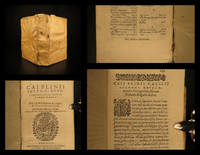
152629791Venetiis: Per Joan. Antoniu et fratres de Sabio 1526. First Edition. Hardcover. 4 64 numbered leaves. Later half vellum over marbled boards. Engraved title page initials woodcut printer's device of Lorenzo Lorio and Battista Putelletto at end featuring Saint Catherine of Alexandria a breaking wheel and the palm of martyrdom. Text block is faintly stained throughout. Old inscription on title a couple of old annotations on the margins tiny hole and mend to title page old mends to the last two leaves two small tears to printer's device. A very good copy. Uncommon. There are no auction records for the first edition and only a handful for later editions. ; Small octavo. Per Joan. Antoniu et fratres de Sabio hardcover
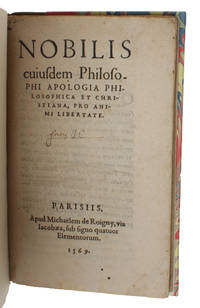
156941451Paris Apud Michaëlum de Roigny 1569. Small 8vo. Very nice recent half calf with five raised bands and gilt title to spine. Old owner's name to title-page discreet. A nice and clean copy with only minor very light soiling. Nice woodcut initials. 51 ff. <br/><br/><em>Very rare first edition of this work on the freedom and immortality of the soul by the father of the famous physicist and anatomist Jean Riolan the Younger. Jean Riolan the Elder 1539-1605 was also himself a noted French anatomist and a leading member of the medical faculty of Paris. He fought against the novelties that entered the faculty due to Paracelsus and authored a number of works attacking the most famous of the scientists who were in favour of chemical means. Works by him are of great scarcity.The work which is divided into three parts attacks the theories on the soul of Pomponazzi Portius Sepulveda and Cardano and as such it is an important document in the seminal controversy about the immortality odf the soul which dominated most philosohical thought of the Renaissance.We have been unable to find the work in any bibliographies. </em> hardcover
1502M250727114Crypt Records 2015-02-17. audioCD. Very Good. 5x0x4. Gently used includes case cover art inserts and CD. Ships Next Business Day. Crypt Records unknown
158857770Kiøbenhaffn Matz Vingaard 1588-89. Folio. 39 x 27 cm. Samtidigt hellæderbind i brunt kalveskind over svært træ og med kanter i smig. Lettere ophøjede bind på ryg. Håndsyede kapitælbånd. Lille hak i skindet på nederste rygfelt. Med de 4 originale hængselsbeslag i støbt messing bevarede men den ene strop fornyet og den anden mangler. Permerne har begge blindtrykte arabesker i midterfeltet en stor arabesk og i hjørner og kanter 6 pyramideformede arabesker som alle er med en blindtrykt krone i pyramidens top. Permerne har mindre messingstifter med store hoveder til beskyttelse af bindet ved opslag. Marmoreret snit. Bindet er ganske velbevaret med kun lidt kantslid og let slid på de ophøjede rygbind. 22353i.e.354226159 blade. Komplet men uden de 3 blanke blade. Træskåret titelblad med tekst trykt i rødt i midterfeltet. Titelbladsvarianten med kongens kobberstukne portræt af Goltzius opklæbet på bagsiden en del eksemplarer udkom uden portrættet. Blad 2 med rigsvåbnet bladet er kantrepareret. 2 træskårne deltitelblade. Registerbladene med svag skjold i ydre marginer. De sidste 35 blade delvist omkantede for det meste i ydre marginer. Ganske få spredte brunpletter. Iøvrigt ganske lette brugsspor. Et udmærket velbevaret og komplet eksemplar bortset fra de 3 blanke.På forreste friblad er anført lidt af eksemplarets ejerhistorie fra 1819 - erhvervet af Mikkel Johannesson Fladebøe som her delvist klausulerer dens ejerskab til fremtidige ejere af gården Fladebøe . Senere synes den overgået til andre i slægten bosat i U.S.A. Olaf Albertsen Axel Albertsen Stanley Albertsen Sidney Albertsen. Folio. 39 x 27 cm. Contemporary brown full calf over heavy wooden boards with oblique edges. Sloghtly raised bands to spine. Hand-stitched capital bands. A small notch to the leather of bottom compartment of spine. With the four original brass clasps preserved but one strap has been renewed and the other is missing. Boards with large blindstamped centre-arabesque and six pyramid shaped arabesques to corners and edges all with a blindstamped crown on top. Large-headed bras spins to boards to protect the boards when open. Marbled edges. A bit of wear to edges and light wear to the raised bands. 22 353i.e.354 226 159 ff. Complete save for the three blank leaves. Woodcut title-page with centre-text printed in red. The title-page variant with the engraved portrait of the king by Goltzius mounted on verso. Several copies were issued without portrait and some were issued as here with the title-page mounted on verso. F. 2 with the royal arms restored at edges. Two woodcut helf-titles. The index-leaves with a vague damp stain to the outer margins. The last 35 leaves have been partly re-edged mostly at the very outer margins. A bit of light scattered brownspotting. Light signs of wear. An overall well preserved copy in- as well as externally. Front free end-paper with handwritten notes on provenance from 1819 onward – bought by Mikkel Johannesson Fladebøe who partly clauses the ownership of the copy to the future owners of the estate Fladebøe. It seems to have then passed to other generations of the same lineage located in The United States Olaf Albertsen Axel Albertsen Stanley Albertsen Sidney Albertsen. <br/><br/><em>The magnificent first printing of the second Danish-Norwegian Bible in folio. This the second Danish Bible in folio is also the first to be printed by a Dane. The scarce and famous "Frederik II-Bible" constitutes the magnum opus of the famed book printer Mads Vingaard "and the most extensive work of printing undertaken in Denmark during the sixteenth century. The book is profusely illustrated with woodcuts copied from a german Bible issued by Sigmund Feyerabend in Frankfurt a. M. 1560. The original woodcuts were made by the artist and craftsman Virgil Solis. Wide woodcut borders together with pictures using themes from the Scriptures surround the title pages and the illustrations. On the reverse of the first title page many copies have pasted in a portrait of Frederich II engraved by the Dutch artist Hendrick Goltzius. However this portrait may also be found on a separate leaf." Thesaurus I.Lauritz Nielsen 405. - Thesaurus I 129. - Birkelund 34. </em> hardcover
1519ZB393224Macmillan Co. 1915-1937. Volumes 15-39 lacking vol. 26#6; partly bound minor ownership markings else texts clean and bindings tight. - If you are reading this this item is actually physically in our stock and ready for shipment once ordered. We are not bookjackers. Buyer is responsible for any additional duties taxes or fees required by recipient's country. Photos available upon request. Macmillan Co. unknown
154719486Lugduni: Apud Seb. Gryphium Sébastien Gryphius 1547. EARLY GRYPHIUS EDITION. Printer’s device on title historiated capitals. Contemporary vellum speckled edges; a few wormholes on the final leaves and back board otherwise an excellent copy with ownership signatures on the title page. Early edition of the works of Pliny the Younger. This edition is a reprint of a 1508 Aldine edition by the notable Lyon-based printer Sébastien Gryphius who published editions in 1531 1539 and 1542. Pliny the Younger was one of the best-known first century historians and his written works were very popular. This series of personal letters to Roman figures provide a detailed view of everyday life within the Roman empire especially Pliny’s views on Christianity. Indeed the tenth letter treats situations in which people are accused of being Christians and how to deal with their interrogation. Also included is Pliny’s panegyric on Trajan and short treatises by Suetonius and Julius Obsequens. This edition includes an introductory note by Gryphius and a preface by Aldus Manutius.<br /> <br /> Caius Plinius Caecilius Secundus nephew and son of the elder Pliny was born at Novum Comum in 62 CE. After studying rhetoric under Quintilian he began his career as advocate at the age of nineteen. He subsequently served in Syria as a military tribune was a quaestor under Domitian and consul under the emperor Trajan. About the year 112 he governed Bithynia as imperial legate his death occurring shortly after in the year 114. He was more or less of a dilettante painstaking very desirous of making a literary reputation and amiable but lacking in force of character and original thought. His panegyric on Trajan delivered to express his gratitude to the emperor who had recently appointed him consul is his only speech which really possessed vitality and his letters which exhibit his self-complacency form entertaining reading. <br /> <br /> German-born Gryphius 1493-1556 was one of the most successful printers in sixteenth-century Lyon. He specialized in popular small-format editions of classical texts and actively competed with Italian printers like Aldus Manutius. <br /> <br /> See Baudrier Bibliographie lyonnaise 8 pp. 211; on the 1508 Aldine Press edition see Renuoard pp. 53-54. Apud Seb. Gryphium [Sébastien Gryphius] unknown
15889875<p>1588 1st ed Pliny the Younger Epistles Panegyricus Vesuvius ROME Early Church<br />Pliny the Younger one of the most notable 1st-century historians is best remembered for his written works and orations. His best-known and still widely popular work is his 'Epistles' which was a series of personal letters to other Roman figures. They give an important view of Roman everyday life as well as an interesting perspective on Pliny's views against Christianity. <br />However the most important epistles concern Pliny's account of the Mount Vesuvius eruption. Tacitus a friend of Pliny wanted to know more about the death of his uncle Pliny the Elder and the eruption itself.<br />This 1588 first edition was published by Jean Richer and includes a dedicatory epistle from Claude Mignault<br />Item number: #9875Price: $599<br />PLINY the Younger<br />Cai Plinii Secundi Novocomensis Epistolarum libri decem. Notæ & observationes auctore Claudio Minoe jurisc. Cum indicibus amplißimis & certißimis.<br />Parisiis apud Joannem Richerium via D. Joannis Lateranensis sub Arbore virescente. 1588. First edition.<br />Details: • Collation: Complete with all pageso 10 287 19• References: USTC 170912• Language: Latin • Binding: Vellum; secure• Size: ~6in X 3.75in 15cm x 9.5cm<br />Our Guarantee:Very Fast. Very Safe. Free Shipping Worldwide.Customer satisfaction is our priority! Notify us with 7 days of receiving and we will offer a full refund without reservation!<br /><br />9875<br />Photos available upon request.</p> Joannem Richerium, via D. Joannis Lateranensis, sub Arbore virescente hardcover
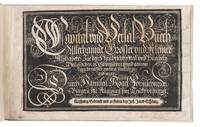
156821281Augsburg: Johann Jacob Schönig 1568. Vellum ca. 1985 with each leaf attached to a stub and the stubs side stitched in a cloth slipcase. Oblong folio 21 x 34 cm. With a richly calligraphic woodcut title-page 18 x 28 cm with text in white fraktur lettering on black with a white panel at the foot with the letterpress imprint in a fraktur type; and 9 of 10 full-page woodcuts about 17 x 25.5 cm showing alphabets in white on black one dated 1568: 8 with decorated gothic capitals versals: 22-150 mm and 1 with textura capitals textura lowercase and roman capitals all versos blank. Lacking 1 leaf. With a small and perhaps fragmentary manuscript on parchment 2 ll. 11.5 x 13.5 cm written on both sides: a Protestant copybook written soon after 1557 probably in Basle or vicinity with 7 writing samples including alphabets of capitals and minuscules the first two pages in fraktur gothic styles and the last two in humanistic styles. Sixth known copy of Johann Jacob Schönig's edition of a stunningly decorative Augsburg writing master's woodcut copybook devoted primarily to decorated gothic capitals versals printed in the period 1680-1694 from the original woodblocks of the first edition of 1568. Hans Rogel the elder 1532-1592 writing master school teacher poet wood-block cutter engraver printer and publisher at Augsburg cut the woodblocks and probably executed the lettering himself. All the lettering examples and the title-page are printed from large richly calligraphic woodcuts with their lettering in white on black. Nine of the ten examples display versals the missing leaf supplied in reproduction including complete alphabets in three sizes. The final leaf displays alphabets of textura capitals textura minuscules and roman capitals. As early as 1779 Paul von Stetten described Rogel's Capital und Versal Buech as "besonders fein geschnitten" and said that if Rogel executed the lettering himself he "ist er billig den zierlichsten Schreibmeistern beyzuzählen". He thought it good enough to be the work of Caspar Brinner 1565-1610 the greatest Augsburg writing master of the second half of the century apparently not knowing Brinner was only about three years old in 1568.All editions should apparently contain 11 leaves but many contain only 10 and some fewer. Some have also been bound with additional leaves that do not belong to the edition. There appear to be only 3 complete copies of the present edition.An early owner skilfully wrote out alphabets in the fore-edge margins of 2 leaves and phrases at the foot of one. It seems likely to be the copy owned by Jan Willem Six van Vromade 1872-1936. Lacking leaf "2" as noted professionally and unobtrusively restored in 1984 and probably rebound soon after: the tattered fore-edge margins of several leaves were restored and a couple gaps in the right border of the title-page filled in with black ink. A small brown smudge in the unnumbered first page of versals 22 mm slightly affects small bits of 4 letters but in general the woodcuts remain in good condition.l Berlin Kat. 4799; Bonacini 1548 Berlin copy; Doede 21 note; Hollstein German 34 KVK & WorldCat 4 copies: 2 lacking 1 leaf; Van Stockum Cat. bibl. J.W. Six de Vromade part 1 16-21 November 1925 lot 407 the present copy; cf. Paul von Stetten Kunstgewerbe und Handwerksgeschichte . Augsburg 1779 vol. 1 p. 23 1655/68 ed. Johann Jacob Schönig, hardcover
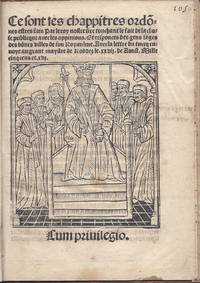
15161704S.l.: s.n. 1516. First edition. Title page with large woodcut illustration showing the King on his throne surrounded by the delegates. In Bastarda type with two floral woodcut initials. In later hard paper. Gilt title vignette on spine damaged. Concise marginal notes and page-numbers in ink by a contemporary hand throughout. Trimming of the leaves slightly affects the glosses with no effect to legibility otherwise the margins are wide. Title page crinkled at the upper right corner with a small tear that only affects the margin. Narrow inkblot to the lower margin throughout. B4 with two light brown stains C1 crinkled at lower corner. Bookplates on the inner front panel G. J. Arvanitidi; Antoine Mouradian. Overall in very good condition. First edition. Title page with large woodcut illustration showing the King on his throne surrounded by the delegates. In Bastarda type with two floral woodcut initials. In later hard paper. Gilt title vignette on spine damaged. 20 p. <p><br /> A bibliographically unrecorded early sixteenth-century French book about royal ordinances regarding the commonwealth along with the French translation of Sultan Selim I's letter of conquest fethname addressed to the Grand Master of Rhodes. <br /> <p><p><br /> The first and major part of the book presents nine concepts of orders of Francis I 1494-1547 King of France from 1515 until his death regarding the commonwealth chose publique. The drafts concern such topics as the commerce of spices and drugs wool cloth and other goods chapter 1-4 the weights and equivalents of coins and the recognized foreign currencies chapter 5 the recognized units of measures chapter 6 the regulation of the extravagance of clothing chapter 7 the inn trade chapter 8 and the money that goes to Rome for obtaining Bulls chapter 9. <br /> <p><p><br /> The second section comprises the responses to the aforementioned concepts of the representatives of the Good Cities Bonnes Villes Provence and Dauphiné who had been previously assembled in Paris by the order of the King in March 1516. In most cases they requested a delay of reply to discuss the matters with those who they were representing.<br /> <p><p><br /> The third section presents the grievances and requests delivered to the King by the delegates regarding the provincial councils conciles provinciaux the prolixity of the trials the tariffs the public officers the superior courts cours souveraines the land taxes tailles and the abuse and plunder by the soldiers crossing the kingdom. <br /> <p><p><br /> These sections were recorded and written down by the court clerk Jean Hesselin Seigneur of Girodon. Hesselin mentions himself twice p. 14 and 17 once by name p. 14 within the text.<br /> <p><p><br /> The final part is the French translation of the Ottoman Sultan Selim I's fethname letter of conquest sent on 27 August 1516 from Aleppo to Fabrizio del Carretto 1455-1521 Grand Master Magnus Magister of the Knights Hospitaller in Rhodes between 1513 and 1521. The fethname accordingly to its genre details Selim's expedition and the conquest and emphasizes the power and grandeur of the Sultan and his army. <br /> <p><p><br /> Selim I 1470-1520 ascended the throne as the Sultan of the Ottoman Empire in 1512. He is remembered for the enormous expansion of the Empire during his reign thus raise the Ottomans to the leaders of the Muslim world. Selim's most notable deed was the conquer of the Mamluk Sultanate which included Levant Hejaz and Egypt in 1516 and 1517 at the Battles of Marj Dabiq and Ridaniya.<br /> <p><p><br /> The Battle of Marj Dabiq near Aleppo took place on August 24 1516 where Selim defeated the Mamluk Sultan Al-Ashraf Qansuh al-Ghuri. This was a decisive victory of the war between the Ottoman Empire and the Mamluk Sultanate which ended in the conquest of much of the Middle East. Such an expansion of the Ottoman territory was a clear threat to Rhodes which was the nearest Christian possession to the coast of Asia halfway between Constantinople and Egypt. At the time the Grand Master in Rhodes was the Italian admiral Fabrizio del Carretto 1455-1521; Grand Master from 1513 to 1521 for a short interlude of a course of fifty-five years of Frenchmen serving as the supreme heads of the Order. Selim announced his victory and forecasted his threat to del Carretto in a fethname presented here in French translation however eventually he did not have the time to conduct the campaign against Rhodes. It was his successor Suleiman I who conquered the island in 1522 thus gained control over the eastern Mediterranean for the next centuries. By the time of the siege the commander of the Order was again a Frenchman Grand Master Philippe Villiers de L'Isle-Adam 1464-1534. Suleiman allowed him and the surviving knights to leave unmolested and eventually the Hospitallers were quartered permanently on Malta in 1530.<br /> <p><p><br /> To the best of our knowledge the original fethname has not survived and we could not trance any other printed version or edition of the French translation. We could find one surviving copy of a Spanish translation of Selim's letter which was addressed to Pope Leo X titled Carta de nuevas grandes buenas y ciertas embiada a nuestro s. padre Leon X de las cosas que han passado en Levante entre el gran turcho y el gran solda Valencia Juan Viñao 1517; Norton 1256 IB 11215 USTC 344377 kept at Cambridge University Library F151.d.8.12.<br /> <p><p><br /> Provenance: Bookplate of Georgios Arvanitidis 1876-1953 a noted Constantinopolitan collector of books on Turkish and Greek history. Bookplate with the motto "On abuse du vrai" of Antoine Mouradian.<br /> <p><p><br /> Ref.: Bibliographically unrecorded.<br /> <p><p><br /> Bibl.: Setton K. M. Hazard H. W. ed.: A History of the Crusades. Vol. 3. Wisconsin: The University of Wisconsin Press 1975. pp. 332-335. Pedani-Fabris M. P.: Ottoman Fetihnames. The Imperial letters announcing a Victory. In: Tarih İncelemeleri Dergisi 13 1998. 181-192. <br /> <p>. [s.n.] unknown
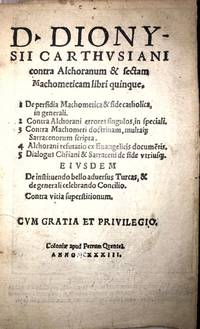
15331027Coloniae Köln: apud Peter Quentel 1533. First edition. In later gilt burgundy maroquin. Gilt floral ornaments and title on spine. Marbled endpapers. Gilt edges. Green silk bookmark. Two leaves misbound: Oov–vi after Qqiiii. Pages trimmed that occasionally effects the printed marginals and page headers. Two wormholes effects the upper part of the last four signatures slightly the text as well partly restored with old paper. Otherwise clean. Engraved bookplate and printed bibliographic reference on inner front panel. Collection vignette on front and rear endpapers. Collection inscription and stamp on additional endpaper. Overall in fine condition. With two large woodcut illustrations the Virgin and Child on verso of title and woodcut of the author at end. Woodcut initials. With two large woodcut illustrations the Virgin and Child on verso of title and woodcut of the author at end. Woodcut initials. First edition. In later gilt burgundy maroquin. Gilt floral ornaments and title on spine. Marbled endpapers. Gilt edges. Green silk bookmark. 16 628 i.e. 626 2 p. Pages 113 and 178 omitted in pagination. Signatures: AA8 A-Z8 Aa-Nn8 Oo10 Pp-Qq8. <p><br /> First edition of Denis the Carthusian’s treatise against Islam with numerous quotations from the Qurʼan. Preceded the earliest complete Latin edition of the Qurʼan by ten years. <br /> <p><p><br /> “Contra Alchoranum†the anti-Islamic work of the Carthusian monk Dionysius 1402–1471 was written around 1454 but only printed some eighty years later in this edition. It was edited by Petrus Blomeuenna whose dedicatory epistle is addressed to Emperor Ferdinand I. The laudatory poem about Dionysius Carthusianus that closes the book was written by Nicolas van Essche 1507–1578.<br /> <p><p><br /> Dionysius cites passages of the Qur’an in the Latin translation of Robert of Ketton and counters them by biblical quotations he places these Qur’anic theses and biblical antitheses in the mouths of a Christian and a Saracen as a fictitious dialogue. He also encourages crusades against the Ottoman Turks who shortly before he wrote this treatise had conquered Constantinople. <br /> <p><p><br /> “Contra Alchoranum†is considered to be the first printed source in Latin of the legend of Bahira or Sergius the Nestorian Monk who according to the story together with three Jews conveyed the text of the Qur'an to Mohammed with massive falsification of the Biblical traditions.<br /> <p><p><br /> The book has been published ten years earlier than the first printed version of the entire text of the Qurʼan in Latin translation Machumetis Saracenorum principis; Basel 1543 and uses the same translation by the English scholar Robert of Ketton Robertus Ketenensis; 1110–1160. In 1540 a paraphrased abridged German translation of “Contra Alchoranum†was published in Strasbourg under the title “Alchoran. Das ist des Mahometischen Gesatzbuchs …†whose translator was probably Heinrich von Eppendorff.<br /> <p><p><br /> Bibl.: Francisco A.: Martin Luther and Islam. A Study in Sixteenth-Century Polemics and Apologetics. Leiden; Boston: Brill 2007. pp. 16–17.<br /> <p><p><br /> VD 16 D 1863.; USTC 626366.; Adams D 539.<br /> <p>. apud Peter Quentel unknown
1600957544 Vols. 1979. Near Fine. 1600. First Edition. Softcover. Glossy pictorial softcovers. First editions. Books are in near fine condition crisp and clean with tight binding and sharp corners. Historic photos color illustrations and crew info as well as technical specs throughout. 4tos . paperback
1576EE5120Apud Hieronymum Wellæum bybliop. Iurat. 1576. ~The seven works are: Liber de arcta via salutis & contemptu mundi / Speculum amatorum mundi / Liber de gravitate & enormitate peccati / Liber de conversione peccatoris / Liber de fonte lucis & semitis vitae / Liber devotum praecordiale praenotatus / Dialogus patroni ad Canonicum. ~Original full vellum yapped fore-edges folded in. Low raised bands to spine. Some loss to fore-edges. 12mo 7.5 x 11.5cm. Numbered by leaf not page. All edges speckled darkened. Hinges sound. Two owners' signatures in old hands to front endpapers. Loss to top of rear free endpaper. Printer's device to title page and final page. Decorated initials and elaborate tail-pieces throughout. Numbered as leaves but printed as pages. Rare: only one volume on WorldCat. Denis the Carthusian 1402-1471 theologian and mystic. ~Robust packaging. All UK orders trackable others on request. Used books are exempt from USA tariffs. 1st edn. Hardback. Hardback. Good. 8 330 2ff. Apud Hieronymum Wellæum bybliop. Iurat. Hardcover
159355259Slesvig Nicolai Wegener 1593. 4to. Helpergamentsbind fra 1600-taller. Ved ombindingen er bagerst indsat ca. 100 blanke blade. Forgyldt titeletiket i skind på ryg. Etiketten med lidt tab. Gl. ejernavn Bille Brahe Hvedholm. 129 blade. På titelbladet er 2 linier som var trykt med rødt overskrevet med sort. Blad 1b med stort træsnit af Danmarks våben. Blad 2a med helsides træsnit Christian IV's portræt. Gl. ejernavn på titelbladet. Rent eksemplar trykt på kraftigt skrivepapir og med talrige samtidige tilskrifter i en net hånd. <br/><br/><em>Yderst sjældent forekommende anden udgave den første trykt af Brandis 1486 af den plattyske oversættelse af Jyske Lov ved Blasius Eckenberger. Der eksisterer kun en lille håndfuld bevarede eksemplarer i privat ejerskab. Det foreliggende eksemplar er en af varianteksemplarerne som er beskrevet af Lauritz Nielsen Dansk Bibliografi p.348 no.1072 og som gør sig bemærket ved flere udeladelser. Således er udeladt oversætterens eneretsprivilegium dedikationen fra oversætteren Chr. IV's autorisation m.v. = læg 2 og 3. I dette eksemplar starter teksten med "Vörrede" som har arksignatur D og slutter med blad 139 b som er et helsides træsnit af oversætterens bomærke. Repertoriet som Eckenberger udgav 1594 sammen med loven er heller ikke tilstede.Lauritz Nielsen 1072. - Thesaurus I 167. </em> unknown
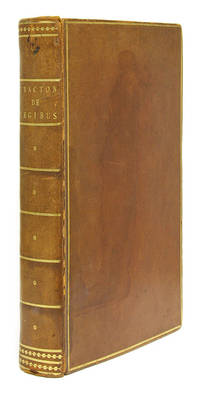
1569673671569. London 1569. First edition. Folio. London 1569. First edition. Folio. PMM 89: "The Crown and Flower of English Medieval Jurisprudence" Bracton Henry de d. 1268. De Legibus & Consuetudinibus Angliae Libri Quinq; In Varios Tractatus Distincti ad Diversorum et Vetustissimorum Codicum Collationem Ingenti Cura Nunc Primum Typis Vulgati; Quorum Quid Cuiq; Insit Proxima Pagina Demonstrabit. London: Apud Richardum Tottellum An. do. 1569. With imprimatur "Cum priuilegio" at foot of title. xvi 172 175-444 ff. Complete. Folio 11-1/4" x 7-3/4"; 28.6 x 19.7 cm. Nineteenth-century diced calf gilt rules to boards gilt fillets ornaments and title to spine gilt rules to board edges gilt inside rules marbled endpapers ribbon marker. Light rubbing to boards faint dampstain to front board moderate rubbing to extremities front joint starting at head rear joint cracked corners bumped and somewhat worn armorial bookplate "Ex Libris Munden" to front pastedown. Attractive large woodcut decorated initials. Light toning to text somewhat heavier in places light foxing and finger smudges to some leaves some fading to text of ff. 1 and 2. A handsome copy of a landmark work with an interesting provenance perserved in a navy blue clamshell box. $13000. First edition. Written between 1250 and 1256 De Legibus et Consuetudinibus Angliae The Laws and Customs of England is the first treatise on English law. A systematic work it emphasizes the separation of procedural and substantive matters and also cites cases as sources of at least intellectual if not formal authority. Both the principles formulated in this work and its use of precedents determined the development of English law and established the method adopted by Littleton and Coke. In Maitland's words it is "the crown and flower of English medieval jurisprudence" and "by far the greatest of our medieval law books." This copy belonged to Arthur Henry Holland-Hibbert 3rd Viscount Knutsford 1855-1935 of Munden House Hertfordshire. He served as both a justice of the peace and High Sheriff of Hertfordshire. His bookplate was engraved by Sir Henry Badeley who designed bookplates for a number of important clients including the House of Lords Library. Maitland Collected Papers II:43. Dauchy et al. Eds. The Formation and Transmission of Western Legal Culture: 150 Book. unknown
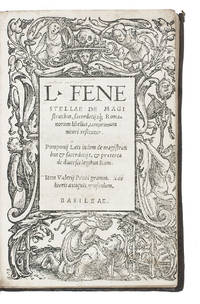
15236849Basel: colophon: Valentino Curio 1523. Contemporary panel-stamped calf sewn on 4 supports each board with the same 3 panel stamps: 2 virtually identical panels 76 x 52 mm with the foot of the panels toward the spine with 6 animals in 2 grape vines the animals from head to foot in the left vine: a monkey dog and wyvern 2-legged dragon; and in the right vine: a squirrel hare and lion in a border of a diaper of quatrefoils in lozenges the two separated by a small panel stamp 12 x 75 mm with a peacock right side up with its head toward the right but turned back and pecking at the ground paste-downs made from a leaf from an Aristotle manuscript on vellum with a fragment of another manuscript in a bastarda script under it. 8vo 16 x 10.5 cm. Ad 1: With the general title in a woodcut border with a woman mounting a man as if he were a horse a head on a stake and other grotesque or satirical figures Curios large architectural woodcut device on the otherwise blank final page with a shield held by 4 putti bearing a hand emerging from a cloud painting or writing on a tablet with what appears to be a brush 4 woodcut decorated initials 2 series: roman inscriptional capitals with pictorial backgrounds and a vine-leaf ornament Vervliet 7. Ad 2: With 2 woodcut decorated initials. Ad 3: With 3 woodcut decorated initials 2 series and 2 different vine-leaf ornaments Vervliet 7 & 8. All three editions set in italic type with upright capitals ad 2 with equally extensive passages in roman. 3 works in 1 volume. Including with a drop-title: POMPONIO LETO Giulio. De Romanorum. magistratibus .With:2 LUCIANUS OF SAMOSATA. Complures . dialogi à Desiderio Erasmo Roterodamo . in Latinum conversi & à Nicolao Buscoducensi illustrati additis Fabularum & difficilium vocabulorum explanationibus.Colophon: Antwerp Michael Hillen van Hoochstraten 1524.3 MOSELLANUS Petrus Peter SCHADE. Paedologia . in puerorum usum conscripta & aucta. Dialogi XXXVII. Dialogi pueriles Christophori Hegendorphini. XII. .Including with a drop-title: HEGENDORF Christoph. Dialogi pueriles . XII. .Colophon: Antwerp Michael Hillen van Hoochstraten 1523. Three rare editions of humanist works in a contemporary panel-stamped binding all well produced and the panel stamps finely rendered. Fogelmark p. 33 calls panel-stamps with gothic animals in foliage "the Flemish panel stamp par préférence". We have not found an exact match in the literature. The impressions of the panels are very crisp and clear especially that on the lower half of the front board.Ad 1: First Basel edition of an account of the sacerdotium priesthood and administration in ancient Rome written by the Florentine humanist Andrea Domenico Fiocco d. 1452 assuming the name of a first century Roman writer Lucius Fenestella. It is followed by a work on the same subject by the Italian humanist Giulio Pomponio Leto 1428-1498 and a list of abbreviations by Valerius Probus. While these works by Fiocco and Leto had been published together since 1510 the present edition introduces a new form that seems to have become the standard followed by others.Ad 2: Rare Antwerp edition of satirical dialogues by the 2nd-century rhetorician Lucianus of Samosata now in Turkey near the Syrian border often simply called Lucian in English. They come from his Dialogues of the gods and Dialogues of the dead. The present translation from the Greek by Erasmus first appeared at Louvain in 1512. Only one other copy of the present edition is known.Ad 3: Rare early Antwerp edition of a very popular pedagogical work by the German humanist and professor at Leipzig Peter Schade better known as Petrus Mosellanus 1493-1524. The present edition includes as usual the dialogues for children by the German Hellenist Christoph Hegendorf 1500-1540. Only one other copy of the present edition is known.With several early owners' and other inscriptions and an occasional manuscript note or underlining in the text. The title page of ad 1 with an owner's inscription removed and about a millimetre shaved from the fore-edge of the woodcut border a small worm hole in the first 5 leaves and some mostly marginal water stains not significant outside the last 8 leaves: still in good condition. Recased with the four corners of each board and the head and foot of the spine restored and a few small wormholes and cracks in the calfskin of the boards slightly affecting the panel stamps but nearly all of each of the 6 panel impressions survives in very good condition. Three humanist works in Latin two in extremely rare Antwerp editions with finely executed contemporary panel stamps.l Ad 1: Adams F597; BMC STC German p. 300; Hieronymus Oberrhein. Buchillustr. 377c; USTC 671401; VD16 F1641; ad 2: Netherlandish books 19680 1 copy; Nijhoff & Kronenberg 1401 same copy; USTC 437231 same copy; not in Adams; BMC STC Dutch; UniCat; ad 3: Netherlandish books 21706 1 copy; USTC 404733 same copy; not in Adams; BMC STC Dutch; Buisson; EOL www.erasmus.org; Nijhoff & Kronenberg; UniCat; the main panel stamps not in Fogelmark; Goldschmidt; Indestege "De boekband in de Zuidelijke Nederlanden ." in De Gulden Passer XXXIV 1956 or the addendum in XXXV 1957; Oldham; Weale. (colophon:) Valentino Curio, hardcover
1576304748Venice: Aldus Manutius 1576. First edition. viii 125 3 blank; 106 6 blank; 103 pp. 8vo. 17th-century German blind-stamped pigskin red edges. First edition. viii 125 3 blank; 106 6 blank; 103 pp. 8vo. This work on questions of antiquity written by Aldus the Younger son of Paulus Manutius esteemed Cicero scholar and grandson and namesake of the famous Venetian printer Aldus Manutius covers astronomy the Ptolemies and questions of the liberal arts. <br /> <br /> Aldus the Younger was the last member of the Manutius family to be active with the family's renowned press in Venice. Ahmanson-Murphy 898; Renouard 223:13. Provenance: early canceled ownership inscription at base of title "Paulus Johanne Patavii MDLXXVII"; Earls of Maccelsfield North Library bookplate embossed stamp to title and following leaf [Aldus Manutius] unknown
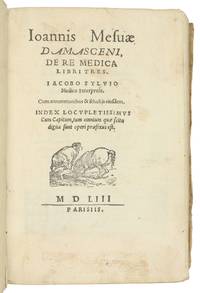
1553L7NA2E7L5WJBParis = Venice: Girolamo Scotto 1553. Contemporary vellum traces of ties. 8vo. With Scottos woodcut device on the title page showing what are probably two of the wild mares of King Abderus being devoured by the mares of King Diomedes of Thrace devouring either Abderos or Diomedes himself and about 22 woodcut decorated nearly all pictorial initials 7 series plus a few repeats. Rare Venetian edition with a false Paris imprint of Mesues three seminal pharmacological works including his great pharmacological handbook the principal model for the European pharmacopoeias translated into Latin by Jacques Dubois/Jacobus Sylvius 1478-1555 who taught anatomy at Paris his students including Vesalius and Gesner. Dubois first published it in a Paris folio edition in 1542. As far as we know the present edition has not previously been recognised as a false imprint but Girolamo Scotto in Venice used the woodcut device on the title-page in 1543 Bernstein Music printing p. 88 & fig. 3.16: much more artistic than most publishers devices so perhaps made to illustrate an unidentified book and the woodcut pictorial initial on r8r also appears in Lippomano Espositioni volgare Venice Girolamo Scotto 1554 A4r where some of the types match as well. Moreover the 2 initials in the largest series A on l2v and H on e2v show respectively: another Scotto device anchor with S O S and the motto in tenebris fulget: see Scottos 1554 Lippomano 1555 Aquinas and his heirs 1585 Monte Madrigali and the coat of arms of the Medici Grand Dukes of Tuscany dexter impaled with a tree atop six mounts sinister.De Vos calls Mesues present works a conduit for the Arabic contributions to that epistemology and its subsequent development and impact describing them as the most dominant source of pharmaceutical writings and by far the most influential in the subsequent development of European pharmacy with Duboiss new Latin translation of particular note pp. 668 670 673. Though these Mesue works had been printed already in 1471 Duboiss translation became the standard De Vos counting 17 editions in less than a century. The preliminaries include the title-page Duboiss 7-page dedicatory epistle addressed to Etienne de Poncher 1446-1529 Bishop of Bayonne and chancellor of the University of Paris and an 8-page contents covering all three works. The three Mesue works follow: Methodus medicamenta purgantia simplicissima deligendi & castigandi theorematis quatuor absolutus = Canones universales ll. 1r-33v 13 chapters; De singulis medicamentis purgantibus deligendis & castigandis = De simplicibus ll. 34r-82v 30 chapters; and De antidotis = Antidotarium or Grabadin ll. 82v-239r 12 sections; followed by definitions of the technical words ll. 239v-248r and a 9-page table of contents for all three works. Duboiss version of the first work differs considerably from earlier editions where it bore the title Canones universales. It describes general techniques in the preparation of medicines and was originally closely associated with the simples in the following work but it was given a much broader application. The De simplicibus originally gave information on 49 simples mostly purgatives here expanded to 53. Although it includes many known since classical antiquity more than a fourth are additions made by the mediaeval Arabic physicians. The bulk of the book is devoted to the Antidotarium also called Garbadin after the Arabic for dispensary. It is by far the most detailed and extensive mediaeval book of pharmacological recipes far surpassing the 12th-century Antidotarium Nicolai which had been the standard work in Europe. Not only does it include 432 recipes for compound medications compared with Nicolais 85 it arranges them by the kind of medicine rather than alphabetically and unlike Nicolai it gives detailed instructions for their preparation. It largely superseded Nicolai in Europe in the late 1300s and early 1400s. Although Mesue and his present works have fallen into undeserved obscurity in the general public they went through more editions than Ibn Sina Avicenna Galen or Discorides.If the attribution to Joannis Mesuae Damasceni is correct the author must be Yahya = Yuhanna ibn Masawaih al-Mardini ca. 925-1015 known in the West as Mesue the younger. He is said to have been a Syrian Jacobite/Nestorian Christian physician from Mardin in upper Mesopotamia now on the Turkish-Syrian border who worked in Damascas may have headed the Baghdad hospital served as personal physician to caliphs in Cairo and wrote in Arabic. His present principal works are now known however from Latin translations the earliest from 1281 and De Vos even suggests they may have been compiled in Bologna after 1260 adapting several unidentified Arabic medical works of the 10th and 11th centuries to 13th-century European needs. She notes that Dubois published a new Latin translation in 1542 and emphasises its importance but she does not discuss his sources he was well-versed in Greek and Hebrew but apparently not in Arabic. In any case the writings attributed to Mesue the younger clearly derive from the mediaeval Islamic world and contain many innovations that provided the basis for the theory and practice of pharmacology for centuries and perfectly met the demands of the developing medical marketplace of mediaeval Europe. The early Paris folio editions of Duboiss translation would have been out of reach of most students and country or small town physicians or apothecaries so Lyon printers introduced 8vo editions in 1548. The present 8vo edition appears to be the first outside Lyon and Scotto may have thought a false Paris imprint would make it seem more authentic than the Lyon competitors.With faint brown stains some marginal worming near the end of the text and the corner of Aa3 lost not affecting the text.l Durling 3145; ICCU NAPE 006561 8 copies; USTC 151259 2 copies; WorldCat 9 copies in 7 entries; cf. Brockelmann GAL I 232; Hirsch I 171f; not in Adams; BM STC French; EDIT 16; Wellcome; for Mesue and the present works: Paula De Vos The Prince of Medicine: Yuhanna ibn Masawayh and the foundations of the Western pharmaceutical tradition in: Isis 104 2013 pp. 667-712; Prioreschi History of medicine IV Byzantine and Islamic pp. 290-291. [Girolamo Scotto], hardcover
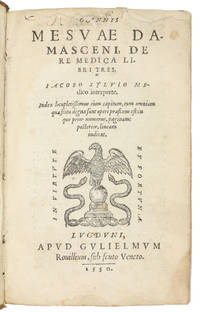
1550L7NAYKM7EWW1Lyon: Guillaume Rouillé colophon: printed by Philibert Rollet 1550. 19th-century marbled boards manuscript spine label. 8vo. With Rouillés woodcut device on the title-page eagle on a globe flanked by 2 snakes numerous woodcut decorated initials and an arabesque decoration below the colophon. Well-made but popularly priced Lyon 8vo edition of Mesues three seminal pharmacological works including his great pharmacological handbook the principal model for the European pharmacopoeias translated into Latin by Jacques Dubois/Jacobus Sylvius 1478-1555 who taught anatomy at Paris his students including Vesalius and Gesner. Dubois first published it in a Paris folio edition in 1542. Speaking of the artisanal epistemology crucial to the European scientific revolution De Vos calls Mesues present works a conduit for the Arabic contributions to that epistemology and its subsequent development and impact describing them as the most dominant source of pharmaceutical writings and by far the most influential in the subsequent development of European pharmacy with Duboiss new Latin translation of particular note pp. 668 670 673. It is by far the most detailed and extensive mediaeval book of pharmacological recipes far surpassing the 12th-century Antidotarium Nicolai which had been the standard work in Europe. Not only does it include 432 recipes for compound medications compared with Nicolais 85 it arranges them by the kind of medicine rather than alphabetically and unlike Nicolai it gives detailed instructions for their preparation. It largely superseded Nicolai in Europe in the late 1300s and early 1400s. Although Mesue and his present works have fallen into undeserved obscurity in the general public they went through more editions than Ibn Sina Avicenna Galen or Discorides.If the attribution to Joannis Mesuae Damasceni is correct the author must be Yahya = Yuhanna ibn Masawaih al-Mardini ca. 925-1015 known in the West as Mesue the younger.Provenance: 1 owners inscription in ink dated 1636 struck through and difficult to decipher on front paste-down; 2 another dated 21 August 1818 on back paste-down also difficult to read; 3 19th-century ink owners inscription of Arthur Rénaux on front paste-down. Occasional browning; an owners inscription erased on the title-page with slight loss to authors name. Binding rubbed; hinges cracked and minor chips in the spine.l Baudrier IX 176; Durling 3144; USTC 150499; Wellcome 4280; cf. Hirsch I 171f; not in BMC STC French; for Mesue and the present works: Paula De Vos The Prince of Medicine: Yuhanna ibn Masawayh and the foundations of the Western pharmaceutical tradition in: Isis 104 2013 pp. 667-712; Prioreschi History of medicine IV Byzantine and Islamic pp. 290-291. Guillaume Rouillé (colophon: printed by Philibert Rollet), hardcover
1512250826035Real Gone Music 2015-12-04. audioCD. Very Good. 5x4x0. 40th Anniversary Remastered & Expanded Edition RGM-0411; bonus tracks & outtakes; tiny ding to booklet; otherwise jewel case and rear cover art are in excellent condition; disc is mint/near mint; because we care that your order arrives in the condition stated we have additionally sealed the case in bubblewrap for added protection during shipment Real Gone Music unknown
1544321627Wittenberg Germany: Veit Kreutzer 1544. Hardcover. Very Good. Wittenberg: Veit Kreutzer 1544 German edition of Melanchthon's Loci Communes first published in Latin in 1521 as "Loci communes or Loci communes rerum theologicarum seu hypotyposes theologicae" Latin for Common Places in Theology or Fundamental Doctrinal Themes. Very good. Pages of the text are numbered entirely in roman numerals to page CCCLIII. With an unnumbered register index of 23 pages. Beautiful contemporary stamped ivory vellum veneer boards with a set of elegant silver clips. No front endpaper. The copy bears an early bookplate "Ex bibliotheca Gust. Ad. Hauseri theol et philos. stud. Cl nr" inside the front board. Light pencil signatures from the 19th century trace the stewardship of Ole Lokensgaard 1854-1931 Granite Falls Minnesota who came to the US in 1857. The family was associated through his son Gerhard W. Lokensgard with St. Olaf College in Northfield. It has been held by the family through 3 generations. The Loci Communes evolved with the reform movement. This 1544 edition is translated by Justus Jonas into German based on Melanchthon's 1542 revision. Title in English: "The Heubtartike Christian Literature/ drawn together/ By Philippum Melanthon/ called in Latin/ Loci Communes Theologici. Germanized by Justum Jonam/Doctor/ and in the 1542nd year/ By Philip. Melanth. checked again and improved." The Loci Communes evolved with the movement. Philipp Melanchthon 1497 – 1560 was a German reformer a collaborator with Martin Luther and part of the Wittenberg team that established the foundation of the Protestant Reformation. Melanchthon was its first systematic theologian and an intellectual leader of the Lutheran Reformation who with Luther was a primary founder of Lutheranism. Loci Communes was Melanchthon's Magnum Opus. "Melanchthon points out that he wrote the Loci Communes to encourage people to bypass extra-biblical sources and go straight to scripture. He does not believe it makes sense to try to integrate philosophy with the interpretation of the Holy Scriptures. Melanchthon berates the scholastic methodology of dialectic. He discusses the skewing of scripture that those who employ such methodology foisted upon the interpretation of scripture". The colleagues that Luther assembled in Wittenberg’s theological faculty formed the nucleus of his team. This included Justus Jonas 1493 –1555 who served in addition to roles as advisor and legal expert as translator of the works of Luther and Melanchthon from Latin into German or German into Latin. In the 16th century intellectuals across Europe spoke Latin. To spread the Wittenberg message this process of translation and revision was essential to the maturing of the movement. The later editions were published from 1543-1559 with the final edition being published just one year before Melanchthon’s death in 1560. The 1560 edition is four times the size of the original 1521 edition. "The German text of the third generation remains close to the second generation of the Latin Loci; the text is a revision by Melanchthon of the translation of Jonas.He once confessed that he found the final revision of this German translation better than the Latin Loci CR 22 31/32." We believe that this 1544 Jonas translation may be the one to which Melanchthon refers. But that is a matter for further scholarly investigation. The simple beauty of the copy with its silver clasps is exceptional. Veit Kreutzer hardcover
1551V73009Paris Lutetiae: Robertus Stephanus Cum privilegio Regis 1551. Hardcover. Very Good. Nice Estienne printer's device on titlepage of basilisk wound round vine and floral headpiece and initial on first page of life of Pompey the Great. Small quarto 23.5x14mm half 19th century morocco on 5 bands gilt ruled with Greek title and brown marbled boards marbled endpapers with neat Greek Athens bookseller's label 357pp 3pp Variae Lectiones & Errata. Beautifully clean and crisp handsome Greek typography. Editio princeps of the epitome of Dio's Roman history abridged in the 11th century by Joannes Xiphilinus the only source for Dio's lost books 61-80 dealing with events from 47 B.C. to 235 A.D. Robert Estienne issued this epitome to compliment his folio edition of Dio Cassius of 1548. Printed in the gros-romain font of the "grecs du roi" cut by Claude Garamond. Robertus Stephanus Cum privilegio Regis hardcover
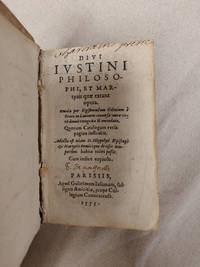
157541312Paris at William Julian's in the Garden of Friendship near the College of Cameracenfe 1575. Vellum. Very Good. 32 mo aged vellum boards with what appears to be the title stamped on the spine though very faded. Rough translation - All the extant works of the great philosopher and martyr of Ivstin Justin passed down translated into Latin by Sigismund Celenius. Includes an addition/addendum trans from D. Hippolyi Epifcopi. The condition of the book is Very Good for it's age binding of the text block intact; general aging to the vellum; fading on the spine as noted prior; text block separating some from the boards but the exposed bands on the spine are intact. 440pgs roughly100pg index. <br/> <br/> hardcover
1572EE4911Haeredum Iohannis Quentel / Viduam Mauricii a Porta / et al 1572. ~DATE RANGE: 1547-1572 ~FULL TITLES: D. Dionysii Carthusiani Enarrationes piae ac eruditae in quatuor prophetas quos vocant maiores. Imprint: Coloniae : Ex Officina Haeredum Iohannis Quentel. M.D. LVII. BOUND WITH: D. Dionysii Carthusiani Enarrationes piae ac eruditae in duodecim prophetas quos vocant minores. IMPRINT: Coloniae Apud Geruuinum Calenium & haeredes Iohannis Quentel. M. D. LXVIII. 2 VOLS IN 1. / D. Dionysii Carthusiani Insigne commentariorum opus in Psalmos omnes Davidicos. Imprint: Parisiis Apud Dionysiam & Hieronymum de Marnes viduam spectabilis viri Ambrosii Girault. M.D. XLVII. BOUND WITH: D. Dionysii Carthusiani Enarrationes piae ac eruditae in quinque libros Sapientiales. IMPRINT: Coloniae ex officina Haeredum Ioannis Quentel. M. D. LV. 2 VOLS IN 1. / D. Dionysii Carthusiani Enarrationes piæ ac eruditæ in quinque Mosaicæ legis libros. Imprint: Coloniae : Apud haeredes Joannis Quentel et Geruuinum Calenium M.D. LXVI. / D. Dionysii Carthusiani enarrationes piae ac eruditae in libros Iosue Iudicum Ruth Regum Primum secundum tertium & quartum item Paralipomenon primum & secundum . Coloniae Ex Officina Haeredum Ioannis Quentel. M.D.LII. BOUND WITH: D. Dionysii Carthusiani eruditae ac piae enarrationes in Librum Iob Tobiae Iudith Hester Nehemiae Machabaeorum primum & II. IMPRINT: Coloniae. Impensis Geruini Calenii & haeredum Iohannis Quentel. Anno M. D. LXXII. 2 VOLS IN 1. / D. Dionysii Carthusiani in quatuor Evangelistas enarrationes. Paris. Apud Viduam Mauricii a Porta. M.D.LII. BOUND WITH: D. Dionysii Carthusiani in omnes B. Pauli epistolas commentaria. IMPRINT: Parisiis Apud spectabilem viduam Maruicii a Porta. 1548. BOUND WITH: D. Dionysii Carthusiani in Catholicas septem epistolas piae ac eruditae admodum enarrationes. Eiusdem Commentarii doctissimi in Acta Apostolorum Apocalypsim ac Hymnos ecclesiasticos. IMPRINT: Parisiis. Apud Viduam Maruitii a Porta. 1548. 3 VOLS IN 1. ~PAGINATION: 16 814 2 12 358pp. 12 327ff. 28 593 2pp. 12 1015pp. 12 611 4 501pp. 10 348 4 130 5 170ff. ~Full uniform 18th-century mottled calf bindings raised bands to spines. Spines decorated in gilt with small tools. Blind triple fillets to boards. Gilt decor to board edges much rubbed. Two brown gilt labels per spine intact only on 'libros Iosue .'. Other vols have single label remaining or none 'Prophetas'. All edges red. Endpapers marbled in Placard pattern. Folios 21 x 31.5cm. Library markings to prelims including Pusey Library markings to all vols. Owner's signature of E. B. Pusey to vols I & II. Loss to spines of 'Prophetas' & 'Pentateuch'. Headbands loose. Splitting over all outer hinges but all hinges holding. Decorated initials throughout to all vols. Publisher's devices to all title pages. Dedicatory epistle to Henry VIII dated 1532 to 'in quatuor Evangelistas enarrationes'. A little sidelining and annotation in old hand especially to final vol. with some more recent pencil sidelining throughout. Text printed in double columns. Some age-browning and foxing mostly to vol. I & 'enarrationes in Librum Iob .'. Tiny amount of worm damage to inside front board of 'Psalmi'. Tear 7cm to p. 1015 of 'Pentateuch' minor effect to text. With tickets from 2005 Christie's sale. 19th-century bookmarks to vols I & II one with Pusey's name on part of ironmonger's bill. 5 striking identical woodcuts 12.5 x 16.2cm of Denis with the Virgin and Child to verso of some tps in vols I-IV. Woodcut of Denis triumphing over devil 12.7 x 17cm to final page of vol. I. All woodcuts signed with monogram 'A W' i.e. Anton Woensam c.1493/1496 - c.1541 a frequent collaborator with the Quentel publishing house. Denis the Carthusian 1402-1471 theologian and mystic. Collection of 16th century editions of his influential Biblical commentaries with close association with E. B. Pusey 1800-1882 leading figure in Oxford Movement. ~Robust packaging. All UK orders trackable others on request. Used books are exempt from USA tariffs. Hardback. Hardback. Good/Fine. c. 500pp. per vol. Haeredum Iohannis Quentel / Viduam Mauricii a Porta / et al Hardcover