BALZAC (Honoré de)Livre Rare Book
8 979 résultats
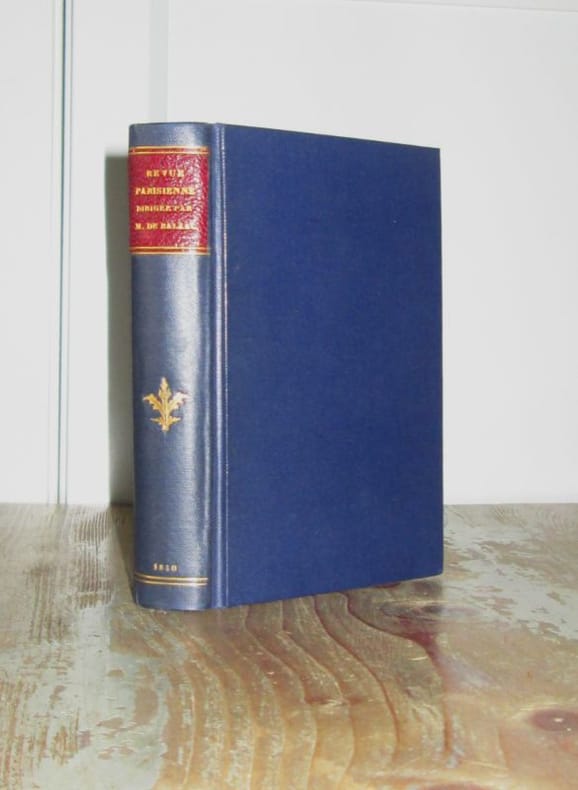
184033571Paris, A la Revue Parisienne, 1840. Du n° 1, 25 juillet 1840 au n° 3, 25 septembre 1840, Paris, Directeur : Honoré de Balzac, Administrateur : J.-B. Huicque. In-16 relié pleine percaline bleu marine (15 x 10 cm), titre et fleuron dorés sur le dos, couvertures originales conservées, (4)-396 p. Collection complète.Joint : 1 coupure dune couverture des Français peints par eux-mêmes, annonçant la parution de la Revue parisienne ; 4 pages extraites de la Revue critique des livres nouveaux publiés pendant lannée 1840, rédigée par Joël Cherbuliez (septembre 1840) ; 2 articles extraits de LArtiste (1840) ; 1 annonce coupée dans un journal de lépoque de la parution de la Revue parisienne ; 2 portraits de Balzac. Les trois livraisons entièrement rédigées par Balzac contiennent en édition originale, Z. Marcas, Les Fantaisies de Claudine (réimprimé sous le titre Un Prince de la Bohême), une étude féroce sur le Port-Royal de Sainte-Beuve, et, enfin, l'Étude sur M. Beyle, long et élogieux compte-rendu de La Chartreuse de Parme. Vicaire I, 215. - ON JOINT en sus divers documents 1 coupure dune couverture des Français peints par eux-mêmes, annonçant la parution de la Revue parisienne ; 4 pages extraites de la Revue critique des livres nouveaux publiés pendant lannée 1840, rédigée par Joël Cherbuliez (septembre 1840) ; 2 articles extraits de LArtiste (1840) ; 1 annonce coupée dans un journal de lépoque de la parution de la Revue parisienne ; 2 portraits de Balzac. Très bon état.
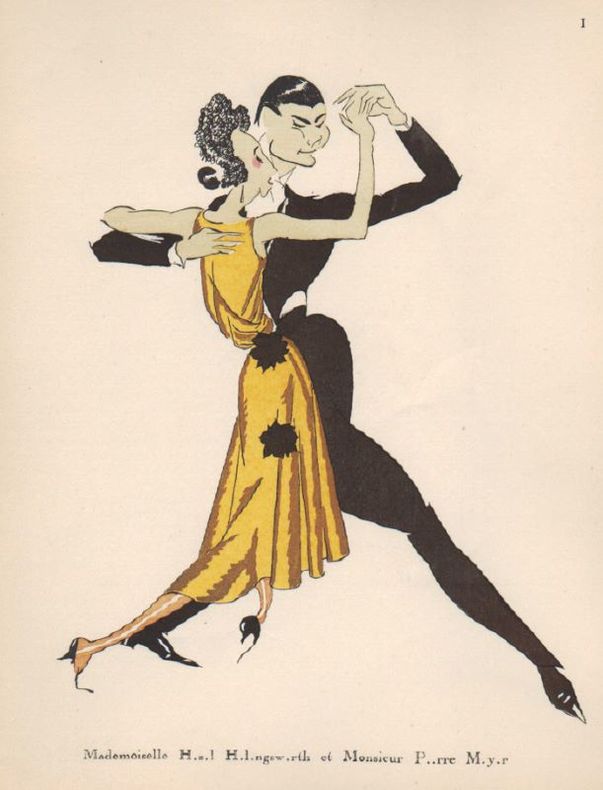
9799Paris EDITIONS DU BON TON 1 Paris, Éditions du Bon Ton, 24 planches en couleurs de caricatures de Roger Chastel et Pierre Mourgue, dont une double planche, in-12, en feuilles, sous couverture crème illustrée par Mourgue et Chastel d'un couple dansant, vert et noir.
Format (Platte): 29 x 21,5 cm (bis auf die Plattenkante beschnitten). Gratiker Abzug in sehr guter Erhaltung. *Le Blanc 8 II (von III). Der dargestellte François Chauveau (* 10. Mai 1613 in Paris; † 3. Februar 1676 ebenda) war ein französischer Zeichner, Kupferstecher, Radierer und Maler. Graphiken de
1930791DG1930. Farbige Ölkreide, in der Mitte rechts monogrammiert und datiert. 53 x 42 cm + Wichtig: Für unsere Kunden in der EU erfolgt der Versand alle 14 Tage verzollt ab Deutschland / Postbank-Konto in Deutschland vorhanden +, A
Format Platte): 49,5 x 33 cm. Blatt: 56,5 x 40 cm. *Franz Stephan von Lothringen (* 8. Dezember 1708 in Nancy; † 18. August 1765 in Innsbruck) war von 1729 bis 1736 als Franz III. Herzog von Lothringen und Bar, anschließend ab 1737 als Franz II. Großherzog der Toskana und ab 1745 als Franz I. Kaiser des Heiligen Römischen Reiches. - Franz Stephan heiratete 1736 Erzherzogin Maria Theresia von Österreich, die einzige Erbin Kaiser Karls VI., und begründete mit ihr das Haus Habsburg-Lothringen. Seit 1740 war er ihr Mitregent in den Habsburgischen Erblanden, wurde aber kaum an den Regierungsgeschäften beteiligt. Daher widmete er sich erfolgreichen Finanzgeschäften und der Förderung der Naturwissenschaften. 1740 starb Kaise Karl VI. Da er keinen männlichen Nachfolger hatte, erbte gemäß der 1713 erlassenen pragmatischen Sanktion seine Tochter Maria Theresia die habsburgischen Lande. Für die Kaiserkrone galt dies jedoch nicht, weshalb Franz Stephan dafür vorgesehen war. Das bot den Anlass für den österreichischen Erbfolgekrieg, der mit dem Einmarsch Friedrichs des Großen in Schlesien begann. Seltenes und großformatiges Bildnis, vorliegend ein sehr gut erhaltenes Exemplar mit Rand. Graphiken de
1906010223Paris Grande Imprimerie de Montrouge, H. Belleville, 1906 plaquette in-8 En feuilles
Format: 50 x 35 cm.Blatt: 55,5 x 39 cm. *Joseph II. (* 13. März 1741 in Schloss Schönbrunn; † 20. Februar 1790 in Wien) war von 1765 bis 1790 als erster Angehöriger des Hauses Habsburg-Lothringen Kaiser des Heiligen Römischen Reiches. - Prächtiger detailreicher großer Kupferstich. Seltenes Blatt, vorliegend ein schöner kräftiger Abzug in sehr guter Erhaltung mit Rand. Graphiken de
1793AGo.J. Gouache auf Karton. Bildgrösse: 35,5 x 27 cm. + Wichtig: Für unsere Kunden in der EU erfolgt der Versand alle 14 Tage verzollt ab Deutschland / Postbank-Konto in Deutschland vorhanden +, A
181613384Paris PELICIER ET PETIT 1816 1 Paris, Chez Pélicier et Petit, 1816, in-8, demi-basane mouchetée à coins, 132 pages.
1783230727k043xbvkIa/Ib. Berlin und Leipzig, bei George Jacob Decker - Königl. Hof-Buchdrucker, 1773-1781. / II. -, 1783. Ia. Titelblatt, Widmungsblatt, (4) S. Widmung, XVI S., 436 (7) Seiten, mit einigen beidseitigen Medaillen-Kupferstichen im Text. / Ib. 1 unbedrucktes Blatt, Doppeltitelblatt, (8) S. 'Vorrede' und 'Inhalt', 576 (7) Seiten, 3 einseitig bedruckte Kupfertafeln auf kräftigerem Papier. / II. Titelblatt, (6) 226 Seiten, 1 Kupfertafel (Medaillen ''zu Thurneisers Lebensbeschr[eibung]''). - Ia. Schwarzer Halbleineneinband Ende des 19. Jahrhunderts mit dezenter Rückenvergoldung und goldgeprägtem Rückentitel, dunkler Kopffarbschnitt, unbedruckte Endblätter; 4to (ca. 25 x 22 x 3 cm, ca. 1.3 kg.). / Ib.;II. Kräftiger Halbpergamenteinband der Zeit über 5 durchstochene Bünde mit braunem Deckelbezugspapier, großen Pergamentecken und grünem Rundum-Farbschnitt; 4to (ca. 25 x 22 x 5 cm, ca. 1.8 kg.).
1919108343Adelaide 1919. First Edition. Hardcover. Very Good. Adelaide circa 1919. A custom-made photograph album 190 × 200 mm containing 6 card leaves with an original gelatin silver photograph mounted on both sides of each leaf with interleaved tissue-guards. Each photograph is approximately 135 × 95 mm. Half leather and cloth lettered in full in gilt on the front cover with 'The Eucalypts' in gilt on the spine; leather discoloured and moderately rubbed with slight wear in a few areas; some tiny paint spots near the head of the front cover; tissue-guards a little foxed and offset; marginal silvering-out to five prints; overall in very good condition. All but the first portrait is signed and only the last one contains an additional inscription the date '10.1.19'. The State Library of South Australia has another example of this album enabling us to confirm the identities where the handwriting was unclear. Ministers of religion lawyers doctors and architects predominate. The subjects are Reverend A.H. Gifford possibly A.E. Gifford; Benjamin Benny 1869-1935 senator and solicitor; George McEwin 1873-1945 lawyer and philanthropist; Edward Erskine Cleland 1869-1943 barrister and judge; Alfred McBain Bonython 1865-1954 architect; Sir James Wallace Sandford 1879-1958 merchant and politician; Reverend Wilfred Harris Unitarian minister returned to England in 1918; Dr Herbert Frank Shorney 1878-1933 opthalmologist; Sir Thomas John Mellis Napier 1882-1976 later a SA Supreme Court judge; Harold Reid; Edward Warner Benham 1872-1948 lawyer and academic; and Francis Hedley Counsell 1864-1933 architect. <p>The subtitle is a misquote from 'Among the Sandhills' by Adela Florence Nicolson née Cory 1865-1904 an English poet who wrote under the pseudonym Laurence Hope 'The scented orange bushes check the breeze Granting in tribute many waxen stars And aromatic Eucalyptus trees Defy the sun with grey-green scimitars'. We have saved the best until the end: we purchased this item decades ago and have postponed cataloguing it innumerable times not knowing who 'The Eucalypts' were. We have finally solved the puzzle by the simple expedient of spending untold hours on it. We eventually discovered the lengthy biographical sketch of Alfred Bonython compiled by Giles Walkley for the University of SA's database on architects accessible online. Among many other interesting details he records that 'At the age of 42 Bonython became the father of a fourth daughter . Determinedly reviving his literary activities he joined both at their outset in 1910 Lady Symon's Poetry Society and the "liberal Christian" discussion group The Eucalypts Club . SRG 252'. hardcover
197188113[Hamburg], Edition Griffelkunst, 1971. Auf festem grauen Karton. 43 x 59,7 cm.
184313631CBWien, Pietro Mechetti, (1843). 39 x 30 cm Bildausschnitt., 1
191471309Bez., dat. und sign.: "Frl. Clärchen. I. 1914. E. Souchay". 34,5 x 27,2 cm.
71153In der Platte monogrammiert. 19,5 x 14 cm.
1930791DG1930. Farbige Ölkreide, in der Mitte rechts monogrammiert und datiert. 53 x 42 cm
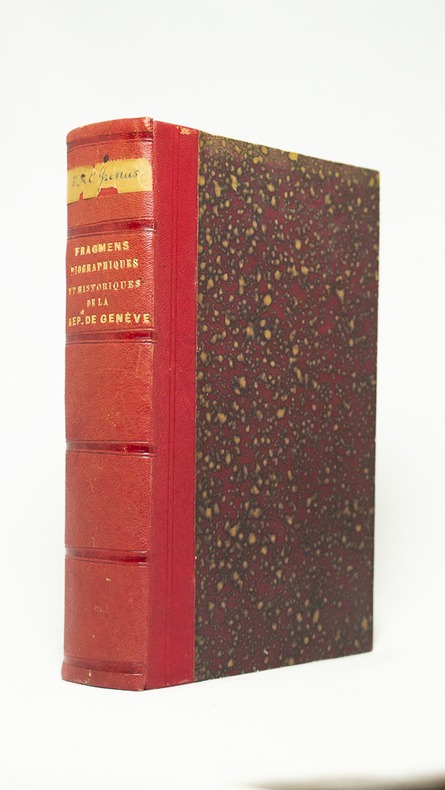
181516358Genève, Manget et Cherbulier, 1815. Grand in-8 de [4]-XVI-[2]-461 pages, demi-chagrin rouge, dos lisse. Manque de papier dans la marge supérieure du faux-titre.
1793AGGouache auf Karton. Bildgrösse: 35,5 x 27 cm.
Ritratto di Giovanni Girolamo Sbaraglia, di profilo, rivolto a destra; entro un ovale affiancato da due putti in piedi su cornucopie. In cartiglio quattro righe in latino riferite all'autore e sotto l'immagine i dettagli della produzione: "Donatus Creti Bononiensis delineavit et sculpsit 1716". Acquaforte del 1716, firmata e datata sulla lastra in basso sul margine bianco. Esemplare nell'unico stato conosciuto. Bella prova, stampata in inchiostro olivastro su carta vergata coeva, priva di filigrana, rifilata alla lastra su tre lati, leggermente all'interno in alto, in ottime condizioni. Giovanni Girolamo Sbaraglia (medico, intellettuale ed accademico, 1641 - 1710) fu un importante anatomista bolognese, le cui teorie scientifiche erano in netto contrasto con quanto sosteneva Marcello Malpighi. Nonostante Sbaraglia non lo citasse mai esplicitamente, il principale bersaglio polemico delle sue dissertazioni era Malpighi, ormai divenuto uno degli anatomisti più famosi dell’epoca. Un monumento dedicato a Sbaraglia, progettato da Donato Creti. si trova all’interno del palazzo dell’Archiginnasio, accanto a quello del suo avversario Malpighi. Donato Creti è stato un importante disegnatore e pittore cremonese. La sua arte, poetica e individuale, rappresenta, insieme a quella di Marcantonio Franceschini, la più significativa espressione dello sforzo classico-idealista della pittura bolognese. Svolse la sua attività quasi esclusivamente a Bologna, dove realizzò affreschi decorativi, pale d’altare e quadri per collezionisti privati. Due caratteristiche sono di grande importanza: la sopraffina qualità della pennellata e la suggestione poetica della situazione e dell’umore. Cercava la bellezza della figura individuale e per questo si esprimeva al massimo in dipinti meditativi con poche figure; i suoi soggetti combinano grazia delle forme e precisione dei contorni, con la carne che raggiunge la delicatezza della porcellana e i colori che possiedono una brillantezza diamantina. Fu disegnatore prolifico con uno stile assolutamente distinto; disegnava per piacere così come per preparare le sue composizioni; di solito usava una penna d’oca e realizzava le ombre con l’acquaforte. Una delle rare incisioni dell’artista cremonese, bolognese di adozione. Portrait of Giovanni Girolamo Sbaraglia, bust, in profile, facing right; within an oval flanked by two putti standing on cornucopias. Lettered in cartouche with four lines in Latin referring to the sitter and below image with production details: “Donatus Creti Bononiensis delineavit et sculpsit 1716”. Etching, 1716, signed and dated on plate at bottom on white margin. Example in the only known state. Giovanni Girolamo Sbaraglia (physician, intellectual, and academic, 1641 - 1710) was an important Bolognese anatomist whose scientific theories were in sharp contrast to what Marcello Malpighi advocated. Although Sbaraglia never explicitly mentioned him, the main polemical target of his dissertations was Malpighi, who by then had become one of the most famous anatomists of the time. A monument dedicated to Sbaraglia, designed by Donato Creti. is located inside the Archiginnasio Palace of Bologna, next to that of his opponent Malpighi. Beautiful proof, printed in olive-coloured ink on contemporary laid paper, no watermark, trimmed at the platemark on three sides, slightly indented at the top, in very good conditions. Donato Creti was an Italian painter and draughtsman. His individual and poetic art represents, with that of Marcantonio Franceschini, the last significant expression of the classical–idealist strain in Bolognese painting. His activity was almost wholly confined to Bologna, where he painted decorative frescoes, altarpieces and easel pictures for private collectors. Two qualities are paramount: a perfected finesse of handling and poetic suggestiveness of situation and mood. He sought the ideal beauty of the individual figure and was thus at his best in meditative pictures with few figures; his subjects combine grace of form and precision of contour with flesh that attains the surface delicacy of porcelain and colours that have a mineral-like refulgence. He was a prolific draughtsman with a distinct personal manner, who drew for pleasure as well as to prepare his compositions, usually using a quill-pen and producing shadowing by hatching. One of the rare prints by the Cremonese artist. De Vesme 3, Bertelà 263.
1909AUB-7469Ed. Georges Bridel 1909. Bel exemplaire relié, reliure plein cuir, exemplaire sur véritable Japon no 10/10, VII + 279 pages.
194311473Lausanne, L'Abbaye du livre, 1943. In-4 broché non paginé, couverture illustrée.
184221029Paris, L. Curmer, 1842. 2 volumes in-4 de [8]-XXIV-416 et [4]-664 pages. Demi-chagrin mauve-rose (?) à coins, dos à nerfs ornés de filets dorés, tranches dorées.
182019060Paris, Crevot, libraire, 1820. 2 volumes in-18 de VIII-251; IV-282-[2] pages, plein maroquin rouge à grains long, dos lisses ornés de filets et fleurons dorés, jolie guirlande de roses dorées bordée de filets large et fin encadrant les plats. Roulette de points dorés sur les coupes, grecque dorée intérieure, garde de soie moirée bleue, tranches dorées.
18580144-24o. O. [Berlin, Schauer 1858?]. gr.-8°. 76 lithographische Taf. [von 90?] Blauer zeitgen. Samtbd. mit goldgeprägtem Deckeltitel. Rücken ausgeblichen, durchgeh. ungterschiedl. stark stockfleckig. [3 Warenabbildungen]