8 977 résultats
Incisione tratta dalla celebre Icones principum, virorum, doctorum, pictorum, chalcographorum, di Anton van Dyck, edita per la prima volta ad Anversa nel 1645. Opera celebre ed importante, vero monumento dell’arte incisoria fiamminga del sec. XVIII, contiene le biografie ed i ritratti degli uomini illustri che Van Dyck aveva conosciuto econ i quali aveva avuto importanti rapporti. L’artista ne eseguì le effigi in numerosi dipinti e disegni che poi decise di pubblicare, affidandone la trasposizione calcografica ai migliori incisori del suo tempo, come Bolswert, Pontius, Vorsterman, de Jode, Hollar, molti dei quali aveva avuto come condiscepoli nell’atelier di Rubens. Acquaforte con ritocchi al bulino, stampata su carta vergata coeva, con margini, in ottimo stato di conservazione. Etching and engraving, circa 1645, signed on plate at lower edge. A fine impression, printed on contemporary laid paper, with margins, very good condition. From Icones principum, virorum, doctorum, pictorum, chalcographorum by Anton van Dyck, printed for the first time in Antwerp, 1645. A famous and important work, a real monument of the Flemish engraving art of the XVIII century, containing the biographies and portraits of the famous artists Van Dyck had met and with whom he had worked. Following the success of his portrait paintings and in the tradition of Italian and Flemish portrait series, Van Dyck decided to organise a print publication containing portraits of the most prominent men during his lifetime, divided into three categories: princes, politicians and soldiers (16), statesmen and scholars (12), artists and art connoisseurs (52). The initial idea could have been that Van Dyck would etch the faces (a process possibly learnt from Vorsterman) while others would finish the plates in engraving. Designs were needed for the plates and several drawings and oil sketches (grisailles, sometimes in different versions) have survived. Van Dyck only etched 17 plates himself, while he commissioned others to complete the set, overseen by Lucas Vorsterman I (especially after Van Dyck settled in England in the Spring of 1632). Although this project was started by Van Dyck around 1630, he never saw it completed. The Antwerp publisher Maarten van den Enden may have been involved from the start as eighty early impressions bear Van den Enden's address. They are engraved by Paulus Pontius (30 plates), Lucas Vorsterman I (22), Pieter de Jode II (12), Schelte a Bolswert (7), Robert van Voerst (4), Willem Hondius (2), Willem Jacobsz Delff (1), Cornelis Galle (1), and Nicolaes Lauwers (1). It is known that Van den Enden was in debt to Gillis Hendricx around 1644, the Antwerp publisher who must have obtained Van den Enden's plates which he published in 1645 in the first edition of these plates (containing between 100 and 104 portrait plates). Hendricx continued to publish these plates until his death in 1677 when they were auctioned off by the St Luke guild (keeping the Iconography plates together). It is not clear who bought these plates but they re-appeared around 1720 when they were published by Hendrick and Cornelis Verdussen in Antwerp.
Format (Bildbereich): ca. 420 x 340 mm. Blattgröße: 610 x 450 mm. *Gebhardt: Hanfstaengl Werkverzeichnis, S. 252. Slg. Maillinger III, 1356. - Ludwig Tieck war ein deutscher Dichter der Romantik. - Der Lithograph Franz Seraph Hanfstaengl (1804-1877) war ein deutscher Maler, Lithograf und Fotograf. Er studierte 1819-25 an der Akademie der Bildenden Künste in München und wurde in Lithographie ausgebildet. Als Porträtlithograf der Münchner Gesellschaft erfreute sich Hanfstaengl großer Beliebtheit, was ihm den Spitznamen „Graf Litho“ eintrug. 1833 gründete er in München die berühmt gewordene lithografische Anstalt Hanfstaengl, die er selbst bis 1868 leitete. - Leicht gebräunt, Seitenränder angestaubt, breitrandig. Graphiken de
Format (Platte): 241 x 172 mm. Blattgröße: 375 x 235 mm. *Blatt aus der berühmten "Iconographia" oder Iconographie, einer Sammelausgabe von ca. 100 der gemalten Bildnisse des Anthonis van Dyck (1599-1641) in Kupferstich. - Wibiral 13, VI. - Antoine (oder Antonius) Triest wurde Bischof von Brügge und von Gent. - Außenränder leicht gebräunt, insgesamt gut erhalten. Graphiken de
Format (Platte): 380 x 280 mm und kleines umlaufendes Rändchen. *Typaldos (1648-1713) war Metropolit von Philadelphia, der Patriarch der orthodoxen griechischen Gemeinde in Venedig. Typaldos war damit eine Art Bischof der orthodoxen Gemeinde. Er arbeitete jedoch an einer Konversion. Er wollte die orthodoxe Gemeinde dem römischen Papst unterwerfen, um den Einfluß einiger mächtiger Personen unter venzianischer Herrschaft ein Ende zu setzen. Die anti-orthodoxe Arbeit von Typaldos ist bis nach Russland bekannt geworden, so daß sich selbst Peter der Große an den venezianischen Staat wandte mit dem Auftrag der Verurteilung. 2 Jahre später wurde Typaldos vom Patriarchat von Konstantinopel abgesetzt. - Sauber und sehr gut erhalten. Graphiken de
Format (Platte): 368 x 230 mm (bis zum Plattenrand beschnitten). *James Ussher, geb. 1681 in Dublin, war ein irischer anglikanischer Theologe und Bischof. Er schrieb zahlreiche theologische und geschichtliche Werke, am bekanntesten sind seine "Annales veteris testamenti" (1650). Es begründete darin die heute als Ussher-Lightfoot-Kalender bekannte Zeitrechnung, die sich allein auf Bibelstellen stützt. Er wurde Vorsteher der protestantischen Kirche von Irland und traditionell eine stark antikatholische Haltung. - Schönes Bildnis des produktiven englischen Kupferstechers Vertue. Nagler, No. 13. - Sauber und sehr gut erhalten. Graphiken de
188310280Paris C. Marpon, E. Flammarion 1883 GRAND In-8 V+ij-ix+261 pp, (.) Le sport à Paris. Préface de Guy de Maupassant et lettre de Prince Bibesco. Illustrations de Berne-Bellecourt, A. Goelzer, Jeanniot, Kauffman, De Liphart, Manet, Mesplès, Du Paty, F. Régamey, Rochegrosse, etc. 43 portraits sur chine hors-texte, couvertures rempliées illustrées avec dorure sur la 1ère, dos partiellement débroché. Ensemble passé avec frottis, rousseurs éparses.
17101328AGO.J. (um 1710). Kupferstich (Brustbild in ovaler Umrahmung). Bildgrösse: 32 x 24 cm. Blattgrösse: 33 x 25 cm. + Wichtig: Für unsere Kunden in der EU erfolgt der Versand alle 14 Tage verzollt ab Deutschland / Postbank-Konto in Deutschland vorhanden +
Bildformat (Plattengröße): 37 x 28 cm. Blattgröße: 40,5 x 31,5 cm. *Friedrich Volckamer von Kirchensittenbach (1619-1682) war Ratsherr in Nürnberg, Architekt, Baumeister, Ratsbaumeister. Er förderte die Malerakademie in Nürnberg. - Mit geglättetem Mittelfalz. Die weißen Außenränder geringfügig angestaubt, insgesamt noch gutes Exemplar mit Rand. Graphiken de
Format (Platte): 305 x 250 mm. (Bildformat: 25,8 x 23,8 cm). Blattgröße: 400 x 285 mm. *Sehr seltenes Blatt. Collection De Vinck 4111 (histoire de France, 1770-1871). - Oben mit der gedruckten Bezeichnung "Fr. Marie Arrouet Voltaire", unten mit der Druckwidmung "Dedie a son Altesse Serenissime Monsigneur le Duc de Bourbon". - Rechter Seitenrand mit hinterlegtem Randeinriß (außerhalb der Darstellung), sonst sauber und gut erhalten. Graphiken de
Incisione tratta dalla celebre raccolta Icones principum, virorum, doctorum, pictorum, chalcographorum, di Anton van Dyck, edita per la prima volta ad Anversa verso il 1640. Opera celebre ed importante, vero monumento dell’arte incisoria fiamminga del sec. XVIII, contiene le biografie ed i ritratti degli uomini illustri che Van Dyck aveva conosciuto e con i quali aveva avuto importanti rapporti. L’artista ne eseguì le effigi in numerosi dipinti e disegni che poi decise di pubblicare, affidandone la trasposizione calcografica ai migliori incisori del suo tempo, come Bolswert, Pontius, Vorsterman, de Jode, Hollar, molti dei quali aveva avuto come condiscepoli nell’atelier di Rubens. "Sir Anthony Van Dyck stands out as the solitary great etcher of the school. Portrait etching had scarcely had an existence before his time, and in his work it suddenly appears at the highest point ever reached in the art" (Hind, p. 165). "The plan of this publication took shape after Van Dyck returned from Italy (1626) and before he went to England (1632). He made careful preparatory drawings in chalk and brush for the publication. He directed and revised the work of the engravers, the best of the Rubens circle; he collaborated with his etching needle in some of the plates and himself etched the most beautiful set, mainly portraits of artists. One of the most brilliant in human characterization is the portrait of Peter Brueghel the Younger, son of the great Peasant Brueghel. It is remarkable that the etching appeared in this sketchy form in the book, proving that the master regarded it as finished. All interest is focussed on the wonderful had. The first edition was published in Antwerp in 1635-1636. Yet it was not complete, and the title-page did not appear before the Gillis Hendricx edition of 1645, engraved by Jacob Neels" (Benesch, Artistic and Intellectual Trends, p. 32.) Hofer, Baroque Book Illustrations 132. Acquaforte con ritocchi al bulino, stampata su carta vergata coeva, filigrana del “giullare”, con margini, in ottimo stato di conservazione. Etching and engraving, circa 1645, signed on plate at lower edge. A fine impression, printed on contemporary laid paper, with margins, very good condition. From Icones principum, virorum, doctorum, pictorum, chalcographorum by Anton van Dyck, printed for the first time in Antwerp, 1645. A famous and important work, a real monument of the Flemish engraving art of the XVIII century, containing the biographies and portraits of the famous artists Van Dyck had met and with whom he had worked. Following the success of his portrait paintings and in the tradition of Italian and Flemish portrait series, Van Dyck decided to organise a print publication containing portraits of the most prominent men during his lifetime, divided into three categories: princes, politicians and soldiers (16), statesmen and scholars (12), artists and art connoisseurs (52). The initial idea could have been that Van Dyck would etch the faces (a process possibly learnt from Vorsterman) while others would finish the plates in engraving. Designs were needed for the plates and several drawings and oil sketches (grisailles, sometimes in different versions) have survived. Van Dyck only etched 17 plates himself, while he commissioned others to complete the set, overseen by Lucas Vorsterman I (especially after Van Dyck settled in England in the Spring of 1632). Although this project was started by Van Dyck around 1630, he never saw it completed. The Antwerp publisher Maarten van den Enden may have been involved from the start as eighty early impressions bear Van den Enden's address. They are engraved by Paulus Pontius (30 plates), Lucas Vorsterman I (22), Pieter de Jode II (12), Schelte a Bolswert (7), Robert van Voerst (4), Willem Hondius (2), Willem Jacobsz Delff (1), Cornelis Galle (1), and Nicolaes Lauwers (1). It is known that Van den Enden was in debt to Gillis Hendricx around 1644, the Antwerp publisher who must have obtained Van den Enden's plates which he published in 1645 in the first edition of these plates (containing between 100 and 104 portrait plates). Hendricx continued to publish these plates until his death in 1677 when they were auctioned off by the St Luke guild (keeping the Iconography plates together). It is not clear who bought these plates but they re-appeared around 1720 when they were published by Hendrick and Cornelis Verdussen in Antwerp.
Incisione tratta dalla celebre raccolta Icones principum, virorum, doctorum, pictorum, chalcographorum, di Anton van Dyck, edita per la prima volta ad Anversa verso il 1640. Opera celebre ed importante, vero monumento dell’arte incisoria fiamminga del sec. XVIII, contiene le biografie ed i ritratti degli uomini illustri che Van Dyck aveva conosciuto e con i quali aveva avuto importanti rapporti. L’artista ne eseguì le effigi in numerosi dipinti e disegni che poi decise di pubblicare, affidandone la trasposizione calcografica ai migliori incisori del suo tempo, come Bolswert, Pontius, Vorsterman, de Jode, Hollar, molti dei quali aveva avuto come condiscepoli nell’atelier di Rubens. "Sir Anthony Van Dyck stands out as the solitary great etcher of the school. Portrait etching had scarcely had an existence before his time, and in his work it suddenly appears at the highest point ever reached in the art" (Hind, p. 165). "The plan of this publication took shape after Van Dyck returned from Italy (1626) and before he went to England (1632). He made careful preparatory drawings in chalk and brush for the publication. He directed and revised the work of the engravers, the best of the Rubens circle; he collaborated with his etching needle in some of the plates and himself etched the most beautiful set, mainly portraits of artists. One of the most brilliant in human characterization is the portrait of Peter Brueghel the Younger, son of the great Peasant Brueghel. It is remarkable that the etching appeared in this sketchy form in the book, proving that the master regarded it as finished. All interest is focussed on the wonderful had. The first edition was published in Antwerp in 1635-1636. Yet it was not complete, and the title-page did not appear before the Gillis Hendricx edition of 1645, engraved by Jacob Neels" (Benesch, Artistic and Intellectual Trends, p. 32.) Hofer, Baroque Book Illustrations 132. Acquaforte con ritocchi al bulino, stampata su carta vergata coeva, filigrana del “giullare”, con margini, in ottimo stato di conservazione. Etching and engraving, circa 1645, signed on plate at lower edge. A fine impression, printed on contemporary laid paper, with margins, very good condition. From Icones principum, virorum, doctorum, pictorum, chalcographorum by Anton van Dyck, printed for the first time in Antwerp, 1645. A famous and important work, a real monument of the Flemish engraving art of the XVIII century, containing the biographies and portraits of the famous artists Van Dyck had met and with whom he had worked. Following the success of his portrait paintings and in the tradition of Italian and Flemish portrait series, Van Dyck decided to organise a print publication containing portraits of the most prominent men during his lifetime, divided into three categories: princes, politicians and soldiers (16), statesmen and scholars (12), artists and art connoisseurs (52). The initial idea could have been that Van Dyck would etch the faces (a process possibly learnt from Vorsterman) while others would finish the plates in engraving. Designs were needed for the plates and several drawings and oil sketches (grisailles, sometimes in different versions) have survived. Van Dyck only etched 17 plates himself, while he commissioned others to complete the set, overseen by Lucas Vorsterman I (especially after Van Dyck settled in England in the Spring of 1632). Although this project was started by Van Dyck around 1630, he never saw it completed. The Antwerp publisher Maarten van den Enden may have been involved from the start as eighty early impressions bear Van den Enden's address. They are engraved by Paulus Pontius (30 plates), Lucas Vorsterman I (22), Pieter de Jode II (12), Schelte a Bolswert (7), Robert van Voerst (4), Willem Hondius (2), Willem Jacobsz Delff (1), Cornelis Galle (1), and Nicolaes Lauwers (1). It is known that Van den Enden was in debt to Gillis Hendricx around 1644, the Antwerp publisher who must have obtained Van den Enden's plates which he published in 1645 in the first edition of these plates (containing between 100 and 104 portrait plates). Hendricx continued to publish these plates until his death in 1677 when they were auctioned off by the St Luke guild (keeping the Iconography plates together). It is not clear who bought these plates but they re-appeared around 1720 when they were published by Hendrick and Cornelis Verdussen in Antwerp.
Incisione tratta dalla celebre raccolta Icones principum, virorum, doctorum, pictorum, chalcographorum, di Anton van Dyck, edita per la prima volta ad Anversa verso il 1640. Opera celebre ed importante, vero monumento dell’arte incisoria fiamminga del sec. XVIII, contiene le biografie ed i ritratti degli uomini illustri che Van Dyck aveva conosciuto e con i quali aveva avuto importanti rapporti. L’artista ne eseguì le effigi in numerosi dipinti e disegni che poi decise di pubblicare, affidandone la trasposizione calcografica ai migliori incisori del suo tempo, come Bolswert, Pontius, Vorsterman, de Jode, Hollar, molti dei quali aveva avuto come condiscepoli nell’atelier di Rubens. "Sir Anthony Van Dyck stands out as the solitary great etcher of the school. Portrait etching had scarcely had an existence before his time, and in his work it suddenly appears at the highest point ever reached in the art" (Hind, p. 165). "The plan of this publication took shape after Van Dyck returned from Italy (1626) and before he went to England (1632). He made careful preparatory drawings in chalk and brush for the publication. He directed and revised the work of the engravers, the best of the Rubens circle; he collaborated with his etching needle in some of the plates and himself etched the most beautiful set, mainly portraits of artists. One of the most brilliant in human characterization is the portrait of Peter Brueghel the Younger, son of the great Peasant Brueghel. It is remarkable that the etching appeared in this sketchy form in the book, proving that the master regarded it as finished. All interest is focussed on the wonderful had. The first edition was published in Antwerp in 1635-1636. Yet it was not complete, and the title-page did not appear before the Gillis Hendricx edition of 1645, engraved by Jacob Neels" (Benesch, Artistic and Intellectual Trends, p. 32.) Hofer, Baroque Book Illustrations 132. Acquaforte con ritocchi al bulino, stampata su carta vergata coeva, filigrana del “giullare”, con margini, in ottimo stato di conservazione. Etching and engraving, circa 1645, signed on plate at lower edge. A fine impression, printed on contemporary laid paper, with margins, very good condition. From Icones principum, virorum, doctorum, pictorum, chalcographorum by Anton van Dyck, printed for the first time in Antwerp, 1645. A famous and important work, a real monument of the Flemish engraving art of the XVIII century, containing the biographies and portraits of the famous artists Van Dyck had met and with whom he had worked. Following the success of his portrait paintings and in the tradition of Italian and Flemish portrait series, Van Dyck decided to organise a print publication containing portraits of the most prominent men during his lifetime, divided into three categories: princes, politicians and soldiers (16), statesmen and scholars (12), artists and art connoisseurs (52). The initial idea could have been that Van Dyck would etch the faces (a process possibly learnt from Vorsterman) while others would finish the plates in engraving. Designs were needed for the plates and several drawings and oil sketches (grisailles, sometimes in different versions) have survived. Van Dyck only etched 17 plates himself, while he commissioned others to complete the set, overseen by Lucas Vorsterman I (especially after Van Dyck settled in England in the Spring of 1632). Although this project was started by Van Dyck around 1630, he never saw it completed. The Antwerp publisher Maarten van den Enden may have been involved from the start as eighty early impressions bear Van den Enden's address. They are engraved by Paulus Pontius (30 plates), Lucas Vorsterman I (22), Pieter de Jode II (12), Schelte a Bolswert (7), Robert van Voerst (4), Willem Hondius (2), Willem Jacobsz Delff (1), Cornelis Galle (1), and Nicolaes Lauwers (1). It is known that Van den Enden was in debt to Gillis Hendricx around 1644, the Antwerp publisher who must have obtained Van den Enden's plates which he published in 1645 in the first edition of these plates (containing between 100 and 104 portrait plates). Hendricx continued to publish these plates until his death in 1677 when they were auctioned off by the St Luke guild (keeping the Iconography plates together). It is not clear who bought these plates but they re-appeared around 1720 when they were published by Hendrick and Cornelis Verdussen in Antwerp.
Incisione tratta dalla celebre raccolta Icones principum, virorum, doctorum, pictorum, chalcographorum, di Anton van Dyck, edita per la prima volta ad Anversa verso il 1640. Opera celebre ed importante, vero monumento dell’arte incisoria fiamminga del sec. XVIII, contiene le biografie ed i ritratti degli uomini illustri che Van Dyck aveva conosciuto e con i quali aveva avuto importanti rapporti. L’artista ne eseguì le effigi in numerosi dipinti e disegni che poi decise di pubblicare, affidandone la trasposizione calcografica ai migliori incisori del suo tempo, come Bolswert, Pontius, Vorsterman, de Jode, Hollar, molti dei quali aveva avuto come condiscepoli nell’atelier di Rubens. "Sir Anthony Van Dyck stands out as the solitary great etcher of the school. Portrait etching had scarcely had an existence before his time, and in his work it suddenly appears at the highest point ever reached in the art" (Hind, p. 165). "The plan of this publication took shape after Van Dyck returned from Italy (1626) and before he went to England (1632). He made careful preparatory drawings in chalk and brush for the publication. He directed and revised the work of the engravers, the best of the Rubens circle; he collaborated with his etching needle in some of the plates and himself etched the most beautiful set, mainly portraits of artists. One of the most brilliant in human characterization is the portrait of Peter Brueghel the Younger, son of the great Peasant Brueghel. It is remarkable that the etching appeared in this sketchy form in the book, proving that the master regarded it as finished. All interest is focussed on the wonderful had. The first edition was published in Antwerp in 1635-1636. Yet it was not complete, and the title-page did not appear before the Gillis Hendricx edition of 1645, engraved by Jacob Neels" (Benesch, Artistic and Intellectual Trends, p. 32.) Hofer, Baroque Book Illustrations 132. Acquaforte con ritocchi al bulino, stampata su carta vergata coeva, filigrana del “giullare”, con margini, in ottimo stato di conservazione. Etching and engraving, circa 1645, signed on plate at lower edge. A fine impression, printed on contemporary laid paper, with margins, very good condition. From Icones principum, virorum, doctorum, pictorum, chalcographorum by Anton van Dyck, printed for the first time in Antwerp, 1645. A famous and important work, a real monument of the Flemish engraving art of the XVIII century, containing the biographies and portraits of the famous artists Van Dyck had met and with whom he had worked. Following the success of his portrait paintings and in the tradition of Italian and Flemish portrait series, Van Dyck decided to organise a print publication containing portraits of the most prominent men during his lifetime, divided into three categories: princes, politicians and soldiers (16), statesmen and scholars (12), artists and art connoisseurs (52). The initial idea could have been that Van Dyck would etch the faces (a process possibly learnt from Vorsterman) while others would finish the plates in engraving. Designs were needed for the plates and several drawings and oil sketches (grisailles, sometimes in different versions) have survived. Van Dyck only etched 17 plates himself, while he commissioned others to complete the set, overseen by Lucas Vorsterman I (especially after Van Dyck settled in England in the Spring of 1632). Although this project was started by Van Dyck around 1630, he never saw it completed. The Antwerp publisher Maarten van den Enden may have been involved from the start as eighty early impressions bear Van den Enden's address. They are engraved by Paulus Pontius (30 plates), Lucas Vorsterman I (22), Pieter de Jode II (12), Schelte a Bolswert (7), Robert van Voerst (4), Willem Hondius (2), Willem Jacobsz Delff (1), Cornelis Galle (1), and Nicolaes Lauwers (1). It is known that Van den Enden was in debt to Gillis Hendricx around 1644, the Antwerp publisher who must have obtained Van den Enden's plates which he published in 1645 in the first edition of these plates (containing between 100 and 104 portrait plates). Hendricx continued to publish these plates until his death in 1677 when they were auctioned off by the St Luke guild (keeping the Iconography plates together). It is not clear who bought these plates but they re-appeared around 1720 when they were published by Hendrick and Cornelis Verdussen in Antwerp.
1859654BB(Hamburg), 1859. 22,5 x 15,5 cm (Blatt)., Warburg Daniel Rudolf Portrait, Halbfigur
Bulino, 1572 circa, tratta da Pictorum Aliquot Celebrium Germaniae Inferioris Effigies. Primo stato. La prima edizione viene pubblicata dalla vedova di Hieronymus Cock ad Anversa nel 1572. Pictorum aliquot celebrium Germaniae inferioris effiges, una serie di 23 ritratti di artisti dei Paesi Bassi, è pubblicato nel 1575 con imprint “In de Vier Winden”, una delle principali stamperie di Amsterdam. Sebbene alcuni abbiano suggerito che la serie è stata concepita dall'umanista Dominicus Lampsonius, che ha composto versi per accompagnare i ritratti, è più probabile che l'autore sia stato Hieronymus Cock, il fondatore della tipografia con sede “In de Vier Winden”. La serie è apparsa in un momento in cui l'interesse per la vita degli artisti stava crescendo e di conseguenza ha attraversato diverse edizioni e interpretazioni di altri editori. Ottime condizioni. Engraving, 1572 circa, from Pictorum Aliquot Celebrium Germaniae Inferioris Effigies. First state. The first edition published by the widow of Hieronymus Cock in Antwerp in 1572. The Pictorum aliquot celebrium Germaniae inferioris effiges, a series of 23 portraits of artists from the Low Countries, published in 1575 by In de Vier Winden, a leading Amsterdam printing house. Although some have suggested that the series was conceived by the humanist Dominicus Lampsonius, who composed verses to accompany the portraits, the author is more likely to have been Hieronymus Cock, the founder of In de Vier Winden. The series appeared at a time when interest in the lives of artists was growing and consequently went through multiple editions and reinventions by other publishers. Very good condition.
Bildformat: 210 x 210 mm. Blattgröße: 510 x 360 mm. *Friedrich Wilhelm Carl (geb. 1781 in Lüben in Schlesien; gest. 1864 in Cannstatt) war von 1816 bis 1864 als Wilhelm I. der zweite König von Württemberg mit einer 48 Jahre dauernden Regierungszeit. - Der belgische Historien- und Porträtmaler Nicaise de Keyser (1813-1887) hatte um 1850 auch Porträts von König Karl und seiner Frau Olga angefertigt. - Seltenes Bildnis. Vollrandiges Exemplar in tadelloser Erhaltung. Graphiken de
Bildformat: 210 x 210 mm. Blattgröße: 510 x 360 mm. *Friedrich Wilhelm Carl (geb. 1781 in Lüben in Schlesien; gest. 1864 in Cannstatt) war von 1816 bis 1864 als Wilhelm I. der zweite König von Württemberg mit einer 48 Jahre dauernden Regierungszeit. - Minimal gebräunt, insgesamt sauber und gut erhalten. Breitrandiges Exemplar. Graphiken de
Format (Platte): 377 x 283 mm, mit kleinem Rand um die Plattenkante. *Wilhelm Ludwig war von 1674 bis 1677 der neunte Herzog von Württemberg. Er starb bereits im Alter von 30 Jahren. Vorliegend sein Bildnis in Kupferstich im Alter von 27 Jahren. - Schöner Abzug in sauberer und guter Erhaltung. Graphiken de
Platte: 375 x 263 mm (Blattgröße: 480 x 337 mm). *William Pitt, 1. Earl of Chatham (* 15. oder 16. November 1708 in London; † 11. Mai 1778 in Hayes, Kent) war Premierminister von Großbritannien und ein großer und berühmter Staatsmann, erfolgreich in der Rivalität mit Frankreich. Das ehemalige französische Fort Duquesne benannt (Fort Pitt), Pittsburgh wurde nach ihm benannt. - Vollrandiges Blatt in guter Erhaltung. Graphiken de
Format (Bildbereich): 280 x 190 mm. Blattgröße: 520 x 340 mm. *Über den Wiener Magnetiseur Zeidler ist heute kaum noch etwas bekannt. Das Bildarchiv Austria nennt 1810 als Geburtsjahr von Zeidler. - Sauber und sehr gut erhalten. Graphiken de
xxxi, [1], 464 pages. Index of common names. Index of Latin names. Glossary. 130 black and white plates. "Intended for amateurs like ourselves; lovers of outdoor life and the world of nature, drawn to the observation and study of wild flowers for their beauty as living things." - Author's Preface. "A popular treatise which embodies the results of recent research. Our native orchids are retreating before the advance of agriculture and some of them are already threatened with extinction. In making careful photographic records of the species in their natural environment, the authors have rendered a notable service to orchidology." - Foreword. Light wear to original green cloth-covered boards featuring bright gilt lettering upon front board and spine. Prior owner's name and date atop front free endpaper. Binding sound. Book
5684Très beau portrait, sur Chine appliqué. Rousseurs. En feuille très bon Paris 47,5 x 33
79 pp. The extremely rare catalogue raisonne of Soutine's drawings, all of which are intense portraits. According to some scholars, these drawings, although few in number and little known, constitute an important and intensely personal segment of his oeuvre. Other scholars, however, doubt whether these drawings (all of which are certainly by the same hand) should in fact be attributed to Soutine. Introduction by Lanthemann. 19 full-page plates. Large 4to. Original wraps. Tiny traces of wear to covers, else fine and bright. An important document, especially as no other drawings by Soutine are known to exist.
15134, Aetas Aurea, Vol. XVI , Cloth bound with dusjacket, as new !!, 2002. 4to., 542 pp. text, 378 ill. (33 full-page colourplts). ISBN 9070288370.
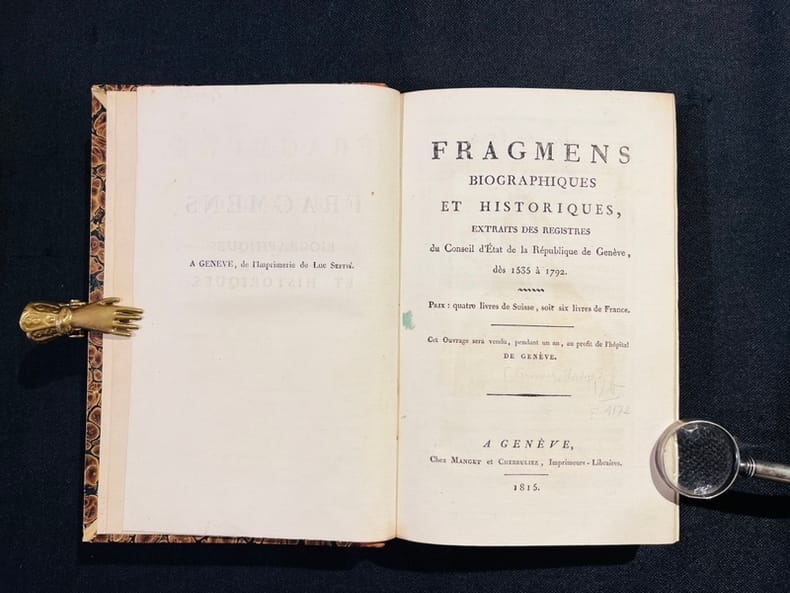
181521083A Genève, chez Manget et Cherbuliez, 1815. In-8 de [2]-XVI-[2]-80-[4]- de 81 à pages 461, demi-basane brune, dos lisse avec titre et filets dorés.