MONET Adolphe LucienBiblio.com
12 résultats
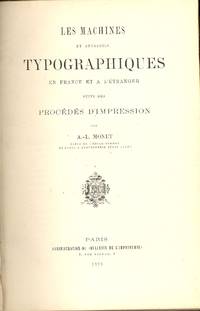
187897930Paris: Administration du Bulletin de l'Imprimerie 1878. Rilegato mezza tela half-cloth binding. Molto buono Very Good. Incisioni xilografiche anche a piena e doppia pagina in bianco e nero. 8vo. pp. 434. Molto buono Very Good. Copertine leggermente sciupate Covers lightly worn. . Administration du Bulletin de l'Imprimerie, hardcover
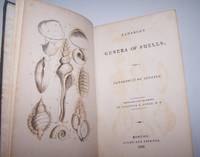
183344880Boston: Allen And Ticknor. 1833. First American Edition. Hardcover. Very Good. 19th Century Science and History of Science Most Recent Listing; 12mo; xiv 110 pages; Boston: Very Good. 1833. First American Edition. Xiii 1 110 pages; Original owner's faint pencil note on ffep "Sylvester Judd / from his friend / Geo. Buel" Otherwise unmarked and secure in original green cloth binding with printed title label at spine. Text quite clen and fresh foxing to endpapers a couple small supeficial spots to boards. Delightful engraved frontispiece depicting various shells. OCLC 3214774 This First American Edition of Lamarck's Genera of shells is a gem from his oeuvre. During his lifetime Lamarck named a large number of species; e. G. The World Register of Marine Species attributes the names of more than 1 600 records to him. Lamarck 1744-1829 was a French naturalist soldier biologist taxonomist academic and an early proponent of the idea that biological evolution occurred and proceeded in accordance with natural laws. Today Lamarck is primarily remembered for a theory of inheritance of acquired characteristics called soft inheritance or Lamarckism. Previous owner is Sylvester Judd 1813-1853 clergyman lecturer and author. Judd received his degree from Yale in 1836 and then entered the Harvard Divinity School. In 1840 he became pastor of the Unitarian Church at Augusta Maine where he served until his death in 1853. He lived through New England's social and literary renaissance known as Transcendentalism and is best known for his novel MARGARET which was printed in 1845 and attracted critical acclaim. . Allen And Ticknor hardcover
18922307060054G. Masson 1892. Hardcover. Acceptable. 98 pages 18 cm. Hardcover. Spine leather chipped with loss. Library stamps and markings. Contents: Sur l'etat actuel de la distribution et de la classification des animaux; Degradation et simplification de l'organisation d'une extremite a l'autre de la chaine animale; De l'influence des circonstances sur les actions et les habitudes des animaux et de celle des actions et des habitudes de ces corps vivants comme causes qui modifient leurs organisations et leur parties; Lamarck d'apres Haeckel G. Masson hardcover
18918814Paris: A. Savine 1891. Fine. A. Savine Paris 1891 16.50 x 25.50 cm broché First edition. Work illustrated by A. Gérardin G. Scot L. Tinayre Guilliod and Moreno. Small lack to foot of spine. Work sold for the benefit of the victims of the cyclone of August 18 1891 which caused 1800 casualties and extensive damage. A. Savine unknown
19001260538Paris France: Societe D'edition Artistique 1900. First. Octavo; Fair/no-DJ; Brown leather spine no text; Boards strong generally clean stray marks along cloth binding quarter binding with leather spine rubbing at corners covers edgeworn leather worn in patches at the head and tail of quarter binding along edges of spine for both front and back covers spine leather flaking off in pieces alternatively rubbed in patches exposing spine front and back covers partially detached at head and tail signatures exposed; Textblock darkened by age otherwise generally clean pencil notations throughout text in mix of French and English name of previous owner inscribed on half title page stray blue pen mark on page 29 edges of several pages soiled with age evidence of missing fly leaf at end of text front and back hinges cracked textblock cocked top edge gilt all edges show signs of wear; pp N/A.<br /> <br /> <p> Rodin's first Exhibition Catalog <br /> <br /> <p> Sculpture <br /> <br /> <p> eb/nd. 1260538. Rockville Non-Retail Listings. Societe D'edition Artistique unknown
180291311Paris: MaillardChez l'AuteurAgasse 1802. Fine. ""Very rare first edition enriched with an autograph manuscript by Lamarck"" Maillard Chez l'Auteur Agasse Paris An x 1802 12.8 x 20.4 cm Relié First edition very scarce of this important work. Contemporary-style half speckled fawn calf binding smooth spine decorated with triple gilt fillets green shagreen title label small vellum corners marbled paper boards bookplate pasted onto a pastedown red edges modern binding. A restored loss to the left margin of the title page. Hydrogéologie contains Lamarck’s geological observations gathered during his travels in Germany Hungary and France. Its principal merit lies in demonstrating the considerable importance of plants and animals as agents of geological transformation. It is in this work that the word biology appears for the first time on page 8 which Lamarck regarded as an appropriate term for the sciences of life. ""Lamarck's geology was closely connected with his work in other fields. His Hydrogéologie which grew out of a 1799 memoir presented to the Academy and his work in invertebrate paleontology was published in 1802. He originally intended it to be a much broader work as the manuscript shows … It was to have been a terrestrial physics including meteorology geology and biology a term he coined. He had not only a sense of interrelation of fields but within geology a vision of the whole. He saw all of nature working according to similar principles : general natural tendencies producing gradual change over long periods of time with local circumstances explaining the irregularities. His approach to geology was similar to that in other sciences : concern with the general principles and contempt for those who interested themselves too much with the specifics"". Cf. Leslie J. Burlingame notice ""Lamarck"" in: D.S.B. A remarkable copy enriched with a 6-line autograph manuscript by Lamarck inserted between pp. 56 and 57 providing details on an ancient masonry discovered in the Somme department and attesting to an earlier shoreline: ""L'abbaye de Valoir près de l'Authie dépt. de la Somme conserve encore dans ses fondations et ses caves les restes d'une maconnerie tres ancienne soupconnée romaine dans lesquels on voit les anneaux pour amarer les batimens marins et des eperons de vaisseau accompagnés de beaucoup de petrifications ; ce qui prouve qu'alors c'etoit un quai ou arrivoient les eaux de la mer"" s.l.n.d. 1 p. oblong 16mo. A very good copy.  MaillardChez l'AuteurAgasse hardcover
188988035Paris: Galerie G. Petit 1889. Fine. Galerie G. Petit Paris 1889 16 x 24.50 cm broché First edition of the exceptionally rare catalog of Claude Monet and Auguste Rodin's dual exhibition at the Georges Petit gallery in Paris. With introductory essays by Octave Mirbeau for Monet and Gustave Geffroy for Rodin. The catalog features 145 paintings by Monet and 36 sculptures by Rodin in chronological order including the famous Impression soleil levant Impression Sunrise as well as Le Penseur The Thinker still described as a part of the Gates of Hell for which it was originally created. Small restoration to head of spine title and dates penned on spine traces of stamp on front pastedown scattered foxing thoughout. Rare copy of the exhibition catalog of Claude Monet and Auguste Rodin: the greatest of the Impressionists and the most famous sculptor of his time united by their love of nature and their tireless quest towards artistic ideal. ""Rodin and Monet were bound by a lifelong friendship and reciprocal admiration. While they were true contemporaries born within two days of one another in November 1840 it is hard to pinpoint when they actually met. They were almost certainly introduced by mutual friends like writers and critics Octave Mirbeau and Gustave Geoffroy or the art dealer Paul Durand-Ruel. On his return from Belle-Île in 1886 Monet is known to have started attending dinners held by the ""Bons Cosaques"" a group of artists and men of letters gathered together by Octave Mirbeau. Rodin also frequented these literary and artistic dinners that contributed to the intellectual effervescence of the period and challenged Academicism. By the time of the exhibition held at the Galerie Georges Petit in 1889 the four protagonists Rodin Monet Mirbeau and Geffroy definitely knew and already respected each other. On a visit to the Mirbeau family near Auray Brittany in 1887 Rodin saw the ocean for the first time and is said to have exclaimed: ""It's a Monet!"" To Mirbeau's way of thinking Rodin and Monet had embarked on the same artistic adventure and were destined to be equally successful. In November 1886 he wrote to Rodin about the paintings that Monet was going to exhibit at Petit's gallery the following year: ""He works hard and in my opinion he has done great things: it will be a new facet of his talent; a formidable awe-inspiring Monet of whom we were unaware. Our friend Monet is a heroic man of courage and if anyone deserves to succeed alongside you it's him. . the dual exhibition was a great success with the public and critics. According to Mirbeau Monet and Rodin embodied ""most gloriously and most definitively the two arts of painting and sculpture"" Rodin Museum. Galerie G. Petit unknown
190013587JLondon: 3 pages octavo February 28 1900. A remarkable historic letter quoted and discussed in Daniel Wildenstein’s definitive Claude Monet biography Monet or the Triumph of Impressionism page 348. Written in French on the printed stationery of the Savoy Hotel in London during one of Monet’s most important periods while he was painting his classic series of the bridges over the Thames river and the Houses of Parliament attempting to capture the unusual and often spooky effects of light and fog while looking out his window at the Savoy Hotel. Monet has dated the letter at 10 a.m. and literarily stops in the middle of painting to quickly write to his wife. “.A few words in haste between two strokes so that you get news before you leave for Rouen.†Monet’s son is ill with the measles and is staying with English friends who were taking care of him while he recovers. “.I could not see Michel yesterday because Mr. Darby was not expected to come back here unless Michel felt worse and he did not show up which is a good sign. I will go immediately to see him tonight because he must be truly bored but as the days grow longer I am more and more busy. I think I will take care of him for the revision but without letting him now.†Monet’s great friends French politician Georges Clemenceau and art critic and Monet supporter Gustave Geffroy visited Monet during his London sojourn. “.Clémenceau and Geffroy left a while ago we dined together yesterday at the restaurant at the Savoy after we saw the Minstrels at St. James. Both of them were very nice and did not prevent me at all from working.†Monet then remarks on his artist friend the great American painter John Singer Sargent who had worked in France becoming good friends with Monet and after the public scandal of Sargent’s daring Portrait of Madame X had relocated to London. “.I just received a note from Sargent who apologizes for not having come by to see me because he has people sitting for him morning and afternoon. He invited me for dinner this coming Monday so that I may meet a couple of young artists who love my work.†Often waiting hours for just the right effect of light to take place while painting a scene Wildenstein writes in his biography “Like a sentinel on the city wall the painter would lie in wait for the returning effect. When it came Monet rushed to his canvas abandoning everything else.†In this letter Monet finds that the light has reached the right effect and time has come to return to his painting. “.But here comes my effect. I must leave you for today. I send you tender hugs and all of my thoughts. Love to Germaine. Regards to Miss Jeans. Your old man who loves you Claude.†Wildenstein remarks that when Monet came to receive Sargent at the Savoy “.the visitor was ‘a little astonished by some of the canvases but full of admiration for others’. In fact the main impression Sargent took away was of too many pictures in progress simultaneously.he watched Monet struggling surrounded by 80 canvases searching desperately for the right one when the effect he was waiting for occurred and as often as not unable to lay hands on it until the effect had passed.†Wildenstein also notes that in Geffroy’s book Claude Monet he devotes four pages to his visit to Monet at the Savoy quoting Geffroy “.Whenever the fog had completely blotted out the the view Monet would remark: ‘Theres no more sun and stop painting. When a little later he would all of the sudden pick up his palette again saying ‘The sun is back ‘ his guests were often bemused. It took them a good while before they could discern the faint premonitory glow of the emerging sun. Monet alone had been able to detect it.†3 pages, octavo unknown