359 résultats
38009901Korea late 18th-early 19th century 1780-1810. Eight color gouache pastel tinted maps ca. 57.5 x 90.1 cm.contemporary re-backing very solid clean examples complete set of all provinces hand-painted gouache manuscripts. RARE & OBSCURE . . . . A RARE & COMPLETE SET OF ANTIQUARIAN MANUSCRIPT KOREAN . . . YI PERIOD PROVINCIAL MAPS . . "P'ALTO CHIDO" OR "EIGHT PROVINCES MAPS" . . . DELUXE ELEPHANT FOLIO SIZE SHEETS . . . HAND-COLORED GOUACHE PASTELS . This is a very RARE & COMPLETE set of eight Korean provincial manuscript maps. Drawn circa 1780-1810 by an unsigned Korean cartographer. These maps are of historical importance giving place names isolating the time frame. . Painted on very thin finely hand-made mulberry-fiber tissue paper contemporary re-backed with a stiff hand-made paper. Beautifully hand-painted & colored in gouache pastels. . The record shows several reliable verities of manuscript maps showing the eight ancient Korean provinces. . Commonly these maps had no title cartographer's name date or other critical bibliographic colophon data. This is a common theme with Korean manuscript maps. . Political divisions of Korea are by and large mostly stable making name comparisons easier. . PROBABLE MAP TITLES INCLUDE: . a. The "SINJUNG-TONGGUK-YOJI-SUNGNAM:" "EIGHT SEPARATE MAPS EACH SHOWING ONE COMPLETE PROVINCE OF THE EIGHT KOREAN PROVINCES similar in intention to the "P'ALTO CHIDO." . The eight provinces were established during the Chosen dynasty 1392-1910 alternately and commonly called the Yi dynasty. . The eight provinces are from the north to south: . 1. Hamgyong 2. P'yong'an 3. P'yongyang 4. Kangwon 5. Hwanghae 6. Kanghwa 7. Kyongsang 8. Cholla'ungch'ong . During the Sejo reign 1455-68 Yang Songji made the first "P'Alt-do "P'ALTO CHIDO" type maps of the eight provinces this type and style became the "standard" for future examples. There after his style and format were copied by others for centuries. . b. A second version and style of the above eight provinces maps is called "TONGGUK CHIDO: MAP OF THE EASTERN COUNTRY i.e. KOREA" showing a compressed northern frontier along Manchuria the characteristic "CHONG CH'OK" style. . c. A third similar map: "P'ALDO-CHONGDO: A SINGLE MAP SHOWING THE EIGHT PROVINCES OF KOREA." . These maps are pictorially beautiful and artistically drawn in detail. Graphics expressing a primitive naive folk charm depicts prominent geological landscape features. Mountain ranges hills forests in green streams/rivers blues political district seats distinctively painted cartouches box-like in various differing colors for each province. Roads paddy coastal shore line & islands in blue tints with other features nicely colored. . There are a large number of name throughout each map all written in Hanzi traditional Chinese characters called "Hanja" in Korean as was the common practice at that time for Koreans. There are no Hangul characters at all. The Hanja identify navigational directions names of surrounding ocean harbors beaches geographical names city towns villages mountains rivers roads and the like. . Each of the eight maps illustrates a complete single province. Within each of the various political divisions and boundaries outlined and named. . RARITY OF KOREAN ANTIQUITIES: Antiquarian Korean examples are sparse when compared to items of the same period in China and Japan. Korean works are less than 10% of those created elsewhere. . Fewer Korean items were made survived and preserved. The attrition rate: bad weather unstable ancient mud building structures fires natural disasters earthquakes war and other factors diminished the remaining examples. . Those the numbers that come to marked are steadily reduced while the value continues to appreciate. Many never return to market when acquired by institutions or private collectors who eventually donate to museums. . DATING THESE MAPS: These were mostly undated. . There are three possible methods of dating. . a. BY PLACE NAME: there are details in the reference books about county seat names being colored or put in various kinds of 'boxes' on the map depending on that according to the resources approximate dates can be derived. . b. PAPER TECHNOLOGY & FIBERS: Koreans have been using hand-made mulberry bark and fiber paper from the Zhenguan period AD 627-649 printing Buddhist sutras by woodblocks on similar kinds of paper. . These two technologies papermaking and woodblock printing was transmitted to Japan around 700 AD. . Since that time both Koreans & Japanese have utilized mulberry paper Washi in Japanese to woodblock print and paint a large variety of items including maps books and single page works. . By comparing the paper of these maps with known dated printed Japanese books a very close approximate date can be derived. . These Korean map papers are nearly identical to dated woodblock-printed Japanese examples we have. It is therefore highly possible these maps were painted on hand-made mulberry paper from circa 1780-1810 period. . In ancient times sheet size was limited to a small size then joined to other sheets to create a large size single sheet. These maps are of that format. See McCune below where he states the kind of paper used which matches our examples. . CONDITION: Per McCune we summarize: as usual these maps were folded several times from their creation time so they could be safely stored and carried in small 'book' format in covers with a tied string. See McCune below. . Being painted on very fine & thin hand-made mulberry paper most all examples were eventually re-backed. Ours as typical have period re-backing using the same character hand-made mulberry fiber paper of a thicker quality. . They are well preserved however nevertheless as usual there remains some old original wear at the folds the expected light water stains dustiness with other typical very minor flaws for an item of this grand size being 200 years old. These do not detract from the overall excellent impression and stunning appeal. . RARITY: . The complete set is RARE! The work is nicely executed in a firm hand with artistic value illustrating artistically hills mountains and other features of the map pictorially. It is not only a map but a work of art. Tastefully colored in subtle pastels nice representation of water rives and sea. . Such early and beautifully artistic examples seldom come to market. . A RARE AND FRESH EXAMPLE NEVER BEEN ON THE MARKET IN THE LAST 120 YEARS ! . PROVENANCE: These items were acquired from a former missionary's estate who was stationed in Korea from circa 1900-1930's. They have been in this private collection since and have never been on the market. . Color scans are posted to our website. . REFERENCES: . TOOLEY Ronald V. et al.: Article: Shannon McCune: SOME KOREAN MAPS pp.70-102 with illustrations. McCUNE Shannon.: KOREAN MAPS OF THE YI DYNASTY KOREAN CULTURE Korean Consulate General L.A. Ca. Sept. 1983 pp.21-31 34 back cover color plate color & b.w. illustrated. . He discusses "P'ALTO CHIDO""EIGHT PROVINCES MAP" origins maps without scale and were copies of a Korean scholar named Won his title was: Haksaeng works based on Chong Ch'ok's 1390-1475 TONGGUK CHIDO MAP OF THE EASTERN COUNTRY then modified by Won to be the more typical "P'ALTO CHIDO" "EIGHT PROVINCES MAP" but in his new style. This new style clearly resembles our maps in layout format color of county seats and similar boxes around them and other critical details. KOREAN CONSUL GENERAL KOREAN CULTURE September 1983 pp.21-31 34 color map on back cover color and b.w. illustrated. . It was from these maps that the later versions similar to ours eventually emerged mostly by Imperial Order by the ".Yi Dynasty court specifically decreed that both magistrates and governors should prepare up-to-date maps of their territories udder their supervision." p.25. HARLEY J.B. ed. et al.: CARTOGRAPHY IN THE TRADITIONAL EAST AND SOUTHEAST ASIAN SOCIETIES. Ahead of Title: THE HISTORY OF CARTOGRAPHY Vol. 2 Book 2 an excellent article by Gari Ledyard: CARTOGRAPHY IN KOREA pp. 235-345239 figures 10.23 10.24 et al. NAKAMURA Hiroshi.: EAST ASIA IN OLD MAPS. . --. NIHON KO CHIZU TAISEI: GREAT COLLECTION OF OLD JAPANESE MAPS MONUMENTA CARTOGRAPHICA JAPONICA . --. OLD CHINESE WORLD MAPS PRESERVED BY THE KOREANS. Article in IMAGO MUNDI IV 1958. LEE Chan. CH'AN Yi.: OLD MAPS OF KOREA. Han'guk ko chido. By: Ch'an Yi Hong-gyu Che Han'guk Tosogwanhak Yon'guhoe. He discusses and illustrates a good number of similar examples. On pp.226-27 he outlines an early Yi Dynasty example of: THE MAP OF EIGHT provinces found in TONGGUK YOJI SUNGNAM Chong Sang-gi's Tongguk Chido. These manuscripts were on large paper one province per sheet. Many other fine related examples are illustrated & discussed. . --. OLD MAPS OF KOREA: HISTORICAL SKETCH. He traces the early origins of Early Yi dynasty1392-1910 Eight Provinces Map origins and progressions excellent lucid article with illustrations and references to Yi HOE's MAP OF EIGHT PROVINCES. Excellent essay on provincial maps. SHIN Michael D. ed.: KOREAN HISTORY IN MAPS: From Prehistory to the Twenty-First Century. British Museum similar examples cited: commons-wikimedia-org/wiki/Category:Room_67_British_Museum# /media/File:Map_of_the_Jeolla_Province_British_Library_c.27. f.14_fol.12_n02.jpg Library of Congress: Young Il Kim: dong-kookyu-do: A RECENTLY DISCOVERED MANUSCRIPT OF A MAP OF KOREA. Imago Mundi vol.21 1967 pp.31-49 illustrated. . . unknown
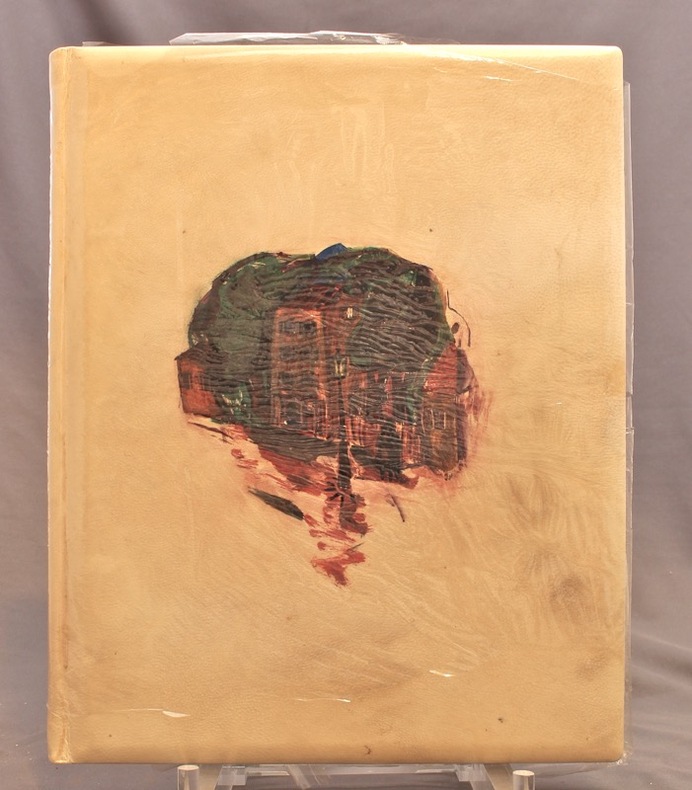
12735[Lausanne], [Association des écrivains vaudois - AEV], [1947]. In-4 de [106] pages, plein parchemin muet, orné au premier plat d'une composition originale du peintre Jean-Jacques Mennet. Sous emboîtage avec dos toilé muet. La maison Mayer & Soutter à Lausanne a soigné la reliure de ces pages autographes.
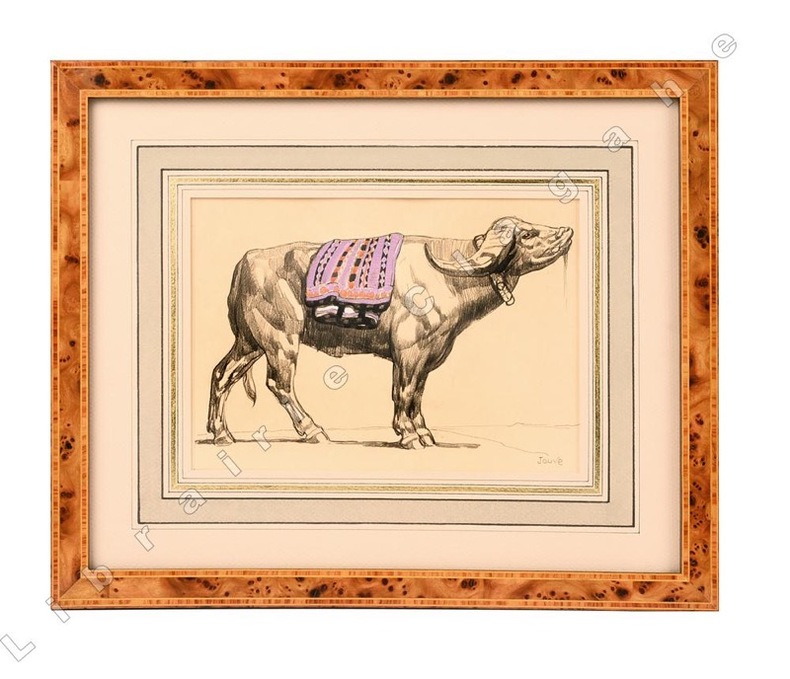
185221442Dessin original au crayon gras, gouache et aquarelle sur papier japon impérial (185 x 217 mm ; recadré 151 x 212), signé au crayon dans le coin inférieur droit ; passe-partout à large encadrement bicolore beige et vert et large filet doré, encadrement de loupe. Format total 295 x 355 mm. Au dos, partie de dessin au crayon et fusin, découpée.
091-Do.J. Gouache, auf Bütten. 47,5:38,5 cm. Verso an den Rändern Reste einer alten Verklebung.
80799Paris Editions Le Soleil Noir 1969. 8° Buch: 91 S. m. 1 losen Gouache hinter Passepartout; Skulptur: 15 x 5 x 4 cm; Sockel: 2 x 23 x 8 cm Brosch. m. OU Der OU-Rücken min. gebräunt sonst tadelloses unaufgeschnittenes Ex. und tadellose Beigaben Ex. Nr. 29 der 50 Ex. der Luxusausgabe auf Vélin d’Arches mit 1. der beiliegenden signierten Gouache von Isabelle Waldberg 2. im Plexiglas-Schuber und 3. mit dem Plexiglas-Sockel mit der im Sockel monogrammierten Bronzeskulptur von derselben. - Isabelle Waldberg 1911 Oberstammheim - 1990 Chartres «sculptrice ayant participé aux activités du groupe surréaliste à Paris et membre du groupe Allianz; professeure à l'Ecole des beaux-arts de Paris» SIKART. 010 Paris, Editions Le Soleil Noir, 1969 unknown
110-Do.J. Gouache mit schwarzer Tuschlinie umrandet, auf Bütten mit Wasserzeichen, verso in der rechten unteren Ecke bezeichnet oder signiert ?Rauscher?. 22,2:27,3 cm. Typische Arbeit des Coburger Hofmalers in makelloser Frische erhalten!
183155862Hartberg, 1831. Prachtvolle, großformatige Gouache, ?Aufgen: u. gemahlt 1831 v. V. Ressavar?. Bildgröße ca. 44,5 x 72 cm, zeitgen. auf Trägerkarton montiert (ca. 52 x 78,5 cm).
007-Do.J. Aquarell und Deckfarben auf braunem Velin. 27,2:37,8 cm. Vergleichsliteratur: M. Bircher u. G. Lammel, Helvetien in Deutschland. Schweizer Kunst aus Residenzen deutscher Klassik 1770-1830. Zürich, 1991, S. 98, Farbabb. S. 99, Nrn. 74-80 mit Abb.
46629Gouache signée de 57 cm de largeur et 41 cm de hauteur.Cadre d'époque. Les couleurs sont éclatantes.
291-Eo.J. Gouache, mit schwarzer Tuschlinie umrandet und mit grünlich gouachiertem Rand, auf dünnem Karton, verso bezeichnet ?Glacier du Rosenlaui vue en passant le Scheidegg. Chez J. Louis Bleuler au château de Laufen près Schaffhouse Suisse?. Darstellungsgröße 33:48 cm, Blattgröße 43,7:57,5 cm. Im gouachierten Rand rechts und unten leicht berieben, sonst tadellos.
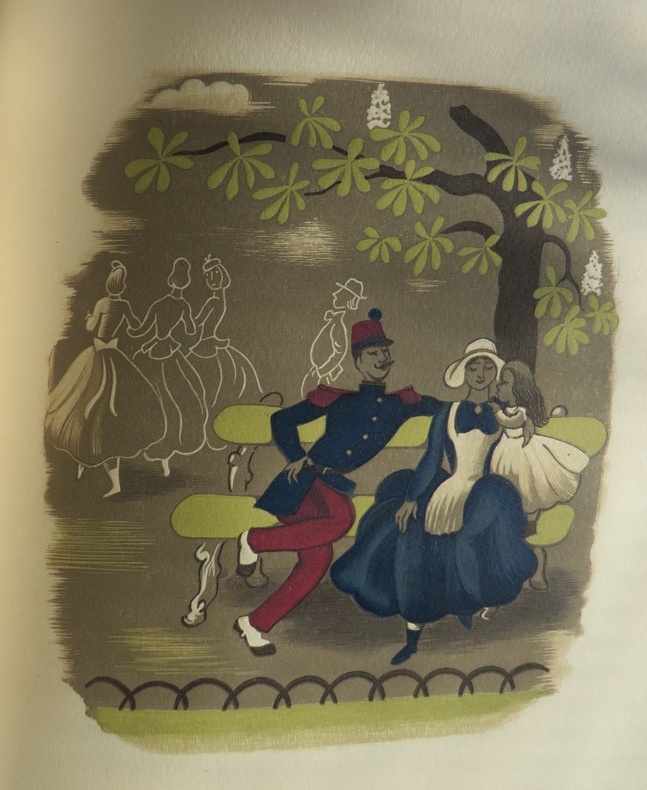
1953933éditions Marcel Lubineau, 1953, format : 18 x 27 cm, 160 pages suivies de la suite et gravures non retenues. Edition limitée à 750 exemplaires et numérotée. 25 aquarelles de LUCIEN BOUCHER interprétées en gravures sur bois par Pierre BOUCHET. Ici, un des 50 premiers auquel est joint : une suite des illustrations sur Malacca, la décomposition de couleur d'une planche, trois gravures non retenues et une aquarelle originale. De plus il a été relié à cet exemplaire la plaquette de présentation. Superbe reliure plein cuir fauve, mosaïquée au motif de Voyelles a, e, i, o, u, signée SEGUIN à ANGERS, dos à 4 nerfs, titre et tête dorés, sous emboitage au sommaire : les étrennes des orphelins, sensation, première soirée, soleil et chair, à la musique, le forgeron, Ophélie, Le châtiment de Tartuffe, bal des pendus, morts des quatre vingt douze, Vénus anadyomène, les réparties de Nina, le mal, les effarés, le dormeur du val, roman, rage des Césars, rêvé pour l'hiver, au cabaret-vert, la Maline, le buffet, l'éclatante victoire de Sarrebruck, les douaniers, ma bohême, les assis, tête de faune, chant de guerre parisien, mes petites amoureuses, oraison du soir, les poètes de sept ans, accroupissements, les pauvres à l'église, l'orgie parisienne, l'étoile a pleuré rose, les mains de Jeanne Marie, voyelles, les sœurs de charité, les premières communions, le cœur volé, l'homme juste, les chercheuses de poux, ce qu'on dit au poète, le bateau ivre, qu'est ce pour nous mon cœur, les corbeaux, comédie de la soif, mémoire, la rivière de Cassis, Larme, Michel et Christine, fêtes de la patience, est elle almée, bonne pensée du matin, jeune ménage, fêtes de la faim, bruxelles, ô saisons, ô châteaux, le loup criait sous les feuilles, entends comme brame, honte.
130-Wo.J. Gouache, auf schwarz grundiertem chamoisfarbenem Bütten, verso monogrammiert ?M R? sowie signiert ?Reinheimer? und Paraphe. 29,9:22,4 cm.
Snt. .
1961014593Alès PAB 1961 In-8 carré Pleine reliure d'époque Signé par l'auteur et l'illustrateur
1850171731800 - 1850. Ca. 47 cm x 32 cm. [2 Warenabbildungen]
209-Do.J. Feder in Schwarz und Aquarell, über leichter Skizze in schwarzer Kreide, mit schwarzer Tuschlinie umrandet, auf Bütten mit Wasserzeichen: kleiner Wappenschild, links unten mit brauner Feder bezeichnet ?W. Hollar delin.?. 15,4:27,7 cm. - Das lediglich skizzenhaft angelegte gegenüberliegende Flussufer ist nur schwach sichtbar, durchgehend braunfleckig, am Oberrand Reste alter Verklebungen. Provenienz: J. Schröfl, nicht bei Lugt.
485-Eo.J. Gouache, auf Velin mit undeutlichem Wasserzeichen mit Datum ?1812?. 32 : 43,5 cm. Mit Bereibungen der Bildoberfläche, kleine Fehlstelle an der rechten unteren Ecke. Verso ältere Zuschreibung an J.Chr. Reinhart. Quelle: Ovid, Metamorphosen 7, 149ff.
60399BBo.J. [3 Warenabbildungen] (Petra Petitpierre, geborene Frieda Kessinger, geboren am 13. Mai 1905 in Zürich, gestorben am 23. Dezember 1959 in Murt
477-Eo.J. Aquarell, stellenweise mit Eiweißlasur, rechts unten signiert und datiert ?J. W. Lindlar. F. 1845.?. 21,2:23,5 cm. Sehr schöne, fein gezeichnete und dadurch sehr plastisch wirkende Arbeit dieses Künstlers.
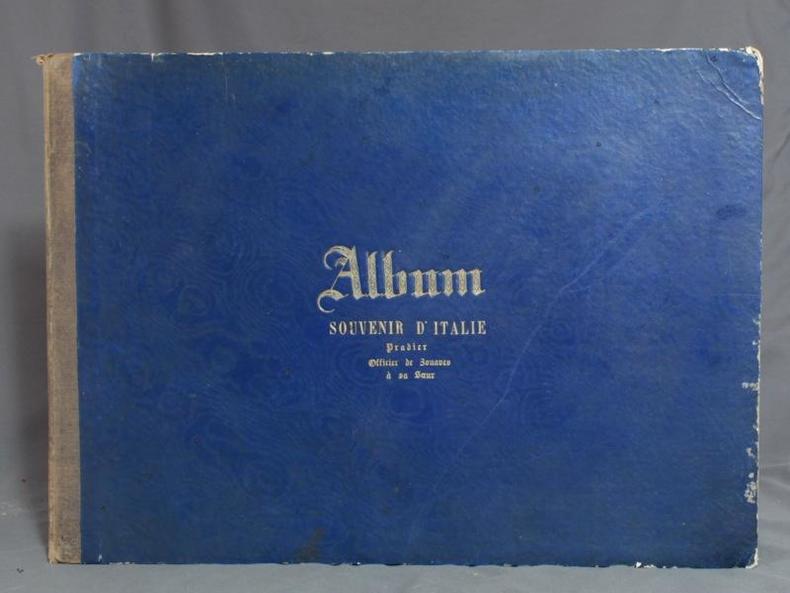
4550[vers 1840]. In-folio à l'italienne, dos en toile, plats de papier moiré bleu nuit, titre doré au premier plat (coins légèrement frottés).
60448BBo.J. [4 Warenabbildungen] (Petra Petitpierre, geborene Frieda Kessinger, geboren am 13. Mai 1905 in Zürich, gestorben am 23. Dezember 1959 in Murt
161-Do.J. Deckfarbenmalereien, die Ecken braun gouachiert, auf Velin. Je ca. 15,5 : 12,3 cm. Bei dem Herrenporträt linke obere Ecke außerhalb der Darstellung ergänzt, bei dem Frauenporträt sind die Ränder ringsum ergänzt. - Porträts von feinster malerischer Qualität, für die z. B. Anton Graff (1736 Winterthur - Dresden 1813) als Autor infrage kämen.
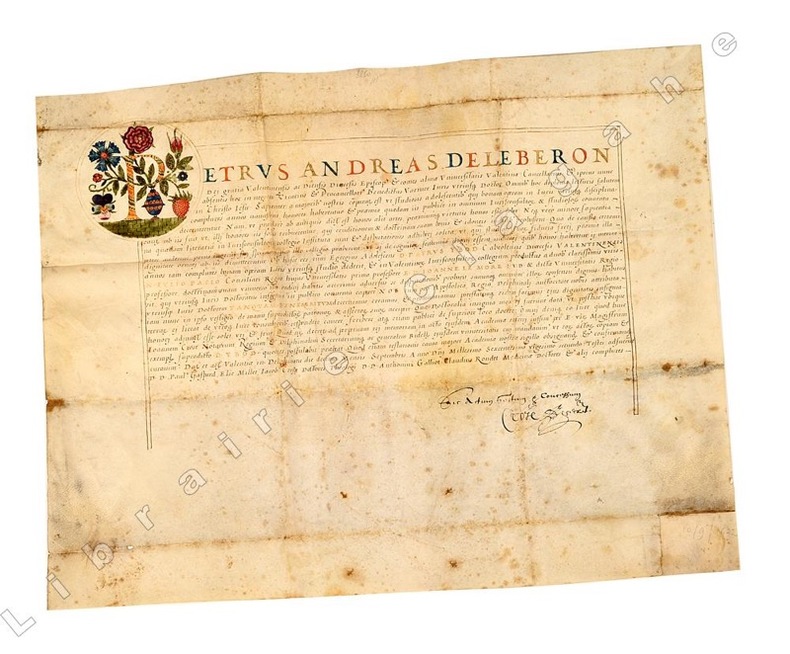
21381et enluminé sur velin ivoire (380 x 485 mm) en faveur de Petrus Ybod, reconnu comme docteur en droit, en date du 10 septembre 1622, sous l’autorité de Joanne Le More, son professeur et de Julius Pacius, premier docteur régent de la faculté de droit, sous la présidence de Petrus Andrea de Gelas de Léberon, évêque de Valence et de Die de 1600 à 1622 en sa qualité de Chancelier de l’Université. On peut noter que le jury était composé aussi de Paul Gaspard, Elie Millet et Jacques Crespe, docteurs en théologie et Antoine Galliot et Claude Rondet docteurs en médecine. Absence des lacs, signature autographe de Joannem Crose notaire du Roi et secrétaire du Dauphiné.
196-Do.J. Gouache, mit einzelner Federlinie in Goldbronze umrandet, auf Pergament, im Unterrand signiert und bezeichnet ?JM Däubler. pinx: Norimbg.?. 17,2:22,6 cm.
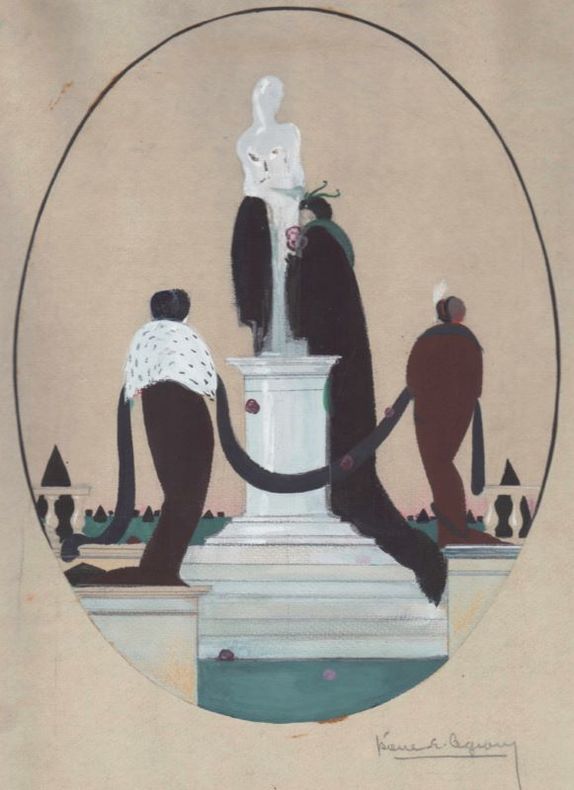
1920210741920 Gouache et mine de plomb sur papier gris contrecollé, signée en bas à droite sous le dessin, (1920), titre et signature au dos du carton d'origine, 31.5 x 24 cm.