13 résultats
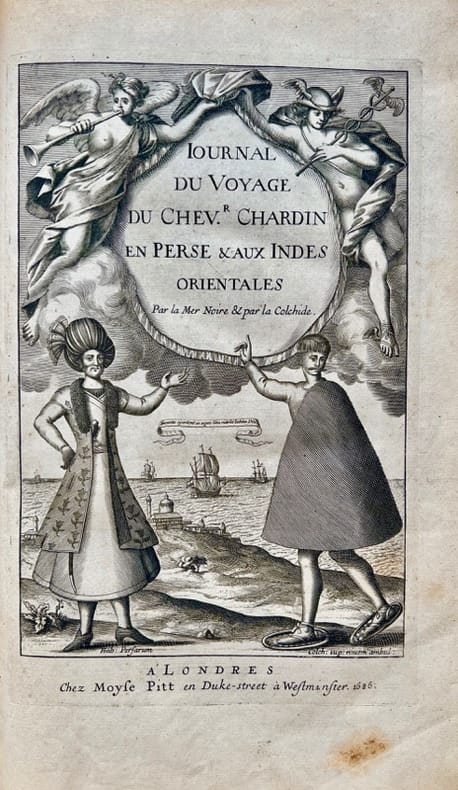
1686002109London England: Moses Pitt 1686. Full-Leather. Fair/No Jacket. Original leather covers and partial spine with 6 bands worn with covers detached; title page loose with some ink signatures of previous owners; missing plates 1 2 3 5 of 16 plates total; missing folding map; text split into 4 parts; Table Index of 5 pages at rear; 12mo; with 154 pages. <br/> <br/> Moses Pitt hardcover
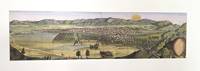
1686P4510Paris c.1686. Very Good. Notes: A view of the city of Qom Ghom Iran during the the mid 17th century. Image Size : 129x330 mm 5.08x12.99 Inches Platemark Size : Paper Size : 160x377 mm 6.30x14.84 Inches Coloring: Black & White Medium: Copper Engraving Categories: Views Asia Middle East Iran; unknown
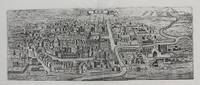
1690P5438Paris: Jean Chardin c.1690. Very Good margins trimmed. Notes: Rare view of Shiraz Iran in the late 17th century. It is beautifully hand coloured.<br>Jean Chardin born Jean-Baptiste Chardin; 16 November 1643 – 5 January 1713 known as Sir John Chardin in England was a French-born English jeweller traveller and writer whose ten-volume book The Travels of Sir John Chardin is regarded as one of the finest works of early Western scholarship on Safavid Iran and the Near East in general. Image Size : 201x744 mm 7.91x29.29 Inches Platemark Size : Paper Size : Coloring: Hand Colored Medium: Copper Engraving Categories: Views Asia Middle East Iran; Jean Chardin unknown
16911105030003London; Christopher Bateman 1691. Leather Bound. Very Good. Christopher Bateman; London 1691. 154 pp. plus table and 1 plate. Folio. Rebound in modern dark brown leather. Endpapers have been replaced. 5 raised bands. 6 compartments. Gilt embossed lettering on spine. Tight binding and solid boards. Internally clean with light marks.<br><br>Initially included as a companion to the larger Travels of Sir John Chardin into Persia and the East-Indies Through the Black Sea and the Country of Colchis. This book provides a vivid and accurate depiction of the cultural practices and political structure of the region at that time. London; Christopher Bateman hardcover
16861335530Amsterdam: Abragam Wolfgangh 1686. Second Edition. Hardcover. 16mo 496 pages; VG; bound in full contemporary vellum; minor edge wear and bumping; text block clean; some end-paper markings; shadow of lost bookplate; index 18 illus. complete with frontispiece engraved title-page; and folded plates; plate 14 bound at pg. 358 instead of at 458 as listed; other decorative figures; light foxing; spine sunned; boards spot staining and discoloration; else very good; shelved case 3. 1335530. Shelved Dupont Bookstore. Abragam Wolfgangh hardcover books
16862411052London: Moses Pitt 1686. first. hardcover. very good. First edition 1686. Original leather front and back covers new leather spine new paste-downs and front free end papers. Multiple fold-out maps and plates. Sir John Chardin was a French jeweller and traveller. This book is regarded as one of the finest works of early Western scholarship on Safavid Iran and the near East. In very good condition. Some pages show damage to side edges a couple of pages have a small tear to bottom of page some fold-outs have tears that have been repaired and also not repaired. Moses Pitt unknown
1685D7313Amsterdam / Utrecht: chez Jean Wolters et Ysbrand Haring / Frans Halma 1686 / 1685. Hardcover. Very Good. 12mo 155 x 88 mm. 432pp. 7. Full-page engraved portrait of Chardin above his heraldry bearing arms of two rosettes chevron and bird additional engraved title 16 engraved plates including two chapter headpieces 12 folding are maps city panoramas or charts. The first English edition appeared in 1686 in London by Moses Pitt of 1686; Chardin having settled in England after his travels and was knighted there by Charles II. The title was reprinted twice in Amsterdam in the original French at different locations. First at Abraham Wolfgang and then at Wolters and Haring as in this copy. Contemporary vellum ms. title on spine with foldover edges speckled edges; light soiling and few small stains few minor tears on engraved title or marginal wear to plates. A very nice copy with plates in excellent shape. Bound after: SPON Jacob 1647-1685. Histoire de la Ville Et de l'Estat de Genève. Utrecht: Frans Halma 1685. 522pp. 16 of table. Woodcut printers device of Halma with motto Vivitur ingenio one lives on in spirit to title additional engraved title 6 plates of which 3 are folding among which the view of the Geneva region with placenames highlighted in yellow woodcut headpieces and decorative initials; one small fold-tear to Geneva plate. Formerly in the collection of famed bibliophile Henri Burton of Geneva his morocco bookplate neatly to front endpaper. <br/><br/>French sammelband of the Travels of Sir Jean Chardin; one of the finest works of early Western scholarship on Persia and India and Spons History of Geneva from the collection of Henri Burton. A great deal of European travel writing details the history of Europes relationship to the Orient a place highly exoticized by western observers. Jean Chardin was a trader and the son of a jeweler who first went to the Levant in 1665 to purchase gems. He made a second journey in 1671 in the company of the artist Guillaume Grelot whom he met in Istanbul and whose drawings inspired the engravings in the present work. This edition comprises the first volume of the authors manuscript dealing with the period 1671-1673 and is all that was published until 1711. His work is divided into four parts: the first recounts his journey from Paris to Ispahan 1671-77 the second describes Persia and Ispahan the third the ruins of Persepolis and the fourth gives a history of Persia based on Persian writers. /// Spon 1647-1685 was a doctor and pioneering archaeologist of Greek antiquities. After the revocation of the Edict of Nantes he fled France for Switzerland dying not long after in Geneva. His history of Geneva first published in 1680 was translated into English in 1687. Chardin an experienced trader is in a position to give detailed accounts of trade-routes prices articles bought and sold customs problems and so on whereas Spon is primarily interested in Antiquity concentrating on giving the exact wording of inscriptions illustrations of medals and ancient buildings and the comparison of towns and landscapes with the descriptions which appear in Classical texts. A fine sammelband neat and sturdy contained two important travel texts printed within just one year of each other. chez Jean Wolters et Ysbrand Haring / Frans Halma hardcover books
168642700Londres, Moses Pitt, 1686. In-folio de (10)-349-(5) pp., veau havane marbré, dos orné à nerfs, pièce de titre en maroquin rouge, tranches rouges (reliure de l'époque).
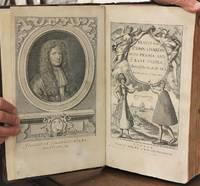
1686B6871London: Moses Pitt. 1686. Corners bumped some wear to extremities. Interior largely clean and crisp; occasional tears or edgewear. Pgs. 357/8 with tear and marginal piece lacking at front edge text affected by tear but present. Pagination jumps from 264 to 331 but text continuous. . Edition: First English Edition. Binding: Full contemporary calf boards rebacked in matching style. Spine with 5 raised bands title in gilt on black label in 2 blind motifs stamped in remaining compartments. New pasted and free endpapers. Top edges black front and bottom red. Notes: Narrow Folio 322 x 195 mm. <br>Jean John Chardin 1643-1713 was a French jeweller and traveller whose Travels of Sir John Chardin is regarded as one of the finest works of early Western scholarship on Safavid Iran and the near East in general. Only the first of ten volumes was translated into English which was published concurrently with the French version; this volume covers the author's journey from Paris to Ispahan and contains the author's half-length portrait by Loggan in addition to 18 copper plates mostly folding. In 1664 Chardin started for the East Indies and journeyed by Constantinople and the Black Sea reaching Persia in 1666. That same year the shah Abbas II made Chardin his agent for the purchase of jewels. In the middle of 1667 Chardin visited India and returned to Persia in 1669. The next year he arrived in Paris. He issued an account of some events to which he was an eyewitness in Persia entitled 'Le Couronnement de Soleiman Troisième' Paris 1671. A learned nobleman Mirza Sefi a prisoner in his own palace at Isfahan had entertained Chardin instructed him in the Persian language and assisted him in this work. <br>Chardin again started for the East in 1671 and was at Constantinople from March to July of 1672. A quarrel between the grand vizier and the French ambassador made the position of French subjects dangerous and Chardin escaped across the Black Sea. He stayed at Ispahan for four years and made various journeys throughout the land from the Caspian to the Persian Gulf and the river Indus visiting several Indian cities. <br>In 1681 Chardin emigrated to England and a few years later he was appointed to the East India Company; during this time he had a chance to work on the publication of his memoirs assisted by John Evelyn. <br><br> Size: Narrow Folio Illustration: A very good example of this First English Edition of Chardin’s voyages. Complete with 19 engraved plates and maps; including a frontispiece portrait of the author engraved titlepage a map of the Black Sea and surrounding countries an important map of Iran and 16 numbered plates of which 12 folding. Including bird’s-eye views of the cities of Teflis Irivan Tabriz Kaschan and others. With additional engraved vignettes and historiated initials. Plate “Ecs-Miazin commonly called the Three Churches†numbered in index as 9 10 plate itself numbered 9 9. Pages: P. Blank. Frontispiece. Engraved title. Blank. Title. Printer’s colophon. Dedication 4. Preface 7. Blank. Folding map. First book: pp. 1-417. Blank. Index 5. Blank 2. Plate index. // The Coronation of Solyman III. The Present King of Persia: title. Blank. P. 1-154. Table 5. Blank. Category: Book Asia Middle East Iran; Book Voyages General; Moses Pitt. hardcover
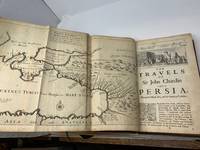
168680746London: Printed for Moses Pitt in Duke Street Westminster 1686. First Edition in English. Leather-bound. Good. Quarto. Contemporary English panel calf boards 417 5 pp. index. 11 7/8" x 7 1/2" sympathetically rebacked in mottled calf on hempen cords. Contrasting spine label of gilt on maroon Rubbing to extremities. Marbled endpapers and edges. 12' x 20' elaborate foldout frontis map of the Black Sea. Handwritten in two places: "Marshall Lister's Book 1785" once on the verso of the mounted title page bordered by elaborate doodles followed by a line of what appears to be shorthand; the second inscription at the top of the first page. Most curiously opposite the "Epistle Dedicatory" are printed the words: "Let this BOOK be Printed". <br /> <br /> The dedicatory itself rather over the top adulatory addressed to the King concludes: "I might advance in this parallel where. Your Majesty has so much the advantage if I did not find my Eyes dazled when I attempt to fix them upon Your Majesty." LARGE foldout engravings by Paul Bouche mounted on stiff card stock SOME of which are: Teflis a five-fold panorama extending to nearly 30" in length; a Nuptial Feast at Tefles; Irivan Erivan; Sultani; The Tombs of the two last kings of Persia; Kom; Sefy Premier; Kachan; The Great Inn in Cashan;. Chardin 1643-1713 was a French traveler and merchant who spent many years in England and and travelled in Persia and India from 1665-1667. There was only one volume published. It was originally published in French. Chardin was knighted by Charles II and appointed jeweller to the court. Howgego C -102. Printed for Moses Pitt in Duke Street, Westminster unknown
1686017257London: Moses Pitt 1686. First Edition in English. Hardcover. Minor soiling and wear Near Fine. Folio 7-3/4" x 12-1/8" bound in later calf leather recently and sympathetically rebacked with a gilt-decorated spine preserving the original morocco spine label; xviii 264 331-417 9 154 6 pages. Complete with the frontispiece portrait of the author an additional engraved title-page a folding engraved map of the Black Sea and surrounding countries and 16 plates 11 of which are folding along with a couple of engravings in the text. Published in English and French concurrently in 1686 as Part I of the Travels. Three other volumes with the general title page VOYAGES DE MONS. LE CHEVALIER CHARDIN were published in Amsterdam in 1711. The last volume announced by Chardin in his preface to this edition was never published. THE CORONATION OF SOLYMAN III. THE PRESENT KING OF PERSIA at the end of this volume is a translation of Chardin's LE COURONNEMENT DE SOLEIMAN TROISIÈME first published in Paris in 1671. Includes two indexes one bound following part 1; the other bound at the end. The fine plates include views of the cities of Tefflis Erivan Tauris Sultanie Kom and Cashan as well as important monuments. <br/><br/>Chardin was a jewelry merchant who traveled extensively throughout Persia in the 1670s and was a keen observer of the area's culture. Moses Pitt hardcover
168160953Genff, Widerhold, 1681. Folio (340 x 210 mm). Recently bound in a magnificent pastiche-binding of brown half calf with gilt red leather title-label to elaborately gilt spine. Vellum corners. Title-page with stains. A few marginal repairs, not affecting text. (8), 82 pp.
168160953Genff Widerhold 1681. Folio 340 x 210 mm. Recently bound in a magnificent pastiche-binding of brown half calf with gilt red leather title-label to elaborately gilt spine. Vellum corners. Title-page with stains. A few marginal repairs not affecting text. 8 82 pp. <br/><br/><em>Exceedingly rare first German translation of Chardin’s “Le Couronnement de Soleimaan troisieme†1671 - his report on the coronation of the new Persian king and what happened during the first years of his reign. Returning to Persia on the way home to Europe Chardin witnessed the coronation of Suleiman III in 1669. Chardin’s works are considered some of the finest works of early Western scholarship on Iran and the Subcontinent in general and the present work offered Europe a rare glimpse into the customs of the Royal house of Persia. “Chardin details the ceremonies in the present work with a preface that laid out the parallels between the French and Persian monarchies. Chardin portrays a filial bond between the two monarchies. The Persian shah he declares calls “Your Majesty Louis XIV his brother†due to their shared grandeur. Chardin proclaims “The Kind of France is the greatest Emperor in Europe as he the shah is the most powerful Prince in Asia.†He emphasizes his admiration for Persia and its likeness to France: “Of all the vast Empires of the Orient … there is not one that should not yield to Persia for the temperature of the air for genius that is more reasonable than other places and is closest to our own and for all the excellent and rare things that are found there in abundance.†Mokhberi The Persian Mirror Born in Paris in a Hugenot Protestant family Jean Chardin 1643-1713 undertook his travels to Persia because of his father's position as a jeweler and shareholder in the French East India Company. Chardin set out in 1664 traveling through Turkey the Black Sea Georgia and Armenia. Soon after his arrival in Persia he received a commission to create jewelry for Shah Abbas II who died in 1666 and was succeeded by Shah Safi. After witnessing the latter's coronation Described here Chardin went on India and finally returned to Paris in 1670. In 1671 he published an account of the coronation and in the same year set off for Persia again arriving in Isfahan in 1673 and remaining there for several years before once more visiting India and returning home in 1677. With the persecution of the Hugenots in France he moved to England in 1680. "Travel restarted with 17th-century missionaries whose medical and pedagogical expertise helped counterbalance Orthodox or pagan reservations. Dominican Prefects Dortelli D'Ascoli and Giovanni da Lucca 1630s extended Giorgio Interiano's description of Circassia and Abkhazia. Theatine proselytisers targeted Mingrelia/western Georgia Capuchins the eastern provinces - the Vatican's Fide Press further contributed by printing the first Georgian books Chikobava/Vateishvili. Many including mission-head Don Pietro Avitabile 1626-1638 recounted their experiences. Prefect to Mingrelia Joseph Marie Zampi a 23-year denizen from approximately 1645 contributed a third significant source in his description of Mingrelian religious practice. This he handed to Jean Chardin 1643-1713 in 1672. A French traveller who became English! ambassador in Holland Chardin translated and incorporated it as a substantial part of his own description of a sometimes perilous journey through Transcaucasia 1672-3 which reflects Ottoman and Persian influence in western and eastern parts respectively - a Turkish organized slave-trade flourished from various Mingrelian ports. Linguistically Zampi revealingly observed that the ecclesiastical language Georgian was as difficult for even the Mingrelian priesthood to understand as Latin was for Italian peasants!" Speake The Literature of Travel and Exploration 1 199-202. Brunet I 1802 – A later French edition. Graesse II P. 121. </em> hardcover