7 résultats
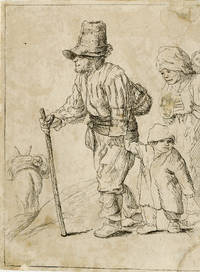
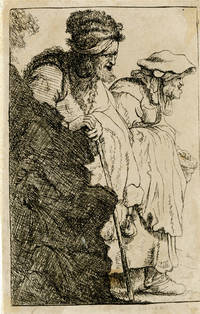
16309771630. Etching on cream laid paper laid down to a wove paper support 4 x 2 5/8 inches 101 x 67 mm sheet. In good condition with scattered light areas of discoloration. Printed early 19th century.<br /> <br /> Bartsch 165. Charles Amand Durand 1831-1905 is recognized and praised for accomplishing the difficult task of renewing original copper plate designs made by Rembrandt. It is by Amand that many of Rembrandt's works were saved. He also restored plates by Albrecht Durer Beham and other various Old Masters from the 15th 16th and 17th centuries. The task started when the main curator of the Louvre gave Amand Durand the important mission of restoring the worn down and fragile engravings made by Rembrandt. This is a printing from the Durand plates. Published in "Eaux-Fortes et Gravures des Maîtres anciens Tirées Des Collections Les Plus Célèbres" by Edouard Lièvre and Georges Duplessis. unknown
16509781650. Heliogravure on cream laid paper 3 1/4 x 4 1/4 inches 80 x118 mm thread margins. In good condition with a soft vertical crease and minor uniform toning. Printed early 19th century.<br /> <br /> Bartsch 236. Charles Amand Durand 1831-1905 is recognized and praised for accomplishing the difficult task of renewing original copper plate designs made by Rembrandt. It is by Amand that many of Rembrandt's works were saved. He also restored plates by Albrecht Durer Beham and other various Old Masters from the 15th 16th and 17th centuries. The task started when the main curator of the Louvre gave Amand Durand the important mission of restoring the worn down and fragile engravings made by Rembrandt. This is a printing from the Durand plates. Published in "Eaux-Fortes et Gravures des Maîtres anciens Tirées Des Collections Les Plus Célèbres" by Edouard Lièvre and Georges Duplessis. unknown
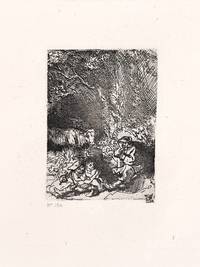
16529791652. Etching on cream laid paper 4 5/8 x 3 1/2 inches 118 x 89 mm thread margins. Laid down to a medium weight laid support scattered nicks and corner wear. The top and bottom corners have been repaired. Printed early 19th century.<br /> <br /> Bartsch 131 copy in reverse; New Hollstein 266 copy b. Charles Amand Durand 1831-1905 is recognized and praised for accomplishing the difficult task of renewing original copper plate designs made by Rembrandt. It is by Amand that many of Rembrandt's works were saved. He also restored plates by Albrecht Durer Beham and other various Old Masters from the 15th 16th and 17th centuries. The task started when the main curator of the Louvre gave Amand Durand the important mission of restoring the worn down and fragile engravings made by Rembrandt. This is a printing from the Durand plates. Published in "Eaux-Fortes et Gravures des Maîtres anciens Tirées Des Collections Les Plus Célèbres" by Edouard Lièvre and Georges Duplessis. unknown
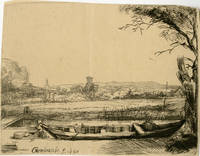
16442160Paris 1644. Etching and engraving on high quality buff wove paper 4 7/8 x 4 1/2 inches 124 x 114 mm; sheet 12 5/8 x 12 1/2 inches 321 x 318 mm the full sheet. In very good condition with the artist's moniker in the image in the lower right. No. 154 from a 19th century collection of etchings by Durand after Rembrandt. <br /> <br /> Bartsch 109. unknown
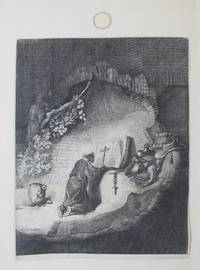
1631P4145Holland c. 1631. Very Good. Notes: In an imagined grotto St. Jerome with crucifix in hand reads from a great Bible. His faithful lion reclines at his side.<br><br>A second state from van Vliet. In this state the print is reversed and the only inscription is "RIV. Rindbrand in" instead of also having van Vliet's name and the year. <br><br>Gary Schwartz the noted Dutch art historian in his internet column http://www.garyschwartzarthistorian.nl/schwartzlist/id=142 refers to this state as done by Jan Joris van Vliet.<br><br>However other noted Rembrandt scholars such as Detuit Royalton-Kisch and Hinterding have a different opinion; that these reversed copies are not done by van Vliet but by an unknown pupil of Rembrandt.<br><br>References: Benesch 18. Starcky 1988 nr. 4. MRK 2010<br><br>Jan Joris Van der Vliet 1610 – 1668 was a Dutch Golden Age painter and Rembrandt pupil. Many of his etchings were directly after Rembrandt paintings and his etching of Rembrandt's "St. Jerome Praying in a Cavern" is considered to be his finest work fitting as the original painting by Rembrandt was lost. This is a second state print because only Rembrandt's name is signed of this etching and can be traced to the mid 17th century. <br><br><br>Rembrandt Harmenszoon van Rijn 1609 – 1669 was a Dutch painter and etcher. He is generally considered one of the greatest painters and printmakers in European art and the most important in Dutch history. His contributions to art came in a period of great wealth and cultural achievement that historians call the Dutch Golden Age when Dutch Golden Age painting although in many ways antithetical to the Baroque style that dominated Europe was extremely prolific and innovative and gave rise to important new genres in painting. Image Size : 355x282 mm 13.98x11.10 Inches Platemark Size : 370x290 mm 14.57x11.42 Inches Paper Size : 575x393 mm 22.64x15.47 Inches Coloring: Black & White Medium: Etching Categories: Religious Christianity; Old Masters; unknown
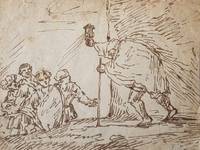
16502105Dutch mid-17th century drawing possibly by Rembrandt pupil Willem Drost. Depicted is Diogenes in robes with his lantern in his left hand and a staff in his right and a group of four figures. Diogenes the Cynic 4th cent. BC renounced material possessions and lived in poverty. He would go out with a lighted lantern in broad daylight to look for an honest man instead he would only find that everyone around him was morally corrupted. He would scare passersby with his lantern causing them to lose their mask and reveal their true intentions.In the present drawing the group of four is clearly scared by the lantern of Diogenes who seems to be towering over them. In fact the artist has placed Diogenes on a higher plane than the passersby an invention that effectively enhances the morality of the scene. This is not found in other contemporary depictions of the same story by artists like Rubens Sandrart Castiglione and Jordaens.The artistdisplays a masterful understanding and application of chiaroscuro. Not only does he use it for the composition he also applies it to benefit the narrative. Light is literally and figuratively at the center of the scene. The artist from the "Rembrandt school" who made most use of stark chiaroscuro in his drawings was Willem Drost 1633-1659. He became a student of Rembrandt around 1650 which corresponds with the dating of the watermark. The style of drawing is also close to drawings attributed to Drost. The facial type of Diogenes in particular the pointy nose corresponds with that found in each of Drost's drawings in the Rijksmuseum. Also the hatchingsmatch those in other works by Drost who made much use of individual lines instead of a continuous zig-zagging stroke and penstrokes of varying thickness to create depth in his compositions Bonny van Sighem 2000.<i>Condition: Number 3 in pencil at the bottom previous attribution to Ferdinand Bol written in pencil on the back. Several small brown spots and a couple minor defects including one on the face of the central figure in the group top edge slightly frayed and creaded. Old repair with tape on the back at the top.Literature: B. van Sighem 'attributed to Willem Drost David Prevents Abishai from Killing Saul Amsterdam c. 1650 - c. 1655' in J. Turner ed. Drawings by Rembrandt and his School in the Rijksmuseum online coll. cat. Amsterdam 2000 Bonny van Sighem 2000; for the watermark cf. Churchill fig. 305; Heawood 305 & 307.</i>
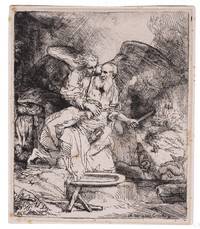
1655L2F9MTNGS4Y7Amsterdam 1655. 4to leaf 16.5 x 14 cm. Rembrandt Mounted with two hinges in a passepartout which is kept in sturdy cardboard folder covered on the outside with beige suede. Etching and drypoint on European laid paper plate size 15.7 x 13.2 cm. A fine impression of one of Rembrandt's most famous prints "Abraham's sacrifice" illustrating Genesis 22: 10-12 where Abraham after god ordered him to sacrifice his only son Isaac raises his knife to do so but is stayed by an angel who reveals that it was only a test of his obedience to god. In the Bible the angel merely speaks to Abraham but Rembrandt made the scene much more intimate with the angel reaching around Abraham from behind almost in an embrace holding his left arm with the knife just above the elbow and his right arm holding Isaac's head near the wrist. The Dutch States Bible of 1637 does place the angel behind Abraham but still only speaking to him. Rembrandt made the etching in 1655 and no variant states are known. It differs greatly from his 1635 painting of the same subject where the figures are not so closely united and neither Abraham nor the angel expresses such tenderness. The present example of the etching retains the finest lines very clearly for example in the background along the edge of the angel's left wing between the highest point of the wing and the top of Abraham's head and shows considerable burr giving the scene a powerful richness and contrast.The etching has two collectors' stamps on the back: those of Count Johann Nepomuk Ernst Harrach 1756-1829 and Senator Johann Karl Brönner 1738-1812. The etching came into the hands of the Dutch Dreesmann family art collectors and founders in 1887 of the Vroom & Dreesmann department stores who gave it to the Van Ravesteijn family before 1982 for services rendered. With minor foxing but otherwise in fine condition. A fine example of one of Rembrandt's most famous etchings.l Hind 283; Laurentius Rembrandts etchings 19; New Hollstein Rembrandt 287; Perlove & Silver Rembrandts faith pp. 86-92; White & Boon B35. ABE CAT Art History ABE CAT Bibles Sermons & Psalmbooks unknown