Rubens, Heinrich & Hertz, GustavBiblio.com
332 résultats
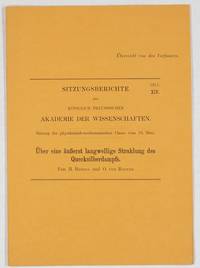
1912111851912. S.ber. Akad. Wiss. Berl. 1912. - Berlin 1912 8° pp.256-274 9 Fig. orig. Broschur. Rare Offprint! Heinrich Rubens 1865-1922 physicist. He is known for his measurements of the energy of black-body radiation which led Max Planck to the discovery of his radiation law. This was the genesis of quantum theory. Rubens worked on electromagnetic radiation particularly in the infrared. In 1900 he proved through measurements with Ferdinand Kurlbaum that Wien's law of radiation does not apply to the long-wave range. These precise investigations into the radiation of black bodies were essential for the development of the origins of quantum theory by Max Planck. He used the Auer gas incandescent light and proved that Planck's law of radiation also applies in the infrared part of the spectrum. He developed the method of Rubens' residual rays to generate infrared radiation and the Rubens flame tube named after him. He was regarded as a masterful experimenter who did not spare himself in his experiments he carried out the precision measurement of blackbody radiation for a long time at night in winter in an unheated laboratory in favourable weather conditions. His lecture experiments were also considered exemplary. Gustav Ludwig Hertz 1887-1975 was a German experimental physicist and Nobel Prize winner for his work on inelastic electron collisions in gases and a nephew of Heinrich Hertz. Biography He received his doctorate in 1911 under Heinrich Leopold Rubens. From 1911 to 1914 Hertz was an assistant to Rubens at the University of Berlin. It was during this time that Hertz and James Franck performed experiments on inelastic electron collisions in gases known as the Franck-Hertz experiments and for which they received the Nobel Prize in Physics in 1925. See: Ewald P.P. Zu Rubens und Hertz Note "Über den Einfluß der Temperatur auf die Absorption langwelliger Wärmestrahlen in einigen festen Isolatoren". Naturwissenschaften 10 1057-1058 1922 unknown
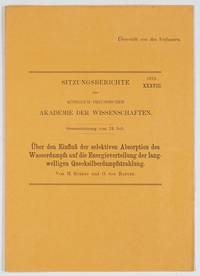
1913111871913. S.ber. Akad. Wiss. Berl. 1913. - Berlin 1913 Gr.8° pp.802-809 4 Fig. orig. Broschur. Rare Offprint! Heinrich Rubens 1865-1922 physicist. He is known for his measurements of the energy of black-body radiation which led Max Planck to the discovery of his radiation law. This was the genesis of quantum theory. Rubens worked on electromagnetic radiation particularly in the infrared. In 1900 he proved through measurements with Ferdinand Kurlbaum that Wien's law of radiation does not apply to the long-wave range. These precise investigations into the radiation of black bodies were essential for the development of the origins of quantum theory by Max Planck. He used the Auer gas incandescent light and proved that Planck's law of radiation also applies in the infrared part of the spectrum. He developed the method of Rubens' residual rays to generate infrared radiation and the Rubens flame tube named after him. He was regarded as a masterful experimenter who did not spare himself in his experiments he carried out the precision measurement of blackbody radiation for a long time at night in winter in an unheated laboratory in favourable weather conditions. His lecture experiments were also considered exemplary. Otto von Baeyer 1877-1946 was a German physicist. Otto Hahn and Lise Meitner together with Otto von Baeyer focussed on the magnetic deflection of ß-rays. They succeeded for the first time in obtaining beta-ray spectra from a series of radioactive emitters. unknown
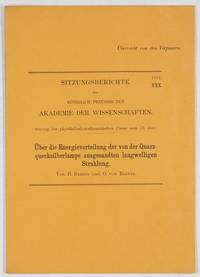
1913111861913. S.ber. Akad. Wiss. Berl. 1913. - Berlin 1913 8° pp.513-549 14 Fig. orig. Broschur. Rare Offprint! Heinrich Rubens 1865-1922 physicist. He is known for his measurements of the energy of black-body radiation which led Max Planck to the discovery of his radiation law. This was the genesis of quantum theory. Rubens worked on electromagnetic radiation particularly in the infrared. In 1900 he proved through measurements with Ferdinand Kurlbaum that Wien's law of radiation does not apply to the long-wave range. These precise investigations into the radiation of black bodies were essential for the development of the origins of quantum theory by Max Planck. He used the Auer gas incandescent light and proved that Planck's law of radiation also applies in the infrared part of the spectrum. He developed the method of Rubens' residual rays to generate infrared radiation and the Rubens flame tube named after him. He was regarded as a masterful experimenter who did not spare himself in his experiments he carried out the precision measurement of blackbody radiation for a long time at night in winter in an unheated laboratory in favourable weather conditions. His lecture experiments were also considered exemplary. unknown
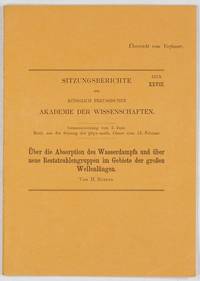
1911111831911. S.ber. Akad. Wiss. Berl. 1911. - Berlin 1911 8° pp.666-677 5 Fig. orig. Broschur. Rare Offprint! Heinrich Rubens 1865-1922 physicist. He is known for his measurements of the energy of black-body radiation which led Max Planck to the discovery of his radiation law. This was the genesis of quantum theory. Rubens worked on electromagnetic radiation particularly in the infrared. In 1900 he proved through measurements with Ferdinand Kurlbaum that Wien's law of radiation does not apply to the long-wave range. These precise investigations into the radiation of black bodies were essential for the development of the origins of quantum theory by Max Planck. He used the Auer gas incandescent light and proved that Planck's law of radiation also applies in the infrared part of the spectrum. He developed the method of Rubens' residual rays to generate infrared radiation and the Rubens flame tube named after him. He was regarded as a masterful experimenter who did not spare himself in his experiments he carried out the precision measurement of blackbody radiation for a long time at night in winter in an unheated laboratory in favourable weather conditions. His lecture experiments were also considered exemplary. Otto von Baeyer 1877-1946 was a German physicist. Otto Hahn and Lise Meitner together with Otto von Baeyer focussed on the magnetic deflection of ß-rays. They succeeded for the first time in obtaining beta-ray spectra from a series of radioactive emitters. unknown
1911111841911. S.ber. Akad. Wiss. Berl. 1911. - Berlin 1911 8° pp.339-345 1 Fig. orig. Broschur. Rare Offprint! Heinrich Rubens 1865-1922 physicist. He is known for his measurements of the energy of black-body radiation which led Max Planck to the discovery of his radiation law. This was the genesis of quantum theory. Rubens worked on electromagnetic radiation particularly in the infrared. In 1900 he proved through measurements with Ferdinand Kurlbaum that Wien's law of radiation does not apply to the long-wave range. These precise investigations into the radiation of black bodies were essential for the development of the origins of quantum theory by Max Planck. He used the Auer gas incandescent light and proved that Planck's law of radiation also applies in the infrared part of the spectrum. He developed the method of Rubens' residual rays to generate infrared radiation and the Rubens flame tube named after him. He was regarded as a masterful experimenter who did not spare himself in his experiments he carried out the precision measurement of blackbody radiation for a long time at night in winter in an unheated laboratory in favourable weather conditions. His lecture experiments were also considered exemplary. Otto von Baeyer 1877-1946 was a German physicist. Otto Hahn and Lise Meitner together with Otto von Baeyer focussed on the magnetic deflection of ß-rays. They succeeded for the first time in obtaining beta-ray spectra from a series of radioactive emitters. unknown
1911111821911. Verh. Dtsch. Physik. Ges. 13/ 2. - Braunschweig Druck und Verlag von Friedrich Vieweg und Sohn 1911 8° pp.102-110 3 Fig. orig. Broschur. Rare Offprint! Heinrich Rubens 1865-1922 physicist. He is known for his measurements of the energy of black-body radiation which led Max Planck to the discovery of his radiation law. This was the genesis of quantum theory. Rubens worked on electromagnetic radiation particularly in the infrared. In 1900 he proved through measurements with Ferdinand Kurlbaum that Wien's law of radiation does not apply to the long-wave range. These precise investigations into the radiation of black bodies were essential for the development of the origins of quantum theory by Max Planck. He used the Auer gas incandescent light and proved that Planck's law of radiation also applies in the infrared part of the spectrum. He developed the method of Rubens' residual rays to generate infrared radiation and the Rubens flame tube named after him. He was regarded as a masterful experimenter who did not spare himself in his experiments he carried out the precision measurement of blackbody radiation for a long time at night in winter in an unheated laboratory in favourable weather conditions. His lecture experiments were also considered exemplary. unknown
1915111901915. S.ber. Akad. Wiss. Berl. 1915 . Berlin 1915 8° pp.4-20 1 Falttafdel orig. Broschur. Rare Offprint! Heinrich Rubens 1865-1922 physicist. He is known for his measurements of the energy of black-body radiation which led Max Planck to the discovery of his radiation law. This was the genesis of quantum theory. Rubens worked on electromagnetic radiation particularly in the infrared. In 1900 he proved through measurements with Ferdinand Kurlbaum that Wien's law of radiation does not apply to the long-wave range. These precise investigations into the radiation of black bodies were essential for the development of the origins of quantum theory by Max Planck. He used the Auer gas incandescent light and proved that Planck's law of radiation also applies in the infrared part of the spectrum. He developed the method of Rubens' residual rays to generate infrared radiation and the Rubens flame tube named after him. He was regarded as a masterful experimenter who did not spare himself in his experiments he carried out the precision measurement of blackbody radiation for a long time at night in winter in an unheated laboratory in favourable weather conditions. His lecture experiments were also considered exemplary. unknown