5 résultats
1538RHOLBIB00twThomas Platter 1538. Very Good. Holbein Hans. Bible leaf from German 1538 Bibel with Hans Holbein illustrations. Bale: Thomas Platter 1538. 22 x 33 cm. Book condition: Very good but sadly mounted with glue on a piece of modern pres board. Lightly soiled. Pencil identifications on lower margin. Page 3 with Genesis is visible. It contains a 8.5 x 5.5 cm illustration of the flood and two black and white historiated initials 6 lines high. Thomas Platter unknown
1523LCPCVOY-0031(La Géographie de Strabon dans un séduidant exemplaire du XVI siècle, illustrée de gravures sur bois d'après Hans Holbein) STRABON. (vers 60 av. J.-C. - 20 ap. J.-C.) "EN TIBI LECTOR STUDIOSE STRABONIS GEOGRAPHICORUM COM(M)E(N)TARIOS, OLIM A GUARINO VERONESE...". 1523, Basileae, V. Curio. 1 volume in-fol. (308x215 mm) (dimensions pages 305x205 mm) (18) ff. (titre, dédicace, index des auteurs et index) avec 3 encadrements sur bois, 566 pp., (1) f. (avec la marque de l'imprimeur) ((4) ff., Aa6, Bb8, a-z6, A-Z6, &8) Reliure du XVIIe siècle en vélin rigide. Séduisante édition de cette traduction latine des humanistes Guarino de Vérone (livres I-X) et Grégoire Trifernate (livres XI-XVII), améliorée par C. Herensbach. Elle est illustrée avec des superbes encadrements gravés sur bois par Iacobus Faber (chiffre IF à côté des gravures d'Aristote et d'Erate) d'après Hans Holbein le Jeune. Quelques frottements à a reliure, usures à trois coins et petite fente de 4 cm dans la partie inférieure de la charnière du premier plat. Tout petit manque de vélin dans la charnière du second plat. Le premier f. de garde partiellement détaché. Mouillure claire dans l'angle supérieur des vingt premiers ff., plus foncée dans les 4 premiers ff. Mouillure claire dans l'angle inférieur des cent derniers ff. Une petite déchirure, sans perte, sur la p. du titre et tout petit manque dans la marge externe de l'encadrement gravé. Une petite galerie de ver dans la marge supérieure des cahiers d-f. Un autre galerie de ver qui touche quelques lettres au centre des pages sur moitié du volume. Une tache dans la marge des ff. r4 et r5. Quelques pages avec des rousseurs. Bel exemplaire en général. Strabon, issu d'une famille illustre d'Amasée, "s'installa à Rome probablement juste avant la mort de César, ce qui fait de lui une source supplémentaire pour l'étude de l'histoire romaine sous Auguste. A ses nombreux séjours à Rome s'ajoutent d'autres voyages, notamment dans le reste de l'Italie, en Gaule mais aussi en Afrique (Ethiopie et Egypte en particulier)... Ses nombreux voyages lui permires d'accumuler une documentation suffisante pour écrire la Géographie, un ouvrage en 17 livres organisés par régions. Fondé sur une démarche scientifique et ethnographique, cet ouvrage apparaît comme une oeuvre notable pour l'époque du fait de son ampleur". "Si son oeuvre reprend parfois des textes antérieurs de plusieurs siècles, sa connaissance du droit romain des différentes cités en fait aussi une source essentielle pour décrire les débuts de la romanisation en Gaule et dans la péninsule ibérique... Il consacre quelques lignes... aux événements en Gaule lors de la révolte des Gaulois et confirme l'importance des effectifs qui furent rassemblés par Vercingétorix". "L'oeuvre de Strabon resta dans l'ombre sous l'empire romain... Ce n'est qu'à partir du Ve siècle qu'elle commence à être citée, et que Strabon devient même l'archétype du géographe". "Au XVe siècle l'érudit italien Guarino de Vérone traduisit la totalité de l'oeuvre de Strabon, contribuant ainsi à sa redécouverte". (Source Wikipedia) Provenance : Un ex libris L. Pedrini (1718). (LCPCVOY-0031) (2.800,00 €)
1567127481567 un volume, reliure, reliure plein maroquin noir (19ème) petit in-octavo (full morocco in-octavo), dos long (spine without raised band), décoré or (gilt decoration) - titre frappé or (gilt title) - , plats décorés d'un encadrement à double filets à froid (cover with double line blind-stamping), tête lisse (top edge smooth), toutes tranches lisses (all smooth edges) noires (all edges black), orné de 53 bois de Hans HOLBEIN gravés sur bois en noir (woodcuts) par Antoine Silvius, 1567 Cologne héritiers de Arnold Birckmann Editeurs (Coloniae : Apud haeredes Arnoldi Birckmanni, 1567),
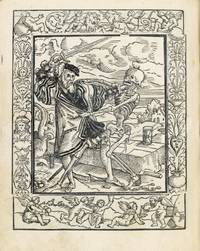
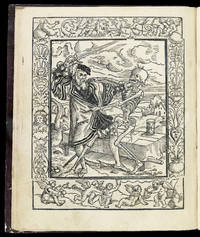
157288<p>The <i>Dance of the Dead</i> described in the British Museum as follows:<br /></p><p>" A series of 40 woodcuts by Jost de Negker which are free and enlarged copies after Hans Holbein the Younger's " Dance of Death " series with exception of the first two leaves all leaves with woodcuts on verso and German letterpress on recto both text and images in decorative woodcut borders the woodcuts with traces of colour and with a titlepage mutilated the text partly cut up and rearranged mounted and in modern binding ; fourth edition published in Leipzig by David de Negker. 1572</p><p>Woodcut and letterpress.</p><p>According to Hollstein there were four editions of Jost de Negker's 'Todtentantz' after Holbein : Augsburg 1544 n.p.; n.d; Augsburg 1561 and Leipzig1572 the last two by David de Negker.</p><p>The BL holds an imperfect coloured copy of the 1544 Jobst Denecker Jost de Negker edition C.43.d.3. A comparison of that and the 1572 edition would confirm that the woodcuts are by Jost de Negker as stated by Hollstein and not by David de Negker as stated by Paisey. The 1544 edition appears to have two woodcuts with inscriptions fol.F2 verso with date '1542' and fol.D3 verso with monogram 'HVE' see Dodgson II.207 which however this edition does not have.</p><p>The original woodcuts for Holbein's Dance of Death series were cut by Lützelberger. " B.M.</p><p>Engraved title framed by a large woodcut frieze depicting faces animals and plant decorations 10 pages of text 2 blank pages and 40 full-page engravings framed by a large frieze 4 types repeated text in Latin gothic characters framed by identical friezes opposite.</p><p>Jost de Negker c. 1485-1544 was a cutter of woodcuts and also a printer and publisher of prints during the early 16th century mostly in Augsburg Germany. He was a leading "formschneider" or blockcutter of his day but always to the design of an artist. He is "closely tied to the evolution of the fine woodcut in Northern Europe". For Adam von Bartsch although he did not usually design or draw the quality of his work along with that of Hans Lützelburger and Hieronymus Andreae was such that he should be considered as an artist.<br /></p><p>Some prints where the designer is unknown are described as by de Negker but it is assumed there was an artist who drew the design although it has been suggested that de Negker might fill in a landscape background to a drawing of a figure…</p><p>On Maximilian's death in 1519 the large teams assembled for his projects dispersed and de Negker became as much a publisher as a cutter retaining many blocks by Burgkmair Hans Weiditz and others and infringing many works such as the Dance of Death by Holbein Lützelburger's masterpiece as a cutter. Negker's edition of this was published in 1544 and is his last known work. </p><p><b>Rare complete copy of this very interesting Danse des Morts.</b></p> Durch David de Necker Formschneider hardcover
1572117<p>A rare complete copy of de Jost de Negker's Dance of Death well described by the British Museum.</p><p>From A. Brölemann's library.</p><p>The <i>Dance of Death's </i>description by theBritish Museum :<br /></p><p>" A series of 40 woodcuts by Jost de Negker which are free and enlarged copies after Hans Holbein the Younger's " Dance of Death " series with exception of the first two leaves all leaves with woodcuts on verso and German letterpress on recto both text and images in decorative woodcut borders the woodcuts with traces of colour and with a titlepage mutilated the text partly cut up and rearranged mounted and in modern binding ; fourth edition published in Leipzig by David de Negker. 1572</p><p>Woodcut and letterpress.</p><p>According to Hollstein there were four editions of Jost de Negker's 'Todtentantz' after Holbein : Augsburg 1544 n.p.; n.d; Augsburg 1561 and Leipzig1572 the last two by David de Negker.</p><p>The BL holds an imperfect coloured copy of the 1544 Jobst Denecker Jost de Negker edition C.43.d.3. A comparison of that and the 1572 edition would confirm that the woodcuts are by Jost de Negker as stated by Hollstein and not by David de Negker as stated by Paisey. The 1544 edition appears to have two woodcuts with inscriptions fol.F2 verso with date '1542' and fol.D3 verso with monogram 'HVE' see Dodgson II.207 which however this edition does not have.</p><p>The original woodcuts for Holbein's Dance of Death series were cut by Lützelberger. " B.M.</p><p>Engraved title with an engraved border illustrated withfaces animals vegetal 10 pages of text 2 blank pages and 40 full page engravings with border text in Latin gothic.</p><p>Jost de Negker c. 1485-1544 was a cutter of woodcuts and also a printer and publisher of prints during the early 16th century mostly in Augsburg Germany. He was a leading "formschneider" or blockcutter of his day but always to the design of an artist. He is "closely tied to the evolution of the fine woodcut in Northern Europe". For Adam von Bartsch although he did not usually design or draw the quality of his work along with that of Hans Lützelburger and Hieronymus Andreae was such that he should be considered as an artist.</p><p>Some prints where the designer is unknown are described as by de Negker but it is assumed there was an artist who drew the design although it has been suggested that de Negker might fill in a landscape background to a drawing of a figure…</p><p>On Maximilian's death in 1519 the large teams assembled for his projects dispersed and de Negker became as much a publisher as a cutter retaining many blocks by Burgkmair Hans Weiditz and others and infringing many works such as the Dance of Death by Holbein Lützelburger's masterpiece as a cutter. Negker's edition of this was published in 1544 and is his last known work. </p><p><b>A rare complete copy of this very interesting Dance of Death</b><b>.</b></p> Durch David de Necker Formschneider hardcover