8 résultats
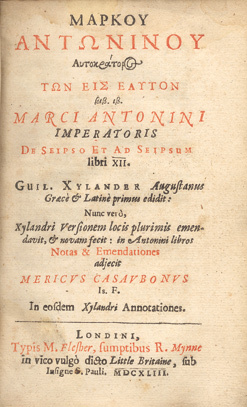
165631994Amsterdam ex officina Elzeviriana 1656 reliure en mauvais état, cuir frotté avec manque et mors fendu mais aucunement dérelié, Brunet mentionne cette édition , ( III, 272-273 ) : Belle édtion dont le texte est formé sur ceux de Turnèbe et d'Estienne,mais impr. peu correctement. La version latine est celle de Giphanius, corrigée : et quant aux scolies, on a reproché à Shrevelius de les avoir arbitrairement mutilées et interpolées (..) Tome 1 seul pour l'Illiade un frontispice - 8 ff - 716 pp
1689C0924<p>343 pages with woodcut printer's device on title. Duodecimo 5 1/2 x 3 1/4. Bound in leather with raised spine bands and gilt to spine. Originally written in 1619 in Italian. From the library of Lothar Schmid. Biblioteca van Der Niemeijeriana: 400 Third French edition.<br /><br />Gioachino Greco also known as Il Calabrese was born around 1600 in Celico which near Cosenza in Calabria. Calabria had already produced such players as Leonardo di Bono and Michele di Mauro. From his writing it's apparent the he wasn't educated and likely came from a lower class family. Already in 1619 Greco started keeping a notebook of tactics and particularly clever games and he took up the custom of giving copies of his manuscripts to his wealthy patrons. In Rome Monsignor Corsino della casa Minutoli Tegrini Cardinal Savelli and Monsignor Francisco Buoncompagni all received copies of which there are extant copies dated 1620 in the Corsiniana library in Rome under the title Trattato del nobilissimo gioco de scacchi. Despite his popularity in Rome in 1621 Greco took off to test himself against the rest of Europe leaving this paper trail as he went. In 1621 he left a fine copy of his manuscripts with Duke Enrico of Lorraine in Nancy. He traveled to Paris where he played Arnauld Isaac de Corbeville Enrico di Savoia the Marquis of St. Sorlin and the Duke of Nemours and Geneva and others. He had apparently been quite successful because in traveling from Paris to England he was waylaid by robbers who divested him of 5000 scudi a princely sum. Finally making it to London he beat all the best players. Sir Francis Godolphin and Nicholas Mountstephen were given copies of his manuscripts. While in London Greco developed an idea to record entire games rather than positions for study and inclusion in his manuscripts. He returned to Paris in 1624 where he rewrote his manuscript collection to reflect his new ideas. He then went to Spain and played at the court of Philip IV. There he beat his mentor and the strongest player of the time other than himself don Mariano Morano. He finally returned to Italy where he was enticed to traveling to the New Indies the Americas by a Spanish nobleman. He seemingly contracted some disease there and died around 1630 possibly 1634 at the young age of 30 34. He generously left all the money he earned at chess to the Jesuits. Gioachino Greco stood head and shoulders above his contemporaries a feat seldom duplicated. David Hooper in The Oxford Companion to Chess states that Greco probably made up the games in his manuscripts. The question of whether he actually played the games or invented them is rather moot since if he invented them he was perfectly capable of playing them.<br /><br />Lothar Maximilian Lorenz Schmid 10 May 1928 – 18 May 2013 was a German chess grandmaster. He was born in Radebeul near Dresden into a family who were the co-owners of the Karl May Press which published the German Karl May adventure novels. He was best known as the chief arbiter at several World Chess Championship matches in particular the 1972 encounter between Bobby Fischer and Boris Spassky at Reykjavic. He was also an avid collector of chess books and paraphernalia. It was reputed that he owned the largest known private chess library in the world as well as a renowned collection of chess art chess boards and chess pieces from around the globe.</p><p><strong>Condition:</strong><br /><br />Leather rubbed and scuffed Lothar Schmid's label to front paste down. Spine label missing spine bands rubbed old neat signature to title some doodling to back end papers else a good copy.</p> Jacques le Febure hardcover
16436506London, Flesher, R. Mynne, 1643 ; petit in-8 ; plein veau glacé havane, dos à nerfs richement décoré et doré, titre doré, double filet doré d'encadrement des plats avec au centre les armes de Louis-Urbain Le Fevre, seigneur de Caumartin, marquis de Saint-Ange, comte de Moret (OHR, 651), roulette sur les coupes (reliure fin du XVIIe - déb. XVIIIe) ; (56), 343, (1 bl.), 148, (4) pp. (bien complet du feuillet blanc qui suit le feuillet de titre).
1689C0924343 pages. Duodecimo 5 ½" x 3 ¼". Bound in leather with raised spine bands and gilt to spine. Originally written in 1619 in Italian. From the library of Lothar Schmid. Biblioteca van Der Niemeijeriana: 400 Third French edition.<br /><br />Gioachino Greco also known as Il Calabrese was born around 1600 in Celico which near Cosenza in Calabria. Calabria had already produced such players as Leonardo di Bono and Michele di Mauro. From his writing it's apparent the he wasn't educated and likely came from a lower class family. Already in 1619 Greco started keeping a notebook of tactics and particularly clever games and he took up the custom of giving copies of his manuscripts to his wealthy patrons. In Rome Monsignor Corsino della casa Minutoli Tegrini Cardinal Savelli and Monsignor Francisco Buoncompagni all received copies of which there are extant copies dated 1620 in the Corsiniana library in Rome under the title Trattato del nobilissimo gioco de scacchi. Despite his popularity in Rome in 1621 Greco took off to test himself against the rest of Europe leaving this paper trail as he went. In 1621 he left a fine copy of his manuscripts with Duke Enrico of Lorraine in Nancy. He traveled to Paris where he played Arnauld Isaac de Corbeville Enrico di Savoia the Marquis of St. Sorlin and the Duke of Nemours and Geneva and others. He had apparently been quite successful because in traveling from Paris to England he was waylaid by robbers who divested him of 5000 scudi a princely sum. Finally making it to London he beat all the best players. Sir Francis Godolphin and Nicholas Mountstephen were given copies of his manuscripts. While in London Greco developed an idea to record entire games rather than positions for study and inclusion in his manuscripts. He returned to Paris in 1624 where he rewrote his manuscript collection to reflect his new ideas. He then went to Spain and played at the court of Philip IV. There he beat his mentor and the strongest player of the time other than himself don Mariano Morano. He finally returned to Italy where he was enticed to traveling to the New Indies the Americas by a Spanish nobleman. He seemingly contracted some disease there and died around 1630 possibly 1634 at the young age of 30 34. He generously left all the money he earned at chess to the Jesuits. Gioachino Greco stood head and shoulders above his contemporaries a feat seldom duplicated. David Hooper in The Oxford Companion to Chess states that Greco probably made up the games in his manuscripts. The question of whether he actually played the games or invented them is rather moot since if he invented them he was perfectly capable of playing them.<br /><br />Lothar Maximilian Lorenz Schmid 10 May 1928 – 18 May 2013 was a German chess grandmaster. He was born in Radebeul near Dresden into a family who were the co-owners of the Karl May Press which published the German Karl May adventure novels. He was best known as the chief arbiter at several World Chess Championship matches in particular the 1972 encounter between Bobby Fischer and Boris Spassky at Reykjavic. He was also an avid collector of chess books and paraphernalia. It was reputed that he owned the largest known private chess library in the world as well as a renowned collection of chess art chess boards and chess pieces from around the globe. Jacques le Febure books
1689267448Paris: Jacques Le Febvre 1689. Second French edition. 24 344 pp. 1 vols. 12mo. Modern plain calf red morocco spine label. Text browned some spotting and dampstaining towards rear of volume. Second French edition. 24 344 pp. 1 vols. 12mo. Translated from the Italian of Gioachino Greco c.1600-1634 considered by some to be the first professional chess player. Greco was one of the most celebrated players of the seventeenth century and importantly recorded many of his matches as he travelled across Europe. A complete copy of one of the most famous early chess books. DeLucia 2nd ed. p. 61; Niemeijer 400; Schmid 187 Jacques Le Febvre unknown books
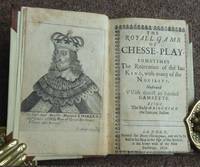
165653269<p>London printed for Henry Herringman and are to be sold at his shop at the sign of the Anchor in the lower walk of the New Exchange 1656. FIRST ENGLISH EDITION 1656 translation by Francis Beale of Gioachino Greco: Trattato del nobilissimo giuoco degli scacchi. 12mo approximately 145 x 90 mm 5½ x 3½ inches engraved portrait of King Charles by P. Stent as frontispiece and a woodcut text illustration of a chess board on page 14 pages: 18 1-120 followed by 1 leaf advert to recto and Errata on verso a poem on A5 recto and verso signed E. Revet. Bound in modern polished half calf pale cream boards gilt lettering and rules to spine new cream endpapers. Lacks first blank endpaper which is counted in the collation but final one is present neat narrow repairs to stab holes to several inner margins including title page and following page plus1 outer margin using archival tape most hard to see probably done when rebound portrait slightly trimmed at outer edge with loss of blank margin no loss to image the same to title page affecting engraved outer decorative border and foot of title page with slight loss to decorative borders pale age toning throughout pale ink letter and number to bottom margin of first dedication page final blank has pale staining to outer edges otherwise a very good tight copy. See: Whyld and Ravilious Chess Texts in the English Language Printed before 1850 page 21-22 No.1656:2; Murray A History of Chess page 830: "Greco's great service to chess lies in the fact that he made his material known to a wider circle of players than Polerio and his contemporaries ever reached. In this way his MSS became one of the most important productions in the literature of chess"; George Thomason Catalogue of Pamphlets Books etc. Relating to the Civil War 1640-1662 Volume 2 page 148 May 12. E. 1612 1.; Sotheby's catalogue of the chess collection of Lothar Schmid April 17th 2026 Lot 37; Sotheby's The Robert S. Spirie Collection part 1 page 242 Lot No. 403; ESTC R23418. MORE IMAGES ATTACHED TO THIS LISTING ALL ZOOMABLE. FURTHER IMAGES ON REQUEST. POSTAGE AT COST. Seller Inventory # 40643</p> London, printed for Henry Herringman and are to be sold at his shop at the sign of the Anchor in the lower walk of the New Excha hardcover
165621872London: Printed for Henry Harriman 1656. First edition. Hardcover. Very good. 12mo. 141202. Plate of chessboard present. Contemporary sheep blind rules on the boards. Light dampstain across the top the leather cracked and rubbed especially at the spine lacking the preliminary blank and the portrait of the King else a very good copy. Makes one wonder if the portrait of Charles II was deliberately destroyed.<br /> <p><br /> A translation by Francis Beale of Trattato del Nobilissimo Giuco degli Scacchi by Giachino Greco and consists of 94 chess gambits. Contains the first documented use of 'castle' as a chess verb according to the OED.<br /> <p><br /> ESTC R23418; Wing G1810.<br /> <p>. Printed for Henry Harriman hardcover
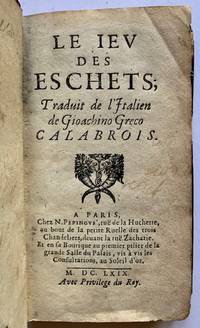
166920514Paris: Chez N. Pepingve Avec Privilege du Roi 1669. Full leather. The 1669 1st French edition --and 1st published edition-- of Gioachino Greco's seminal "Le Jeu des Eschets". Greco c. 1600 - c. 1634 was the strongest player in Europe in the early 17th century and among the first to record entire games not just particular openings or combinations. His vast influence as cited by H.J.R. Murray among other historians of the game is keenly felt to this day. This copy is likely in its original full-leather binding certainly in a contemporary-to-the-period binding. Solid and VG with minor forgivable wear along the edges and the preliminaries. The interior though is very clean the pages surprisingly crisp and clean. Originally recorded by hand in Greco's native Italian here translated --and issued in book form-- for the first time. Chez N. Pepingve (Avec Privilege du Roi) unknown