Gioachino GrecoBiblio.com
1 023 résultats
B9781166505226New. unknown
46470329like new. unknown
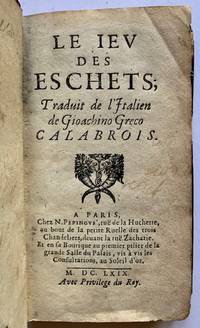
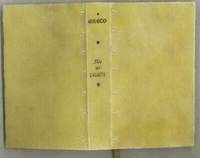
166920514Paris: Chez N. Pepingve Avec Privilege du Roi 1669. Full leather. The 1669 1st French edition --and 1st published edition-- of Gioachino Greco's seminal "Le Jeu des Eschets". Greco c. 1600 - c. 1634 was the strongest player in Europe in the early 17th century and among the first to record entire games not just particular openings or combinations. His vast influence as cited by H.J.R. Murray among other historians of the game is keenly felt to this day. This copy is likely in its original full-leather binding certainly in a contemporary-to-the-period binding. Solid and VG with minor forgivable wear along the edges and the preliminaries. The interior though is very clean the pages surprisingly crisp and clean. Originally recorded by hand in Greco's native Italian here translated --and issued in book form-- for the first time. Chez N. Pepingve (Avec Privilege du Roi) unknown
B9781166319984New. unknown
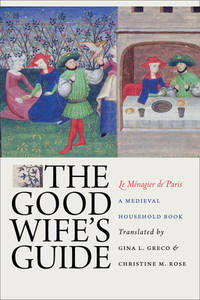
A9780801447389Hardback. New. "You said that you would not fail to improve yourself according to my teaching and correction and you would do everything in your power to behave according to my wishes." Prologue "I urge you to bewitch and bewitch again your future husband and. hardcover
6925229Cornell University Press pp. 384 . Papeback. New. Cornell University Press unknown
B9783725805846Hardback. New. hardcover
1689C0924<p>343 pages with woodcut printer's device on title. Duodecimo 5 1/2 x 3 1/4. Bound in leather with raised spine bands and gilt to spine. Originally written in 1619 in Italian. From the library of Lothar Schmid. Biblioteca van Der Niemeijeriana: 400 Third French edition.<br /><br />Gioachino Greco also known as Il Calabrese was born around 1600 in Celico which near Cosenza in Calabria. Calabria had already produced such players as Leonardo di Bono and Michele di Mauro. From his writing it's apparent the he wasn't educated and likely came from a lower class family. Already in 1619 Greco started keeping a notebook of tactics and particularly clever games and he took up the custom of giving copies of his manuscripts to his wealthy patrons. In Rome Monsignor Corsino della casa Minutoli Tegrini Cardinal Savelli and Monsignor Francisco Buoncompagni all received copies of which there are extant copies dated 1620 in the Corsiniana library in Rome under the title Trattato del nobilissimo gioco de scacchi. Despite his popularity in Rome in 1621 Greco took off to test himself against the rest of Europe leaving this paper trail as he went. In 1621 he left a fine copy of his manuscripts with Duke Enrico of Lorraine in Nancy. He traveled to Paris where he played Arnauld Isaac de Corbeville Enrico di Savoia the Marquis of St. Sorlin and the Duke of Nemours and Geneva and others. He had apparently been quite successful because in traveling from Paris to England he was waylaid by robbers who divested him of 5000 scudi a princely sum. Finally making it to London he beat all the best players. Sir Francis Godolphin and Nicholas Mountstephen were given copies of his manuscripts. While in London Greco developed an idea to record entire games rather than positions for study and inclusion in his manuscripts. He returned to Paris in 1624 where he rewrote his manuscript collection to reflect his new ideas. He then went to Spain and played at the court of Philip IV. There he beat his mentor and the strongest player of the time other than himself don Mariano Morano. He finally returned to Italy where he was enticed to traveling to the New Indies the Americas by a Spanish nobleman. He seemingly contracted some disease there and died around 1630 possibly 1634 at the young age of 30 34. He generously left all the money he earned at chess to the Jesuits. Gioachino Greco stood head and shoulders above his contemporaries a feat seldom duplicated. David Hooper in The Oxford Companion to Chess states that Greco probably made up the games in his manuscripts. The question of whether he actually played the games or invented them is rather moot since if he invented them he was perfectly capable of playing them.<br /><br />Lothar Maximilian Lorenz Schmid 10 May 1928 – 18 May 2013 was a German chess grandmaster. He was born in Radebeul near Dresden into a family who were the co-owners of the Karl May Press which published the German Karl May adventure novels. He was best known as the chief arbiter at several World Chess Championship matches in particular the 1972 encounter between Bobby Fischer and Boris Spassky at Reykjavic. He was also an avid collector of chess books and paraphernalia. It was reputed that he owned the largest known private chess library in the world as well as a renowned collection of chess art chess boards and chess pieces from around the globe.</p><p><strong>Condition:</strong><br /><br />Leather rubbed and scuffed Lothar Schmid's label to front paste down. Spine label missing spine bands rubbed old neat signature to title some doodling to back end papers else a good copy.</p> Jacques le Febure hardcover
1713C0588<p>343 pages. Duodecimo 5 ½" x 3 ¼". Bound in vellum with black lettering to spine. Originally written in 1619 in Italian. Biblioteca van Der Niemeijeriana: 402<br /><br />Gioachino Greco also known as Il Calabrese was born around 1600 in Celico which near Cosenza in Calabria. Calabria had already produced such players as Leonardo di Bono and Michele di Mauro. From his writing it's apparent the he wasn't educated and likely came from a lower class family. Already in 1619 Greco started keeping a notebook of tactics and particularly clever games and he took up the custom of giving copies of his manuscripts to his wealthy patrons. In Rome Monsignor Corsino della casa Minutoli Tegrini Cardinal Savelli and Monsignor Francisco Buoncompagni all received copies of which there are extant copies dated 1620 in the Corsiniana library in Rome under the title Trattato del nobilissimo gioco de scacchi. Despite his popularity in Rome in 1621 Greco took off to test himself against the rest of Europe leaving this paper trail as he went. In 1621 he left a fine copy of his manuscripts with Duke Enrico of Lorraine in Nancy. He traveled to Paris where he played Arnauld Isaac de Corbeville Enrico di Savoia the Marquis of St. Sorlin and the Duke of Nemours and Geneva and others. He had apparently been quite successful because in traveling from Paris to England he was waylaid by robbers who divested him of 5000 scudi a princely sum. Finally making it to London he beat all the best players. Sir Francis Godolphin and Nicholas Mountstephen were given copies of his manuscripts. While in London Greco developed an idea to record entire games rather than positions for study and inclusion in his manuscripts. He returned to Paris in 1624 where he rewrote his manuscript collection to reflect his new ideas. He then went to Spain and played at the court of Philip IV. There he beat his mentor and the strongest player of the time other than himself don Mariano Morano. He finally returned to Italy where he was enticed to traveling to the New Indies the Americas by a Spanish nobleman. He seemingly contracted some disease there and died around 1630 possibly 1634 at the young age of 30 34. He generously left all the money he earned at chess to the Jesuits. Gioachino Greco stood head and shoulders above his contemporaries a feat seldom duplicated. David Hooper in The Oxford Companion to Chess states that Greco probably made up the games in his manuscripts. The question of whether he actually played the games or invented them is rather moot since if he invented them he was perfectly capable of playing them.<br /><br /><strong>Condition:</strong><br /><br />Old owner's inscription laid in to both front and back paste downs some slight foxing still has the original ribbon book mark. Other wise a good copy.</p> Chezz Jacques Le Febvre hardcover
27855bagaloni Ancona. Broschiert 359 Seiten Vordergelenk mit Geweband verstärkt das Buch ist gut erhalten -- Softcover 359 pagesfrontjoint with tape the book is in a good condition bagaloni Ancona paperback
2009123551Naus Editoria. New. 2009. Paperback. 8874780125 . FREE UPGRADE to Courier/Priority Shipping Upon Request - IN STOCK AND IMMEDIATELY AVAILABLE FOR SHIPMENT - Flawless copy brand new pristine never opened. Text in Italian. with a bonus offer-- . Naus Editoria paperback
2005Q-157826197xHatherleigh Press 2005-08-30. Paperback. New. In shrink wrap. Looks like an interesting title! Hatherleigh Press paperback
2005Q-1578261988Hatherleigh Press 2005-08-30. Paperback. New. In shrink wrap. Looks like an interesting title! Hatherleigh Press paperback
2006G0975581201I4N00Quiet Time Publishing 2006. Paperback. Very Good. May have limited writing in cover pages. Pages are unmarked. ~ ThriftBooks: Read More Spend Less.Dust jacket quality is not guaranteed. Quiet Time Publishing paperback
0975581201.Gpaperback. Good. Access codes and supplements are not guaranteed with used items. May be an ex-library book. paperback
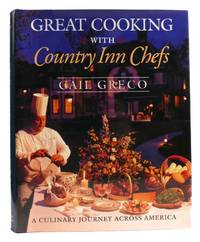
1992323346Nashville: Rutledge Hill Press 1992. First Edition; First Printing. Hardcover. Near Fine in a Near Fine dust jacket.; :; 256 pages. Rutledge Hill Press hardcover
20112-8884027187Salerno 2011. Perfect Paperback. New. Italian language. 9.06x6.30x1.34 inches. Salerno paperback
1993263650PN. New. 1993. Soft Cover. Date is original print. This is a reprint edition . PN paperback
ria9782817800158_inpPaperback. New. New Book; Fast Shipping from UK; Not signed; Not First Edition; N/A paperback
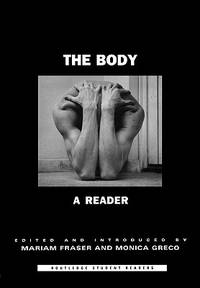
2005Q-041534008XRoutledge 2005-01-10. Paperback. New. In shrink wrap. Looks like an interesting title! Routledge paperback
2005x-041534008XRoutledge 2005. Paperback. New. 1st edition. 348 pages. 9.25x7.00x0.75 inches. Routledge paperback
1989798535PN. New. 1989. Soft Cover. Date is original print. This is a reprint edition. . PN paperback
Sidén, KarinIn Pristine Condition. unknown
2017x-331961892XSpringer 2017. Hardcover. New. 511 pages. 9.25x6.10x1.30 inches. Springer hardcover
2018x-3319871870Springer-Verlag New York Inc 2018. Paperback. New. com rep edition. 502 pages. 9.25x6.10x1.34 inches. Springer-Verlag New York Inc paperback