MareMagnum
Antiquariat.de
The European Fine Art Fair . Maastricht 06
200611621Maastricht o. V., 2006. 565 S. 4° Quart Brosch.

Antiquariat Boller · DE - Staufenberg14,10 €
2 649 résultats
EXTREMELY RARE collection of 51 engravings, originally collected by Yitzhak Ben-Zvi, the second President of the State of Israel. The engravings were originally produced in the 19th century, and reprinted for this undated book. There is no information given about the identity of the artists nor the date of printing of these reproductions, but they are likely to have been printed in the late 1960's - the years in which the Israeli Publishing Institute was active. The book contains all 51 engravings listed in its index. All engravings are in b&w, and depict dramatic landscape art and the daily life in the 19th-century Hold Land. Each engraving is mounted inside a separate plate with a window at the front. The 51 plates are loose inside a cardboard case, which also contains a short introduction (unsigned) and three index pages. The index gives some explanation about each image. 285x235mm. Unpaginated, with a title page, 1 introduction page, 3 index pages, and the aforementioned 51 engravings mounted on separate plates. Tan faux-parchment cardboard folder case with illustrated title sticker on front. Case is in shoddy condition, with all corners worn, most edges worn, and all hinges broken detached from each other. All pages and plates in excellent condition with very mild yellowing and a few very-slightly bent corners. Plate 21 is creased, though the engraving itself is not creased nor damaged. [SUMMARY]: Despite considerable deterioration in the state of its outer casing, this relatively unknown collection of extremely-rare 19th-century engravings is internally in excellent condition.
EXTREMELY RARE collection of 51 engravings, originally collected by Yitzhak Ben-Zvi, the second President of the State of Israel. The engravings were originally produced in the 19th century, and reprinted for this undated book. There is no information given about the identity of the artists nor the date of printing of these reproductions, but they are likely to have been printed in the late 1960's - the years in which the Israeli Publishing Institute was active. The book contains all 51 engravings listed in its index. All engravings are in b&w, and depict dramatic landscape art and the daily life in the 19th-century Hold Land. Each engraving is mounted inside a separate plate with a window at the front. The 51 plates are loose inside a cardboard case, which also contains a short introduction (unsigned) and three index pages. The index gives some explanation about each image. 285x235mm. Unpaginated, with a title page, 1 introduction page, 3 index pages, and the aforementioned 51 engravings mounted on separate plates. Tan faux-parchment cardboard folder case with illustrated title sticker on front. Case is in shoddy condition, with all corners worn, most edges worn, and hinges partly cracked and glued/taped, thus the folder case is still more or less intact. All pages and plates in excellent condition with very mild yellowing and a few very-slightly bent corners. [SUMMARY]: Despite considerable deterioration in the state of its outer casing, this relatively unknown collection of extremely-rare 19th-century engravings is internally in excellent condition.
200611621Maastricht o. V., 2006. 565 S. 4° Quart Brosch.
200811620Maastricht o. V., 2008. 573 S. 4° Quart Brosch.
201011619Maastricht o. V., 2010. 639 S. 4° Quart Brosch.
201111622Maastricht o. V., 2011. 627 S. 4° Quart Brosch.
A clean, unmarked book with a tight binding. 64 pages. Includes work by Canadian artists Tom Thomson, Alexander Young Jackson, J.E.H. MacDonald, and more.
Revised Edition. This book was published on the occasion of The Rainbow Show exhibition in San Francisco. It focuses on the meaning of color (physically and metaphysically) from ancient to modern times, and information is arranged in increasing order of complexity. Many black and white photographs and illustrations. 7 1/4"w x 11 7/8"h. 208 pages.
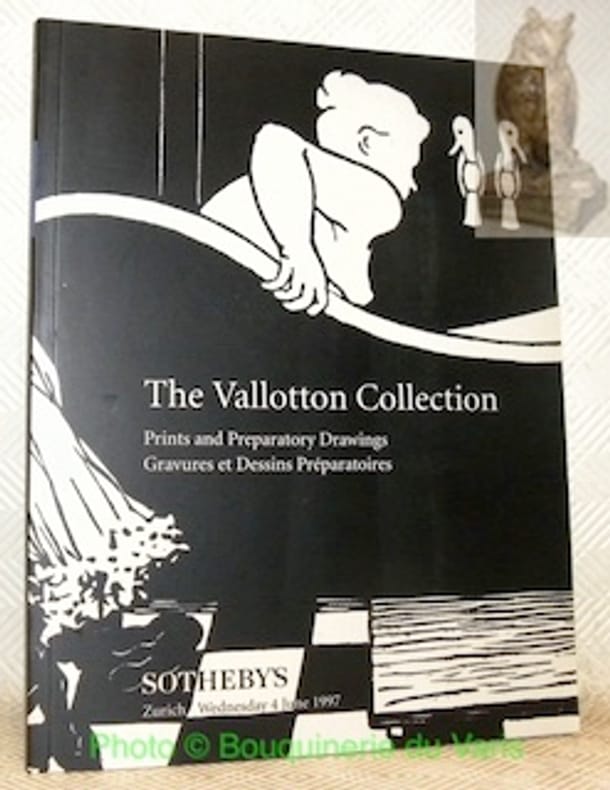
106510Zurich, 1997, 270x210mm, 145pages, paperback. Cachet de possesseur sur le haut de la page de faux-titre, autrement très bel exemplaire.
A clean, unmarked book with a tight binding. Glossy pictorial cover; slightly bumped corners. 11 7/8"w x 8 1/2"h. 86 pages. Published in conjunction with exhibition at Flora Bigai Arte Moderna e Contemporanea, Venezia und Pietrasanta.
Contains b&w plates. 34.5x25.5 cm. 125 pages. Hardcover laid in slipcase. Slipcase yellowing, stained and worn. Cover slightly curved. Few pages slightly stained - no damage to text. Few pages yellowing and slightly wavy. Else in good condition.
345x255 mm. 125 pages. Hardcover. Cover rubbed. Cover corners slightly bumped. Spine edges bumped. Inner cover and pages yellowing. Else in good condition.
1929014644Paris Galerie E. Druet 1929 In-12 Agrafé
1875015992Paris Drouot. Boussaton & Baubigny 1875 in-8° Broché
201068835BBBonn., VG Bild-Kunst., 2010. 29 x 24 cm. 358 S. OEnglisch-Broschur., 68835B Erste Auflage. Sehr gutes, frisches Exemplar.
240x340 mm. No pagination. Gilt hardcover in dust-jacket. Cover slightly curved. Else in good condition.
a105714All 5 are VG or better wraps no owner marks. 1 Indian Paintings from Olsky Collections Art Museum at Princeton University. 40p. bw illus; 2 Paintings from the Muslim Courts of India exhibition British Museum. 99p. 3 Persian and Islamic Works of Art Christies auction April 1976. 92 lots 4 Fine Oriental Miniatures Manuscripts and Islamic Works of Art Sotheby's sale June 1980. 331 items. 5 Sotheby's. Fine Orientla Miniatures etc Dec 10 1981. 321 items. Lot of 5 catalogues: . paperback
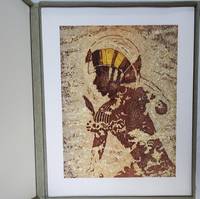
198174497New York: Hammer Publications 1981. First edition. One of 300 numbered copies. Folio 19 x 23 inches. Introduction sheet by Carl Sagan and 10 serigraphs of cave art with each print having a leaf of explanatory text. Housed in the original brown box with cover lettering. Pinholes to corners professionally and invisibly repaired. A very good copy. Oddly only 2 copies recorded by OCLC.The finest and most beautiful reproductions of European cave paintings ever published. Every major continent has cave paintings by prehistoric man and they have long fascinated the modern world. There has been a plethora of books and theories about these cave painting starting from the work of Abbé Henri Breuil and extending to today. Perhaps one of the most finely executed works on the subject is the title offered here. This suite of prints was created in conjunction with an exhibition at Hammer Galleries in NYC in the fall of 1982. Mazonowicz who lived in Spain spent time visiting Altamira and Valltorta and Gasulla and also traveled to the caves of France and the Sahara. He created 20 life sized reproductions of cave paintings ten of which are included in this portfolio. Titles include: Bowmen and Deer Two Figures in Finery Engraved Frieze Hunter and Ibex Head of a Horse Giraffe Prancing Horse Crouching Bison Group of Antelopes and Helmeted Warrior.Douglas Howcroft Mazonowicz a graphic artist helped preserve some of the world's most famous prehistoric cave paintings by recreating them on silk. Born in Swindon in Wiltshire England Mr. Mazonowicz spent 15 years in France Spain North Africa and North America seeking prehistoric art. Mazonowicz wrote several books about prehistoric art including: Prehistoric Rock Paintings of Tassili n’ Ajjer 1969; In Search of Cave Art 1973; Voices from the Stone Age 1974 and The Hand of Man 1981. "Mazonowicz photographed the works he reproduced using a slide projection of the work on drawing paper. Over the slide projection he drew black outline details of the painting. He then began to transfer the image using a silkscreen technique. A new screen was prepared for each color application. Mazonowicz used modern oil based colors instead of the mineral-based colors of the stone age artists. His goal was to faithfully preserve the rock paintings since they are subject to modern day pollution and vandals" Rogallery. Hammer Publications unknown
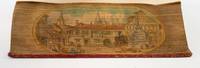
1831ST20481-04London: Thomas Tegg; J. Cumming Dublin; and R. Griffin and Co. Glasgow 1831. 170 x 100 mm. 6 3/4 x 4". Four volumes. Edited by John Wright. <br/> Contemporary black morocco covers with an elaborate frame in gilt and blind raised bands spine compartments gilt with foliate volutes turn-ins with a narrow gilt roll marbled endpapers all edges gilt rear hinge of fourth volume very neatly repaired. The first volume WITH AN EXCELLENT FORE-EDGE PAINTING DEPICTING ROTTERDAM FROM THE WATER. The first volume WITH AN EXCELLENT FORE-EDGE PAINTING DEPICTING ROTTERDAM FROM THE WATER. All volumes with numerous wood-engravings in the text. Corners and spine somewhat worn joints a little rubbed hinges of first volume open but nothing loose; pastedowns with shadow of bookplate removal but internally fresh clean and bright with only trivial defects.<br/> <br/> This set of an English adaptation of one of the most widely read works of the Enlightenment features a pleasing fore-edge painting full of charming detail. With his enormously influential "Histoire Naturelle" Buffon 1707-88 became the first person to present the natural world as one unified whole entirely explicable in scientific terms and in a popular form. Modern evolutionary biologist Ernst Mayr called Buffon "the father of all thought in natural history in the second half of the 18th century" and declared that the "Natural History" was read by "every educated person in Europe." Our editor John Wright has augmented Buffon's work with the works of other naturalists including Culver Lacepede and "a British botanist of acknowledged note" among others. The text is supplemented by numerous wood engravings with perhaps livelier and more attractive depictions than might be expected from a small format abridged edition like this one. The main attraction here the fore-edge painting has been done with not inconsiderable skill and charm. In it two vessels cruise the glassy waters of Rotterdam the city's iconic canal houses and the gothic church of St. Lawrence rising in the background. The scene mixes tranquility and commerce in a tableau rendered with a great deal of care and delicacy in its minute details. Thomas Tegg; J. Cumming, Dublin; and R. Griffin and Co., Glasgow unknown
1809ST14310fLondon: J. Hatchard 1809. 210 x 133 mm. 8 1/4 x 5 1/4". xvi 291 pp.Translated by Louisa A. Marshall. <br/> Contemporary dark blue straight-grain morocco covers bordered with gilt rule flat spine with simple gilt rules and titling gilt-ruled turn-ins all edges gilt and WITH A FINE FORE-EDGE PAINTING OF A SCENIC RIVER VIEW FEATURING CHRIST CHURCH PRIORY in Hampshire. Front free endpaper with owner signature of E. A. Fetherston. Slight variation in color of boards half title with one inch trimmed away at head probably removing owner inscription leaves a shade less than bright occasional minor foxing or offsetting in the text bed but still an excellent copy the text clean and fresh the pleasant binding entirely sound and the lovely fore-edge painting very well preserved.<br/> <br/> The typically bucolic fore-edge scene here--boat in tranquil water stately building occupying center stage trees all around puffy clouds--stands out for the level of achievement in execution by the artist. The clouds are painted in a delicately applied range of shades so that they are very convincing; there is considerable architectural detail visible on the side of the church; and it seems as if one can almost see individual leaves in the trees. These features are all hallmarks of the work of the so-called "Dover Painter" the name given by Jeff Weber to the artist who produced very high quality painted fore edges in the 1920s and 1930s. He did work for the famous London bookseller Marks & Company for Dawson's Bookshop in Los Angeles and for J. W. Robinson Company the Los Angeles department store. Estelle Doheny 1875-1958 whose library comprised one of the great collections of the 20th century bought actively from Dawson's and Weber estimates that approximately half of the very considerable number of especially fine fore-edge paintings in the Doheny collection in Camarillo California were done by the Dover Painter. As the fore-edge painting here evokes a feeling of serenity so too does the content religious meditations by François Fénélon 1651-1715 priest writer and tutor to King Louis XIV's grandson for whom he composed his best-known work "The Adventures of Telemachus.". J. Hatchard unknown
1840ST20481-06Paris: Chez L. Hachette 1840. 224 x 131 mm. 8 1/2 x 5 1/4". 2 p.l. 822 pp. 1 leaf title 1-259 1 pp. <br/> Attractive contemporary scarlet morocco covers ruled in blind central panel with an elaborate gilt-tooled cross surrounded by a scrolling frame raised bands spine gilt in compartments tooled with small fleurons turn-ins tooled in gilt all edges gilt.features a well-executed and historically important fore-edge painting that depicts a famous tribute to one of the most celebrated figures in French Catholicism. The fresh richly painted scene here shows the Place de la Pucelle in Rouen with the fountain of Joan of Arc featured prominently in the foreground. This view inspired works from a number of artists and writers such as watercolorist Samuel Prout and American poet Maria White Lowell whose poem "Rouen Place de la Pucelle" was published ca. 1858. Visual records like this of the square and fountain are historically important because they were destroyed in the Red Week bombings of 1944. WITH AN EXCELLENT FORE-EDGE PAINTING DEPICTING LA PLACE DE LA PUCELLE ROUEN. Occasional early pencil marginalia. Corners a bit bumped edges and joints with a little rubbing but this well disguised with dye spine very slightly sunned and dried. Occasional scattered spots mostly marginal other trivial defects but generally fine internally very fresh and quite bright. An attractive binding with a very lovely painting.<br/> <br/> This attractive French-language Bible features a well-executed and historically important fore-edge painting that depicts a famous tribute to one of the most celebrated figures in French Catholicism. The fresh richly painted scene here shows the Place de la Pucelle in Rouen with the fountain of Joan of Arc featured prominently in the foreground. This view inspired works from a number of artists and writers such as watercolorist Samuel Prout and American poet Maria White Lowell whose poem "Rouen Place de la Pucelle" was published ca. 1858. Visual records like this of the square and fountain are historically important because they were destroyed in the Red Week bombings of 1944. Chez L. Hachette unknown
1797ST19344London: Printed by T. Gillet for Longman et al. 1797. 265 x 163 mm. 10 3/8 x 6 3/8". Two volumes. <br/> Contemporary green straight-grain morocco covers with double gilt fillet border raised bands gilt titling turn-ins with decorative gilt roll marbled endpapers all edge gilt inexpert older repairs to joints. EACH VOLUME WITH RICHLY DETAILED FORE-EDGE PAINTING that on volume I depicting the old Tabard Inn Southwark and that on volume II showing Furnival's Inn Holborn. Housed in a fleece-lined double-compartment slipcase. Title pages with engraved vignette. Front flyleaf of each volume with ink ownership inscription of Mary Erskine dated 1803 noting it was a wedding gift from her cousin Lord Wodehouse and with later ink presentation inscription to "Walter and Katherine" on their 13th wedding anniversary 17 February 1931 from "their mother Kate Goodrich." Spines faded to brown as usual with green morocco and with half a dozen minor abrasions joints somewhat worn front joint of vol. II with four-inch crack at head but the bindings entirely solid the contents clean and fresh with only insignificant imperfections and the fore-edge paintings very well-preserved.<br/> <br/> This is a charming pair of large fore-edge paintings depicting two historic London inns each full of detail and painted on text blocks that fan out beautifully with very little effort. The text here is a late 18th century edition of a controversial and short-lived periodical known as "The Guardian" spearheaded by writer and politician Richard Steele who also founded "The Tatler" and "The Spectator". "The Guardian" as DNB relates ran from 12 March to 1 October 1713 and "is chiefly remembered for the quality of the contributors on whom Steele drew including Edward Young George Berkeley Alexander Pope and of course Joseph Addison." The two inns depicted in the fore-edge paintings here also have literary credentials: the Tabard Inn in Southwark was chosen by Chaucer as the starting point for the "Canterbury Tales" and Furnival's Inn in Holborn will be known to Dickens enthusiasts as the place where he began writing "The Pickwick Papers." The original Tabard Inn burned down in the Great Fire but was immediately rebuilt and became a popular stopping point for stagecoaches as depicted in the present painting. The dirt road in front of the inn is dominated by a large covered wagon and team of horses with a pair of men gesturing in the foreground and others idling nearby; Furnival's Inn by contrast was an Inn of the Chancery and enjoyed much tidier surroundings: the streets in the fore-edge painting here are cobbled the ladies and gentlemen are well dressed and even the rubbish has been neatly piled to one side. Both paintings date from the late 19th century and are based on engravings found in "Old and New London" by George Walter Thornbury ca. 1880. Though unsigned they are extremely well done and offer wonderful views of London haunts from both sides of the Thames. Printed by T. Gillet for Longman et al. unknown
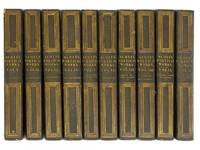
1805ST19580London: Printed for F. C. and J. Rivington et al. 1805. 238 x 145 mm. 9 3/8 x 5 3/4". 10 volumes. Edited by George Steevens and Alexander Chalmers. <br/> EXTREMELY PRETTY CONTEMPORARY DEEP PURPLE STRAIGHT-GRAIN MOROCCO VERY ELABORATELY DECORATED IN GILT AND BLIND covers with frame featuring heavy gilt stippling and tooling spine compartments densely gilt gilt-rolled turn-ins leather hinges all edges gilt. EACH VOLUME WITH AN ATTRACTIVE FORE-EDGE PAINTING featuring scenic views of waterways bridges cottages and castles and one figurative scene. With frontispiece portrait engraved ornament pasted down on title page apparently to cover up the mention of the engravings which this set was evidently issued without. A Large Paper Copy. Jaggard p. 510; Lowndes IV 2264. Just a hint of wear to joints and extremities and this expertly refurbished a small gouge on rear board of volume I internally with occasional mild browning scattered foxing and stains but the bindings lustrous and glittering with gold the fore-edge paintings well preserved and the interiors clean and fresh. AN EXTREMELY ATTRACTIVE COPY OF QUITE A SPECIAL ITEM.<br/> <br/> Enriched with learned essays and commentary this handsome printing of Steevens' acclaimed edition of Shakespeare's dramatic works comes in a lovely contemporary binding with later--but impressive--fore-edge paintings. Our set is the 10-volume version of Steevens printed on royal octavo paper a slightly less desirable nine-volume set on thinner octavo paper was also available. While the set was offered with plates the professionally printed and applied engraved ornaments covering the title page reference to engravings suggests that the publisher also sold sets without them auction records bear out this theory. The original owner may have chosen to save money on plates so he could splash out on the present richly gilt full morocco bindings that make an impressive appearance on the shelf. Then that owner or more likely a somewhat later one commissioned the paintings of the 10 fore edges. These are richly detailed crispy executed compositions mainly showing exterior scenes featuring castles or old city buildings. Although they do not necessarily have a clear connection with any individual play in any specific volume they do communicate the feeling of the period of Shakespeare's life. And most important they are skillfully done by an unusually deft painter. Steevens 1736-1800 had originally published his revision of Johnson's edition of Shakespeare in 1773 the revision being praised by Lowndes as combining "the native powers of Dr. Johnson with the activity sagacity and antiquarian learning of . . . Steevens." Volume I contains prefaces by Pope Johnson and Chalmers a sketch of Shakespeare's life by Chalmers Shakespeare's will and a history of the stage by Malone. Considered in all its aspects--as an esteemed edition of the bard's works as a gloriously decorated set on the shelf and as 10 expert fore-edge paintings--this item has much to recommend it. Printed for F. C. and J. Rivington et al. unknown
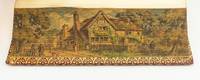
1843ST20616London: Tilt and Bogue 1843. 207 x 135 mm. 8 1/8 x 5 5/8". Two volumes. With a memoir and critical remarks by James Montgomery. <br/> Pleasing contemporary burgundy pebble-grain morocco gilt covers with graceful frame of cresting roll accented with lancets large lyre centerpiece with leafy flourishes and small birds raised bands spine compartments densely gilt gilt lettering gilt turn-ins all edges gilt. WITH LOVELY FORE-EDGE PAINTINGS BY THE "DOVER PAINTER" one of Milton's cottage at Chalfont and the other of St. Giles Church Cripplegate. With decorative engraved initials and 95 engraved vignettes after drawings by William Harvey. Weber "Annotated Dictionary of Fore-edge Painting Artists & Binders" pp. 98-103. Muir "Victorian Illustrated Books" p. 28. Spines gently and evenly sunned joints and extremities a little rubbed one margin with faint paint trail from fore-edge painter's brush other trivial imperfections but A VERY APPEALING COPY internally clean and fresh in solid bindings with bright gilt and the fore-edge paintings especially well preserved.<br/> <br/> This copy of Milton's collected poems is very attractively illustrated inside and out with an extremely skillful painting by a famous artist adorning each of the fore edges. Designed by William Harvey 1796-1866 who Muir tells us was "the longest lived and most important of Bewick's pupils" the engravings here range from charming figural initials to writhing residents of Hell in their smoky abyss to gentle-faced angels bathed in beams of light. The fore-edge paintings are recognizable as the work of the so-called "Dover Painter" the name given by Jeff Weber to the artist who produced very high quality painted fore edges in the 1920s and 1930s for the famous London bookseller Marks & Company. These two depict Milton's cottage and his final resting place St. Giles' Church in London. The cottage is depicted in an idyllic scene of Milton's time with aproned peasants milling about the ivy-covered building under the shade of the trees that frame the scene. The other painting shows a lively urban street: the church's venerable structure is flanked by bustling shops visited by gentlemen with fashionable canes while the smoke from the chimneys trails upward into the cloudy sky. These clouds and the trees surrounding the cottage are particularly demonstrative of our artist's distinctive style of applying dabs of paint a technique that almost suggests a quasi-pointillism. Taken together the substantial content lovely contemporary red morocco bindings and finely executed and well-preserved fore-edge paintings combine to make up a set of considerably seductive appeal. Tilt and Bogue unknown
1821229079Edinburgh: Arch. Constable 1821. Vignette title -page drawn by A. Nasmyth Engraved by W. H. Lizars. 10 vols. 16mo. Contemporary full green straight grained morocco gilt spine a.e.g. Fine some internal foxin. Signed M.T.K. Jr. Xmas 1927. Vignette title -page drawn by A. Nasmyth Engraved by W. H. Lizars. 10 vols. 16mo. Each volume with a fine early fore-edge painting of a Scottish scene identified in an old hand in block letters on the ffep.<br /> Volume I : Berwick-on-Tweed<br /> Volume II : Falkland Palace<br /> Volume III : Edinburgh Castle<br /> Volume IV : Barnborough Castle<br /> Volume V : Hollyrood Palace Edinburgh<br /> Volume VI : Norham The Castle and The Cross<br /> Volume VII: Stirling Castle<br /> Volume VIII: Barnard Castle<br /> Volume IX : Stirling Bridge and Castle<br /> Volume X : Abbotsford. Arch. Constable unknown