(FORE-EDGE PAINTINGS). HAMILTON, ROBERTBiblio.com
2 649 résultats
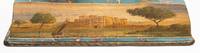
1830ST20481-05London: John Murray 1830. FIRST EDITION. 220 x 130 mm. 8 5/8 x 5 1/8". 2 p.l. ii v-xix 1 411 1 pp. <br/> Agreeable contemporary black morocco covers with an elaborate border in gilt and blind of numerous straight and decorative rules and scrolling foliate cornerpieces raised bands gilt in compartments with a central ornament in blind turn-ins tooled in gilt all edges gilt. Carefully rebacked retaining original spine hinges neatly reinforced with buckram. WITH A FORE-EDGE PAINTING DEPICTING A LANDSCAPE WITH A VERY LARGE CASTLE AND LAKE. With 13 pages of charts. Corners bumped and exposed a handful of scratches to the front cover; occasional spots and soiling internally other trivial defects but still quite a good copy the bulk of the text extremely clean and fresh with a well-preserved fore-edge painting.<br/> <br/> This is a pleasing copy with an attractive fore-edge painting of the final work of Scottish mathematician and economist Robert Hamilton 1743-1829. A professor at the University of Aberdeen and one of the founders of Edinburgh's Royal Society Hamilton wrote this work of political economy shortly before his passing and it was published posthumously. It treats of the relationship between economic principles and the development of social life and is considered perhaps second in importance only to his "Essay on the National Debt" issued in 1813. The fore-edge painting depicts a serene landscape with sailboat gliding across a smooth lake in front of a castle and tree-studded hills. The artist has rendered the details with subtlety for example the castle is faintly reflected in the lake and the scene as a whole is brigher and richer in color than might be expected. John Murray unknown
192 p. Damp stain. Age stain. 12mo. 190 mm. Original cloth spine over paper covered boards. Boards damp stained with loss. Paper spine label perished. Hardbound. Fair. Haliburton was a Nova Scotian politician, judge, and author. Politically, he played a significant role in the history of Nova Scotia prior to its entry into Confederation. While Haliburton gained a reputation as a local businessman and as a judge, his greatest fame came from writing. He wrote a number of books on history, politics, and farm improvement. He rose to international fame with his Clockmaker serial, which first appeared in the Novascotian and later published as a book throughout the British Empire, becoming popular light reading. The work recounted the humorous adventures of the character Sam Slick. He was the first international best-selling author from what is now Canada. S&S/AI 56101. First edition of the second series. PAIMP 23
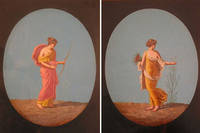
18236probably Italian 19th Century. 2 vols. Oval images each 10 x 8 inches vividly matted in gold and framed and glazed to 20 x 16-1/2 inches. Very good. 2 vols. Oval images each 10 x 8 inches vividly matted in gold and framed and glazed to 20 x 16-1/2 inches. Decorative studies probably from a larger series of classical divinities. unknown
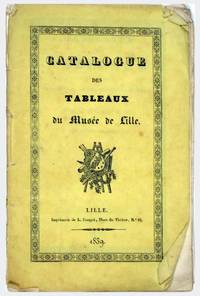
18391001611839. Lille L. Jacqué 1839. Titlepage 231pp. pp. 3-6 loose. 8vo. Original yellow decorated wrappers dam. & dogeared some foxing throughout and a few pages loose. unknown
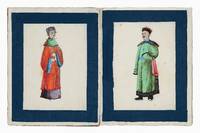
65895China c.1870. 8vo. 20 x 15 cm. Album of contemporary patterned cloth covered boards with 12 leaves of finely coloured illustrations on pith paper each secured with blue silk border. 4 of the images with just minimal cracking. Pith came into use for painting to satisfy the increasing demand for small inexpensive and easily transported souvenirs following the massive growth in the China Trade in the first half of the nineteenth century. Paintings in oils on board and canvas were costly and difficult to carry home. Earlier and more prestigious export water-colours had often been on a larger scale and painted on fine Chinese paper or on paper imported from Europe. The albums of pith paintings and later the little glass-fronted boxes were inexpensive light easy to pack and gave the pictures some protection on the long voyage home. Because many were sold in albums and hence protected from the light they retain their bright colours to this day. Pith comes from the central column of spongy cellular tissue in the stem of a small tree called Tetrapanax Papyrifera native to south-west China. It has had a variety of some going back many centuries. At the imperial court both men and women wore coloured flowers made from pith in their hair. For use in painting it is cut by hand with a knife into thin sheets from short lengths of the spongy tissue. Cutting is highly skilled and the constraints of the process mean that the finished sheets for painting seldom if ever measure more than about 30cms by 20cms. The sheets are dried trimmed and used for painting without any further processing. Because of the nature of pith and its cellular structure the gouache used by the Chinese sat on the surface and produced a bright and even sparkling effect. Very fine detail could be achieved but pith did not lend itself to the flat wash of colour favoured for European watercolours. These albums are difficult to date specifically as they are seldom signed and never actually dated. They are known to have been produced from the 1830s through to the 1870s [China, c.1870] hardcover
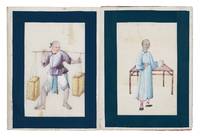
65894China c.1870. 8vo. 20 x 15 cm. Album of contemporary patterned cloth covered boards with 12 leaves of finely coloured illustrations on pith paper each secured with blue silk border. Just 2 short cracks generally very good condition. Pith came into use for painting to satisfy the increasing demand for small inexpensive and easily transported souvenirs following the massive growth in the China Trade in the first half of the nineteenth century. Paintings in oils on board and canvas were costly and difficult to carry home. Earlier and more prestigious export water-colours had often been on a larger scale and painted on fine Chinese paper or on paper imported from Europe. The albums of pith paintings and later the little glass-fronted boxes were inexpensive light easy to pack and gave the pictures some protection on the long voyage home. Because many were sold in albums and hence protected from the light they retain their bright colours to this day. Pith comes from the central column of spongy cellular tissue in the stem of a small tree called Tetrapanax Papyrifera native to south-west China. It has had a variety of some going back many centuries. At the imperial court both men and women wore coloured flowers made from pith in their hair. For use in painting it is cut by hand with a knife into thin sheets from short lengths of the spongy tissue. Cutting is highly skilled and the constraints of the process mean that the finished sheets for painting seldom if ever measure more than about 30cms by 20cms. The sheets are dried trimmed and used for painting without any further processing. Because of the nature of pith and its cellular structure the gouache used by the Chinese sat on the surface and produced a bright and even sparkling effect. Very fine detail could be achieved but pith did not lend itself to the flat wash of colour favoured for European watercolours. These albums are difficult to date specifically as they are seldom signed and never actually dated. They are known to have been produced from the 1830s through to the 1870s [China, c.1870] hardcover
2081502111809475HP image available N.A. Soft Cover. Fine. Number of copies: sheets HP image available paperback
1930012910Paris 1930 In-12 agrafé, couverture illustrée
7669Paris, Drouot Montaigne, 1990. In-4, reliure toilée, reproductions, jaquette.
188135501390Paris, , 1881 ; in-8 br. 89 pp La vente comporte 175 tableaux anciens. 6 eaux-fortes reproduisent les très grandes oeuvres
11914P., Galerie Georges Petit, 1932 ; in-4. 40ff. dont 22 planches reproduisant 24 tableaux en noir. Relié dans sous couverture imprimée à rabats contrecollée sur toile noire. Dos recollé.
GF30409Un catalogue in4 broché nde 16 pages sur papier vergé - reproductions d'oeuvres en noir -
GF30393Une plaquette in-8 brochée non paginée - quelques reproductions d'oeuvres en noir - Textes d'introduction par G. Dezeaux -
GF30392Une plaquette in-8 brochée non paginée - quelques reproductions d'oeuvres en noir - Textes d'introduction -
GF31865Un catalogue in4 broché non paginés imprimé sur beau papier crème -deux illustrations en noir pleine page (le buste de Geroges Gougenot par Pigalle)
GF30513Un catalogue in-4 broché non paginé imprimé sur papier glacé - nombreuses reproductions d'oeuvres en noir et en couleurs -
GF30346Un volume grand in-4 de 101 pages sur beau papier teinté beige - Illustrations en noir hors texte protégées par une serpente. couverture rempliée - (311 lots sont décrits) -
GF20919Paris - Hotel Drouot - ventes des 25 et 26 février 1929 - Un volume in-4 broché de 44 pages de texte - 11 planches hors texte de reproductions en noir -
192289851922 Paris, Drouot, 1922. Un volume in-4 broché, couverture bleue imprimée, 81 pages, planches hors-texte. Bon état.
192289801922 Paris, Drouot, 1922. Un volume in-4 broché, couverture bleue imprimée, 88 pages, illustrations en n&b. Bon état.
192989681929 Paris, mai 1929. Un volume in-4 broché, couverture beige imprimée et rempliée, 64 pp. et planches hors-texte. Bon état.
193189821931 Paris, Drouot, 1931. Un volume in-4 broché, couverture beige imprimée,31 pages, planches hors-texte. Bon état.
193289841932 Paris, Drouot, 1932. Un volume in-4 broché, couverture beige imprimée, 29 pages, planches hors-texte. Bon état.
193689691936 Paris, 1936. Un volume in-4 broché, couverture beige imprimée et rempliée, 165 pp. et planches hors-texte. Couverture défraîchie, intérieur frais.
191989771919 Paris, Drouot, 1919. Un volume in-4 broché, couverture orange imprimée, 20 pages, planches hors-texte. Bon état, exemplaire en partie non coupé.