Knackfuß, HermannAntiquariat.de

34 résultats
189577998Bielefeld und Leipzig: Verlag von Velhagen & Klasing, 1895. 26 cm ; Leder
1898602609Bielefeld, Velhagen & Klasing, 1898. 4°. M. 48 Abb. 2 Bl., 64 S. Flex. OLwd. m. Kppfgoldschn. Einbd. gering fleckig. (Künstler-Monographien 6).
189828711Paris France: Librairie Renouard / Henri Laurens Editeur. As New. 1898. Hardcover. FREE UPGRADE to Courier/Priority Shipping Upon Request - IN STOCK AND IMMEDIATELY AVAILABLE FOR SHIPMENT - AS NEW THE TEXT BLOCK IS PRISTINE CLEAN UNMARKED AND IN EXCELLENT CONDITION - - Illustrated. Rare. -- with a bonus offer-- . Librairie Renouard / Henri Laurens, Editeur hardcover
187680652Richmond VA: Dustin Gilman & Co. 1876. First Edition. Hardback. Worn But Complete Condition. Illus. by "profusely" Illustrated . Dustin, Gilman & Co. Hardcover
1899320237appleton 1899 thick hardback book in good to very good conditionname on first blank page. Hardcover. Good. appleton hardcover
1877mon0000939003D.Appleton & Company 1877. Hardcover. Good. in x in x in. Seoane's Neuman & Baretti's.rnCover has heavy rubbing and chipping discoloration D.Appleton & Company hardcover
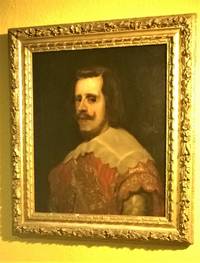
1815149<p><strong>c.1815 Oil on canvas gilt framed portrail of King Philip IV of Spain.</strong></p><p><strong>Attributed to Sir Thomas Lawrence crafted in the manner or style of Diego Velazquez the Court Painter.</strong></p><p>The painting was dated by an expert valuer to 1810-20 based on the frame the age of the paint and also by the particular weave of the canvas being of the type woven on the earliest canvas-making machine which was invented in 1805 in France and became used more widely from 1810 onwards.</p><p>The subject King Philip IV reigned from 1621-1665 having been born in 1605. He was called the Planet King Rey Planeta and reigned during the Thirty Years War while also being renowned as a patron of some of the earliest great Old Master artists such as Spaniard Diego Velazquez and also Peter Paul Rubens the famous Flemish artist.</p><p>The last three great Old Masters of the British painters were John Singer Sargent George Stubbs and Sir Thomas Lawrence. As masters themselves they studied the forms of the older masters and re-worked their themes often adding some detail of their own. It is hard to see the hands of either Stubbs or Sargent at work here but the deeply baroque style of Lawrence sits well with the colours used he loved his red he enjoyed the play of light upon a fleshy face in emulation of Rubens he had an expressed interest in the work of Diego Velazquez. He also worked in London where the frame was made which itself conforms in many ways to the style of frames used for Lawrence's other known artworks in the period 1815-25. In fact in 1815 the studio of Sir Thomas Lawrence purchased from Byfields of Soho some 24 feet and 6 inches of "oak leaf acorn and rope" patterned and gilded plaster to be used in frames itself being crafted by the specialist frame decorator George Jackson. It is likely our painting being dated between 1810-1820 that this frame was crafted from that block. We know also that Sir Thomas Lawrence also kept a stock of spare frames yet there is nothing of the random fit between the portrait of King Philip IV who reigned in the 17th Century at the time when the acorn and oak leaf style of frame was the height of fashion re-worked once again by Sir Thomas Lawrence in London. Most of his artworks were intelligently framed as he himself insisted upon. And he liked his frames not to have accentuation around them especially at the corners no decorations there to distract the eye. And this style of frame perfectly matches his standards as does the level of the art the subject of the artwork an old master's take on a grand European king of Habsburg lineage who are known from their pronounced jaws.</p><p>Condition: Very Good. The painting was formerly removed from the frame by a previous owner with new pins used to replace it back into the rear again so the original backing nails are gone and the grey paper lining to rear was necessarily split open in the process as can be seen. The rear of canvas has light felt pen writing which appears to pertain to a silly game played by a boy possibly in a warehouse or storehouse where the painting once sat for a time. There is also an accompanying light water stain at the rear of the canvas not appearing to have affected the painting itself. Undoubtedly it would benefit from being professionally cleaned although the surface retains its original lustre when seen in the light. Certainly at the top of the king's chest is a small point of damage which can be seen in photos which would need restoring to realise the fullest value. There are also two tiny nicks at the inner edge of the gilt frame one at inner base edge the other in line at the inner top edge neither of these affect the painting itself. The rear of the frame has some pen markings relating to a catalogue or location number there is a torn card which notes it is a portrait of King Philip IV of Spain that it was sold to Mr. the paper is torn off there and possibly at the bottom was attributed to "Velazquez" at the time as a natural mistake. In fact when I bought this painting I hoped that I had stumbled across a lost work by Diego Velazquez only a detective trail led to Sir Thomas Lawrence as the solution to the problem of its creation.</p><p>As to value this painting is not proven to be by Sir Thomas Lawrence. In a mainstream auction house restored and proven as being by Lawrence it would be an easy £500k half a million pounds worth. The historical value of Sir Thomas Lawrence having made such an emulation it is not a copy but a variant of the known works by Velazquez it is a fiction by its artist as to what would King Philip IV appear like when about 35 years old in the period in between the known works by Velazquez. It is also a fiction in seeming to present a fusion of the style of Velazquez blended with that of Rubens' illuminated fleshy face. It would be preposterous to suggest there was some other unknown artist at work in London in 1815 painting baroque style emulations of Old Master works by Velazquez and framing them exactly as Sir Thomas Lawrence did and using his colours of oils and favouring his subjects of artistic fascination. The King's head has no visible edge it is suggested and blurred by the artist precisely in the manner that Lawrence favoured. So with that said this is a confidently attributed artwork only and cannot be sold as the lost Old Master work by Sir Thomas Lawrence that it most certainly is according to all the evidence that can be seen and so at the upper end it has a current value of around £50000 as an early 19th Century oil painting of King Philip IV of Spain in a novel style but emulating or after that of Diego Velazquez.</p><p>Outer frame approx 27 x 32 inches.</p><p>Inner frame approx 19 x 24 inches.</p><p>More photos are available.</p> artist
181319194PALMA: Sin imprenta 1813. Segunda impresión.- 4 tomos grabados.- Medidas totales: 32 x 44 cm.- Medidas plancha de estampación: 18 x 265 cm.- Escala en palmos Mallorquines.- Al pie de los grabados: ""Medida y diseñada por el Arquitecto Isidoro Velazquez - grabada por Francisco Jordán en Mallorca 1813"". Por la filigrana del papel ""A. Romanit T."" sabemos que pertenece a Antonio Romani y Tarres que trabajó en Capellades a partir de 1850. Por la textura de impresión podemos asegurar que se trata de una segunda estampación realizada entre 1850 y 1860. sidro González Velázquez 1765-1829 fue probablemente el arquitecto español más importante entre finales del siglo XVIII y principios del XIX. Nacido en el seno de una familia de artistas se matriculó en la Academia de San Fernando en 1777 y en 1779 empezó a trabajar en el estudio del arquitecto Juan de Villanueva. Entre 1791 y 1796 fue pensionado extraordinariamente por Carlos III para estudiar en Roma. Durante la ocupación francesa José I le confirmó como teniente de Villanueva en las obras reales pero a pesar de ello en diciembre de 1810 salió de la corte con su familia y se exilió en Palma donde permaneció hasta 1814. A su regreso a Madrid Fernando VII le nombró arquitecto mayor. Francisco Jordan 1778-1832 fue un grabador natural de Muro Alicante. Fue otro de los grandes grabadores de la época de la Ilustración. Al igual que Isidro Velázquez se exilió en Palma durante la invasión napoleónica 1808-1814 y a su regreso se retiró al Convento de Cartujos de Porta Coeli donde continuó trabajando hasta su muerte. Muy buen ejemplar limpio y con todos los márgenes sin cortar. Elena Páez 'Repertorio de grabados españoles en la Biblioteca Nacional' 1110-10-13 Sin imprenta unknown
186010864No Place: No Publisher. No Place No Publisher nd 1860s. First Edition. First Impression. Paperback. A very good copy. Recbound in quarter leather. Pulp leaves heavily tanned. One of a number of books from the time creating a fantasy around the Salvadoran siblings. Probably classes as a Lost Race work. 10864 Hyraxia Books. nd 1860s . Very Good. Paperback. 1st Edition. 1860. No Publisher paperback
18724648New York: D. Appleton & Company 1872. Book Book Hardcover. Very Good/No Jacket. New York: D. Appleton & Company 1872. Very Good/No Jacket. Two volume set. Books in uniform quarter-leather binding with cloth to boards wear and marking to cloth. Internally clean bindings are tight. 558 pages and Key runs to 174 pages. New York: D. Appleton & Company hardcover
1876022872Good. 1876. Content is in Spanish. Title on cover reads: "Instrumento No. Oficio Publico de Jose Maria Velazquez. Testimonio Chalchicomula Año de 1876." The cover page is printed; the testimony is handwritten in Spanish. The document is signed by Jose Maria Velazquez with ten 50 centavos stamps affixed to leaves and official notary public stamp. Document has light soiling toning and chipping to edges. This legal document is the testimony of notary public Jose Maria Velazquez pertaining to the ownership of Rancho Santa Cruz de las Peñas in the municipality of Atzitzintla Mexico. The town of Atzitzintla was formed from Rancho Santa Cruz de las Peñas along with land from other ranches and estates. The summary of the testimony states: "Testimony of the judgment of 2nd instance and that of cassation issued in the ordinary court that Doña Dolores Arcos continued against Don Guadalupe Bello concerning ownership of the Rancho Santa Cruz de las Peñas." An interesting Mexico land dispute document from the 19th century. ; 8 1/2" x 13" ; 20 pp . unknown
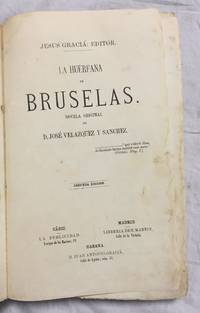
186511278Cádiz: Imp. de la Revista Médica / Jesús Graciá Editor 1865. 2 Vols. 24x15 414p 1h = 406p 1h. 10 dibujos litográficos de V. Urrabieta completo algo de óxido algún cuadernillo desprendido. Holandesa fatigada dorados en lomo. Aceptable estado. Imp. de la Revista Médica / Jesús Graciá, Editor hardcover
18782727Madrid: Terraza Liena y Cia editores. 1878. 18 x 12 cm. Media tela correcto estado de conservacion. Con claras señales de uso. LEA LAS CONDICIONES DE ENVIO DE LA LIBRERÃA. 1752 Terraza, Liena y Cia editores. unknown
1861621881861. unknown
1845135291845-1860 1845. España s.a. 1845-1860. 60 dibujos sobre papel en pluma aguadas de diferentes colores y sanguinas. Diferentes tamaños. Extraordinaria y única colección de dibujos del pintor del Romanticismo español Eugenio Lucas Valázquez 1817-1870 pertenecientes a la colección formada por la reina María Cristina de Borbón viuda de Fernando VII y su segundo esposo el duque de Riansares y acrecentada por sus descendientes los marqueses de Toca. Los inicios de Lucas Velázquez con la pintura comienzan con temprana edad creciendo como artista en la Real Academia de San Fernando y posteriormente se daría lugar en el Museo del Prado copiando obras de Velázquez y de Goya; José Lázaro Galdiano afirmaba que el joven Lucas se estableció como en casa propia en el Museo del Prado. El propio artista se declaró como alumno de la Real Academia de San Fernando en el catálogo de la Exposición Universal de París en 1855 en la que habría tenido como maestro a José de Madrazo. Esta Colección única permite resaltar la facilidad que Lucas tenía para hacer dibujos de manchas y para definir las temáticas y sugestiones que el artista abordó en el amplio periodo entre 1845 y 1860 desde las costumbristas de brujería o taurinas hasta los paisajes y escenas de ambiente africano y orientalista. Los dibujos tienen una doble particularidad: unos copian obras pictóricas o dibujos de Goya y otros se inspiran en obras suyas para recrear el mundo personal en el que los efectos lumínicos y atmosféricos se convierten en protagonistas junto con las figuras recreadas. Aquí no se encuentran dibujos solo de manchas o no definidos sino que todos los presentados en esta Colección salidos de plumas pinceles y sanguinas se pueden vincular al mundo iconográfico de Goya. La mayoría de estos dibujos de Lucas Velázquez corresponden a las etapas menos estudiadas y conocidas del artista como dibujante es decir las de sus comienzos 1840-1850 y la de la consolidación de su figura en el ámbito artístico madrileño en contacto con la Corte 1850-1860. Exposiciones: La estela de Goya. Discípulos y seguidores interpretan la obra del Maestro. Museo del Grabado de Zaragoza Consorcio Cultural Goya-Fuendetodos 30 marzo a 31 mayo de 2009. Organizado por la Diputación Provincial de Zaragoza. Estudio y catalogación: Arturo Ansón Navarro y Ricardo Centellas Salamero Exposiciones: La estela de Goya. Discípulos y seguidores interpretan la obra del Maestro. Museo del Grabado de Zaragoza Consorcio Cultural Goya-Fuendetodos 30 marzo a 31 mayo de 2009. Organizado por la Diputación Provincial de Zaragoza. unknown
185467481D. J. Ruiz de Morales 1854. hardcover. Bueno. Madrid 1854. Publicada por D. J. Ruiz de Morales. Historia Novelesca Española. 316 pp. 23x16. Piel. Con grabados. Cantos coloreados. D. J. Ruiz de Morales hardcover
1856618921856. unknown
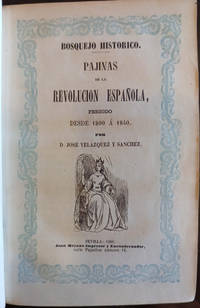
18663705896Sevilla.: Imp. y Litogr. Librería Española y Extranjera de José María Geofrín. 1866. Hardcover. Good. 20 cm. VIII 319 p. Encuadernación en tapa dura artesanal en plena piel. Velázquez y Sánchez José 1826-1880. Anales epidémicos. Por José Velázquez y Sánchez. Enfermedades infecciosas. Sevilla. Historia . Imp. y Litogr., Librería Esp[añola] y Extran[jera] de José María Geofrín. hardcover
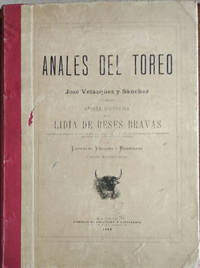
1873Dech1920BC1mhDelgado y Compañía Sevilla 1873 1873. First Edition. Hardcover. Good. Book is in fine condition. Green boards with leather spine. The boards have heavy ware. The spine is peeling but remains intact. Pictorials on spine with title. Fly pages and title page coming loose but still attached. Book details a history of bull fighting. Includes a historical review of Reses Bravas and his fighting as well as a display of other fighters. Text is in Spanish. Please reach out with questions. We are happy to provide pictures. Large folio size. Clean text inside. Delgado y Compañía, Sevilla, 1873 hardcover
186871535Sevilla 1868. Holandesa. Gran folio. hardcover
1888614911888. unknown