2 résultats
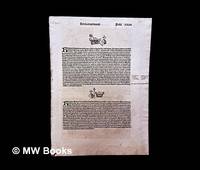
1493460007Nuremburg : Anton Koberger 1493. First Edition. Disbound. Physical description; 1 leaf ; 44 cm. From the 23rd folio with publisher's device. Text in double columns; wide margins with contemporary manuscript annotations. Light marginal dust-dulling and foxing with a faint crease to the top. Remains remarkably well-preserved overall. Notes; Commonly known as the Nuremberg chronicle. Subjects; World history. Chronology. Incunabula. Germany. Nuremberg 1493. Nuremburg : Anton Koberger unknown
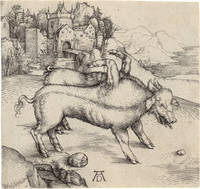
14964191Germany:: ca. 1496. 3rd state of 8. Meder 82 c of h. Engraving:. 11.9 x 12.6 cm. A fine impression with good clarity and strong contrasts. Slight breakdown in the delicate cuts. Trimmed within the platemark inconspicuous paper repair to edge. Provenance: From the renowned collection of Richard Holtkott 1890-1950 Lugt 4265. Bartsch 95 High Crown watermark Meder 20. The pig represented here refers to 'The Monstrous Pig of Landser' born on 1 March 1496 at Landser in Alsace which is represented in a broadside by Sebastian Brant published in German and Latin editions by the Basel publisher Johann Bergmann von Olpe: "In the year 1496 a wondrous sow was born in the village of Landser with one head four ears two bodies eight feet on six of which it stood and with two tongues"."Dürer could not have seen this pig which only lived for one day but he knew the broadside: the pig is shown in a different position to the crudely-cut broadside but the building in the background represents the castle in Landser represented by the Basel woodcutter."The birth of the sow at Landser caused quite a stir and was even mentioned among the events of 1496 annotated by Conrad Peutinger in his copy of 'Scriptores Historiae Augustae' Venice 1489. A further report of conjoined pigs which may have been the Landser sow as a stuffed specimen was made by Heinrich Deichsler in his Nuremberg Chronicle of 1488-1506 who stated that a pair of conjoined pigs was to be viewed in Nuremberg at Easter 1496."It is typical of Dürer's ingenuity that he transformed a newsworthy subject normally interpreted in conjunction with lengthy moralizing verse into a small beautifully engraved image to be taken at face value without any explanatory text. His interest in pigs at this period also relates to the drawings he made for the Prodigal Son cat. no.41."Albrecht Dürer and his Legacy' British Museum exhibition catalogue 2002-3 no.43 Bartsch 95 Meder 82 c of h. Schoch Mende & Scherbaum "Durer Achtzig Meisterblatter" 8; High Crown watermark Meder 20 ca. books