Albrecht DurerBiblio.com
15 résultats
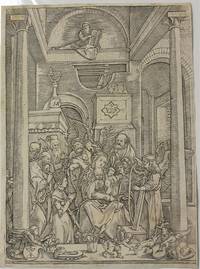
1525P5215Rome c.1525. Very Good margins trimmed. Notes: Engraved by an Italian printmaker Marcantonio Raimondi after a woodcut by Albrecht Durer from the Life of the Virgin.<br>Marcantonio Raimondi often called simply Marcantonio c.1470/82–c.1534 was an Italian engraver known for being the first important printmaker. Image Size : 292x212 mm 11.50x8.35 Inches Platemark Size : 300x216 mm 11.81x8.50 Inches Paper Size : Coloring: Black & White Medium: Wood Engraving Categories: Old Masters; unknown
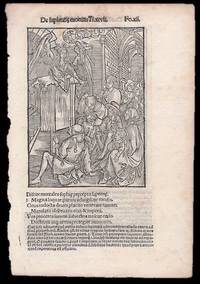
1505008110Paris: Jodocus Badius Ascensius Josse Badius 1505. Leaf. Very Good. The leaf is approximately 5.25" x 8". Each woodcut is approximately 85 x 115 mm. The woodcuts have dark crisp impressions. The leaf has some minor marginal toning. It is a very nice example of one of Dürer's earliest woodcut designs. Thirteen editions were published between 1494 and 1521 six authorized and seven pirated. <br /><br />Leaves from these editions are very easily confused and many later printings are often listed as firsts; in all but the very first edition the woodcuts were done by other craftsmen based on Dürer's original designs. <br /><br />This leaf is from the second Latin edition. It contains two woodcuts most leaves only have one featuring Dürer's fools who always wear cowls with ass-ears and a coxcomb of bells a convention Dürer established. <br /><br />The first woodcut "The Teaching of Wisdom" illustrates both wise men and fools reacting to a sermon. The reverse "Stroking a Fallow Stallion" is depiction of a fool being trampled by a horse he feigned to respect which symbolizers the ultimate fate of false flatters. <br /><br />One of the most famous and popular works during the early years of printing <i>The Ship of Fools</i> was a satire on the many then-current ecclesiastical abuses as exemplified by Brant's imaginary character Saint Grobian the patron saint of vulgarity and coarse manners. A substantial part of <i>The Ship of Fools' </i>popularity was no doubt due to its marvelous woodcut illustrations most of which were created by Albrecht Dürer then a young journeyman woodcut designer working in Basel. Art historians note that his work in these woodcuts Dürer's first significant commissioned effort is not as impressive as his later efforts as a master in Nuremberg; e.g. the hatching consists of only simple parallel lines and contours are crude thick and without much variation. Still they are superior to other illustrations in the book designed by an assortment of masters. <br /><br /> Jodocus Badius Ascensius (Josse Badius) books
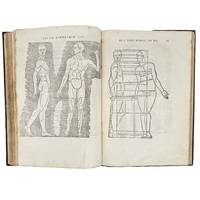
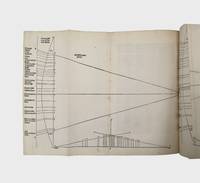
1591durer-della-simmetria-deiVenetia Venice: Domenico Nicolini 1591. First Italian Edition. Hardcover. Fine. Dürer Albrecht. Libri quattro. Leaves 1 f.e 6 143 including 3 folded plates 1 colophon; 1 r.e. Modern period-style binding full morocco with blind and gilt tooling to boards and spine; spine with five raised bands. Leaf 29 misnumbered 27; leaf 74 skipped in the pagination but complete as in other copies. Four double-page plates on three folded leaves the first two only on the recto; the others printed on recto and verso on the same leaf pp. 96-97. 110 woodcut illustrations throughout the text. Very small numerical calculations in ink on the front endpaper in an early hand; possibly the same hand annotated the rear endpaper with notes in Italian relating to the subject matter of the book with references to Michelangelo Buonarroti. Minor worming at the upper inner margin of the last 40 leaves well away from text and images. The folded plate 98 has been professionally restored at the back of the fold. Light browning to a few of the final text pages. A crisp copy in very good condition. Dürer's foundational treatise on human proportion first Italian edition with over 100 woodcuts. First Italian edition of Albrecht Dürer's celebrated treatise on human proportion translated from the Latin version printed in Nuremberg between 1532 and 1534. Originally conceived as an instructional manual for artists and first published in German in 1528 the work applies mathematical proportion to the depiction of the human body in pursuit of harmonious form. Dürer's position within Renaissance debates is distinctive: unlike Leonardo da Vinci or Michelangelo he rejected anatomical dissection believing that anatomy fragmented the body and obscured its unity. Geometry and proportion by contrast offered a comprehensive vision of the figure. Published posthumously in Venice by Nicolini in 1591 this folio edition is a cornerstone of scientific anthropometry. The translation by Giovanni Paolo Gallucci expands the original four books with a fifth addressing the artistic representation of human diversity. Celebrated and influential the work bridges Renaissance art theory and scientific inquiry. Domenico Nicolini hardcover
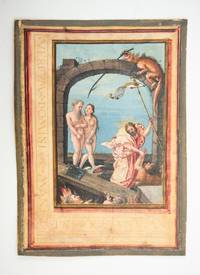
1540ST20622Germany ca. 1540. 183 x 133 mm. 7 1/8 x 5 1/4". <br/> WITH A FULL-PAGE MINIATURE DEPICTING THE HARROWING OF HELL featuring a naked Adam and Eve on the left and on the right Christ bending down to rescue John the Baptist the figures framed by a stone archway supporting a hairy creature who aims the point of a spear directly at Adam and Eve the miniature in a thin brown frame with gilt lines surrounded on two sides by the words "VERBUM DOMINI MANET IN ETERNUM" in gilt all framed in gray and red washes with double rules of black and gilt. Light soiling to frame a little flaking to the gray border and a couple of small scuffs and smudges elsewhere verso with spotting but the miniature vibrant and well preserved with only very trivial imperfections.<br/> <br/> A close copy of an early 16th century engraving by Albrecht Dürer this powerful miniature depicting the Harrowing of Hell is an intriguing artifact that ties together manuscript art print culture and the Reformation. The image depicts an apocryphal tale in the Gospel of Nicodemus in which Christ following his death but before his Resurrection descends into Limbo in order to save righteous souls who had passed away before him particularly figures from the Old Testament. Christ appears here in pale pink robes carrying a long staff with a cross and banner adorning the top. Having just brought down the gates of Hell he stoops to rescue John the Baptist here dressed in furs from its depths. A naked Adam and Eve covering their loins stand at the left of the composition--Adam now a gray-bearded old man as a reflection of sin and mortality but Eve still as she was at the Expulsion in keeping with the period's inclination to retain the classically idealized youthful feminine form. Above them is a stone arch upon which a dog-like demon perches stealthily aiming a spear directly at the oblivious couple. Another demon snaps its jaws at the feet of Christ and we can see a lick of flames below the broken gate as more captive souls clamor to escape. The painting is skillfully done showing the artist's facility with anatomy proportion and foreshortening. The bodies of Adam and Eve are particularly excellent with lovely skin tones and convincing molding. The composition is clearly based on an engraving by Dürer published in 1513 as part of a major series of 16 images known as the "Engraved Passion." In translating a black & white print into a full-color painting the artist here dispensed with a few details seen in Dürer's work such as the shadowy figure behind Adam and Eve and the stigmata on Christ's hand; however the overall composition deviates little from the original suggesting that the artist may have been working from an actual engraving. Although this leaf contains just a few words in the form of a border inscription--"Verbum Domini manet eternum" "the Word of the Lord endures forever"--they are monumentally important. This line from Isaiah 40:8 and 1 Peter 1:25 became the motto of the Lutheran Reformation appearing on art clothing coins and even armor of the 16th century. The Schmalkaldic League an influential group of allied Lutheran principalities in the Holy Roman Empire at the time also adopted it as their motto. Given the dominance of print materials during the Reformation period our hand-painted miniature--possibly produced as a frontispiece--must have been a very special commission. It is also an object that is prime for further study touching on aspects of book production religious art and the transmission of images and ideas in the early modern period. unknown
1522606091522. Nuremberg 1522. First edition. Nuremberg 1522. First edition. With a Full-Page Allegorical Frontispiece by Albrecht Durer Featuring Lady Justice Her First Appearance in a Book Nuremberg. Durer Albrecht 1471-1528. Reformacion der Stat Nuremberg. Nuremberg: Fridrichen Peypus 1522. xxxvi 30 208 ff. Folio 12" x 8" 30.5 x 20 cm. Contemporary panel-stamped reversed calf with traces of gilt stamping early repairs to spine ends clasps present and intact endpapers renewed at some point. Some rubbing to extremities chipping to head of spine a few scuffs and stains to boards small crack to front joint rear hinge cracked due to worming minor worming to fol. 208. Allegorical frontispiece by Durer featuring Lady Justice and a female figure representing charity attractive woodcut decorated initials throughout. Light toning to text some leaves lightly browned faint stains and foxing to a few leaves wide margins. "1522/ jahre" to title page in near-contemporary hand interior otherwise clean. $12500. First edition and only edition with Durer's frontispiece which includes an image of Lady Justice. This was the first time her image appeared in a book. Nuremberg was the center of the Renaissance in Germany and was its leading cultural and intellectual center until the end of the sixteenth century. These qualities are reflected in the contents and design of this volume. Enacted in 1479 the Reformacion or Reformed Civic Legal Code of Nuremberg is known for its humanistic orientation straightforward language and elegant production. It is also notable as the collection of German city laws to be issued in print. The 1522 issue by Peypus is notable for its splendid full-page frontispiece by the great Nuremberg artist Albrecht Durer which was originally issued as an independent print in 1521. The bottom half depicts two putti displaying the arms of the city and empire. The upper half depicts Lady Justice holding scales and a sword and a female figure representing charity who is pouring coins from a purse and opening her bodice to bear her heart which is represented by a flame. The woodcut initials are finely carved and possibly the work of Durer or his workshop. OCLC locates 4 copies in North America 1 in a law library Harvard. Verzeichnis der im Deutschen Sprachraum Erschienenen Drucke des 16. Jahrhunderts N2027. Meder Dure. unknown books
15273416Nürnberg, Hieronymus Andreae, 1527. Erste Ausgabe (Ausgabe B der ersten Ausgabe: mit den verbesserten "Irrthumb", Wasserzeichen "Bär mit A"). - Schoch/Mende/Scherbaum III, S. 282ff. - Bohatta 12. - Vorderer Innendeckel mit Exlibris. Stellenweise etwas braunfleckig, die Falten der doppelblattgroßen Blätter teils angeschmutzt. Die letzten 4 Blätter mit Braunfleck im Bundsteg. Ein Doppelblatt mit restauriertem Einriss. - Mit seiner Befestigungslehre begründete Dürer eine eigene deutsche Festungsbaukunst, deren Konzeption beim Bau von vielen Anlagen bis hinein ins 18. Jahrhundert berücksichtigt wurde. Es ist das erste Werk in deutscher Sprache, das eine Befestigungslehre unter Zugrundelegung von Artillerieeinsatz darlegt. Sicherlich wurde das Werk unter dem akuten Eindruck der "Türkengefahr" verfasst. Dürer wollte sich möglicherweise Erzherzog Ferdinand I., dem das Werk gewidmet ist, als Fachmann für Festungsbau empfehlen. - Das Werk gliedert sich in 4 Abschnitte: 1. Anlage einer Stadtbefestigung; 2. Befestigung mit austretenden Streichwehren; 3. Einrichtung einer Passbefestigung; 4. Vorschläge zur Verstärkung älterer Befestigungen. Als Anhang ist noch die Beschreibung einer Lafettenkonstruktion für ein Geschütz beigegeben. - Die Holzschnitte zeigen Ansichten, Pläne, Aufrisse, Details und Perspektiven, sowie ein Geschütz mit Lafette. - Erstes deutschsprachiges Lehrbuch über den Festungsbau aus der Feder des bedeutendsten Künstlers des deutschen Humanismus.
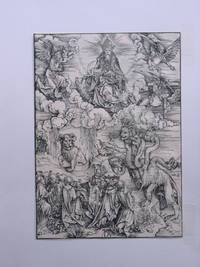
151122161511. Woodcut. One of the plates from the set of 16 illustrations of the Apocalypse of Saint John. Fine impression of the only state with the latin text on the verso. 1511. With 1/4" margins 390 x 279 15 3/8 x 11 Meder 175 B. 74 Pan.294 K. 117 T. 137. Watermark: Flower with a triangle M. Watermark #127. Printers crease in upper left corner some glue stains on verso right border not noticeable from the front. Otherwise in fine condition. books
153271508first volume 2 Ai-Oiii 179 leaves including folded second volume a1-j5 55 leaves including folded 268 pages across the 2 books 12 leaves in facsimilie illustrated throughout with black and white line drawings 96 full page illustrations 4 folded plus 24 within the text also various tables within the text text in Latin Published by Hieronymus Andreae [In aedib viduae Durerianae] hardcover
151122161511. Woodcut. One of the plates from the set of 16 illustrations of the Apocalypse of Saint John. Fine impression of the only state with the latin text on the verso. 1511. With 1/4" margins 390 x 279 15 3/8 x 11 Meder 175 B. 74 Pan.294 K. 117 T. 137Schoch Mende Scherbaum 123. Watermark: Flower with a triangle M. Watermark #127. Printers crease in upper left corner some glue stains on verso right border not noticeable from the front. Otherwise in fine condition.
153266816In aedib. viduae Durerianae [ Hieronymus Andreae] | Norimbergae [Nürimberg] 1532 | 20.50 x 32 cm | relié
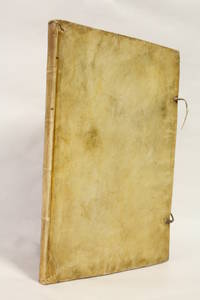
153266816Norimbergae Nürimberg Nuremberg: In aedib. viduae Durerianae Hieronymus Andreae 1532. Fine. In aedib. viduae Durerianae Hieronymus Andreae Norimbergae Nürimberg Nuremberg 1532 20.50 x 32 cm relié Alberti Dureri clarissimi pictoris et geometræ. De symmetria partium in rectis formis humanorum corporum In aedibviduae Durerianae Hieronymus Andreae Norimbergae Nuremberg 1532 folio 20.5 x 32 cm 80 f. A-E6 F4 G-N6 O4 full parchment First edition of the Latin translation created by Joachim Camerarius the work appeared in German in 1528 under the title Vier Bücher von menschlicher Proportion. Our edition contains the first two books the following two will be published in 1534 under the title De varietate figurarum et flexuris partium ac gestibus imaginum. We will have to wait until 1557 for Louis Meigret's French translation to be published. Our edition is illustrated with 85 large wooden insert illustrations and many other smaller in-text illustrations the same as those used in the original German edition. The title page shows Dürer's well-known monogram. Gothic text. The last white leaf missing in most copies is present here. Large greatly fresh margined copy. Full parchment with preserved laces. Very beautiful copy of the most sought-after of Albrecht Dürer's technical works. The illustrations required the examination of several hundred male and female models and something rarer for the time children. These extremely precise analyses resulted in anthropometrical impressionist drawings showing the human body as a whole and also in detail hands feet heads etc. Each drawing squared or scaled in the margin allows the models to be easily reproduced the book being intended to avoid errors of proportion for young artists. Joachim Camerarius' Latin translation humanist and close friend of the author had at the time an essential role: it gave Dürer's work until then written in archaic German a significant audience; without Camerarius Michelangelo would never for example have known of Dürer's theory of proportions. Dürer whose godfather Anton Koberger published La Chronique de Nuremberg in 1493 frequented the world of printing and engraving very early on and unlike his contemporary Florentine Leonardo da Vinci who published nothing he produced several theoretical treatises. It was during a trip to Italy in 1494 that he met Jacopo de' Barbri 1445-1516 who introduced him to the role of mathematics in perspective and the study of the proportions of the human body. On returning to Germany he opened a workshop became the painter of Maximillian I of Habsbourg and joined the Great Council of the City of Nuremberg. Recognition is complete and Dürer becomes an internationally known artist with the knowledge and ability for well-received thought. In the last years of his life not abandoning the pictorial arts Dürer encouraged by his humanist friends spends most of his time writing. Determined to leave the results of his long theoretical thoughts for posterity he publishes several treatises: Instruction sur la manière de mesurer 1525 Instruction relative aux fortifications des bourgs villes et châteaux 1527 and finally Traité des proportions du corps humain 1528. In keeping with the artistic considerations of the Renaissance the intention of this last treaty is to establish a scientific basis geometrical and arithmetical applied to aesthetics and thus to provide practical guidelines aimed at achieving anatomical perfection. A true artistic testament this emblematic work will have a considerable influence on the history of Western art. In aedib. viduae Durerianae[ Hieronymus Andreae] unknown
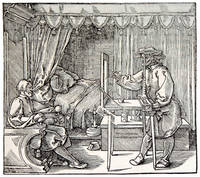
15322727Paris: Christian Wechel 1532. First Latin edition of Dürers first book on the theory of art the Unterweisung der Messung bound with the first Latin edition of his treatise on fortification strictly speaking the first treatise dealing exclusively with this subject Krufft with important material on urban planning and utopianism.1 Illustrated by Dürer himself the Institutionum Geometricarum outlines the artists theory of the work of art as a natural object which became an accepted aesthetic dogma until the 19th century. Far more than the German original of 1525 this translation by the humanist Camerarius brought the treatise to the attention of the whole of Europe. As a theoretical statement by the last major painter to be counted a significant geometer Kemp the work is naturally of interest for applications in Dürers own oeuvre as well as for the history of perspective. After his encounter with Luca Pacioli in Italy Dürer became convinced of how close the links are between art and mathematics and devoted himself to the study of form through the resources offered by arithmetic and geometry. The result was the present work. In this work Dürer teaches the principles of perspective and explains the application of practical geometry to drawing and painting. It became a very influential text as its audience broadened from artists to architects sculptors and different craftsmen and was translated and reprinted several times.Panofsky describes the treatises importance as three-fold: for the technical innovation in the construction of a perspective apparatus in which the eye of the observer is dispensed with entirely; for being the first literary document in which a strictly representational problem received a strictly scientific treatment at the hands of a Northerner; and for emphasizing that perspective is not a technical discipline destined to remain subsidiary to painting or architecture but an important branch of mathematics capable of being developed into what is now known as general projective geometry Panofsky p. 252.Book Three contains Dürers famous treatise on the just shaping of Roman capital letters and gothic or Textur letters built up by means of small geometrical forms a method original with Dürer. This text was translated into English by R.T. Nichol for publication by the Grolier Club Of the Just Shaping of Letters New York 1917.2 Inspired by the artists witnessing the siege of Hohenasperg in 1519 and by fear of the advancing Turkish armies Krufft writes De Urbibus employs a dual approach. On the one hand Dürer develops various alternatives for the construction of bastions to defend existing cities; this is the contemporary aspect. At the heart of the treatise he outlines a utopian city in which the nature of fortification merely serves as a spur to the depiction of a social structure organized on the ground. Related trades are placed side by side; smiths are to be housed near foundries etc. The town hall and the houses of the nobility are sited near the royal palace. The whole system of organization is hierarchical and functional. Dürer thinks of every function of the city right down to the taverns Krufft History of Architectural Theory p. 110 . Elsewhere Krufft suggests that Serlio employed the present treatise in book VI.According to Mortimer the woodblocks are close copies of the 1527 German original. 1Mortimer French I.182; Vagnetti E II.b7; Panofsky The Life and Art of Albrecht Dürer Chapter 8 Dürer as a theorist of Art esp. 247-60; Kemp The Science of Art 53ff.; 2 Mortimer French I.184; Fowler 113 1527 German; Krufft History of Architectural Theory 110-111. 4 ff. recto of last leaf blank woodcut of man with lute on verso 185 pp. verso blank 1 f. printers device on verso recto blank; folding extensions on P6 & Q1 as required by Mortimer. Bound in 18th-century calf over boards spine with raised bands re-backed later red morocco title label. Title dusty; occasional toning; small wormtrack through much of volume generally in blank margin but occasionally grazing a partial letter or printed border on plates. Withal a fresh copy very good.Bound with:DÜRER Albrecht. De Urbibus Arcibus castellisque condendis ac muniendis rationes aliquot praesenti bellorum necessitati accomodatissimae . Paris Christian Wechel 1535. 40 ff. including 10 double-page/extended leaves as described by Mortimer. Christian Wechel hardcover books
15322727Paris: Christian Wechel 1532. First Latin edition of Dürers first book on the theory of art the Unterweisung der Messung bound with the first Latin edition of his treatise on fortification strictly speaking the first treatise dealing exclusively with this subject Krufft with important material on urban planning and utopianism.1 Illustrated by Dürer himself the Institutionum Geometricarum outlines the artists theory of the work of art as a natural object which became an accepted aesthetic dogma until the 19th century. Far more than the German original of 1525 this translation by the humanist Camerarius brought the treatise to the attention of the whole of Europe. As a theoretical statement by the last major painter to be counted a significant geometer Kemp the work is naturally of interest for applications in Dürers own oeuvre as well as for the history of perspective. After his encounter with Luca Pacioli in Italy Dürer became convinced of how close the links are between art and mathematics and devoted himself to the study of form through the resources offered by arithmetic and geometry. The result was the present work. In this work Dürer teaches the principles of perspective and explains the application of practical geometry to drawing and painting. It became a very influential text as its audience broadened from artists to architects sculptors and different craftsmen and was translated and reprinted several times.Panofsky describes the treatises importance as three-fold: for the technical innovation in the construction of a perspective apparatus in which the eye of the observer is dispensed with entirely; for being the first literary document in which a strictly representational problem received a strictly scientific treatment at the hands of a Northerner; and for emphasizing that perspective is not a technical discipline destined to remain subsidiary to painting or architecture but an important branch of mathematics capable of being developed into what is now known as general projective geometry Panofsky p. 252.Book Three contains Dürers famous treatise on the just shaping of Roman capital letters and gothic or Textur letters built up by means of small geometrical forms a method original with Dürer. This text was translated into English by R.T. Nichol for publication by the Grolier Club Of the Just Shaping of Letters New York 1917.2 Inspired by the artists witnessing the siege of Hohenasperg in 1519 and by fear of the advancing Turkish armies Krufft writes De Urbibus employs a dual approach. On the one hand Dürer develops various alternatives for the construction of bastions to defend existing cities; this is the contemporary aspect. At the heart of the treatise he outlines a utopian city in which the nature of fortification merely serves as a spur to the depiction of a social structure organized on the ground. Related trades are placed side by side; smiths are to be housed near foundries etc. The town hall and the houses of the nobility are sited near the royal palace. The whole system of organization is hierarchical and functional. Dürer thinks of every function of the city right down to the taverns Krufft History of Architectural Theory p. 110 . Elsewhere Krufft suggests that Serlio employed the present treatise in book VI.According to Mortimer the woodblocks are close copies of the 1527 German original. 1Mortimer French I.182; Vagnetti E II.b7; Panofsky The Life and Art of Albrecht Dürer Chapter 8 Dürer as a theorist of Art esp. 247-60; Kemp The Science of Art 53ff.; 2 Mortimer French I.184; Fowler 113 1527 German; Krufft History of Architectural Theory 110-111. 4 ff. recto of last leaf blank woodcut of man with lute on verso 185 pp. verso blank 1 f. printers device on verso recto blank; folding extensions on P6 & Q1 as required by Mortimer. Bound in 18th-century calf over boards spine with raised bands re-backed later red morocco title label. Title dusty; occasional toning; small wormtrack through much of volume generally in blank margin but occasionally grazing a partial letter or printed border on plates. Withal a fresh copy very good.Bound with:DÜRER Albrecht. De Urbibus Arcibus castellisque condendis ac muniendis rationes aliquot praesenti bellorum necessitati accomodatissimae . Paris Christian Wechel 1535. 40 ff. including 10 double-page/extended leaves as described by Mortimer. Christian Wechel hardcover
151013681Alemania 1510. 397x281mm. 15¾x11". Grabado Alemania 1510 pero 1511. Xilografía en negro sobre papel. Tamaño imagen y papel: 397 x 281mm. Primera edición temprano estado de uno de los grabados más cautivadores de Dürer incluidos en su famosa serie de La Gran Pasión. Monograma de Albrecht Dürer 1471-1528 "AD" en la parte inferior izquierda. Fechado en el grabado "1510". unknown
1528375684Nuremberg: Jeronymus Formschneyder 1528. First edition. Dürer's large woodcut monogram on title; woodcut proportional figures throughout many two to a page; woodcut ornamental flourishes. 134 leaves plus 4 folded double-page leaves printed on both sides. 1 vols. Folio. Full brown levant by Bedford decoratively stamped and tooled in gilt; title stamped in gilt on spine; a.e.g. Front board rehinged to highest standard; V5-6 closely trimmed but complete. A beautiful copy. First edition. Dürer's large woodcut monogram on title; woodcut proportional figures throughout many two to a page; woodcut ornamental flourishes. 134 leaves plus 4 folded double-page leaves printed on both sides. 1 vols. Folio. First edition of Albrecht Dürer's "Four Books on Human Proportion" his iconic treatise on the geometry of the human body published posthumously for his widow in 1528 six months after his death.<br /> <br /> Best known for both his highly-detailed engravings and woodcuts as well as portraits - in particular those of himself - Dürer had shown early promise as an artist. At the age of fifteen he apprenticed with Michael Wolgemut who also lived in Nuremburg and specialized in woodcuts. While Dürer was training there Wolgemut's workshop began work on the over 1800 illustrations in the famous 1493 Nuremberg Chronicle published by Dürer's godfather Anton Koberger and he may have contributed to several of them.<br /> <br /> After travels to Italy and marriage Dürer settled in Nuremburg and opened his own workshop where he integrated the Italian aesthetics he absorbed on his journeys into the Northern forms of his upbringing and training. In addition to painting and engraving he also began codifying his theoretical approaches to art and perspective. The first of these works "Four Books on Measurement" "Underweysung der Messung mit dem Zirckel und Richt Scheyt" published in 1525 dealt with geometry and as he stated in the introduction it was intended "not only for painters but also for goldsmiths sculptors stonemasons carpenters and all those for whom using measurement is useful." A second book "Various Lessons on the Fortification of Cities Castles and Localities" "Etliche Underricht zu Befestigung der Stett Schloss und Flecken" was issued in 1527.<br /> <br /> "Four Books on Human Proportion" is considered his textual masterpiece however. The first book - primarily written from 1512-1513 - explores five different types of male and female figures all based on his personal observations each divided into fractions of height while the second book examines a further eight anatomical models using Leon Battista Alberti's concepts of linear perspective. In the third book Dürer provides operative principles by which the proportions of human physiognomy can be modified and the fourth concerns his theories of movement. <br /> <br /> An important additional essay by Dürer on aesthetics was included at the rear of the book in which he differentiated himself from prior theoriticians on the human form such as Leonardo da Vinci and Marcus Vitruvius. While clearly influenced by their work Dürer was less interested in celebrating corporeal paragons than surveying the many varieties of bodily shapes and sizes as well as the manners in which those figures moved through the world. As he himself noted "I hold that the perfection of form and beauty is contained in the sum of all men."<br /> <br /> A CHOICE COPY OF THIS BEAUTIFUL AND INFLUENTIAL BOOK ON ANTHROPOMETRY. VD16 ZV 23128. Provenance: Robert Hoe his morocco label; sold Anderson Galleries April 1912 lot 1050; to Albert Gallatin Sr. and by descent in the family Jeronymus Formschneyder unknown