30 résultats
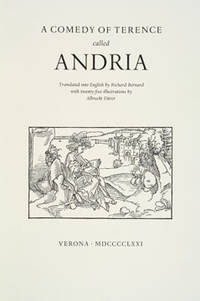
1971527271971. TERENCE. Andria: A Comedy by Terence. 122 4 pp. Folio 347 x 250 mm bound in beige paper boards backed in vellum title gilt on spine t.e.g. in green cloth slipcase. Verona: Officina Bodoni 1971. One of 160 copies. This edition brings to fruition one part of an illustrated edition of Terence that was planned by Basel printer Johann Amerbach in 1493. A number of illustrations for Amerbach's edition were completed by Albrecht Durer before the project was eventually abandoned. For the Bodoni edition of Andria Terence's first comedy twenty five of Durer's illustrations for the Amerbach Terence were copied and cut by engraver Fritz Kredel. The text is based on Richard Bernard's English translation which was first published in 1598. Set in Dante type and pressed on Fratelli Magnani paper. A pristine copy. hardcover books
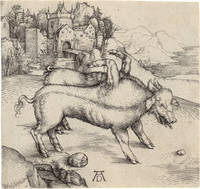
14964191Germany:: ca. 1496. 3rd state of 8. Meder 82 c of h. Engraving:. 11.9 x 12.6 cm. A fine impression with good clarity and strong contrasts. Slight breakdown in the delicate cuts. Trimmed within the platemark inconspicuous paper repair to edge. Provenance: From the renowned collection of Richard Holtkott 1890-1950 Lugt 4265. Bartsch 95 High Crown watermark Meder 20. The pig represented here refers to 'The Monstrous Pig of Landser' born on 1 March 1496 at Landser in Alsace which is represented in a broadside by Sebastian Brant published in German and Latin editions by the Basel publisher Johann Bergmann von Olpe: "In the year 1496 a wondrous sow was born in the village of Landser with one head four ears two bodies eight feet on six of which it stood and with two tongues"."Dürer could not have seen this pig which only lived for one day but he knew the broadside: the pig is shown in a different position to the crudely-cut broadside but the building in the background represents the castle in Landser represented by the Basel woodcutter."The birth of the sow at Landser caused quite a stir and was even mentioned among the events of 1496 annotated by Conrad Peutinger in his copy of 'Scriptores Historiae Augustae' Venice 1489. A further report of conjoined pigs which may have been the Landser sow as a stuffed specimen was made by Heinrich Deichsler in his Nuremberg Chronicle of 1488-1506 who stated that a pair of conjoined pigs was to be viewed in Nuremberg at Easter 1496."It is typical of Dürer's ingenuity that he transformed a newsworthy subject normally interpreted in conjunction with lengthy moralizing verse into a small beautifully engraved image to be taken at face value without any explanatory text. His interest in pigs at this period also relates to the drawings he made for the Prodigal Son cat. no.41."Albrecht Dürer and his Legacy' British Museum exhibition catalogue 2002-3 no.43 Bartsch 95 Meder 82 c of h. Schoch Mende & Scherbaum "Durer Achtzig Meisterblatter" 8; High Crown watermark Meder 20 ca. books
1522606091522. Nuremberg 1522. First edition. Nuremberg 1522. First edition. With a Full-Page Allegorical Frontispiece by Albrecht Durer Featuring Lady Justice Her First Appearance in a Book Nuremberg. Durer Albrecht 1471-1528. Reformacion der Stat Nuremberg. Nuremberg: Fridrichen Peypus 1522. xxxvi 30 208 ff. Folio 12" x 8" 30.5 x 20 cm. Contemporary panel-stamped reversed calf with traces of gilt stamping early repairs to spine ends clasps present and intact endpapers renewed at some point. Some rubbing to extremities chipping to head of spine a few scuffs and stains to boards small crack to front joint rear hinge cracked due to worming minor worming to fol. 208. Allegorical frontispiece by Durer featuring Lady Justice and a female figure representing charity attractive woodcut decorated initials throughout. Light toning to text some leaves lightly browned faint stains and foxing to a few leaves wide margins. "1522/ jahre" to title page in near-contemporary hand interior otherwise clean. $12500. First edition and only edition with Durer's frontispiece which includes an image of Lady Justice. This was the first time her image appeared in a book. Nuremberg was the center of the Renaissance in Germany and was its leading cultural and intellectual center until the end of the sixteenth century. These qualities are reflected in the contents and design of this volume. Enacted in 1479 the Reformacion or Reformed Civic Legal Code of Nuremberg is known for its humanistic orientation straightforward language and elegant production. It is also notable as the collection of German city laws to be issued in print. The 1522 issue by Peypus is notable for its splendid full-page frontispiece by the great Nuremberg artist Albrecht Durer which was originally issued as an independent print in 1521. The bottom half depicts two putti displaying the arms of the city and empire. The upper half depicts Lady Justice holding scales and a sword and a female figure representing charity who is pouring coins from a purse and opening her bodice to bear her heart which is represented by a flame. The woodcut initials are finely carved and possibly the work of Durer or his workshop. OCLC locates 4 copies in North America 1 in a law library Harvard. Verzeichnis der im Deutschen Sprachraum Erschienenen Drucke des 16. Jahrhunderts N2027. Meder Dure. unknown books
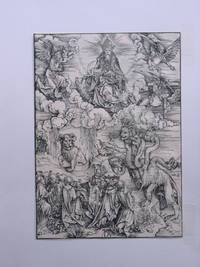
151122161511. Woodcut. One of the plates from the set of 16 illustrations of the Apocalypse of Saint John. Fine impression of the only state with the latin text on the verso. 1511. With 1/4" margins 390 x 279 15 3/8 x 11 Meder 175 B. 74 Pan.294 K. 117 T. 137. Watermark: Flower with a triangle M. Watermark #127. Printers crease in upper left corner some glue stains on verso right border not noticeable from the front. Otherwise in fine condition. books
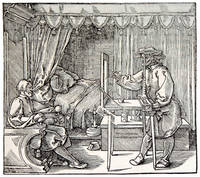
15322727Paris: Christian Wechel 1532. First Latin edition of Dürers first book on the theory of art the Unterweisung der Messung bound with the first Latin edition of his treatise on fortification strictly speaking the first treatise dealing exclusively with this subject Krufft with important material on urban planning and utopianism.1 Illustrated by Dürer himself the Institutionum Geometricarum outlines the artists theory of the work of art as a natural object which became an accepted aesthetic dogma until the 19th century. Far more than the German original of 1525 this translation by the humanist Camerarius brought the treatise to the attention of the whole of Europe. As a theoretical statement by the last major painter to be counted a significant geometer Kemp the work is naturally of interest for applications in Dürers own oeuvre as well as for the history of perspective. After his encounter with Luca Pacioli in Italy Dürer became convinced of how close the links are between art and mathematics and devoted himself to the study of form through the resources offered by arithmetic and geometry. The result was the present work. In this work Dürer teaches the principles of perspective and explains the application of practical geometry to drawing and painting. It became a very influential text as its audience broadened from artists to architects sculptors and different craftsmen and was translated and reprinted several times.Panofsky describes the treatises importance as three-fold: for the technical innovation in the construction of a perspective apparatus in which the eye of the observer is dispensed with entirely; for being the first literary document in which a strictly representational problem received a strictly scientific treatment at the hands of a Northerner; and for emphasizing that perspective is not a technical discipline destined to remain subsidiary to painting or architecture but an important branch of mathematics capable of being developed into what is now known as general projective geometry Panofsky p. 252.Book Three contains Dürers famous treatise on the just shaping of Roman capital letters and gothic or Textur letters built up by means of small geometrical forms a method original with Dürer. This text was translated into English by R.T. Nichol for publication by the Grolier Club Of the Just Shaping of Letters New York 1917.2 Inspired by the artists witnessing the siege of Hohenasperg in 1519 and by fear of the advancing Turkish armies Krufft writes De Urbibus employs a dual approach. On the one hand Dürer develops various alternatives for the construction of bastions to defend existing cities; this is the contemporary aspect. At the heart of the treatise he outlines a utopian city in which the nature of fortification merely serves as a spur to the depiction of a social structure organized on the ground. Related trades are placed side by side; smiths are to be housed near foundries etc. The town hall and the houses of the nobility are sited near the royal palace. The whole system of organization is hierarchical and functional. Dürer thinks of every function of the city right down to the taverns Krufft History of Architectural Theory p. 110 . Elsewhere Krufft suggests that Serlio employed the present treatise in book VI.According to Mortimer the woodblocks are close copies of the 1527 German original. 1Mortimer French I.182; Vagnetti E II.b7; Panofsky The Life and Art of Albrecht Dürer Chapter 8 Dürer as a theorist of Art esp. 247-60; Kemp The Science of Art 53ff.; 2 Mortimer French I.184; Fowler 113 1527 German; Krufft History of Architectural Theory 110-111. 4 ff. recto of last leaf blank woodcut of man with lute on verso 185 pp. verso blank 1 f. printers device on verso recto blank; folding extensions on P6 & Q1 as required by Mortimer. Bound in 18th-century calf over boards spine with raised bands re-backed later red morocco title label. Title dusty; occasional toning; small wormtrack through much of volume generally in blank margin but occasionally grazing a partial letter or printed border on plates. Withal a fresh copy very good.Bound with:DÜRER Albrecht. De Urbibus Arcibus castellisque condendis ac muniendis rationes aliquot praesenti bellorum necessitati accomodatissimae . Paris Christian Wechel 1535. 40 ff. including 10 double-page/extended leaves as described by Mortimer. Christian Wechel hardcover books