DURER, AlbrechtBiblio.com
3 117 résultats
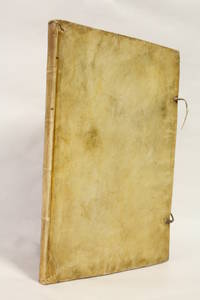
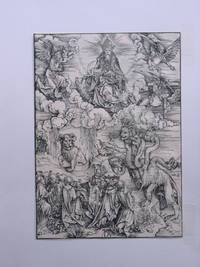
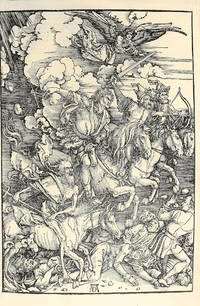
ABAA-75TH-VBF-7<p>Nuremberg Albrecht Durer 1511.</p><p>Folio 431 x 300 mm.</p><p>Title a little soiled and very slightly shorter in the outer margin two small holes filled in the outer margin. One plate remargined <em>martyrdom of St. John</em> with very discreet small hole affecting the engraving. One leaf slightly shorter in the lower margin <em>The seven-headed dragon</em>. Slight foxing. Slipcase and case a little rubbed.</p><p>Ebony morocco flat spine inner gilt fillets <em>G. Cretté successor of Marius Michel</em> blue cloth folder and case.</p><p><strong>One of the masterpieces of engraving and the first large book illustrated by Durer.</strong></p><p>16 woodcuts by Durer including the title text in Latin on the reverse. All the engravings except the title bear the artist's monogram.</p><p>It is between 1496 and 1498 that Durer begins this series of 15 xylographs of the <em>Apocalypse</em> during his trip to Italy. In 1498 a Latin and a German edition were published simultaneously. A few years later in 1511 he published a new printing with the Latin text for which he conceived a title.</p><p>"<em>The Apocalypse</em> is the first large illustrated book designed by Durer. The first book to be exclusively designed and published by an artist without recourse to the financial support of a publisher it is a resolutely innovative and ambitious undertaking" <em>Albrecht Dürer</em> <em>Gravure et Renaissance</em> château de Chantilly dossier de presse p. 25.</p><p>Detail of the engravings:</p><p>- Title St. John at Patmos watermark: crowned tower surmounted by a finial; Meder 259.</p><p>- The Martyrdom of Saint John the Evangelist watermark: triangle with flower.</p><p>- The Vision of the Seven Candlesticks no watermark.</p><p>- St. John before the lord and the elders watermark: crowned tower surmounted by a finial; Meder 259.</p><p>- The Four Horsemen of the Apocalypse no watermark.</p><p>- The Opening of the fifth and sixth seals watermark: crowned tower surmounted by a finial; Meder 259.</p><p>- The Four Angels holding the four winds of the earth no watermark.</p><p>- The Seven Trumpets no watermark.</p><p>- The Four Avenging Angels no watermark.</p><p>- Saint John devouring the Book of Life watermark: triangle with six-leaf flower; Meder 127.</p><p>- The Woman of the Apocalypse and the seven-headed dragon no watermark.</p><p>- Saint Michael slaying the dragon watermark: triangle with six-leaf; Meder 127.</p><p>- The seven-headed dragon and the beast with lamb's horns no watermark.</p><p>- The Adoration of the Lamb no watermark.</p><p>- The Whore of Babylon without watermark.</p><p>- The Angel holding the key to the abyss watermark: triangle with six leaves; Meder 127.</p><p>"<em>Durer himself was very sensitive to the signs of the 'approach of the accursed times' and like no other artist before him brought to life the phantasmagorical visions of the Apocalypse</em>" <em>Albrecht Dürer Œuvre gravé</em> p. 49.</p><p>The <em>Apocalypse</em> properly <em>Apocalypse with Pictures</em> Latin: <em>Apocalipsis cum figuris</em> is a series of fifteen woodcuts by Albrecht Durer published in 1498 depicting various scenes from the Book of Revelation which rapidly brought him fame across Europe. These woodcuts likely drew on theological advice particularly from Johannes Pirckheimer the father of Durer's friend Willibald Pirckheimer.</p><p>Work on the series started during Durer's first trip to Italy 1494–95 and the set was published simultaneously as a book with 15 pages of biblical text facing the 15 illustrations in Latin and German at Nuremberg in 1498 at a time when much of secular Europe feared an invasion of the Ottoman Empire and Christian Europe anticipated a possible <em>Last Judgment</em> in the year 1500. Durer was the publisher and seller of this series and became the first artist to publish a book and create a copyright. Considering the 15 woodcuts <em>The Four Horsemen of the Apocalypse</em> c. 1497-98 referring to Revelation 6:1-8 is often viewed as the most famous piece. The overall layout of the cycle has the illustrations on the recto right and the text on the verso left. This would suggest the importance of illustration over text.</p><p>In 1511 Durer published the second edition of <em>Apocalypse</em> in a combined edition with his <em>Life of the Virgin</em> and <em>Large Passion </em>; single impressions were also produced and sold.</p><p>En 1511 Dürer publie une deuxième édition de la version latine qui diffère principalement par la page de titre dans une édition combinée avec sa <em>Vie de la Vierge</em> et la <em>Grande Passion</em>. Après 1511 la série fait l'objet d'une ultime réimpression de nouveau sans texte au verso.</p><p>The frontispieces of the first two editions show only the letter without the xylography of <em>The Virgin Appearing to Saint John the Evangelist</em>. This plate was added in 1511 for the publication of the second Latin edition.</p><p>With this book woodcutting achieves an unprecedented level of technical virtuosity rarely equaled in later years. Never before had the network of woodcuts been so complex; the combination of different sizes enabled the artist to achieve totally new effects of light and volume. Black lines harmoniously rub shoulders with areas where the paper has been left white creating subtle chiaroscuro effects hitherto reserved for the burin. In this way Durer succeeded in offering the reader striking images that by a veritable tour de force give substance to St. John's visions making them almost real without detracting from their supernatural phantasmagorical character.</p><p>Most of the suites from 1498 or 1511 were cut up and sold as individual sheets in the art trade. They can be found in collections and museums all over the world.</p><p>The 1498 edition has disappeared from the market. Only seven copies are known to exist four in the US <em>National Gallery of Art</em> in Washington <em>Saint Louis Museum of Art</em> <em>Houghton Library</em> at Harvard University and <em>Museum of Fine Arts</em> Boston. The <em>British Museum</em> in London the <em>Staatliche Kunsthalle Karlsruhe</em> and the <em>Staatliche Graphische Sammlung</em> in Munich also own a copy but in German. A fine copy is currently estimated at three million dollars.</p><p><strong>A fine complete copy of the 1511 edition is found every fifteen years and its value continues to rise.</strong></p><p><strong>A very fine copy of the 1511 edition of Durer's Apocalypse.</strong></p><p>FR</p><p><em>Nuremberg Albrecht Dürer 1511.</em></p><p>In-folio regroupant 16 gravures sur bois par Dürer dont le titre texte en latin au verso. <em>Une planche réemmargée martyre de saint Jean un feuillet légèrement plus court en marge inférieure Le dragon à sept têtes. </em>Maroquin ébène dos lisse filets dorés en encadrement intérieur <em>G. Cretté succ. de Marius Michel</em> chemise et étui de toile bleue.</p><p>428 x 295 mm.</p><p><strong>L'un des chefs-d'œuvre de la gravure et le premier grand livre illustré par Dürer.</strong></p><p>16 gravures sur bois par Dürer dont le titre texte en latin au verso. Toutes les gravures sauf le titre portent le monogramme de l'artiste.</p><p>C'est entre 1496 et 1498 que Dürer commence cette série de 15 xylographies de l'<em>Apocalypse</em> pendant son voyage en Italie. En 1498 paraissent simultanément une édition latine et une édition allemande. Quelques années plus tard en 1511 il publie une nouvelle impression avec le texte en latin pour laquelle il conçoit un titre.</p><p>"<em>L'Apocalypse </em>est le premier grand livre illustré conçu par Dürer. Premier livre exclusivement conçu et publié par un artiste sans recourir au soutien financier d'un éditeur il s'agit d'une entreprise résolument novatrice et ambitieuse". <em>Albrecht Dürer</em> <em>Gravure et Renaissance</em> château de Chantilly dossier de presse p. 25.</p><p><u>Détail des gravures</u> :</p><p>- Titre Saint Jean à Patmos filigrane : tour couronnée surmontée d'un fleuron ; Meder 259.</p><p>- Le Martyre de saint Jean l'Évangéliste filigrane : triangle avec fleur.</p><p>- La Vision des sept chandeliers sans filigrane.</p><p>- Saint Jean devant le seigneur et les anciens filigrane : tour couronnée surmontée d'un fleuron ; Meder 259.</p><p>- Les Quatre Cavaliers de l'Apocalypse sans filigrane.</p><p>- L'Ouverture du cinquième et du sixième sceau filigrane : tour couronnée surmontée d'un fleuron ; Meder 259.</p><p>- Les Quatre Anges retenant les quatre vents de la terre sans filigrane.</p><p>- Les Sept trompettes sans filigrane.</p><p>- Les Quatre anges vengeurs sans filigrane.</p><p>- Saint Jean dévorant le Livre de Vie filigrane : triangle avec fleur à six feuilles ; Meder 127.</p><p>- La Femme de l'Apocalypse et le dragon à sept têtes sans filigrane.</p><p>- Saint Michel terrassant le dragon filigrane : triangle avec feuille à six feuilles ; Meder 127.</p><p>- Le dragon à sept têtes et la bête aux cornes d'agneau sans filigrane.</p><p>- L'Adoration de l'Agneau sans filigrane.</p><p>- La Prostituée de Babylone sans filigrane.</p><p>- L'Ange tenant la clef de l'abîme filigrane : triangle avec feuille à six feuilles ; Meder 127.</p><p>" Très sensible lui-même aux signes de " <em>l'approche des temps maudits</em> " Dürer a donné vie comme nul créateur avant lui aux visions fantasmagoriques de l'Apocalypse " <em>Albrecht Dürer Œuvre gravé</em> p. 49.</p><p>The <em>Apocalypse</em> properly <em>Apocalypse with Pictures</em> Latin: <em>Apocalipsis cum figuris</em> is a series of fifteen woodcuts by Albrecht Durer published in 1498 depicting various scenes from the Book of Revelation which rapidly brought him fame across Europe. These woodcuts likely drew on theological advice particularly from Johannes Pirckheimer the father of Durer's friend Willibald Pirckheimer.</p><p>Work on the series started during Durer's first trip to Italy 1494–95 and the set was published simultaneously as a book with 15 pages of biblical text facing the 15 illustrations in Latin and German at Nuremberg in 1498 at a time when much of secular Europe feared an invasion of the Ottoman Empire and Christian Europe anticipated a possible <em>Last Judgment</em> in the year 1500. Durer was the publisher and seller of this series and became the first artist to publish a book and create a copyright. Considering the 15 woodcuts <em>The Four Horsemen of the Apocalypse</em> c. 1497-98 referring to Revelation 6:1-8 is often viewed as the most famous piece. The overall layout of the cycle has the illustrations on the recto right and the text on the verso left. This would suggest the importance of illustration over text.</p><p>In 1511 Durer published the second edition of <em>Apocalypse</em> in a combined edition with his <em>Life of the Virgin</em> and <em>Large Passion </em>; single impressions were also produced and sold.</p><p>En 1511 Dürer publie une deuxième édition de la version latine qui diffère principalement par la page de titre dans une édition combinée avec sa <em>Vie de la Vierge</em> et la <em>Grande Passion</em>. Après 1511 la série fait l'objet d'une ultime réimpression de nouveau sans texte au verso.</p><p>Les frontispices des deux premières éditions présentent seulement la lettre sans la xylographie de <em>La Vierge apparaissant à Saint Jean l'Évangéliste</em>. Cette planche est ajoutée en 1511 pour la parution de la deuxième édition latine.</p><p>La gravure sur bois atteint avec ce livre une virtuosité technique inédite rarement égalée par la suite. Jamais le réseau des tailles dans le bois n'a été autant complexifié ; la combinaison de tailles variées permet à l'artiste d'obtenir des effets de lumière et de volume totalement nouveaux. Les lignes noires côtoient harmonieusement les zones où le papier a été laissé blanc créant de subtils effets de clair-obscur jusque-là réservés au burin. Dürer parvient ainsi à offrir au regard du lecteur des images saisissantes qui par un véritable tour de force donnent corps aux visions de saint Jean et les rendent quasi réelles sans pour autant leur enlever leur caractère surnaturel et fantasmagorique.</p><p>La plupart des suites de 1498 ou 1511 ont été découpées et vendues sous forme de feuilles individuelles dans le commerce de l'art. On les trouve dans des collections et des musées du monde entier.</p><p>L'édition de 1498 a disparu du marché. Seuls sept exemplaires sont répertoriés quatre exemplaires sont connus aux États-Unis <em>National Gallery of Art</em> à Washington <em>Musée d'Art </em>de Saint‑Louis <em>Houghton Library</em> à l'université Harvard et <em>musée des Beaux-Arts</em> Boston. Le <em>British Museum</em> de Londres la <em>Staatliche Kunsthalle Karlsruhe</em> et la <em>Staatliche Graphische Sammlung</em> de Munich en possèdent également un exemplaire mais en allemand. Un bel exemplaire est estimé aujourd'hui trois millions de dollars.</p><p><strong>L'on rencontre un bel exemplaire complet de l'édition de 1511 tous les quinze ans et sa valeur ne cesse de croître.</strong></p><p><strong>Fort bel exemplaire de l'édition de 1511 de</strong> <em>l'Apocalypse</em> de <em>Dürer</em>.</p> hardcover
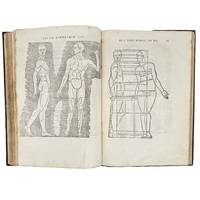
1528375684Nuremberg: Jeronymus Formschneyder 1528. First edition. Dürer's large woodcut monogram on title; woodcut proportional figures throughout many two to a page; woodcut ornamental flourishes. 134 leaves plus 4 folded double-page leaves printed on both sides. 1 vols. Folio. Full brown levant by Bedford decoratively stamped and tooled in gilt; title stamped in gilt on spine; a.e.g. Front board rehinged to highest standard; V5-6 closely trimmed but complete. A beautiful copy. First edition. Dürer's large woodcut monogram on title; woodcut proportional figures throughout many two to a page; woodcut ornamental flourishes. 134 leaves plus 4 folded double-page leaves printed on both sides. 1 vols. Folio. First edition of Albrecht Dürer's "Four Books on Human Proportion" his iconic treatise on the geometry of the human body published posthumously for his widow in 1528 six months after his death.<br /> <br /> Best known for both his highly-detailed engravings and woodcuts as well as portraits - in particular those of himself - Dürer had shown early promise as an artist. At the age of fifteen he apprenticed with Michael Wolgemut who also lived in Nuremburg and specialized in woodcuts. While Dürer was training there Wolgemut's workshop began work on the over 1800 illustrations in the famous 1493 Nuremberg Chronicle published by Dürer's godfather Anton Koberger and he may have contributed to several of them.<br /> <br /> After travels to Italy and marriage Dürer settled in Nuremburg and opened his own workshop where he integrated the Italian aesthetics he absorbed on his journeys into the Northern forms of his upbringing and training. In addition to painting and engraving he also began codifying his theoretical approaches to art and perspective. The first of these works "Four Books on Measurement" "Underweysung der Messung mit dem Zirckel und Richt Scheyt" published in 1525 dealt with geometry and as he stated in the introduction it was intended "not only for painters but also for goldsmiths sculptors stonemasons carpenters and all those for whom using measurement is useful." A second book "Various Lessons on the Fortification of Cities Castles and Localities" "Etliche Underricht zu Befestigung der Stett Schloss und Flecken" was issued in 1527.<br /> <br /> "Four Books on Human Proportion" is considered his textual masterpiece however. The first book - primarily written from 1512-1513 - explores five different types of male and female figures all based on his personal observations each divided into fractions of height while the second book examines a further eight anatomical models using Leon Battista Alberti's concepts of linear perspective. In the third book Dürer provides operative principles by which the proportions of human physiognomy can be modified and the fourth concerns his theories of movement. <br /> <br /> An important additional essay by Dürer on aesthetics was included at the rear of the book in which he differentiated himself from prior theoriticians on the human form such as Leonardo da Vinci and Marcus Vitruvius. While clearly influenced by their work Dürer was less interested in celebrating corporeal paragons than surveying the many varieties of bodily shapes and sizes as well as the manners in which those figures moved through the world. As he himself noted "I hold that the perfection of form and beauty is contained in the sum of all men."<br /> <br /> A CHOICE COPY OF THIS BEAUTIFUL AND INFLUENTIAL BOOK ON ANTHROPOMETRY. VD16 ZV 23128. Provenance: Robert Hoe his morocco label; sold Anderson Galleries April 1912 lot 1050; to Albert Gallatin Sr. and by descent in the family Jeronymus Formschneyder unknown
151013681Alemania 1510. 397x281mm. 15¾x11". Grabado Alemania 1510 pero 1511. Xilografía en negro sobre papel. Tamaño imagen y papel: 397 x 281mm. Primera edición temprano estado de uno de los grabados más cautivadores de Dürer incluidos en su famosa serie de La Gran Pasión. Monograma de Albrecht Dürer 1471-1528 "AD" en la parte inferior izquierda. Fechado en el grabado "1510". unknown
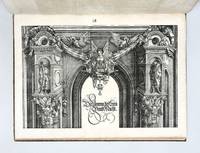
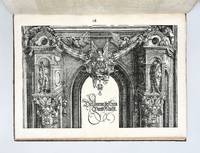
1799147472Vienna: widow of Alberti for T. Mollo 1799. The Triumphal Arch of Maximilian I Printed from the original 16th-century blocks under the supervision of Adam Bartsch this is the fourth edition of Dürer's Ehrenpforte one of the great giant woodcuts of the Renaissance. The blocks are now preserved at the Albertina Museum Vienna. The work was intended for assembly as a gigantic wall print measuring approximately 3.5 x 3 metres 11 x 9 feet. The Hapsburg emperor Maximilian I had insufficient funds to hold a triumphal procession or erect an arch in stone. His place in the imperial Roman tradition was nevertheless guaranteed through the truly monumental scale of this triumphal arch on paper. The arch was originally conceived by the Tyrolean court painter and architect Jörg Kolderer as a miniature. Under the direction of the Emperor Johannes Stabius provided the program of the whole arch and the five sheets of prose commentary at the foot. Dürer supervised the execution of the multi-block print and also contributed ornamental details see Strauss p. 504. The 192 blocks 174 survived of varying size were cut in the workshop of Hieronymus Andreä in Nuremberg. Although probably conceived in 1512 the project was not completed till August or September 1517 despite the date of 1515 on the base of the arch. A large part of the design was the work of Dürer's assistants Springinklee and Traut. After the first of 1517 second and third editions were published in 1526-28 and 1559. This fourth edition of 1799 was printed from 174 surviving blocks. To supply the lack copies were issued with 18 etchings by Bartsch on three sheets which could be cut out and mounted to replace the missing blocks including the Battle of Utrecht Maximilian's coronation and the First Congress of Vienna; the 24th panel shows a new image of the Battle of Pavia; the Dürer block of the Burgundian Wedding was replaced by an earlier block of Springinklee. This copy contains the complete printing of the 174 surviving blocks. It does not have Bartch's replacement etchings nor the latter-day printed matter: the 1799 double-page letterpress title and "avertissement" leaf at the beginning and the double-page letterpress "avis au relieur" a plan showing how the wall print should be assembled at the end. It may possibly have been issued thus as it shows no signs of having been disturbed in its binding. Provenance: from the library of the French sculptress Félicie de Fauveau 1801-1886 who as a fervent royalist had taken refuge in Florence with a gift inscription in French at the foot of the first flyleaf presenting the book to her in spring 1843. Her studio on Via degli Serragli was a regular stop for international travellers on the Grand Tour and she had many influential friends and admirers including Elizabeth and Robert Browning who had also made their home in Florence. Fauveau was a friend and art adviser to Alexander Lindsay 25th Earl of Crawford 1812-1880. Lord Lindsay as he was then styled made several visits to Italy in the 1840s in preparation for his work on art Sketches of the History of Christian Art 1847 which was in part inspired by Fauveau's religious sentiment. Lord Lindsay was an active collector of books including illuminated manuscripts and volumes of engravings. A small paper label hand-lettered in Italian a little worn at the upper inner corner of the front board notes the ownership of Contessa Crawford. Lindsay's wife Margaret was styled as Countess of Crawford from 27 March 1825 until her death in 1850. Broadsheet 65 x 48 cm. 50 numbered woodcuts on 43 sheets the first 5 sheets comprising the legend by Stabius the last sheet also containing 3 woodcut inscriptions numbered 51-53 the entire design made up from 174 original blocks. Lacks the 1799 double-page letterpress title and "avertissement" leaf at beginning the double-page letterpress "avis au relieur" at end and 18 etchings by Bartsch on 3 sheets. Contemporary probably original pink cloth backing marbled boards. Some splitting of cloth at joints but holding firm front free endpaper renewed and helping reinforce front inner hinge a few trivial marks at corners but an excellent copy clean and fresh with clear impressions printed on strong laid paper. Dodgson I p. 311/130-136; Hollstein VII Dürer 251; Meder Dürer 251 p. 215; Strauss Dürer Woodcuts 175. Hugh Brigstock "Lord Lindsay: Travel in Italy and Northern Europe 1841-42 for 'Sketches of the History of Christian Art'" The Volume of the Walpole Society vol. 65 2003 pp. 161-258. hardcover
17993523Vienna: widow of Alberti for T.Mollo 1799 1799. Broadsheet 65 x 48 cm. Contemporary probably original pink cloth backing marbled boards. With fifty numbered woodcuts on forty three sheets the first five sheets comprising the legend by Stabius the last sheet also containing three woodcut inscriptions numbered fifty one to fifty three the entire design made up from 174 original blocks and eighteen etchings by Bartsch on three sheets. Some splitting of cloth at joints but holding firm front free endpaper renewed and helping reinforce front inner hinge a few trivial marks at corners but an excellent copy clean and fresh with clear impressions printed on strong laid paper. Fourth impression of Dürer's Ehrenpforte one of the great giant woodcuts of the Renaissance printed from the original sixteenth-century blocks under the supervision of Adam Bartsch. The blocks are now preserved at the Albertina Museum Vienna. The work was intended for assembly as a gigantic wall print measuring approximately 3.5 x 3 metres 11 x 9 feet. The Hapsburg emperor Maximilian I had insufficient funds to hold a triumphal procession or erect an arch in stone. His place in the imperial Roman tradition was nevertheless guaranteed through the truly monumental scale of this triumphal arch on paper. The arch was originally conceived by the Tyrolean court painter and architect Jörg Kolderer as a miniature. Under the direction of the Emperor Johannes Stabius provided the program of the whole arch and the five sheets of prose commentary at the foot. Dürer supervised the execution of the multi-block print and also contributed ornamental details see Strauss p. 504. The 192 blocks 174 survived of varying size were cut in the workshop of Hieronymus Andreä in Nuremberg. Although probably conceived in 1512 the project was not completed till August or September 1517 despite the date of 1515 on the base of the arch. A large part of the design was the work of Dürer's assistants Springinklee and Traut. After the first of 1517 second and third editions were published in 1526-28 and 1559. The fourth impression of 1799 was printed from 174 surviving blocks with eighteen etchings by Bartsch to replace the missing blocks including the Battle of Utrecht Maximilian's coronation and the First Congress of Vienna; the twenty-fourth panel shows a new image of the Battle of Pavia; the Dürer block of the Burgundian Wedding was replaced by an earlier block of Springinklee. In this copy the latter-day printed matter has been discarded that is the 1799 double-page letterpress title and "avertissement" leaf at the beginning and double-page letterpress "avis au relieur" actually a plan showing how the wall print should be assembled at the end. What remains is the complete fourth impression of the original work. Dodgson I pp. 311 130136; Hollstein VII Dürer 251; Meder Dürer 251 p. 215; Strauss Dürer Woodcuts 175. Hugh Brigstock "Lord Lindsay: Travel in Italy and Northern Europe 184142 for 'Sketches of the History of Christian Art'" The Volume of the Walpole Society vol. 65 2003 pp. 161258. [Vienna]: [widow of Alberti for T.Mollo] [1799] hardcover
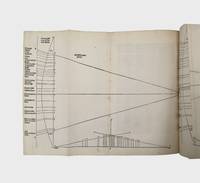
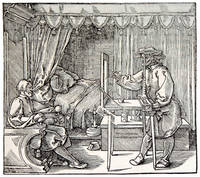
15322727Paris: Christian Wechel 1532. First Latin edition of Dürers first book on the theory of art the Unterweisung der Messung bound with the first Latin edition of his treatise on fortification strictly speaking the first treatise dealing exclusively with this subject Krufft with important material on urban planning and utopianism.1 Illustrated by Dürer himself the Institutionum Geometricarum outlines the artists theory of the work of art as a natural object which became an accepted aesthetic dogma until the 19th century. Far more than the German original of 1525 this translation by the humanist Camerarius brought the treatise to the attention of the whole of Europe. As a theoretical statement by the last major painter to be counted a significant geometer Kemp the work is naturally of interest for applications in Dürers own oeuvre as well as for the history of perspective. After his encounter with Luca Pacioli in Italy Dürer became convinced of how close the links are between art and mathematics and devoted himself to the study of form through the resources offered by arithmetic and geometry. The result was the present work. In this work Dürer teaches the principles of perspective and explains the application of practical geometry to drawing and painting. It became a very influential text as its audience broadened from artists to architects sculptors and different craftsmen and was translated and reprinted several times.Panofsky describes the treatises importance as three-fold: for the technical innovation in the construction of a perspective apparatus in which the eye of the observer is dispensed with entirely; for being the first literary document in which a strictly representational problem received a strictly scientific treatment at the hands of a Northerner; and for emphasizing that perspective is not a technical discipline destined to remain subsidiary to painting or architecture but an important branch of mathematics capable of being developed into what is now known as general projective geometry Panofsky p. 252.Book Three contains Dürers famous treatise on the just shaping of Roman capital letters and gothic or Textur letters built up by means of small geometrical forms a method original with Dürer. This text was translated into English by R.T. Nichol for publication by the Grolier Club Of the Just Shaping of Letters New York 1917.2 Inspired by the artists witnessing the siege of Hohenasperg in 1519 and by fear of the advancing Turkish armies Krufft writes De Urbibus employs a dual approach. On the one hand Dürer develops various alternatives for the construction of bastions to defend existing cities; this is the contemporary aspect. At the heart of the treatise he outlines a utopian city in which the nature of fortification merely serves as a spur to the depiction of a social structure organized on the ground. Related trades are placed side by side; smiths are to be housed near foundries etc. The town hall and the houses of the nobility are sited near the royal palace. The whole system of organization is hierarchical and functional. Dürer thinks of every function of the city right down to the taverns Krufft History of Architectural Theory p. 110 . Elsewhere Krufft suggests that Serlio employed the present treatise in book VI.According to Mortimer the woodblocks are close copies of the 1527 German original. 1Mortimer French I.182; Vagnetti E II.b7; Panofsky The Life and Art of Albrecht Dürer Chapter 8 Dürer as a theorist of Art esp. 247-60; Kemp The Science of Art 53ff.; 2 Mortimer French I.184; Fowler 113 1527 German; Krufft History of Architectural Theory 110-111. 4 ff. recto of last leaf blank woodcut of man with lute on verso 185 pp. verso blank 1 f. printers device on verso recto blank; folding extensions on P6 & Q1 as required by Mortimer. Bound in 18th-century calf over boards spine with raised bands re-backed later red morocco title label. Title dusty; occasional toning; small wormtrack through much of volume generally in blank margin but occasionally grazing a partial letter or printed border on plates. Withal a fresh copy very good.Bound with:DÜRER Albrecht. De Urbibus Arcibus castellisque condendis ac muniendis rationes aliquot praesenti bellorum necessitati accomodatissimae . Paris Christian Wechel 1535. 40 ff. including 10 double-page/extended leaves as described by Mortimer. Christian Wechel hardcover
153266816Norimbergae Nürimberg Nuremberg: In aedib. viduae Durerianae Hieronymus Andreae 1532. Fine. In aedib. viduae Durerianae Hieronymus Andreae Norimbergae Nürimberg Nuremberg 1532 20.50 x 32 cm relié Alberti Dureri clarissimi pictoris et geometræ. De symmetria partium in rectis formis humanorum corporum In aedibviduae Durerianae Hieronymus Andreae Norimbergae Nuremberg 1532 folio 20.5 x 32 cm 80 f. A-E6 F4 G-N6 O4 full parchment First edition of the Latin translation created by Joachim Camerarius the work appeared in German in 1528 under the title Vier Bücher von menschlicher Proportion. Our edition contains the first two books the following two will be published in 1534 under the title De varietate figurarum et flexuris partium ac gestibus imaginum. We will have to wait until 1557 for Louis Meigret's French translation to be published. Our edition is illustrated with 85 large wooden insert illustrations and many other smaller in-text illustrations the same as those used in the original German edition. The title page shows Dürer's well-known monogram. Gothic text. The last white leaf missing in most copies is present here. Large greatly fresh margined copy. Full parchment with preserved laces. Very beautiful copy of the most sought-after of Albrecht Dürer's technical works. The illustrations required the examination of several hundred male and female models and something rarer for the time children. These extremely precise analyses resulted in anthropometrical impressionist drawings showing the human body as a whole and also in detail hands feet heads etc. Each drawing squared or scaled in the margin allows the models to be easily reproduced the book being intended to avoid errors of proportion for young artists. Joachim Camerarius' Latin translation humanist and close friend of the author had at the time an essential role: it gave Dürer's work until then written in archaic German a significant audience; without Camerarius Michelangelo would never for example have known of Dürer's theory of proportions. Dürer whose godfather Anton Koberger published La Chronique de Nuremberg in 1493 frequented the world of printing and engraving very early on and unlike his contemporary Florentine Leonardo da Vinci who published nothing he produced several theoretical treatises. It was during a trip to Italy in 1494 that he met Jacopo de' Barbri 1445-1516 who introduced him to the role of mathematics in perspective and the study of the proportions of the human body. On returning to Germany he opened a workshop became the painter of Maximillian I of Habsbourg and joined the Great Council of the City of Nuremberg. Recognition is complete and Dürer becomes an internationally known artist with the knowledge and ability for well-received thought. In the last years of his life not abandoning the pictorial arts Dürer encouraged by his humanist friends spends most of his time writing. Determined to leave the results of his long theoretical thoughts for posterity he publishes several treatises: Instruction sur la manière de mesurer 1525 Instruction relative aux fortifications des bourgs villes et châteaux 1527 and finally Traité des proportions du corps humain 1528. In keeping with the artistic considerations of the Renaissance the intention of this last treaty is to establish a scientific basis geometrical and arithmetical applied to aesthetics and thus to provide practical guidelines aimed at achieving anatomical perfection. A true artistic testament this emblematic work will have a considerable influence on the history of Western art. In aedib. viduae Durerianae[ Hieronymus Andreae] unknown
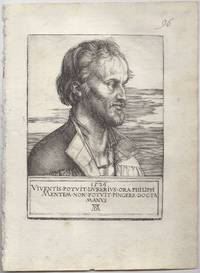
1059Original engraving 1526. Very clear strong contrasts Meder C impression with the stray burin strokes to the left of the head and the scratch on the forehead. Wide-margined. Plate size: 127 × 173 mm; sheet size: 182 × 250 mm. Numbered by old hand in ink at upper right corner monogrammed and dated 1602 on verso probably by different hand. Very light foxing mostly at edges a brown spot beneath the tablet with inscription. In passe-partout. In fine condition. Original engraving 1526. Very clear strong contrasts Meder C impression with the stray burin strokes to the left of the head and the scratch on the forehead. Wide-margined. Plate size: 127 × 173 mm; sheet size: 182 × 250 mm. <p><br /> Albrecht Dürer’s famous 1526 portrait of Philip Melanchthon the humanist scholar religious reformer theologian and educator.<br /> <p><p><br /> Head and shoulder portrait of Philip Melanchthon 1497–1560 facing right with the background of sky with clouds underneath a tablet with date Dürer’s monogram and the Latin inscription “VIVENTIS POTVIT DVRERIVS ORA PHILIPPI MENTEM NON POTVIT PINGERE DOCTA MANVS†Dürer was able to depict the features of the living Philip but the skilled hand could not portray his mind. This image was the last of the series of five portraits with the use of an inscribed tablet and one of the last of Dürer’s portrait prints to be made.<br /> <p><p><br /> In 1525 Melanchthon worked in Nuremberg to establish a new secular school on behalf of the City Council. While in the city he stayed at Willibald Pirckheimer’s home who was the closest friend of Dürer and the two undoubtedly met either through the host or through other members of the city’s humanist circle. A portrait drawing of Melanchthon was probably made at this time and formed the basis of this engraving that was created in 1526.<br /> <p><p><br /> A very well preserved wide-margined copy. <br /> <p><p><br /> Meder 104; Bartsch 104; Dodgson 102<br /> <p>. unknown
151122161511. Woodcut. One of the plates from the set of 16 illustrations of the Apocalypse of Saint John. Fine impression of the only state with the latin text on the verso. 1511. With 1/4" margins 390 x 279 15 3/8 x 11 Meder 175 B. 74 Pan.294 K. 117 T. 137Schoch Mende Scherbaum 123. Watermark: Flower with a triangle M. Watermark #127. Printers crease in upper left corner some glue stains on verso right border not noticeable from the front. Otherwise in fine condition.
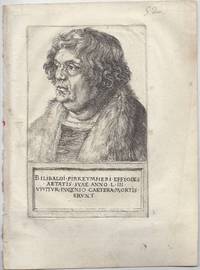
1060Original engraving 1524. Very clear strong contrast but slightly later impression wide-margined. With the “small coat of arms of Augsburg with ‘A’ and ‘M’†watermark around ca. 1560–1600; Meder 179; Briquet 2119. The inscription in the box below the portrait with no date and monogram. Plate size: 114 × 183 mm; sheet size: 182 × 250 mm. Numbered by old hand in ink at upper right corner. A hole restored at the right margin near the plate with no effect on the print. Very light sporadic foxing on recto more to verso. A small red blot to the left edge of the sheet. A trace of folding at right edge. In passe-partout. Overall in fine condition. Original engraving 1524. Very clear strong contrast but slightly later impression wide-margined. With the “small coat of arms of Augsburg with ‘A’ and ‘M’†watermark around ca. 1560–1600; Meder 179; Briquet 2119. The inscription in the box below the portrait with no date and monogram. Plate size: 114 × 183 mm; sheet size: 182 × 250 mm. <p><br /> Albrecht Dürer’s famous 1524 portrait of his closest friend the humanist scholar and art collector Willibald Pirckheimer.<br /> <p><p><br /> Head and shoulder three-quarter view portrait of Willibald Pirkheimer 1470–1530 facing left wearing a fur-lined coat underneath a tablet with Latin inscription “BILIBALDI PIRKEYMHERI EFFIGIES AETATIS SVAE ANNO L III VIVITVR INGENIO CAETERA MORTIS ERVNT†Portrait of Willibald Pirckheimer at the age of 53. We live by the spirit; the rest belongs to death.<br /> <p><p><br /> The portrait as well as the original plate was given by Dürer to Pirckheimer thus he gave up control over future use of the plate. Pirckheimer used it as a bookplate instead of his actual one that was also designed by Dürer. <br /> <p><p><br /> A very well preserved wide-margined copy. <br /> <p><p><br /> Meder 103; Bartsch 106; Strauss 102; Hollstein 103; Dodgson 101<br /> <p>. unknown
153271508first volume 2 Ai-Oiii 179 leaves including folded second volume a1-j5 55 leaves including folded 268 pages across the 2 books 12 leaves in facsimilie illustrated throughout with black and white line drawings 96 full page illustrations 4 folded plus 24 within the text also various tables within the text text in Latin Published by Hieronymus Andreae [In aedib viduae Durerianae] hardcover
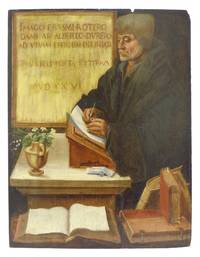
12140s.l. s.n. 16XX. 465 x 355 cm. Not dated not signed early XVII century. Painted on a thin wooden panel consisting of two parts with a small indentation at the top. The original engraving was made in 1526 in Rotterdam by the Germain painter Albrecht Dürer 1471-1528 and is now in The Metropolitan Museum of Art in New York. A Roman Catholic reformer and one the most important Netherlandish humanists Erasmus of Rotterdam held a deep admiration for Albrecht Dürer whom he praised in a eulogy as the greatest of graphic artists: ""And is it not more wonderful to accomplish without the blandishment of colors what Apelles accomplished with their aid"" In likening Dürer to Apellesindeed in asserting the German's superiority over the Greek artistErasmus echoed a tradition dating back to antiquity of judging artists and the visual character of their work by the standards set by their predecessors. Dürer would certainly have appreciated the praise for his graphic talents. The portrait amply demonstrates the virtuous effects Dürer was able to achieve without the benefit of color or a liquid medium. Convincingly aligned at an angle to the picture plane Erasmus stands writing in his study with the books that indicate his substantial intellect and scholarship arranged around him. The vase of lilies probably refers to the purity of his mind while the Latin and Greek inscription prominently framed like a picture on the wall underscores the scholar's humanistic interests: ""This image of Erasmus of Rotterdam was drawn from life by Albrecht Dürer."" Below is the date 1526 in Roman numerals. Dürer met Erasmus at least once in Brussels and twice in Rotterdam during a trip to the Netherlands in 1520 and 1521. Although he sketched Erasmus several times during his trip he did not execute the engraving until six years later and only then with the encouragement of his close friend Willibald Pirkheimer. For certain reasons Dürer had been disappointed by the well-known Protestant reformer. Dürer based the portrait on a medal of 1519 in Pirkheimer's collection by Quentin Massys and reproduced the Greek inscription found on the medal which states: ""A better portrait his writings show."" Presumably Erasmus agreed because he made known his disappointment with this portrait to at least two of his colleagues. And yet Dürer's Erasmus remains one of history's richest and most powerful depictions of scholarly preoccupation and the humanist ideal. 465 x 36 cm. Niet gedateerd niet gesigneerd begin XVII eeuw. Geschilderd op een op een dun houten paneel bestaande uit twee delen met aan de bovenzijde een kleine inkeping. De originele gravure werd in 1526 gemaakt in Rotterdam door de Duitse schilder Albrecht Dürer 1471-1528 en bevindt zich nu in The Metropolitan Museum of Art in New York. Erasmus van Rotterdam een rooms-katholiek hervormer en een van de belangrijkste Nederlandse humanisten had grote bewondering voor Albrecht Dürer die hij in een lofrede prees als de grootste van alle grafische kunstenaars: ""En is het niet wonderbaarlijker om zonder de verleiding van kleuren te volbrengen wat Apelles met hun hulp heeft volbracht"" Door Dürer met Apelles te vergelijken ja door de superioriteit van de Duitser over de Griekse kunstenaar te bevestigen herhaalde Erasmus een uit de oudheid stammende traditie om kunstenaars en het visuele karakter van hun werk te beoordelen naar de maatstaven van hun voorgangers. Dürer zou de lof voor zijn grafische talenten zeker op prijs hebben gesteld. Het portret laat goed zien welke fraaie effecten Dürer kon bereiken zonder het gebruik van kleur of een vloeibaar medium. Erasmus staat overtuigend in een hoek ten opzichte van het beeldvlak schrijvend in zijn studeerkamer met om hem heen de boeken die getuigen van zijn grote intellect en geleerdheid. De vaas met lelies verwijst waarschijnlijk naar de zuiverheid van zijn geest terwijl de Latijnse en Griekse inscriptie prominent ingekaderd als een afbeelding aan de muur de humanistische belangstelling van de geleerde onderstreept: ""Deze afbeelding van Erasmus van Rotterdam is naar het leven getekend door Albrecht Dürer."" Daaronder staat de datum 1526 in Romeinse cijfers. Dürer ontmoette Erasmus ten minste eenmaal in Brussel en tweemaal in Rotterdam tijdens een reis naar de Nederlanden in 1520 en 1521. Hoewel hij Erasmus tijdens zijn reis verschillende malen schetste voerde hij de gravure pas zes jaar later uit en dan nog alleen op aanmoediging van zijn goede vriend Willibald Pirkheimer; kennelijk was Dürer om bepaalde redenen teleurgesteld in de bekende protestantse hervormer. Dürer baseerde het portret op een penning uit 1519 in Pirkheimers verzameling van Quentin Massys en reproduceerde de Griekse inscriptie die op de penning te vinden was en die luidt: ""Een beter portret tonen zijn geschriften."" Vermoedelijk was Erasmus het daarmee eens want hij heeft zijn teleurstelling over dit portret aan tenminste twee van zijn collega's kenbaar gemaakt. En toch blijft Dürers Erasmus een van de rijkste en krachtigste afbeeldingen uit de geschiedenis van de wetenschappelijke preoccupatie en het humanistische ideaal. s.l., s.n. unknown
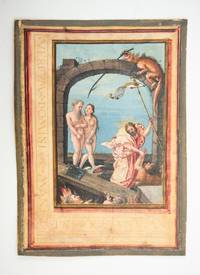
1540ST20622Germany ca. 1540. 183 x 133 mm. 7 1/8 x 5 1/4". <br/> WITH A FULL-PAGE MINIATURE DEPICTING THE HARROWING OF HELL featuring a naked Adam and Eve on the left and on the right Christ bending down to rescue John the Baptist the figures framed by a stone archway supporting a hairy creature who aims the point of a spear directly at Adam and Eve the miniature in a thin brown frame with gilt lines surrounded on two sides by the words "VERBUM DOMINI MANET IN ETERNUM" in gilt all framed in gray and red washes with double rules of black and gilt. Light soiling to frame a little flaking to the gray border and a couple of small scuffs and smudges elsewhere verso with spotting but the miniature vibrant and well preserved with only very trivial imperfections.<br/> <br/> A close copy of an early 16th century engraving by Albrecht Dürer this powerful miniature depicting the Harrowing of Hell is an intriguing artifact that ties together manuscript art print culture and the Reformation. The image depicts an apocryphal tale in the Gospel of Nicodemus in which Christ following his death but before his Resurrection descends into Limbo in order to save righteous souls who had passed away before him particularly figures from the Old Testament. Christ appears here in pale pink robes carrying a long staff with a cross and banner adorning the top. Having just brought down the gates of Hell he stoops to rescue John the Baptist here dressed in furs from its depths. A naked Adam and Eve covering their loins stand at the left of the composition--Adam now a gray-bearded old man as a reflection of sin and mortality but Eve still as she was at the Expulsion in keeping with the period's inclination to retain the classically idealized youthful feminine form. Above them is a stone arch upon which a dog-like demon perches stealthily aiming a spear directly at the oblivious couple. Another demon snaps its jaws at the feet of Christ and we can see a lick of flames below the broken gate as more captive souls clamor to escape. The painting is skillfully done showing the artist's facility with anatomy proportion and foreshortening. The bodies of Adam and Eve are particularly excellent with lovely skin tones and convincing molding. The composition is clearly based on an engraving by Dürer published in 1513 as part of a major series of 16 images known as the "Engraved Passion." In translating a black & white print into a full-color painting the artist here dispensed with a few details seen in Dürer's work such as the shadowy figure behind Adam and Eve and the stigmata on Christ's hand; however the overall composition deviates little from the original suggesting that the artist may have been working from an actual engraving. Although this leaf contains just a few words in the form of a border inscription--"Verbum Domini manet eternum" "the Word of the Lord endures forever"--they are monumentally important. This line from Isaiah 40:8 and 1 Peter 1:25 became the motto of the Lutheran Reformation appearing on art clothing coins and even armor of the 16th century. The Schmalkaldic League an influential group of allied Lutheran principalities in the Holy Roman Empire at the time also adopted it as their motto. Given the dominance of print materials during the Reformation period our hand-painted miniature--possibly produced as a frontispiece--must have been a very special commission. It is also an object that is prime for further study touching on aspects of book production religious art and the transmission of images and ideas in the early modern period. unknown
#[24942]Arnhem Jan Jansz. 1622. Folio half vellum good condition. 266 p. Illustrated with numoerous woodcut prints. Some browning. B0298. hardcover
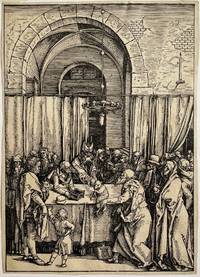
K80093One of the series of 20 woodcuts on the life of the Virgin text on verso.Within a temple in the centre the high priest Ruben rejecting the offering of St Joachim a dove in a cage and a lamb on the right St Anne standing behind St Joachim clutching her hands.Created in c. 1504 this stunning woodcut features Albrecht Dürer's signature monogram on a slate in the lower center of the image.Used as plate in Dürer's: Epitome in Divae Parthenices Mariae Historiam ab Alberto Durero published in Nuremberg in 1511.NL Joachim staat met Anna bij een tafel waaromheen veel mensen staan. De hogepriester achter de tafel duwt het lam dat Joachim aanbiedt van de tafel af. Deze prent is onderdeel van een serie van 20 prenten bestaand uit een titelprent en 19 prenten met scènes uit het leven van Maria. Gemaakt door oude meester Albrecht Dürer 1471-1528. Woodcut and letterpress on laid paper; total: 302 x 218 mm; in great condition mounted on cardboard passepartout; Meder 1932 nr 189 Bartsch VII.131.77. unknown
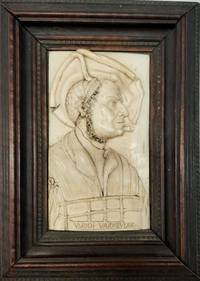
elala5896<p>cGermany: c16th-17th century. The subject Ulrich Varnbüler 1474-1545 was a German humanist and public official. In 1521 he was appointed chancellor to the Reichsregiment 1521-30 which was to exercise imperial powers in Germany in the absence of Charles V. With the Reichsregiment he first resided in Nuremberg where his friend Albrecht Dürer sketched his portrait for a woodcut which was executed in 1522 and upon which this ivory is based. The text in the cartouche of the woodcut reads in translation: "Through this picture Albrecht Dürer from Nuremberg would like to recognize Ulrich the secretary and chief clerk of the Roman imperial government with the surname Varnbüler whom he loves immensely." Varnbüler was also friends with Erasmus and translated into German the latter's adage 'Dulce bellum inexpertis' Basel: 1519. Varnbüler was instrumental in obtaining in the name of the emperor protective privilege against pirated editions for works published by Johan Froben and Andreas Cratander. A number of works were dedicated to him by Cratander Willibald Pirckheimer and Peter II Schöffer. See P.G.Bietenholz Contemporaries of Erasmus' 1987 Vol. III p. 377. 6 3/4 x 3 3/4 inches size of plaque. 10 x 7 ½ inches size with frame. mounted in an antique wooden frame c1840 on a pine backing board a number of minor surface blemishes crack of not more than ½ inch in top near centre & 2 small cracks of not more than ½ inch in hat. elala5896</p> [cGermany: c16th-17th century]
51-6119Amsterdam: Bernard Picart and Paris : Chereau 1729. Oblong 4to. 25.5 x 18.8cm. Contemporary marbled calf and gilt spine.2 6pp. Engraved title page followed by 42 engravings on 36 plates. Very good with unfoxed plates.OCLC Number / Unique Identifier:469747697; Nissen ZBI 3167; Brunet IV 630; Nagler XII 414 123 Amsterdam: Bernard Picart and Paris : Chereau, 1729. unknown
1591durer-della-simmetria-deiVenetia Venice: Domenico Nicolini 1591. First Italian Edition. Hardcover. Fine. Dürer Albrecht. Libri quattro. Leaves 1 f.e 6 143 including 3 folded plates 1 colophon; 1 r.e. Modern period-style binding full morocco with blind and gilt tooling to boards and spine; spine with five raised bands. Leaf 29 misnumbered 27; leaf 74 skipped in the pagination but complete as in other copies. Four double-page plates on three folded leaves the first two only on the recto; the others printed on recto and verso on the same leaf pp. 96-97. 110 woodcut illustrations throughout the text. Very small numerical calculations in ink on the front endpaper in an early hand; possibly the same hand annotated the rear endpaper with notes in Italian relating to the subject matter of the book with references to Michelangelo Buonarroti. Minor worming at the upper inner margin of the last 40 leaves well away from text and images. The folded plate 98 has been professionally restored at the back of the fold. Light browning to a few of the final text pages. A crisp copy in very good condition. Dürer's foundational treatise on human proportion first Italian edition with over 100 woodcuts. First Italian edition of Albrecht Dürer's celebrated treatise on human proportion translated from the Latin version printed in Nuremberg between 1532 and 1534. Originally conceived as an instructional manual for artists and first published in German in 1528 the work applies mathematical proportion to the depiction of the human body in pursuit of harmonious form. Dürer's position within Renaissance debates is distinctive: unlike Leonardo da Vinci or Michelangelo he rejected anatomical dissection believing that anatomy fragmented the body and obscured its unity. Geometry and proportion by contrast offered a comprehensive vision of the figure. Published posthumously in Venice by Nicolini in 1591 this folio edition is a cornerstone of scientific anthropometry. The translation by Giovanni Paolo Gallucci expands the original four books with a fifth addressing the artistic representation of human diversity. Celebrated and influential the work bridges Renaissance art theory and scientific inquiry. Domenico Nicolini hardcover
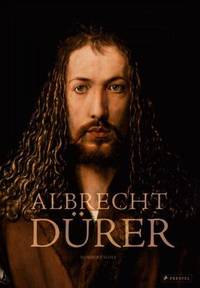
201086911Prestel. New. 2010. Hardcover. 3791344269 . FREE UPGRADE to Courier/Priority Shipping Upon Request - IN STOCK AND IMMEDIATELY AVAILABLE FOR SHIPMENT - Flawless copy brand new pristine never opened -- Text in English. 299 pages; 200 illustrations in color. Catalogue Raisonne Catalog Raisonné Complete Works Life and Work Raisonnee Prestel hardcover
187183819Theodor Ackermann. As New. 1871. Hardcover. FREE UPGRADE to Courier/Priority Shipping Upon Request - IN STOCK AND IMMEDIATELY AVAILABLE FOR SHIPMENT - AS NEW THE TEXT BLOCK IS PRISTINE CLEAN UNMARKED AND IN EXCELLENT CONDITION - - - Text in German. 4 169 3 pages; 343 items described; 2 plates; 4to. -- with a bonus offer-- . Theodor Ackermann hardcover
196986394FLAMMARION. As New. 1969. Hardcover. FREE UPGRADE to Courier/Priority Shipping Upon Request - IN STOCK AND IMMEDIATELY AVAILABLE FOR SHIPMENT - AS NEW THE TEXT BLOCK IS PRISTINE CLEAN UNMARKED AND IN EXCELLENT CONDITION - - - 120 pages; over 350 illustrations including 64 color plates. Duerer Catalogue Raisonné Catalogue Raisonne Catalog Raisonnee uvre Oeuvre FLAMMARION hardcover
196886395Rizzoli. As New. 1968. Hardcover. FREE UPGRADE to Courier/Priority Shipping Upon Request - IN STOCK AND IMMEDIATELY AVAILABLE FOR SHIPMENT - AS NEW THE TEXT BLOCK IS PRISTINE CLEAN UNMARKED AND IN EXCELLENT CONDITION - - 120 pages; many illustrations. Catalogue Raisonné Catalogue Raisonne Catalog Raisonnee Complete Works Rizzoli hardcover
2010C86911Prestel. As New. 2010. Hardcover. 3791344269 . FREE UPGRADE to Courier/Priority Shipping Upon Request - IN STOCK AND IMMEDIATELY AVAILABLE FOR SHIPMENT - Flawless copy brand new pristine never opened -- Text in English. 299 pages; 200 illustrations in color. Catalogue Raisonne Catalog Raisonné Complete Works Life and Work Raisonnee -- with a bonus offer-- - May be EITHER: out of print OOP and extremely rare in this pristine condition; signed by author or contributor; or a first or special edition; inquire for details . Prestel hardcover
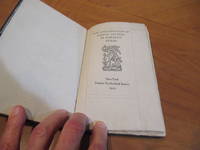
1923031224New York / Mt. Vernon N. Y.: Hubert Rutherford Brown / William Edwin Rudge/ Bruce Rogers 1923. 1st Edition 1st Printing. Hardcover. Good. Illustrated Letters Throughout. 39 Pp. Black Boards Black Leather Spine Elaborately Marbled Endpapers Pages Printed In Red Black And Beige. One Of 350 Copies Printed By Bruce Rogers At The Rudge Press Per The Colophon With A 1923 Hubert Rutherford Brown Imprint Stated On The Title Page Of Which Apparently 300 Have A Later Title Page Tipped In With Imprint Showing Dunster House 1924. Bookplate Of Dorothy W. Thompson.Annotated "Ivins J. / From B. Rogers / 23 Feb. 1924" On Verso Of Front Free Endpaper Probably By Ivins Writing Does Not Appear To Be By Rogers. William Mills Ivins Jr. 1881 - 1961 Was Curator Of The Department Of Prints At The Metropolitan Museum Of Art New York From Its Founding In 1916 Until 1946 When He Was Succeeded By A. Hyatt Mayor. He Was A Friend Of Rogers. Book Has Considerable Wear; Front Pastedown With Traces Of Very Large Removed Bookplate And Small Trace Of Attached Paper On Facing Free Endpaper Newer Large Bookplate On Front Pastedown No Other Names Or Marks; Some Offsetting Onto All Pages From The Facing Page. All Pages Evenly Aged. Rare; Worldcat Shows Only Four Institutional Holdings Of This Edition. <br/> <br/> Hubert Rutherford Brown / William Edwin Rudge/ Bruce Rogers hardcover
1969C86394FLAMMARION. As New. 1969. Hardcover. FREE UPGRADE to Courier/Priority Shipping Upon Request - IN STOCK AND IMMEDIATELY AVAILABLE FOR SHIPMENT - AS NEW THE TEXT BLOCK IS PRISTINE CLEAN UNMARKED AND IN EXCELLENT CONDITION - - - 120 pages; over 350 illustrations including 64 color plates. Duerer Catalogue Raisonné Catalogue Raisonne Catalog Raisonnee uvre Oeuvre -- with a bonus offer-- - May be EITHER: out of print OOP and extremely rare in this pristine condition; signed by author or contributor; or a first or special edition; inquire for details . FLAMMARION hardcover