3 984 résultats
198549652München, Prestel Verlag, 1985. origi.Broschur, 4°, 278 Seiten.
1884100368HBWien:, Gerold, 1884. 3 Bll., 42 (1) Seiten, HLnbd. der Zeit, goldgeprägter Rücken, 20,5 x 14 cm. [2 Warenabbildungen]
1921501519Leipzig, Insel, 1921. 4°. M. 115 Abb. 229 S. OLwd. (Deutsche Meister).
1922102238BBBerlin, Reichsdruckerei, 1922. 8°. 30 S. mit 8 ganzseitigen Abb. Original-Karton.
ART6962MBibliothèque de l'Image, 1994. In-4 à l'italienne, broché, 94 pages. Exemplaire satisfaisant
1978LFA-126721301Un ouvrage de 183 pages, format 230 x 310 mm, illustré, relié cartonnage couleurs, publié en 1978, Editions Time-Life, collection "Le Monde des Arts", bon état
2010123242Galleria. New. 2010. Paperback. FREE UPGRADE to Courier/Priority Shipping Upon Request - IN STOCK AND IMMEDIATELY AVAILABLE FOR SHIPMENT - 75 pages. Flawless copy brand new pristine never opened. Text in Italian. with a bonus offer-- . Galleria paperback
Mm 205x270 Edizione completa, non ridotta. Volume in copertina rigida priva della sovraccoperta, xviii-365 pagine profusamente illustrate con le opere dei maggiori maestri e con un indice dei nomi in chiusura.. Copia ottima con legature ben salde.
192857020Berlin, Grote 1928 - 1931. 1928. Gr.-8° XIII S. 1 Bl., 470 S. u. X S., 1 Bl., 629, (1) S. Mit zus. 62 Tafeln. Orig.-Leinen.
193816593Berlin: Deutsche Buch-Gemeinschaft 1938. 6 S. + 346 Abb. auf Taf. lose in 2° HLn-Mappe. *Leinen teilw. brüchig*.
192550807Dachau: Der Gelbe Vlg. (ca. 1925). XXIV,95 Ss. 4°. Illustr. Pp.
1919249189BBDachau, Der Gelbe Verl., (1919). 1.-30. Tsd. 4°. Mit üb. 100 Abb. 24, 95 S. Ill. OKt. - Kl. Namensschild a. Titel, sonst gutes Expl. 30
Book is in excellent condition with creaseless covers, and barely discernable edgewear. Binding is solid and square, covers have sharp corners, exterior shows no blemishes besides creases at spine, text/interior is clean and free of marking of any kind. 271 pages, heavily illustrated throughout with b&w prints, some color. Published to coincide with the exhibition held at the National Gallery of Art in Washington by the same name as the book title. The collection ranges from mediaeval to present times, with over 100 different artists represented including Braque, Bonnard, Bruegel, Buhot, Butts, Thomas, Jacques Callot, Mary Cassatt, Durer, Gauguin, Hecht, Matisse, Claude Mellan, Charles Meryon, Giorgio Morandi, Otto Muller, Josheph Pennell, Picasso, rembrandt van Rijn, Martin Schongauer, Giovanni Battista Tiepolo, Whistler, et al.
201324528Münster, Aschendorff, 2013. 284 S., 47 Abb. auf 13. Taf. 8°, OBrosch.
Mm 245x285 Volume in copertina rigida con sovraccoperta originale, 240 pagine con un ricco mcorredo di illustrazioni in nero e a colori nel testo. Opera nuova, mai letta, in perfette condizioni. Spedizione in 24 ore dalla conferma dell'ordine.
br. L'opera più enigmatica di Dürer non ha smesso di ispirare e provocare artisti, intellettuali, osservatori attenti. Questo studio ci guida a cogliere in essa un motivo filosofico mai esplorato prima: la figura principale non è Melancholia, come vuole la lettura consueta, né Geometria (Panofsky), né Astronomia (Schuster), bensì Philosophia. Nata in Grecia dallo stupore melanconico, cresciuta in ambito cristiano, è approdata al nord grazie a una translatio della cultura umanistica promossa da Massimiliano I d'Asburgo, il più potente fra i committenti di Dürer e primo sovrano europeo a puntare decisamente sul potere mediatico delle immagini. L'autrice offre un'indagine esaustiva e originale sull'incisione più famosa del mondo riconosciuta dalla critica come «l'immagine delle immagini».
ART6965MImprimerie des Arts et Manufactures, 1987. In-4, relié, cartonnage éditeur, 152 pages comprenant 152 reproductions dont 48 couleurs. Bon exemplaire
ill., ril. Sono integralmente catalogate e descritte tutte le opere - 748 stampe e un trattato - conservate presso il Gabinetto Disegni e Stampe, e storicamente attribuite al maestro tedesco. Il volume indaga inoltre in maniera analitica la ricezione dell'opera a stampa di Dürer in Italia, attraverso la ricostruzione della fortuna che ogni singola stampa ha avuto nell'arte e nella letteratura fino al 1686, anno di pubblicazione della biografia che Filippo Baldinucci dedica a Dürer nel suo Cominciamento e progresso dell'arte dell'intagliare in rame.
pp. 44 con ill. in b/n. Quaderno della Soprintendenza per i beni artistici e storici pubblicato in occasione dell'omonima mostra alla Pinacoteca Naz. di Bologna.
1860270605Nördlingen, Beck, 1860. VI, 525 Seiten. Originalleinen. 22cm
1819625991819 1 dossier in-8 regroupant un cahier par chapitre - Septembre 1971 Vol 1 N° 3
Quando uscì, nel 1923, La «Melencolia I» di Dürer di Erwin Panofsky e Fritz Saxl rappresentò una svolta decisiva negli studi umanistici. Non solamente veniva qui affrontato, con inediti strumenti critici, uno dei più oscuri enigmi della storia dell’arte occidentale, l’incisione Melencolia I di Dürer, ma veniva anche mostrato quello che sarebbe stato il metodo del «circolo di Warburg», di cui questo libro ha rappresentato una prima sintesi programmatica. Ripercorrendo le fonti antiche, alla ricerca dei presupposti – e da qui, poi, l’unicità – della concezione düreriana della malinconia, gli autori hanno ravvisato il loro compito non tanto nel trovare una precisa e magari innovativa soluzione per ciascun simbolo contenuto nell’incisione, quanto piuttosto nel lasciare emergere la grande linea evolutiva il cui punto finale può essere riconosciuto nell’opera di Dürer. Autori: Erwin Panofsky, Fritz Saxl. Curatori: Emiliano De Vito. Prefazione: Claudia Wedepohl.
1998BN154903Bibliothek Otto Schäfer 1998. 1998. Dürer Himmel und Erde - Gottes- und Menschenbild in Dürers druckgraphischem Werk ; Holzschnitte Kupferstiche und Radierungen aus der Sammlung Otto Schäfer II ; 17. Oktober 1999 - 6. Februar 2000 Bibliothek Otto Schäfer Schweinfurt ; 20. Mai - 30. Juli 2000 Museum Bad Arolsen Ausstellungen im Schloß ; 2. September - 25. November 2001 Josef Albers Museum Quadrat Bottrop <br/><br/>Dürer Himmel und Erde - Gottes- und Menschenbild in Dürers druckgraphischem Werk ; Holzschnitte Kupferstiche und Radierungen aus der Sammlung Otto Schäfer II ; 17. Oktober 1999 - 6. Februar 2000 Bibliothek Otto Schäfer Schweinfurt ; 20. Mai - 30. Juli 2000 Museum Bad Arolsen Ausstellungen im Schloß ; 2. September - 25. November 2001 Josef Albers Museum Quadrat Bottrop Erich Schneider Ernst Rebel Albrecht Dürer Bibliothek Otto Schäfer unknown
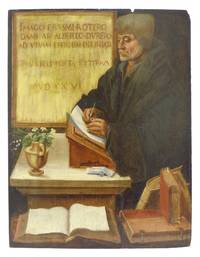
12140s.l. s.n. 16XX. 465 x 355 cm. Not dated not signed early XVII century. Painted on a thin wooden panel consisting of two parts with a small indentation at the top. The original engraving was made in 1526 in Rotterdam by the Germain painter Albrecht Dürer 1471-1528 and is now in The Metropolitan Museum of Art in New York. A Roman Catholic reformer and one the most important Netherlandish humanists Erasmus of Rotterdam held a deep admiration for Albrecht Dürer whom he praised in a eulogy as the greatest of graphic artists: ""And is it not more wonderful to accomplish without the blandishment of colors what Apelles accomplished with their aid"" In likening Dürer to Apellesindeed in asserting the German's superiority over the Greek artistErasmus echoed a tradition dating back to antiquity of judging artists and the visual character of their work by the standards set by their predecessors. Dürer would certainly have appreciated the praise for his graphic talents. The portrait amply demonstrates the virtuous effects Dürer was able to achieve without the benefit of color or a liquid medium. Convincingly aligned at an angle to the picture plane Erasmus stands writing in his study with the books that indicate his substantial intellect and scholarship arranged around him. The vase of lilies probably refers to the purity of his mind while the Latin and Greek inscription prominently framed like a picture on the wall underscores the scholar's humanistic interests: ""This image of Erasmus of Rotterdam was drawn from life by Albrecht Dürer."" Below is the date 1526 in Roman numerals. Dürer met Erasmus at least once in Brussels and twice in Rotterdam during a trip to the Netherlands in 1520 and 1521. Although he sketched Erasmus several times during his trip he did not execute the engraving until six years later and only then with the encouragement of his close friend Willibald Pirkheimer. For certain reasons Dürer had been disappointed by the well-known Protestant reformer. Dürer based the portrait on a medal of 1519 in Pirkheimer's collection by Quentin Massys and reproduced the Greek inscription found on the medal which states: ""A better portrait his writings show."" Presumably Erasmus agreed because he made known his disappointment with this portrait to at least two of his colleagues. And yet Dürer's Erasmus remains one of history's richest and most powerful depictions of scholarly preoccupation and the humanist ideal. 465 x 36 cm. Niet gedateerd niet gesigneerd begin XVII eeuw. Geschilderd op een op een dun houten paneel bestaande uit twee delen met aan de bovenzijde een kleine inkeping. De originele gravure werd in 1526 gemaakt in Rotterdam door de Duitse schilder Albrecht Dürer 1471-1528 en bevindt zich nu in The Metropolitan Museum of Art in New York. Erasmus van Rotterdam een rooms-katholiek hervormer en een van de belangrijkste Nederlandse humanisten had grote bewondering voor Albrecht Dürer die hij in een lofrede prees als de grootste van alle grafische kunstenaars: ""En is het niet wonderbaarlijker om zonder de verleiding van kleuren te volbrengen wat Apelles met hun hulp heeft volbracht"" Door Dürer met Apelles te vergelijken ja door de superioriteit van de Duitser over de Griekse kunstenaar te bevestigen herhaalde Erasmus een uit de oudheid stammende traditie om kunstenaars en het visuele karakter van hun werk te beoordelen naar de maatstaven van hun voorgangers. Dürer zou de lof voor zijn grafische talenten zeker op prijs hebben gesteld. Het portret laat goed zien welke fraaie effecten Dürer kon bereiken zonder het gebruik van kleur of een vloeibaar medium. Erasmus staat overtuigend in een hoek ten opzichte van het beeldvlak schrijvend in zijn studeerkamer met om hem heen de boeken die getuigen van zijn grote intellect en geleerdheid. De vaas met lelies verwijst waarschijnlijk naar de zuiverheid van zijn geest terwijl de Latijnse en Griekse inscriptie prominent ingekaderd als een afbeelding aan de muur de humanistische belangstelling van de geleerde onderstreept: ""Deze afbeelding van Erasmus van Rotterdam is naar het leven getekend door Albrecht Dürer."" Daaronder staat de datum 1526 in Romeinse cijfers. Dürer ontmoette Erasmus ten minste eenmaal in Brussel en tweemaal in Rotterdam tijdens een reis naar de Nederlanden in 1520 en 1521. Hoewel hij Erasmus tijdens zijn reis verschillende malen schetste voerde hij de gravure pas zes jaar later uit en dan nog alleen op aanmoediging van zijn goede vriend Willibald Pirkheimer; kennelijk was Dürer om bepaalde redenen teleurgesteld in de bekende protestantse hervormer. Dürer baseerde het portret op een penning uit 1519 in Pirkheimers verzameling van Quentin Massys en reproduceerde de Griekse inscriptie die op de penning te vinden was en die luidt: ""Een beter portret tonen zijn geschriften."" Vermoedelijk was Erasmus het daarmee eens want hij heeft zijn teleurstelling over dit portret aan tenminste twee van zijn collega's kenbaar gemaakt. En toch blijft Dürers Erasmus een van de rijkste en krachtigste afbeeldingen uit de geschiedenis van de wetenschappelijke preoccupatie en het humanistische ideaal. s.l., s.n. unknown