MareMagnum

26 résultats
In-8 (cm. 24), brossura, titolo al dorso, pp. 171, con illustrazioni in bianco e nero e a colori, ISBN 88-7115-286-7. In buono stato di conservazione (good copy).
162232736France: Privately Printed 1622-1623. First of the Edition. With a description in Italian penned to the inside wrapper and a collation and description on two pages in German for each of the plates additional ephemeral items depicting other Callot engravings slipped into the volume. With 38 copper plates 32 of beggars and 6 of knights in fine dress. Small Folio 215 x 167 mm. a large copy the collection bound into old cloth covered flexible boards hand written title to the tipped on plate at the cover. 38 pp. A very fine survival all the plates in very pleasing condition. FIRST OF THE EDITION. The notes in Italian written at the front of the volume describe the work slightly differently calling the engravings original figures of hunchbacks and cripples while the notes and collation done in German refer to the work as Die Bettler the Beggars as it has been known through history. The 38 figures in this book were copied from the originals as can be seen below in figure 34 in which it is written "In Bas. no p. il Remondini".<br> Jacques Callot; c. 1592 – 1635 was a baroque printmaker and draftsman from the Duchy of Lorraine. He is an important person in the development of the old master print having made more than 1400 etchings that chronicled the life of his period featuring soldiers clowns drunkards Gypsies beggars as well as court life. He also etched many religious and military images and many prints featured extensive landscapes in their background.<br> Callot was born and died in Nancy the capital of Lorraine now in France. He came from an important family his father was master of ceremonies at the court of the Duke and he often describes himself as having noble status in the inscriptions to his prints. At the age of fifteen he was apprenticed to a goldsmith but soon afterward travelled to Rome where he learned engraving from an expatriate Frenchman Philippe Thomassin. He probably then studied etching with Antonio Tempesta in Florence where he lived from 1612 to 1621. More than 2000 preparatory drawings and studies for prints survive but no paintings by him are known and he probably never trained as a painter.<br> During his period in Florence he became an independent master and worked often for the Medici court. After the death of Cosimo II de' Medici during 1621 he returned to Nancy where he lived for the rest of his life visiting Paris and the Netherlands later during the decade. He was commissioned by the courts of Lorraine France and Spain and by publishers mostly in Paris. Although he remained in Nancy his prints were distributed widely through Europe; Rembrandt was a keen collector of them.<br> His technique was exceptional and was helped by important technical advances he made. He developed the échoppe a type of etching-needle with a slanting oval section at the end which enabled etchers to create a swelling line as engravers were able to do.<br> He also seems to have been responsible for an improved recipe for the etching ground that coated the plate and was removed to form the image using lute-makers varnish rather than a wax-based formula. This enabled lines to be etched more deeply prolonging the life of the plate in printing and also greatly reducing the risk of "foul-biting" such that acid gets through the ground to the plate where it is not intended to producing spots or blotches on the image. Previously the risk of foul-biting had always been present preventing an engraver from investing too much time on a single plate that risked being ruined by foul-biting. Now etchers could do the very detailed work that was previously the monopoly of engravers and Callot made good use of the new possibilities.<br> He also made more extensive and sophisticated use of multiple "stoppings-out" than previous etchers had done. This is the technique of letting the acid dissolve lightly over the whole plate then stopping-out those parts of the work which the artist wishes to keep shallow by covering them with ground before bathing the plate in acid again. He achieved unprecedented subtlety in effects of distance and light and shade by careful control of this process. Most of his prints were relatively small – as much as about six inches or 15 cm on their longest dimension.<br> One of his devotees the Parisian Abraham Bosse spread Callot's innovations all over Europe with the first published manual of etching which was translated into Italian Dutch German and English. Privately Printed hardcover
1982RO30142155HARENBERG. VERS 1982. In-12. Broché. Bon état, Couv. convenable, Dos satisfaisant, Intérieur frais. 69 pages augmentées de nombreuses gravures en noir et blanc dans et hors texte. . . . Classification Dewey : 430-Langues germaniques. Allemand
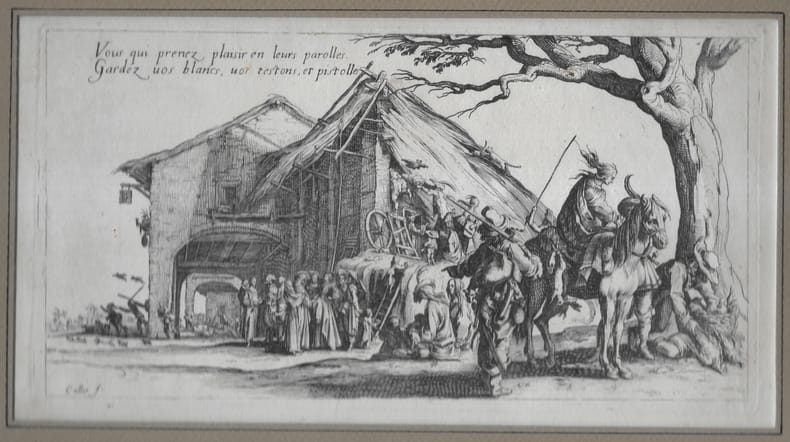
5003Très belle épreuve : 2è état sur 2 avec l'inscription Callot fec. Lieure 376. Belles marges; papier 14,6 x 29,1 cm
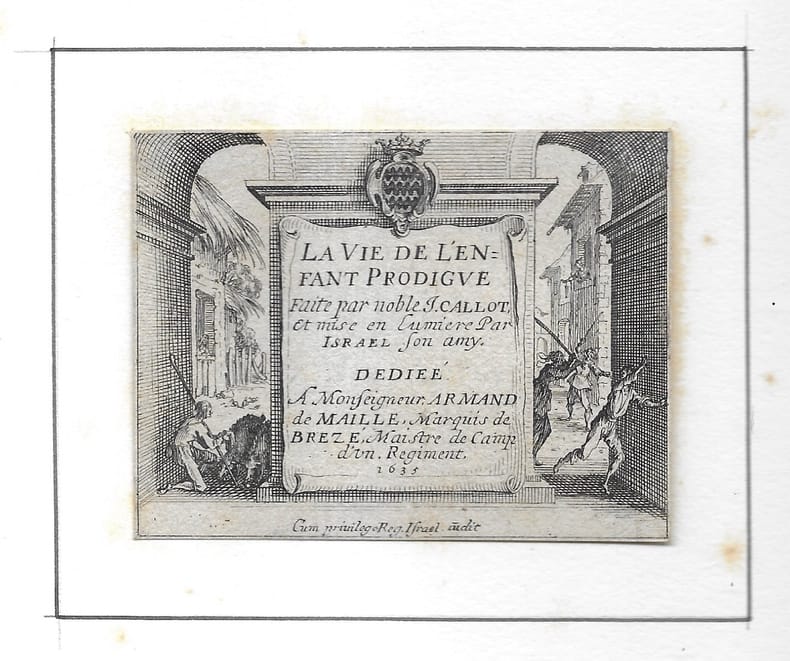
15146Suite de 5 estampes (sur 11). Titre (2è état); L'Enfant prodigue est mis en possession de son héritage (2è ou 3è état, la ligne de privilège ayant été coupée); Il part pour Menphis (2è ou 3è état, la ligne de privilège ayant été coupée); Dans les charmes du vin ... (2è ou 3è état, la ligne de privilège ayant été coupée); Il devient le jouet des impudiques femmes (2è ou 3è état, la ligne de privilège ayant été coupée). en feuilles bon
12797(CALLOT Jacques) La passion de notre seigneur Jésus-Christ en 12 tableaux. Pasquier Paris s.d. (circa 1780). Tirage sur Vélin, reliure in-16 plein papier imitant les lettrines du Moyen Age, tête dorée, état parfait. Rare tirage de ces gravures majeures dans le travail de Jacques Callot
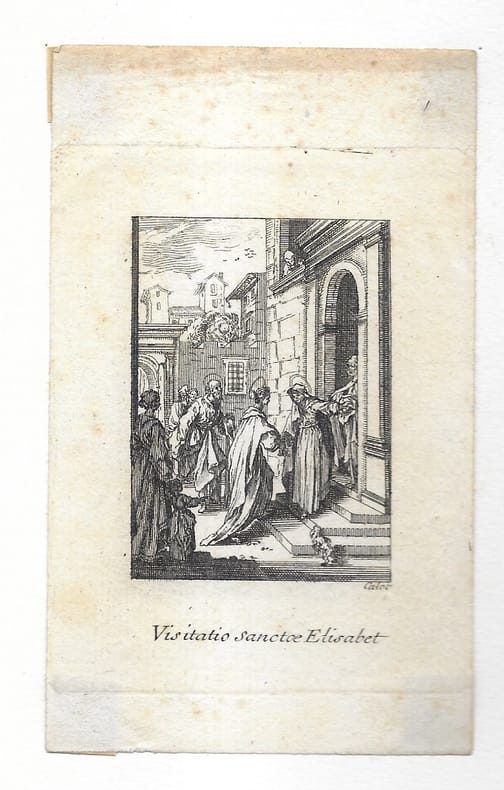
15148Suite de 8 estampes (sur 14). Elle rend visite à Sainte Elisabeth (copie en contre-partie); Elle présente son fils (copie en contre-partie); Elle l'offre à l'adoration des Mages (2è état sur 2); Elle fuit en Égypte (2è état sur 2); Elle meurt (2è état sur 2); On l'ensevelit (2è état sur 2); Elle fait son Assomption (2è état sur 2); L'Immaculée Conception (2è état sur 2). en feuilles bon
15145Suite de 5 estampes (sur 11). Titre (par Abraham Bosse); Jésus-Christ au mimieu des docteurs (1er état rarissime); Il prêche la foule assemblée sur le rivage de la mer(1er état, le privilège a été coupé, mais avant la mention "Jésus de Simonin"); Il s'entretient avec les Pharisiens ... (1er état, le privilège a été coupé, mais avant la mention "Jésus Pharisœos ob confricatas ..."); Il écrit son jujement sur la femme adultère (1er état, le privilège a été coupé, mais avant la mention "Jésus adductam ad se mulierem adulteram absolvit..."). en feuilles bon
15112Lieure 594; 2è état sur 2. Tirage XIXè ? en feuille bon 1 volume in-4°
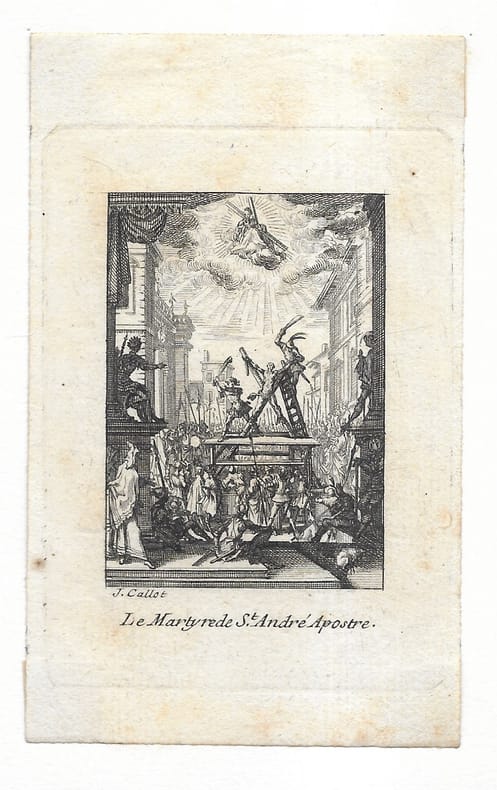
15113Suite en contre-partie de Lieure 1386-1401. 7 planches : Saint André, Saint Jean, Saint Thomas, Saint Barthélemy, Saint Mathieu, Saint Thaddée, et Saint Mathias. en feuilles bon 17 x 12 cm
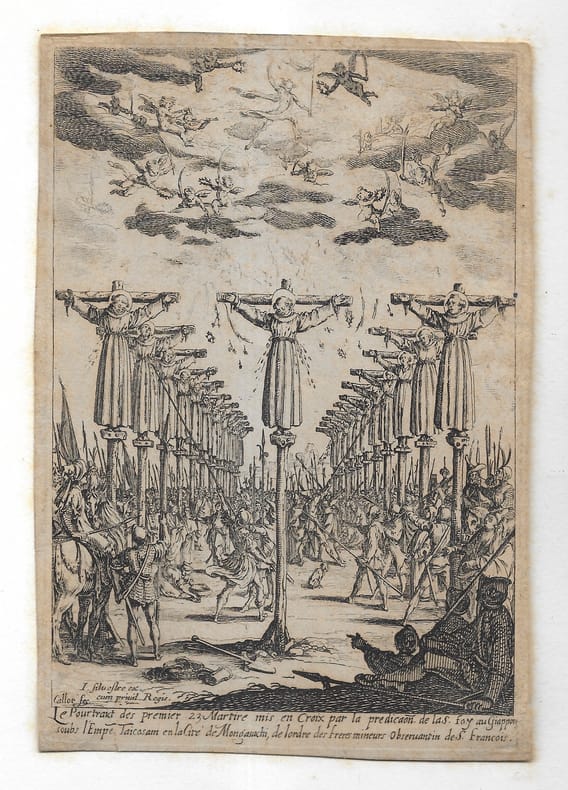
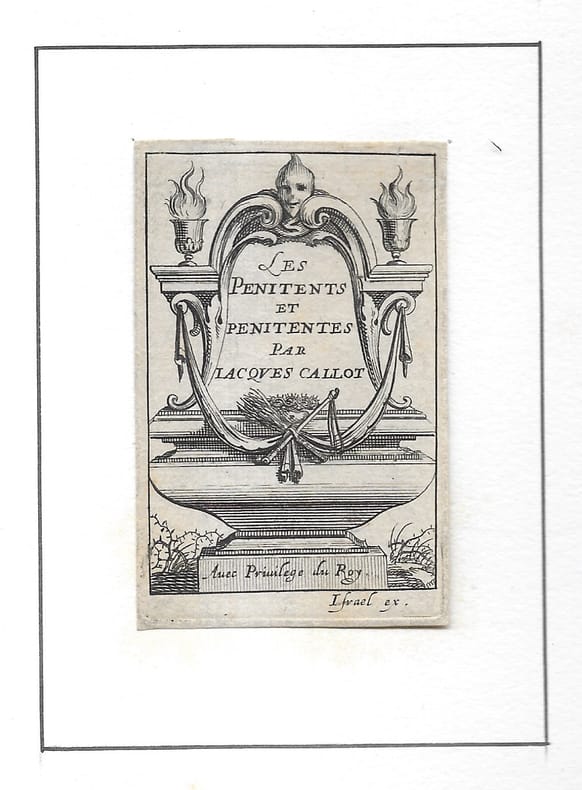
15147Suite de 5 estampes (sur 6). Titre ; Saint Jean Baptiste (état unique); La mort de Madeleine (état unique); Saint Jérome (état unique); Saint François (état unique). en feuilles bon
5302Notre épreuve est une héliogravure Amand-Durand, d’après l’épreuve de la collection Dutuit. Tous ces tirages sont réalisés sur un superbe papier et sont de grande qualité. En feuille très bon Paris 295 x 175
5304Notre épreuve est une héliogravure Amand-Durand, d’après l’épreuve de la collection Ambroise Firmin Didot. Tous ces tirages sont réalisés sur un superbe papier et sont de grande qualité. En feuille très bon 190 x 120
1626134571626 12 petites estampes (format 7 x 9 cm), gravées en taille-douce à l'eau-forte en noir sur papier ligné, collées sur les feuilles d'un petit cahier broché in-douze, recouvert d'une couverture en papier ancien peigné orange, représentant des scènes de La Passion du Christ, Signées J. Callot, sans lieu ni date (17ème), certainement gravures ayant illustré le nouveau testament ?, c'est de trés belle gravures de l'époque mais des copies inversées et elles sont souvent notées : J. Callot au lieu de J. Callot F.
Acquaforte, mm. 359x467 alla battuta compreso parte didascalica, su foglio di mm394x515. Tiratura settecentesca dell'ultimo stato V/V rilevato dalla leggera cancellazione della linea tra la zampa e l'ala del demone in alto.
Insieme di 2 acqueforti mm. 62x85, rifilate ai margini. Ottima conservaz.
Inc. a bulino, mm. 138x88 su foglio di mm. 200x137. Il verso porta la pag. 101 completamente impressa del testo. Stato I/II. Tavola tratta da "Scelta d'alcuni Miracoli e Grazie della santissima Nunziata di Firenze descritti dal P. F. Giovanni Angiolo Lottini...alla Ser.ma Christiana di Loreno gran duchessa di Toscana" In Firenze appresso Cecconcelli alle Stelle Medicee, 1619. (Cfr. Lieure, 95)
Inc. a bulino, mm. 134x83 su foglio di mm. 200x137. Il verso porta la pag. 143 completamente impressa del testo. Stato I/II. Tavola tratta da "Scelta d'alcuni Miracoli e Grazie della santissima Nunziata di Firenze descritti dal P. F. Giovanni Angiolo Lottini...alla Ser.ma Christiana di Loreno gran duchessa di Toscana" In Firenze appresso Cecconcelli alle Stelle Medicee, 1619. (Cfr. Lieure, 103)
Inc. a bulino, mm. 138x88 su foglio di mm. 200x137. Il verso porta la pag. 239 completamente impressa del testo. Stato I/II. Tavola tratta da "Scelta d'alcuni Miracoli e Grazie della santissima Nunziata di Firenze descritti dal P. F. Giovanni Angiolo Lottini...alla Ser.ma Christiana di Loreno gran duchessa di Toscana" In Firenze appresso Cecconcelli alle Stelle Medicee, 1619. (Cfr. Lieure, 102)
Inc. a bulino, mm. 136x85 su foglio di mm. 200x137. In basso a sin. 'Mascagnius Inv.' Il verso porta la pag. 167 completamente impressa del testo. Stato I/II. Tavola tratta da "Scelta d'alcuni Miracoli e Grazie della santissima Nunziata di Firenze descritti dal P. F. Giovanni Angiolo Lottini...alla Ser.ma Christiana di Loreno gran duchessa di Toscana" In Firenze appresso Cecconcelli alle Stelle Medicee, 1619. (Cfr. Lieure, 107)
Acquaforte mm. 150x227, rifilata alla battuta. Bella impressione. In basso a sin. 'Iul. Parigi in. Callot F.'
Magnifico, raro foglio di mm. 340x510 contenente le 4 incisioni. Tiratura fine '600 primissimi '700. Annotazione manoscritta coeva al marg. bianco del 'Combat à la Barrière.
16451Paris, Limage, Cahiers de l'Art Mineur, 1975, in-8 carré broché, 64 pp illustrées. Couverture en bon état, intérieur en très bon état.
10165[Première moitié du XVIIIe siècle]. Petit in-4 (224 x 160 mm), 25 pl. interfoliées. Bradel demi-vélin à petits coins, dos lisse orné de filets dorés, pièce de titre rouge, non rogné, une planche provenant d’un autre tirage, courte de marge et contrecollée sur papier fort, déchirure sans manque sur deux autres (reliure du XIXe siècle).
51963Jacques Callot.(1592-1635).Suite complète des Bohémiens de 1621.Suite de gravures très recherchée.2 gravures par encadrement.Marie-louise et cadre doré.