MUCHA (Alphons),etcLivre Rare Book

533 résultats
1896271911896 Paris, G. D. Hostingue et R. Blum éditeurs,(Imprimerie G. Kadar), 1896 in-4to, 32 p. + Planche gravé de Florian 'Portrait' / gravé par Clément Bellenger 'Les adieux de Gil Blas' / par Luc Pissarro 'Roses d'antan' bois original / par Eugène Grasset en couleur 'les petites faunesses' / double planche avec ills. de Mucha et musique de Edmond Missa 'Marquisette Gavotte', brochure originale ill., couverture Mucha avec manque en marge (ne touchant le dessin de Mucha).,bords des pages defraichies,dans l'etat.
21945Paris, Société anonyme La Plume, 1er juillet 1897. In-4, 96-96 pp., demi-maroquin à coins vert, filets à froid sur les plats, dos à nerfs, tête dorée, trois états du premier plat de la couverture conservés (absence de la quatrième de couverture, légère insolation minuscules épidermures).
16864Titres et coupons illustrés, en couleurs, signés dans la planche, Paris, Imprimerie Chaix, 1898, série de 5 titres en 5 couleurs in-4.
189615844AB1896. Paris F.Champenois 1896. 1003 : 505 cm image Lithograph in colours by Alphonse Mucha. Framed in contemporary wooden frame. Alphonse Mucha's poster "Été" "Summer" is part of his series titled The Seasons created in 1896. This poster captures the essence of summer with its warm golden hues and lush flowing forms. Mucha depicts a young woman draped in a light flowing garment that accentuates the curves of her body embodying the sensuality and warmth of the season. She is surrounded by an abundance of flowers and foliage symbolizing the fullness and fertility of summer. Her hair long and wavy cascades down her back adding to the natural unrestrained feel of the image. Mucha's characteristic use of intricate lines and decorative patterns is evident in the detailed borders and the swirling motifs that frame the central figure. The poster exudes a sense of harmony and beauty typical of Mucha's Art Nouveau style where nature femininity and elegance are central themes. The soft color palette dominated by shades of gold green and soft pastels further enhances the idyllic dream-like quality of the work making "Été" a quintessential representation of summer's warmth and beauty. Alphonse Mucha was known for his distinctive Art Nouveau style characterized by its use of natural forms flowing lines and elaborate decoration. His techniques combined both traditional and innovative approaches contributing to his iconic aesthetic. Here are some of the key techniques and elements in Mucha's work: Line Work: Mucha's use of lines is one of the most defining aspects of his style. He employed fine flowing outlines to create graceful organic shapes that mimic the curves found in nature. His lines were often decorative and stylized contributing to the overall harmony and unity of the composition. Color Palette: Mucha favored a soft pastel color palette often using muted tones of gold green pink and blue. These colors were carefully chosen to create a sense of harmony and to evoke specific moods often reflecting the seasons or the subject matter of the piece. Ornamentation and Patterns: Mucha's works are rich in decorative elements and intricate patterns. He incorporated floral motifs arabesques and geometric designs into his compositions often framing the central figure with these ornate details. This ornamentation was not merely decorative but also served to enhance the thematic elements of the piece. Use of Light and Shadow: Although Mucha's work is more stylized than realistic he employed light and shadow to add depth and dimension to his figures. His approach to light was subtle often using gentle shading rather than harsh contrasts which contributed to the soft ethereal quality of his work. Symbolism: Mucha frequently used symbolic elements in his paintings and posters. For example flowers seasons and zodiac signs often carried deeper meanings related to themes of nature femininity and the passage of time. These symbols were seamlessly integrated into the decorative elements of his work. Composition: Mucha's compositions were carefully balanced often centered around a single idealized figure. He employed symmetry and repetition to create a sense of order and harmony with the figure often surrounded by elaborate circular frames or halos that draw the viewer's eye. Media and Techniques: While Mucha is best known for his posters and prints which were typically lithographs he also worked in a variety of media including painting drawing and jewelry design. His lithographic technique involved multiple layers of color carefully aligned to create richly textured and vibrant images. In his paintings he used traditional techniques such as oil on canvas but applied them with the same decorative and stylized approach as in his graphic works. Mucha's techniques were instrumental in defining the Art Nouveau movement blending fine art with applied arts and his work remains a cornerstone of this decorative style. Alphonse Mucha holds a significant place in the history of art particularly as a leading figure of the Art Nouveau movement. His influence extends beyond his immediate contributions to the art world affecting design advertising and popular culture. Here are some key reasons why Mucha is important in the history of art: 1. Pioneer of Art Nouveau: Mucha is often credited with shaping and popularizing the Art Nouveau style which emerged in the late 19th century. This movement was characterized by its use of organic forms flowing lines and intricate decorative patterns all of which are hallmarks of Mucha's work. His designs especially his posters became synonymous with the Art Nouveau movement defining its aesthetic and helping it gain widespread recognition. 2. Innovative Use of Graphic Design: Mucha was a pioneer in using graphic design as a fine art form. His work in advertising and posters elevated these mediums to a new level blending commercial appeal with artistic integrity. His posters for Sarah Bernhardt the famous actress are particularly notable. They not only promoted her plays but also became collectible works of art in their own right. 3. Influence on Decorative Arts: Mucha's influence extended beyond painting and posters to various decorative arts including jewelry furniture and interior design. His aesthetic principles were applied to everyday objects making art more accessible to the public. This blending of fine art with applied arts helped bridge the gap between high art and popular culture a concept that has continued to evolve in modern design. 4. Impact on Visual Culture: Mucha's style has had a lasting impact on visual culture influencing everything from early 20th-century design to contemporary art and popular media. His work has inspired countless artists and designers in the realms of illustration fashion and graphic design. The Art Nouveau style as epitomized by Mucha has seen periodic revivals and continues to be referenced in various cultural contexts demonstrating its enduring appeal. 5. Symbolism and National Identity: Beyond his contributions to Art Nouveau Mucha was also deeply involved in the promotion of Czech national identity. His later works particularly the Slav Epic reflect his interest in Slavic history and mythology aiming to create a visual narrative that celebrated his cultural heritage. This aspect of his work underscores the role of art in expressing and shaping national and cultural identity adding another layer to his importance as an artist. 6. Legacy in Fine Arts: Mucha's ability to blend aesthetics with practical applications laid the groundwork for future movements in art and design particularly in how art could be integrated into everyday life. His legacy is evident in the continued appreciation and study of his work which remains a significant part of museum collections and exhibitions worldwide. Alphonse Mucha's contributions to the art world go beyond his beautiful and iconic images; he played a crucial role in defining an era shaping modern design and influencing the intersection of art culture and commerce. His work continues to inspire and resonate across disciplines making him a central figure in the history of modern art. The panel 'Ètè' Summer out of the series 'Four Seasons'. Mucha made a panel for each of the four seasons. He represents each season with characteristic flair here the sultry Summer. Four Seasons was Mucha's first series of decorative panels and one of his most popular ones. An classic Art Nouveau piece. A highlight in each Mucha collection. - Here contemporary framed therefore in very good condition. unknown
91686Academy Editions London. 1974. 4to 96pp. 93 black and white plates. A very good hardback copy in like dust jacket with some light creasing and sunning. Inscribed by Ovenden. Academy Editions, London. 1974 hardcover
13930MUCHA Alfons Dictionnaire des Arts Décoratifs 1902 Illustration pour la Couverture du dictionnaire des arts décoratifs de Paul ROUAIX 1902. 265x165mm. Bon état
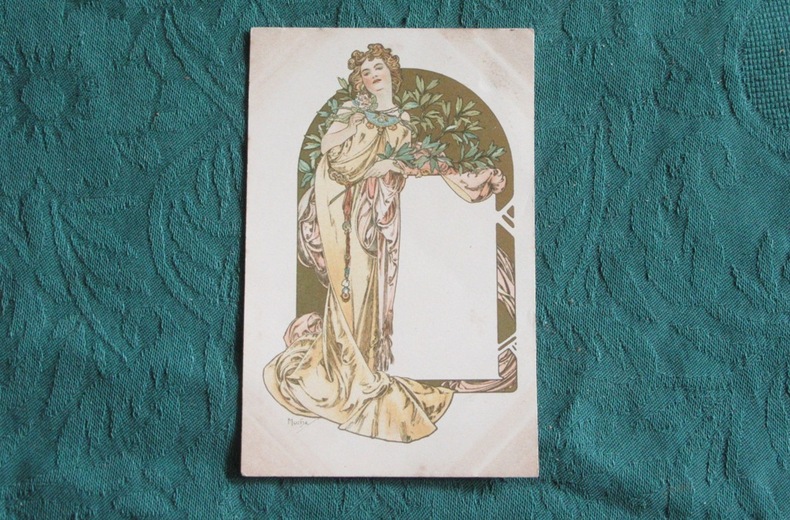
190019103Par Alfons (Alphonse) Mucha (1860-1939). Affichiste, illustrateur, graphiste, peintre Tchèque, il est le fer de lance du style "Art nouveau". Il se rend à Paris en 1887 pour continuer ses études. En 1900 il reçoit la médaille d'argent à l'exposition universelle.Carte postale verticale, femme tenant un petit cartouche vertical. Vers 1900. Non écrite au dos. Signée en bas à gauche.1 ou 2 rousseurs au dos de la carte. Très bon état. Format in-16°(14x9).
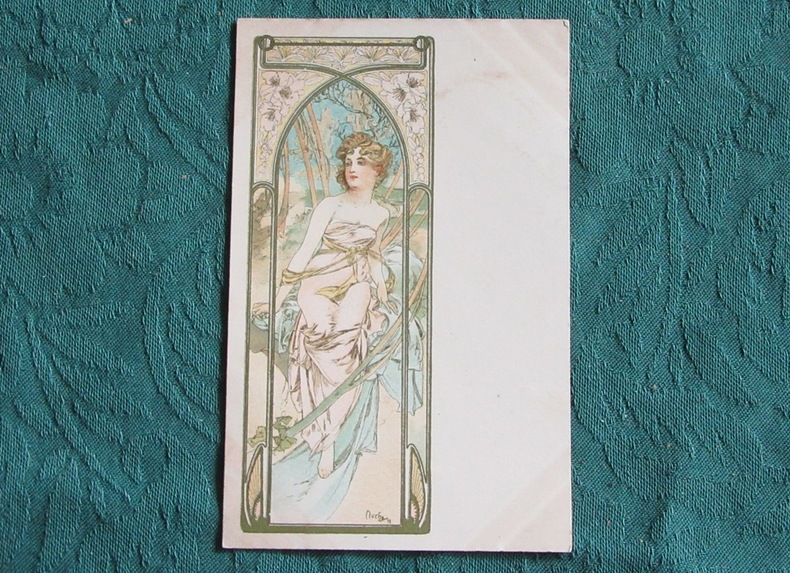
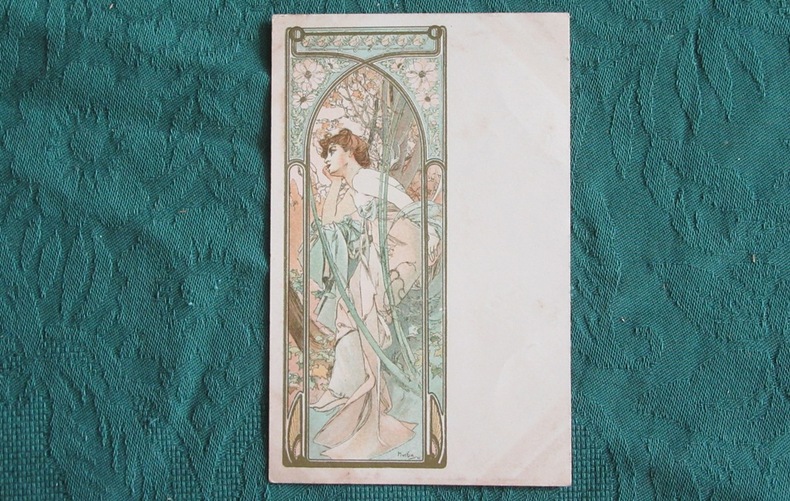
190019105Par Alfons (Alphonse) Mucha (1860-1939). Affichiste, illustrateur, graphiste, peintre Tchèque, il est le fer de lance du style "Art nouveau". Il se rend à Paris en 1887 pour continuer ses études. En 1900 il reçoit la médaille d'argent à l'exposition universelle.Carte postale verticale, avec le dessin sur 60% à gauche dans un cartouche rectangulaire aux arcs croisés "Art nouveau". Vers 1900. Non écrite au dos. Signée en bas à droite.1 ou 2 rousseurs au dos de la carte. Très bon état. Format in-16°(14x9).
190019106Par Alfons (Alphonse) Mucha (1860-1939). Affichiste, illustrateur, graphiste, peintre Tchèque, il est le fer de lance du style "Art nouveau". Il se rend à Paris en 1887 pour continuer ses études. En 1900 il reçoit la médaille d'argent à l'exposition universelle.Carte postale verticale, avec le dessin sur 60% à gauche dans un cartouche rectangulaire aux arcs croisés "Art nouveau". Vers 1900. Non écrite au dos. Signée en bas à droite.1 ou 2 rousseurs au dos de la carte. Très bon état. Format in-16°(14x9).
190019107Par Alfons (Alphonse) Mucha (1860-1939). Affichiste, illustrateur, graphiste, peintre Tchèque, il est le fer de lance du style "Art nouveau". Il se rend à Paris en 1887 pour continuer ses études. En 1900 il reçoit la médaille d'argent à l'exposition universelle.Carte postale verticale, avec le dessin sur 60% à gauche dans un cartouche rectangulaire aux arcs croisés "Art nouveau". Vers 1900. Non écrite au dos. Signée en bas à droite.Pas de rousseur. Très bon état. Format in-16°(14x9).
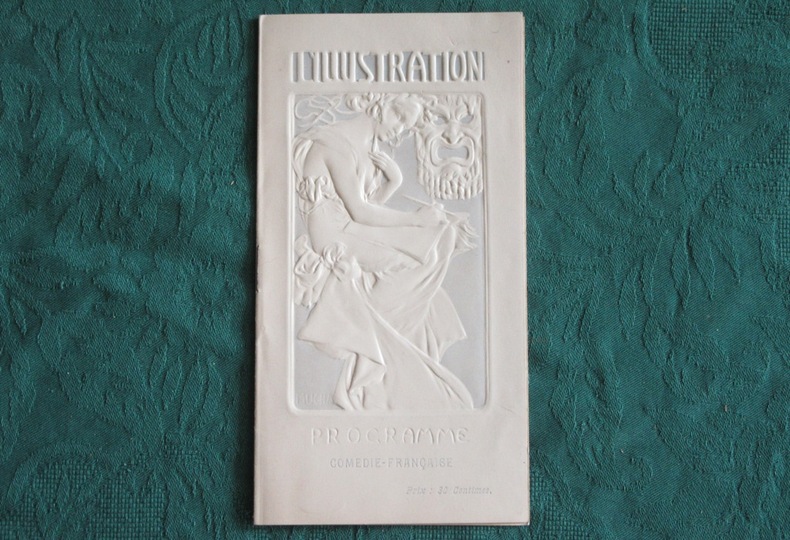
190219104Par Alfons (Alphonse) Mucha (1860-1939). Affichiste, illustrateur, graphiste, peintre Tchèque, il est le fer de lance du style "Art nouveau". Il se rend à Paris en 1887 pour continuer ses études. En 1900 il reçoit la médaille d'argent à l'exposition universelle.Programme de 6 pages intérieures, annonçant diverses représentations théâtrales à la comédie française. Les Burgraves (mercredi 26 février 1902) avec Mounet Sully, Paul Mounet.Couverture gaufrée sur laquelle figure une jeune femme en blanc sur fond gris, en train d'écrire. Signée de Mucha en creux, en bas à gauche.Ce programme annonce également le prochain journal l'illustration dont le numéro est presque entièrement consacré au centenaire de Victor Hugo. Un buste de Victor Hugo est représenté sur la première page.Pas de rousseur. Très bon état. Format in-12°(20x11).
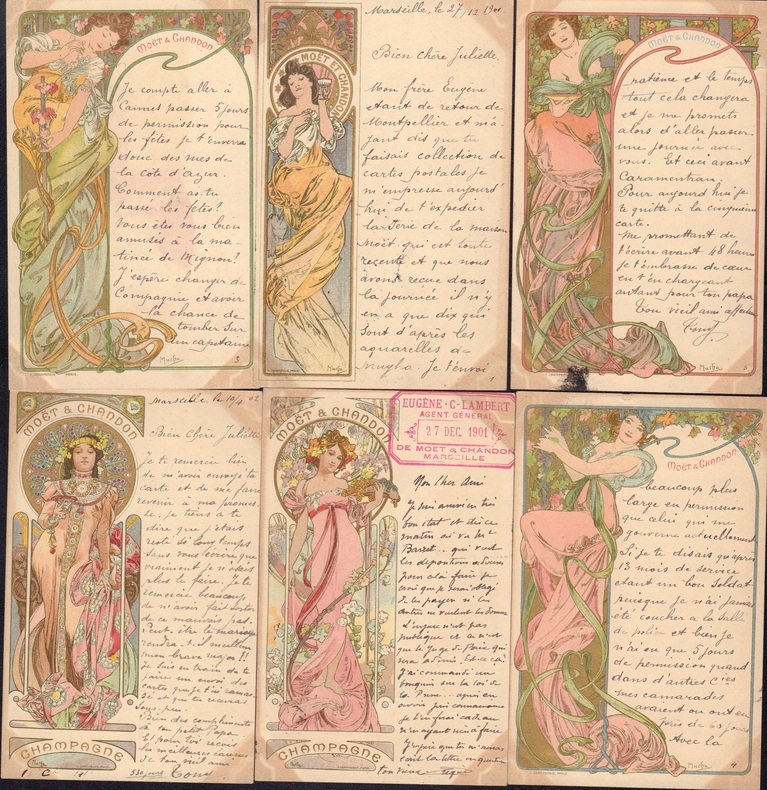
ORD-18241Paris. Champenois. Oblitérations au dos de 1901. Cartes postales de 90 x 140 mm, taille de l'image 32 x 134 mm, entièrement mais proprement écrites. Traces des onglets d'accrochage sur album, 1 carte tachée d'encre dans la marge inférieure, cachet rouge d'un agent marseillais de Moët et Chandon dans le coin supérieur d'une autre carte sans atteinte à l'illustration, sinon bon état, images de toute fraîcheur. Photo sur demande.
1015653693.Gpaperback. Good. Access codes and supplements are not guaranteed with used items. May be an ex-library book. paperback
1897ag579Soleil du Dimanche Illustration 1897 "Couverture originale du ""Soleil du dimanche"" signée Alphonse Mucha (taille de l'illustration 24 x 30 cm hors marges), pour le n°23 (6 juin 1897, 10e année) du journal, très probablement une lithographie, réalisée par Rougeron-Vignerot SC (nom apparaissant bien en bas à droite de l'illustration) ; marques d'usage sur les bordures du support dans les marges, par ailleurs bel état. Livraison a domicile (La Poste) ou en Mondial Relay sur simple demande."
198970007Japan, Committee for the Alphonse Mucha Exhibition & Shuko-sha, 1989, in-4, broché, 246 pages. Good. 298 illustrations in color & several B/W photos. Text in english & japenese.
056114Paris Le Monde illustré ( Imprimerie P. Mouillot ) 1900 in folio (39,5x30) 1 grand fascicule broché, couverture illustrée en couleurs par Alphonse Mucha, de pur style art nouveau (original color cover by Alphonse Mucha signed in the plate), pages 225 à 248, avec 4 faux-feuillet non chiffrés de publicités (numéro complet), avec des illustrations dans le texte. Très rare fascicule de livraison bien complet de sa couverture illustrée en couleurs par Alphonse Mucha. Numéro 2245 du 7 avril 1900. Très bel exemplaire ( Photographies sur demande / We can send pictures of this book on simple request )
19001807PARIS. CHAMPENOIS. VERS 1900. CARTE POSTALE FORMAT 14 X 9 CENTIMETRES. LITHOGRAPHIE EN COULEURS SIGNEE. HORIZONTAL FORMAT. THE IMAGE IS ENCLOSED IN A DOUBLE LINE FRAME AND OCCUPIES ABOUT 1/4 TH OF THE CARD ON THE LEFT. THE CARD HAS THE IMAGE WITHIN A CURVED INNER FRAME WITH A SMALL DECORATIVE PANEL ABOVE : LADY WITH BROWN HAIR IN BLUE DRESS; FACING TO THE RIGHT. VIERGE, NON ECRITE, N'A PAS VOYAGE. QUELQUES FINES ROUSSEURS EPARSES SUR LA PARTIE RESERVEE A LA CORRESPONDANCE, PETITES TRACES HABITUELLES D'ALBUM AUX ANGLES, SINON BEL ETAT.
19001400PARIS. CHAMPENOIS. VERS 1900. CARTE POSTALE FORMAT 9 X 14 CENTIMETRES. LITHOGRAPHIE EN COULEURS, SIGNEE DANS LA PLANCHE. LADY SEATED AT TABLE WITH PEN AND PAPER IN HAND. WITH MUCHA'S SIGNATURE (CARDS WERE ISSUED WITH AND WITHOUT MUCHA'S SIGNATURE). VIERGE, NON ECRITE, N'A PAS VOYAGE. QUELQUES FINES ROUSSEURS EPARSES DANS LA PARTIE RESERVEE A LA CORRESPONDANCE, PETITES TRACES HABITUELLES D'ALBUM AUX ANGLES, SINON BEL ETAT.
12 fasc. in un vol. in-folio (cm. 41,2x31,4), pp. (4), XLVIII, 248 (numerazione continua) + 21 meravigliose TAVOLE f.t. in typogravure (tra cui 19 a colori, 3 doppie); legatura editoriale m. pelle marron zigrinata, con titolo e fregi oro su dorso a 5 nervi. Gran titolo oro editoriale ornato al piatto in tela granulosa rossa, pelle solida e spessa, con qualche graffio o escoriazione, ma solida. Sguardie editoriali a fogliami oro su fondo malva, con brachetta edit. in tela. In fine sono legate le XLVIII pagine iniziali a numerazione romana. Conservate le superbe COPERTINE illustrate a colori da Frédérique Vallet, Hernandez, Bourgain, Jeanniot, Ridgway Knight, Carrier-Belleux, Adrien Moreau, Barrau, E. N. BLUE (la stupenda cop. "l'AUTOMOBILE"), Georges Cain (con BOUQUINISTE e damina; con strappo e manc. ang., da restaurare), Kaemmerer (Les Forains: CIRCO e giocolieri), Flameng. Appena avvertibile alle copp. l'insignif. rifilatura editoriale; forte carta patinata. Strappi a p. 177, minimi a 8 fogli, grave mancanza di un angolo al foglio introduttivo. Da segnalare i due racconti con 12 grandi disegni a colori (uno a piena pagina) di Alphonse MUCHA (Ivancice 1860 - Praga 1939): "Le Verglas" di Henri Ferrare (pp. 61-66) e "Le Fou" di Désiré Malonyay (pp. 221-223); "La Danse de la Petite Sorcière" (pp. 224-226) è anch'essa illustrata a colori da MUCHA + un disegnino b.n. a p. 173. Inoltre, centinaia di ILLUSTRAZIONI a colori e in b.n. n.t. e f.t., dovute a noti nomi dell'arte francese del tempo: JOB, Henri Willems, Trianon, METIVET, BAC, P. Avril, Alfred PARIS (militaria), Flameng, Albert Guillaume, Georges Roux, Adrien e Jean Moreau, Delbrueck (bella ciclista), Rosen (Napoleone), Ad. La Lyre, Piot, Sydney, Dusseuil, Mabuse, Holyoake, Mignard, Lafon ecc. Fra gli autori dei testi: Willy (Henri Gauthier-Villars), Ernest Daudet, Maurice Loir, Emile Duboc, Antonin Proust, Clarétie, Frédéric Masson, Henry Gréville, ecc. Numerose altre illustrazioni fotografiche intercalate n.t. Gli scritti comprendono prose narrative, poesie e saggi di vario genere. Fra gli argomenti toccati: bal masqué, Madame Du Barry, la vita culturale e i teatri a Parigi, Eleonora DUSE, la vita militare, Cosacchi, cannoni e torpediniere, la MARINA militare, la Banca di Francia, la SPEDIZIONE DI NAPOLEONE in SIRIA, WAGRAM, il Maharajah di Kapurthala, num. spec. sulla COMEDIE franç. (ritr. di Molière, molte foto si scena a col.), il giubileo della Regina Vittoria, la Guerra di CRIMEA, il Prix de Rome, ceramiche, viaggio a DELFO, l'Indocina, num. spec. (con 30 sontuosi dis. e foto) sul CIRCO e gli ACROBATI, la lotta libera, le MARIONETTE, i venditori di stracci ("chiffonniers"). 3 partiture musicali.
24137Pars Imprimerie Chaix 1897 Planche N°27, format 29 x 40 cm (toutes marges). Chromolithographie d'époque avec le timbre à sec de l'Imprimerie Chaix (Lugt 1777c). Notre exemplaire est une des très rares épreuves imprimées sur papier Japon (Our plate is one of the few copies printed on Japanese paper). Original plate in good condition). LES MAITRES DE L'AFFICHE, prestigieuse publication d'art, éditée par l'atelier de lithographie Chaix, dont la parution s'étala de décembre 1895 à novembre 1900. Chaque livraison comportait 4 planches de reproduction en chromolithographie d'une remarquable qualité d'impression des plus belles affiches illustrées des grands artistes français et étrangers (auxquelles il faut ajouter 16 planches de lithographies originales données en prime aux abonnés). Lors de l'Exposition universelle de 1889, fut organisée la première exposition rétrospective dévolue à l'affiche, celle-ci devait valider la reconnaissance officielle d'appartenance de l'affiche au monde de l'art. Jules Chéret (1836-1932) y sera sacré '' Maître de l'affiche '', c'est aussi à cette date que Seurat commencera à collectionner les affiches de Chéret. Alfons Maria Mucha, 1860-1939. Bel exemplaire d'une des très rares épreuves imprimées sur papier Japon, du tirage de tête (Our plate is one of the few copies printed on Japanese paper) ( Photographies sur demande / We can send pictures of this book on simple request )
24136Pars Imprimerie Chaix 1897 Planche N°94, format 29 x 40 cm (toutes marges). Chromolithographie d'époque avec le timbre à sec de l'Imprimerie Chaix (Lugt 1777c). Notre exemplaire est une des très rares épreuves imprimées sur papier Japon (Our plate is one of the few copies printed on Japanese paper, original plate in good condition). LES MAITRES DE L'AFFICHE, prestigieuse publication d'art, éditée par l'atelier de lithographie Chaix, dont la parution s'étala de décembre 1895 à novembre 1900. Chaque livraison comportait 4 planches en lithographie, des plus belles affiches illustrées des grands artistes français et étrangers. Chaque livraison comportait 4 planches de reproduction en chromolithographie d'une remarquable qualité d'impression des plus belles affiches illustrées des grands artistes français et étrangers (auxquelles il faut ajouter 16 planches de lithographies originales données en prime aux abonnés). Lors de l'Exposition universelle de 1889, fut organisée la première exposition rétrospective dévolue à l'affiche, celle-ci devait valider la reconnaissance officielle d'appartenance de l'affiche au monde de l'art. Jules Chéret (1836-1932) y sera sacré '' Maître de l'affiche '', c'est aussi à cette date que Seurat commencera à collectionner les affiches de Chéret. Bel exemplaire d'une des très rares épreuves imprimées sur papier Japon, du tirage de tête (Our plate is one of the few copies printed on Japanese paper) ( Photographies sur demande / We can send pictures of this book on simple request )
1992RO40173240Pontificia Università Lateranense, Roma. 1992. In-8. Broché. Bon état, Couv. convenable, Dos satisfaisant, Intérieur frais. 183 pages. Etiquette de code sur le 1er plat. Tampons et annotation de bibliothèque sur le 1er plat et en page de titre.. . . . Classification Dewey : 430-Langues germaniques. Allemand
6139024749.Gpaperback. Good. Access codes and supplements are not guaranteed with used items. May be an ex-library book. paperback
20182-6139083990Editorial Académica Española 2018. Paperback. New. 160 pages. Spanish language. 8.66x5.91x0.37 inches. Editorial Académica Española paperback
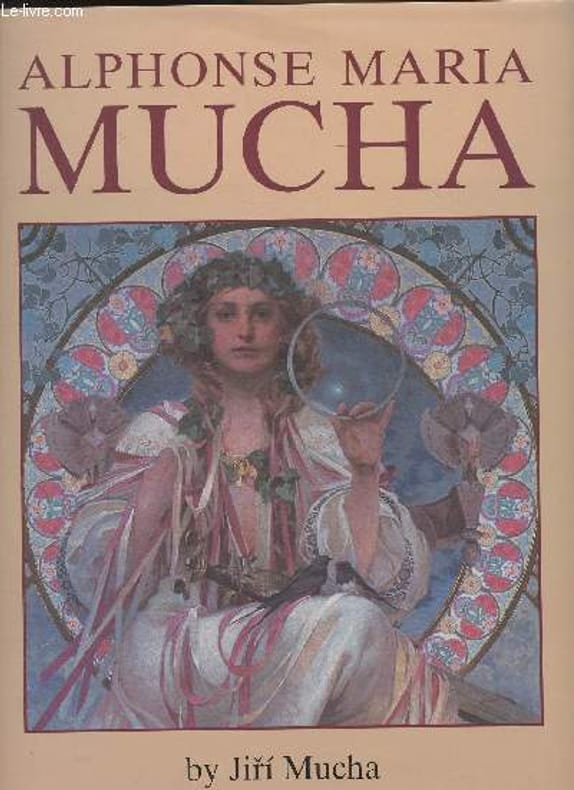
1989R300322074Academy Editions. 1989. In-4. Relié. Etat d'usage, Couv. convenable, Dos satisfaisant, Intérieur frais. 300 pages - nombreuses illustrations en noir et blanc et en couleurs dans et hors texte et en frontispice, certaines planches dépliantes. Texte en anglais. Jaquette légèrement fanée sur le dos.. Avec Jaquette. . . Classification Dewey : 420-Langue anglaise. Anglo-saxon