MUCHA AlfonsLivre Rare Book
533 résultats
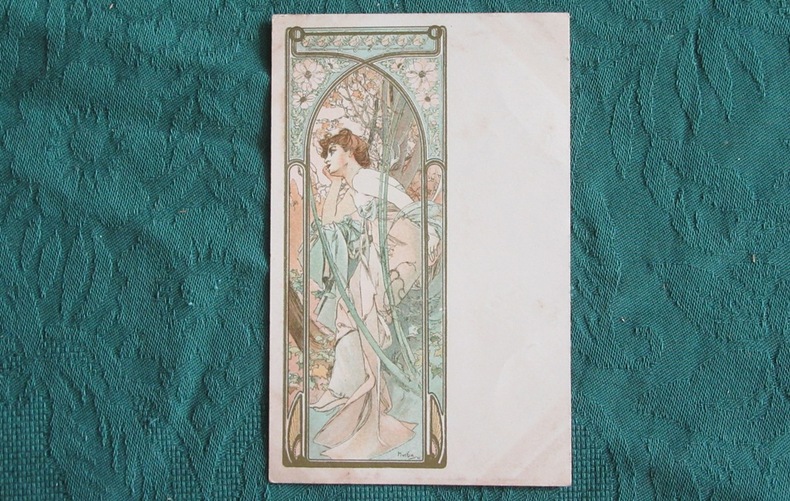
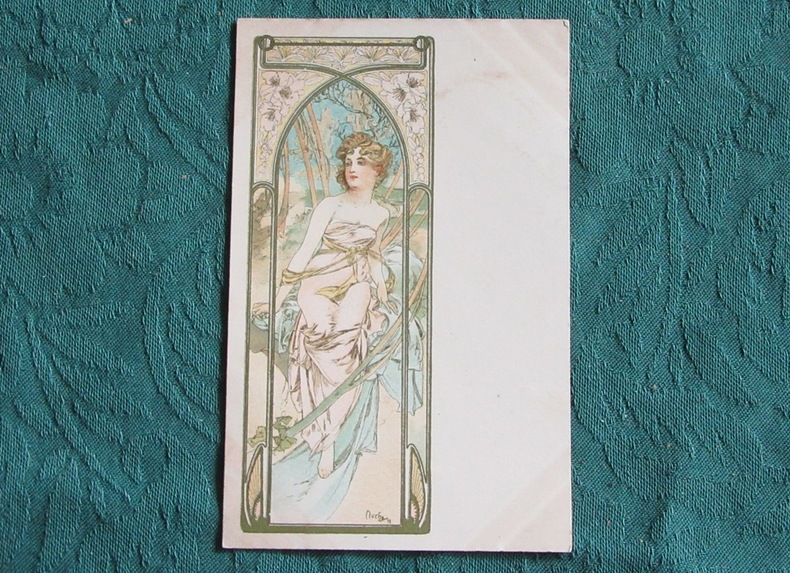
190019106Par Alfons (Alphonse) Mucha (1860-1939). Affichiste, illustrateur, graphiste, peintre Tchèque, il est le fer de lance du style "Art nouveau". Il se rend à Paris en 1887 pour continuer ses études. En 1900 il reçoit la médaille d'argent à l'exposition universelle.Carte postale verticale, avec le dessin sur 60% à gauche dans un cartouche rectangulaire aux arcs croisés "Art nouveau". Vers 1900. Non écrite au dos. Signée en bas à droite.1 ou 2 rousseurs au dos de la carte. Très bon état. Format in-16°(14x9).
190019107Par Alfons (Alphonse) Mucha (1860-1939). Affichiste, illustrateur, graphiste, peintre Tchèque, il est le fer de lance du style "Art nouveau". Il se rend à Paris en 1887 pour continuer ses études. En 1900 il reçoit la médaille d'argent à l'exposition universelle.Carte postale verticale, avec le dessin sur 60% à gauche dans un cartouche rectangulaire aux arcs croisés "Art nouveau". Vers 1900. Non écrite au dos. Signée en bas à droite.Pas de rousseur. Très bon état. Format in-16°(14x9).
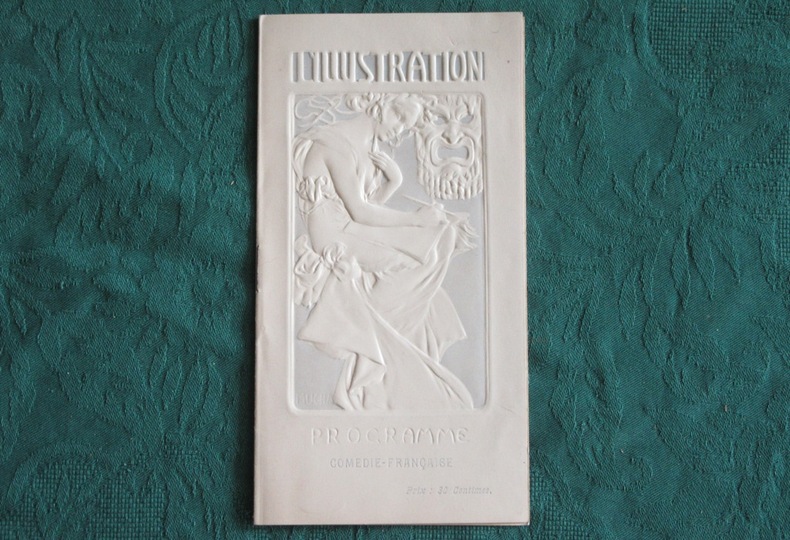
190219104Par Alfons (Alphonse) Mucha (1860-1939). Affichiste, illustrateur, graphiste, peintre Tchèque, il est le fer de lance du style "Art nouveau". Il se rend à Paris en 1887 pour continuer ses études. En 1900 il reçoit la médaille d'argent à l'exposition universelle.Programme de 6 pages intérieures, annonçant diverses représentations théâtrales à la comédie française. Les Burgraves (mercredi 26 février 1902) avec Mounet Sully, Paul Mounet.Couverture gaufrée sur laquelle figure une jeune femme en blanc sur fond gris, en train d'écrire. Signée de Mucha en creux, en bas à gauche.Ce programme annonce également le prochain journal l'illustration dont le numéro est presque entièrement consacré au centenaire de Victor Hugo. Un buste de Victor Hugo est représenté sur la première page.Pas de rousseur. Très bon état. Format in-12°(20x11).
91686Academy Editions London. 1974. 4to 96pp. 93 black and white plates. A very good hardback copy in like dust jacket with some light creasing and sunning. Inscribed by Ovenden. Academy Editions, London. 1974 hardcover
189615844AB1896. Paris F.Champenois 1896. 1003 : 505 cm image Lithograph in colours by Alphonse Mucha. Framed in contemporary wooden frame. Alphonse Mucha's poster "Été" "Summer" is part of his series titled The Seasons created in 1896. This poster captures the essence of summer with its warm golden hues and lush flowing forms. Mucha depicts a young woman draped in a light flowing garment that accentuates the curves of her body embodying the sensuality and warmth of the season. She is surrounded by an abundance of flowers and foliage symbolizing the fullness and fertility of summer. Her hair long and wavy cascades down her back adding to the natural unrestrained feel of the image. Mucha's characteristic use of intricate lines and decorative patterns is evident in the detailed borders and the swirling motifs that frame the central figure. The poster exudes a sense of harmony and beauty typical of Mucha's Art Nouveau style where nature femininity and elegance are central themes. The soft color palette dominated by shades of gold green and soft pastels further enhances the idyllic dream-like quality of the work making "Été" a quintessential representation of summer's warmth and beauty. Alphonse Mucha was known for his distinctive Art Nouveau style characterized by its use of natural forms flowing lines and elaborate decoration. His techniques combined both traditional and innovative approaches contributing to his iconic aesthetic. Here are some of the key techniques and elements in Mucha's work: Line Work: Mucha's use of lines is one of the most defining aspects of his style. He employed fine flowing outlines to create graceful organic shapes that mimic the curves found in nature. His lines were often decorative and stylized contributing to the overall harmony and unity of the composition. Color Palette: Mucha favored a soft pastel color palette often using muted tones of gold green pink and blue. These colors were carefully chosen to create a sense of harmony and to evoke specific moods often reflecting the seasons or the subject matter of the piece. Ornamentation and Patterns: Mucha's works are rich in decorative elements and intricate patterns. He incorporated floral motifs arabesques and geometric designs into his compositions often framing the central figure with these ornate details. This ornamentation was not merely decorative but also served to enhance the thematic elements of the piece. Use of Light and Shadow: Although Mucha's work is more stylized than realistic he employed light and shadow to add depth and dimension to his figures. His approach to light was subtle often using gentle shading rather than harsh contrasts which contributed to the soft ethereal quality of his work. Symbolism: Mucha frequently used symbolic elements in his paintings and posters. For example flowers seasons and zodiac signs often carried deeper meanings related to themes of nature femininity and the passage of time. These symbols were seamlessly integrated into the decorative elements of his work. Composition: Mucha's compositions were carefully balanced often centered around a single idealized figure. He employed symmetry and repetition to create a sense of order and harmony with the figure often surrounded by elaborate circular frames or halos that draw the viewer's eye. Media and Techniques: While Mucha is best known for his posters and prints which were typically lithographs he also worked in a variety of media including painting drawing and jewelry design. His lithographic technique involved multiple layers of color carefully aligned to create richly textured and vibrant images. In his paintings he used traditional techniques such as oil on canvas but applied them with the same decorative and stylized approach as in his graphic works. Mucha's techniques were instrumental in defining the Art Nouveau movement blending fine art with applied arts and his work remains a cornerstone of this decorative style. Alphonse Mucha holds a significant place in the history of art particularly as a leading figure of the Art Nouveau movement. His influence extends beyond his immediate contributions to the art world affecting design advertising and popular culture. Here are some key reasons why Mucha is important in the history of art: 1. Pioneer of Art Nouveau: Mucha is often credited with shaping and popularizing the Art Nouveau style which emerged in the late 19th century. This movement was characterized by its use of organic forms flowing lines and intricate decorative patterns all of which are hallmarks of Mucha's work. His designs especially his posters became synonymous with the Art Nouveau movement defining its aesthetic and helping it gain widespread recognition. 2. Innovative Use of Graphic Design: Mucha was a pioneer in using graphic design as a fine art form. His work in advertising and posters elevated these mediums to a new level blending commercial appeal with artistic integrity. His posters for Sarah Bernhardt the famous actress are particularly notable. They not only promoted her plays but also became collectible works of art in their own right. 3. Influence on Decorative Arts: Mucha's influence extended beyond painting and posters to various decorative arts including jewelry furniture and interior design. His aesthetic principles were applied to everyday objects making art more accessible to the public. This blending of fine art with applied arts helped bridge the gap between high art and popular culture a concept that has continued to evolve in modern design. 4. Impact on Visual Culture: Mucha's style has had a lasting impact on visual culture influencing everything from early 20th-century design to contemporary art and popular media. His work has inspired countless artists and designers in the realms of illustration fashion and graphic design. The Art Nouveau style as epitomized by Mucha has seen periodic revivals and continues to be referenced in various cultural contexts demonstrating its enduring appeal. 5. Symbolism and National Identity: Beyond his contributions to Art Nouveau Mucha was also deeply involved in the promotion of Czech national identity. His later works particularly the Slav Epic reflect his interest in Slavic history and mythology aiming to create a visual narrative that celebrated his cultural heritage. This aspect of his work underscores the role of art in expressing and shaping national and cultural identity adding another layer to his importance as an artist. 6. Legacy in Fine Arts: Mucha's ability to blend aesthetics with practical applications laid the groundwork for future movements in art and design particularly in how art could be integrated into everyday life. His legacy is evident in the continued appreciation and study of his work which remains a significant part of museum collections and exhibitions worldwide. Alphonse Mucha's contributions to the art world go beyond his beautiful and iconic images; he played a crucial role in defining an era shaping modern design and influencing the intersection of art culture and commerce. His work continues to inspire and resonate across disciplines making him a central figure in the history of modern art. The panel 'Ètè' Summer out of the series 'Four Seasons'. Mucha made a panel for each of the four seasons. He represents each season with characteristic flair here the sultry Summer. Four Seasons was Mucha's first series of decorative panels and one of his most popular ones. An classic Art Nouveau piece. A highlight in each Mucha collection. - Here contemporary framed therefore in very good condition. unknown
16864Titres et coupons illustrés, en couleurs, signés dans la planche, Paris, Imprimerie Chaix, 1898, série de 5 titres en 5 couleurs in-4.
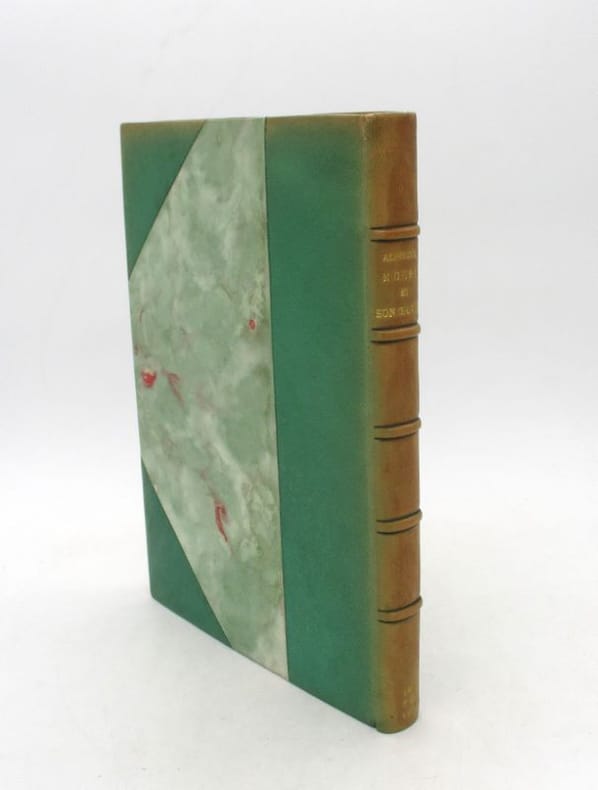
21945Paris, Société anonyme La Plume, 1er juillet 1897. In-4, 96-96 pp., demi-maroquin à coins vert, filets à froid sur les plats, dos à nerfs, tête dorée, trois états du premier plat de la couverture conservés (absence de la quatrième de couverture, légère insolation minuscules épidermures).
1896271911896 Paris, G. D. Hostingue et R. Blum éditeurs,(Imprimerie G. Kadar), 1896 in-4to, 32 p. + Planche gravé de Florian 'Portrait' / gravé par Clément Bellenger 'Les adieux de Gil Blas' / par Luc Pissarro 'Roses d'antan' bois original / par Eugène Grasset en couleur 'les petites faunesses' / double planche avec ills. de Mucha et musique de Edmond Missa 'Marquisette Gavotte', brochure originale ill., couverture Mucha avec manque en marge (ne touchant le dessin de Mucha).,bords des pages defraichies,dans l'etat.
1896271901896 Paris, Floury, 1896-1897. In-4 broché, couv.generale illustrée et gravée par PEYAT et ANGST, conservée. Collection complète des 12 numéros (décembre 1896 à novembre 1897) de cette belle revue consacrée à l'illustration gravée sur bois avec de nombreuses figures gravées dans et hors texte, certaines originales, par Degas, M. Denis, Van Dongen, Rodin, Pissaro, Mucha, Toulouse-Lautrec, Steinlen, Laboureur, Jongkind, Helleu, Bonnard, Vallotton, etc. Les 12 couvertures illustrées (par MUCHA, DE FEURE, DARBOUR, VERNEUIL, DROGUE, BELLERY DESFONTAINES,BERTON, PROUVÉ, BELLEVILLE, TOULOUSE-LAUTREC, LENOIR) sont presentes. Revue fondée par la corporation française des graveurs sur bois, publiée sous la direction littéraire de Roger Marx et Jules Rais et sous la direction artistique de Tony Beltrand, Auguste Lepère et Léon Ruffe. Textes d'Arsène Alexandre, Barrès, Debussy, R. de Gourmont, P. Louÿs, Mauclair, Mellerio, Rodenbach et Verhaeren, illustrés par Auriol, Cheret, Degas, Denis, Doudelet, Van Dongen, De Feure, Grasset, Lepère, Maillol, Millet, Mucha, Lucien Pissaro, Steinlen, Toulouse-Lautrec, Valloton. Exemplaire complet de cette revue fondée par la jeune corporation française des graveurs sur bois, et publiée par l'éditeur des lithographies de Toulouse-Lautrec (Au pied du Sinaï, Histoires naturelles, Café-Concert). L'Image compte parmi les plus belles réalisations de l'édition d'art ""Fin de Siècle"". Les directeurs de la revue, et notamment le célèbre graveur Auguste Lepère, fondateur de la corporation, tentèrent d'y rassembler et promouvoir, selon l'idée d'Arts and Crafts et de l'Art Nouveau, le savoir-faire des artisans de la gravure sur bois menacé par l'utilisation de procédés plus rapides et de moindre qualité. Cette collection complète réunit les oeuvres de 106 graveurs et de dizaines d'écrivains, faisant d'elle une oeuvre d'une qualité bibliophilique et artistique exceptionnelles..........The first "numéro spécimen" was published in 1896 to encourage people to subscribe to "L'I'mage". 8 pp + 5 hors-texte plates. It features wood-engraved illustrations after Lepère, Willette, De Feure (in color), Merson, Steinlen, Chéret, and others, and A FULL-PAGE HORS-TEXTE WOOD ENGRAVING BY LEPERE ("La prière", Lotz-Brissonneau 254) ?- THESE SPECIMEN ISSUES--ESPECIALLY THE FIRST--ARE VERY RARE, FAR MORE SO THAN THE 12 REGULARLY-PUBLISHED ISSUES.L'Image. Numéro spécimen. Préface d'Anatole France. G. d'Hostingue et R. Blum éditeurs. in-8, en feuilles, 8 pages illustrations in texte et 5 feuilles d'illustrations pleines pages imprimées au recto.Ont collaboré à ce numéro-spécimen.Dessinateurs : Bellery-Desfontaines. Cappiello. Ch. Cottet. G. de Feure. Degas. G. Jeanniot. P. Jouve. B. Naudin. Rodin. D. Vierge. Graveurs : Aubert. Beaujan. E. d'Eté. V. Dutertre. Ch. Guillaume. A. Hoffmann. Jeoffroy. Labat. C. Marx. Mathieu. C. Maylander. L. Perrichon. Revel. L. Ruffe. Vibert.manque au bas de la couverture ,exemplaire défraichi avec les 5 ht .
46633Carton d’invitation 10,8x15cm + journal 32x45cm de 4 pages sur papier fort illustrées en noir + vignette en couleurs 10,5x21cm. Bon état.
19005901900 Paris, Calmann Lévy, 1900 ; in-8 de [3] ff., 188 pp., [2] ff., demi-maroquin rouge, dos à nerfs, tête mouchetée, non rogné (reliure de l'époque).
198946447Paris: Editions Eole 1989 . # 90 of an edition limited to 300 numbered copies. Hardcover. Very good/No jacket issued. Paris: Editions Eole 1989 . # 90 of an edition limited to 300 numbered copies. Inscribed and signed by the author with a signed note laid-in. Illustrated with b/w photographs and a few color plates. 127 pp. Hardcover. 8vo. Black paper covered boards. A very good copy. Very good/No jacket issued. Editions Eole hardcover books
195258153NY: Arts Inc. 1952. First US edition. 271 pp. Very good plus in full gray cloth. Lacks dust jacket. Translated from the original Czech by E. Osers. NY: Arts, Inc., hardcover books
1973145744London / New York New York: Academy Editions / St. Martin's Press Inc 1973. Hardcover. VG / VG Some faint darkening around page edges. Otherwise clean and tight. Some light wear to extremities of dj. Red cloth over boards color illus. dj.; 143 pp.; Profusely illustrated in color and bw. Edited by Mucha's son Jiri. Introduction by Marina Henderson. Nicely illustrated with many full-page plates. Academy Editions / St. Martin's Press Inc hardcover books
1989169216London: Academy Editions 1989. Hardcover. VG-/VG- stain at bottom of back cover light wear to edges and corners of book and dust jacket. Red cloth boards with gilt stamped lettering. Beige and color-illustrated dust jacket with brown lettering. 300 pp. Color and BW illustrations. ".the definitive biography of that superb decorative artist. As Mucha's son the author has enjoyed unrivalled aceess to his writings and correspondence. He has documented works in private collections which would have remained closed to the general public and has talked to many people still alive who knew his father. With the additions of his personal recollections he has provided us with a uniquie portrait of a remarkable man and his work." -Jacket. Academy Editions hardcover books
1966170959Prague: Artia Prague 1966. Hardcover. VG-/G foxing to boards to block overall shelfwear to boards corners bumped moderate wear to dust jacket including rips. White cloth boards with gilt design and stamped spine lettering. Glossy color-illustrated dust jacket with black and gold lettering. Illustrated end pages 291 pp. BW and color illustrations. Translated by Geraldine Thomsen. Introduction by Enid Da Silva. Photographs by Ladislav Neubert. Artia Prague hardcover books
1945117526London: The Hogarth Press 1945. Octavo original orange cloth stamped in gold. First edition first impression. Linked stories about life during wartime. A very good copy pulpy paper browned in good pictorial dust jacket with shelf wear at edges closed tear at lower rear spine fold and and some tanning and staining to spine panel. #117526 The Hogarth Press unknown books
1971177162London: Academy Editions 1971. Hardcover. VG/Good light foxing to text block previous owner book plate on ffep pages of text and illustrations are otherwise clean. Dust jacket has heavy shelf wear/tears inside corner of dust jacket flap is clipped. Black cloth boards with gilt lettering on spine white dust jacket with color illustration on front and rear black lettering 136 pp 157 illustrations of which 40 are in color. "The grace and originality of Mucha's art is illustrated by a comprehensive selection of his work with over 100 black and white and 40 colour reproductions of the high quality necessary for the true representation of Mucha's suble and muted colours and delicate draughtsmanship. Many of the photographs that Mucha took of his models have recently ben re-discovered giving a fascinating glimpse of the raw material that Mucha transmuted in his drawings and paintings. The photographic section of the book is introduced by Dr. Aaron Scharf who places Mucha's photography in the context of his time. and the use that Mucha made of his photographs in the planning of his work is discussed by Marina henderson in an essay on Mucha and the Camera." Dust Jacket. Academy Editions hardcover books
1984007523Boston: G. K. Hall 1984. Publisher's promotional poster for the book published in 1984 22 1/2"w x 33"h featuring Mucha's classic image "Reverie". Distributed in limited numbers at the ABA trade show in 1984. Well suited for framing will be shipped loosely rolled in a mail;ing tube. . First Printing. Poster. Near Fine. 22 1/2" x 33". G. K. Hall books
1981007516New York: Dover Publications Inc. 1981. Publisher's promotional poster featuring the classic Art Nouveau Alphonse Mucha poster "Salon des Cent" 1896 celebrating Dover's 40th anniversary. Dover Publications was founded in 1941. A poster distributed in limited numbers at the ABA trade show in 1981. Near Fine faint creases. Printed on heavy paper. Well suited for framing will be shipped loosely rolled in a mailing tube. . First Printing. Poster. Near Fine. 22" w x 33" h. Dover Publications, Inc. books
1980007521New York: Park South Presentations 1980. A reproduction of Mucha's famous Art Nouveau poster "Princezna Hyacinta" 23"w x 34"h printed in Lithoverite on rag paper. Near Fine a few faint creases. Well suited for framing will be shipped loosely rolled in a mailing tube. . First Thus. Poster. Near Fine. 23"w x 34"h. Park South Presentations books
1971007536New York: Dover Publications Inc. 1971. Publisher's promotional poster 22" w x 34" h featuring Mucha's famous woman for JOB cigarette papers. Near Fine faint creases. Well suited for framing. Will be shipped loosely rolled in a mailing tube. First Thus. Poster. Near Fine. 22" w x 34" h. Dover Publications, Inc. books
18935115Paris: Librairie Centrale des Beaux-Arts 1893. First illustrated edition. Mucha Alphonse. Original decorated wrappers. Corner clipped from front free endpaper otherwise a very nice copy. Cover design and 14 illustrations after paintings by Mucha. Copy 6 of 75 printed on japon the tirage de tête from a total edition of 200. Inscribed by the author "au cher Maître Alexandre Dumas de l'Académie Française un puissant et inpeccable moraliste." <br/><br/> Librairie Centrale des Beaux-Arts unknown books
412Photo relief. Czechoslovakia. June and December 1897. LITHOGRAPH FROM L'ESTAMPE MODERNE. L'Estampe Moderne 1897-1898 a more commercial and later version of L'Estampe Originale was a monthly publication of print portfolios producing twenty-four issues containing four color lithographs each. Only a few prints exhibiting Japanese influence were issued mostly by minor artists yet they were equally as beautiful in image as their predecessors. unknown books
1976136653New York: Rizzoli 1976. First edition. Softcover. Includes 48 color illustrations. A tight near fine copy in wrappers. Rizzoli unknown books