Mandeville, Bernard deBiblio.com
32 résultats
1772022660Edinburgh: J. wood 1772. title continues."and an abusive letter to Lord C. Two volumes octavo title page pp viii 316; xxii 23 - 298 14 pages a little age-toned throughout the first few pages are a little foxed in the first volume contemporary calf re-backed a long time ago with original spines relaid rather worn and frayed at the edges one corner neatly repaired. The front cover to the second volume is nearly detached and now just hanging by one thread. Bernard Mandeville or Bernard de Mandeville 1670 -1733 was an Anglo-Dutch philosopher political economist and satirist. Born in Rotterdam Netherlands he lived most of his life in England and used English for most of his published works. The book was primarily written as a political satire on the state of England in 1705 when the Tories were accusing John Churchill 1st Duke of Marlborough and the ministry of advocating the War of the Spanish Succession for personal reasons. In 1723 a later edition appeared including An Essay on Charity and Charity Schools and A Search into the Nature of Society. The former essay criticised the charity schools designed to educate the poor and in doing so instil virtue in them. Mandeville disagreed with the idea that education adds virtue because he did not believe that evil desires existed only in the poor but rather he saw the educated and wealthy as much more crafty. Mandeville also believed that educating the poor increased their desires for material things defeating the purpose of the school and making it more difficult to provide for them. Full Leather. Fair. J. wood Hardcover
1796182275Paris.: Mercier. 1796. 12mo. Old plain wraps. Lacking pages 133-136 otherwise good plus title page has small marginal waterstain second leaf has a small hole back cover has a wormhole untrimmed in the wraps. 14x9x1 cm. French text. lacks the last two leaves. Scarce edition of Mandeville’s famous satirical defense of state-regulated prostitution. weight: 0.2 lb. Mercier. paperback
1728r029F.022GB: J Tonson 1728. NOTE: A second part was published later. DISBOUND TEXT No covers. Text commences at title page last numbered page is 477. 16 and 478 pages. Two library stamps on title page and one on last leaf. Title page detached and a bit browned on leading edge. Else very good clean tight text most suitable to rebind. . 1st Edition. Hardback. Good/No DW. J Tonson Hardcover
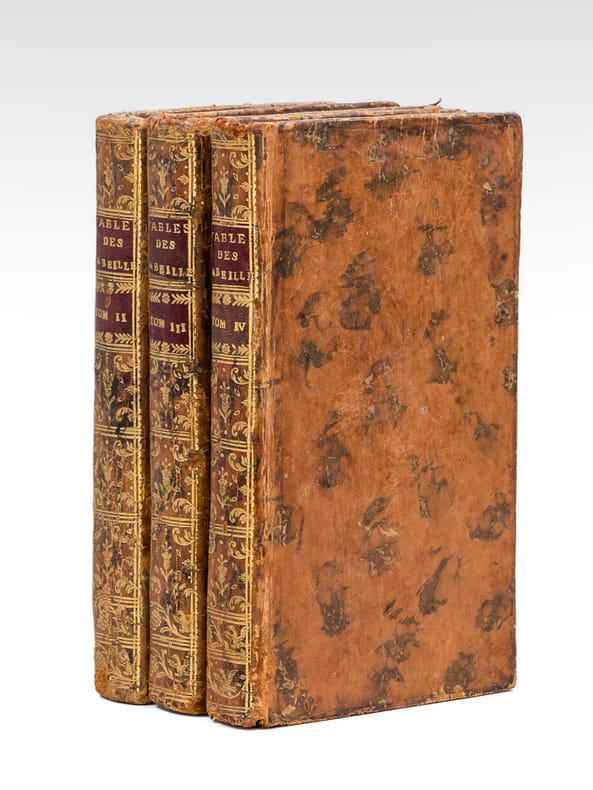
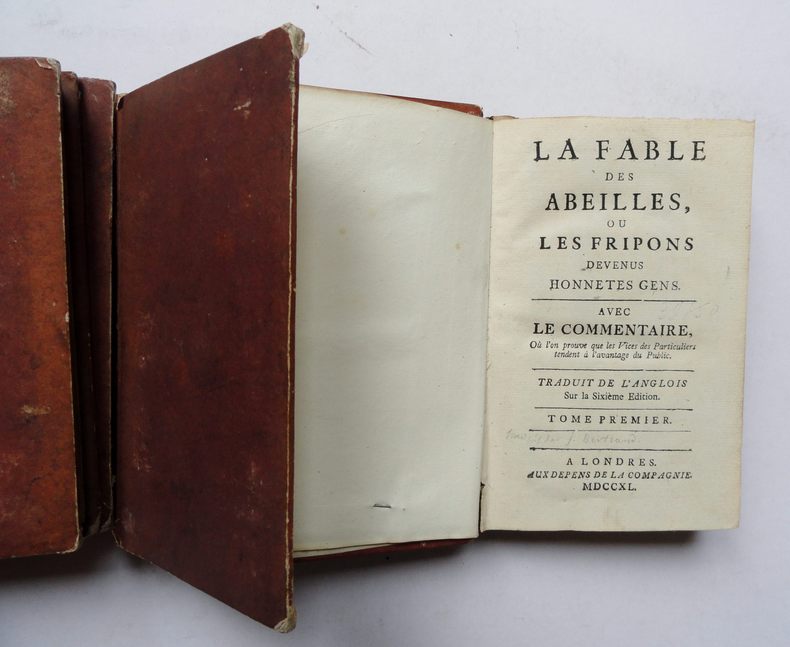
175069470Avec le Commentaire, Où l'on prouve que les Vices des Particuliers tendent à l'avantage du Public, Traduit de l'Anglois sur la sixième édition, 3 vol. in-12 reliure de l'époque plein veau marbré, dos lisse orné, Chez Jean Nourse, Londres, 1750, 2 ff., 362 pp. ; 2 ff., LXVI-339 pp. ; 2 ff., 361 pp.
1755226135Edinburgh: W. Gray and W. Peter 1755. Hardcover. Near Fine-/No Jacket. Hardcover; 12mo; 374 pages. Part 1 only complete as is but lacking the later release part II also published in this edition. A clean and sound copy attractively rebound in red mottled leather. Gilt titles on spine five blind bands. The leather is quite supple. Red and yellow headbands tight. Marbled endpapers. Several small marks on title-page lightly brown stained. Age-toned but clean and tight interior. NF-/-- <br/> <br/> W. Gray and W. Peter hardcover
1795171857London: Allen & West 1795. hardcover. very good. ix 534 pages 8vo old tree calf; rubbed light foxing and toning to some pages repaired chipping at spine ends hinges mended. London: Allen & West 1795. A well worn but still solid and very good copy.<br/> <br/> The author's name which is not printed on the title page has been written in by an early hand. The same person has written a neat full page review extolling the book on the blank verso of the Contents page. This is one of many editions of the famous and popular satire on the true causes of social welfare and riches Mandeville suggesting that base behavior produces positive economic effects. Ownership signature of art historian Meyer Schapiro and a page of handwritten notes by him.<br/> <br/> Allen & West unknown
1795171857London: Allen & West 1795. hardcover. very good-. With an Essay on Charity and Charity Schools and A Search into the Nature of Society. Also A Vindication of the Book from the Aspersions contained in a Presentment of the Grand Jury of Middlesex and an Abusive Letter to Lord C-. 8vo old tree calf; rubbed; front cover loose. London: Allen & West 1795. Very good .<br/><br/> The author's name which is not printed on the title page has been written in by an early hand. The same person has written a neat full page review extolling the book on the blank verso of the Contents page. This is one of many editions of the famous and popular satire on the true causes of social welfare and riches Mandeville suggesting that base behavior produces positive economic effects. Ownership signature of art historian Meyer Schapiro and a page of handwritten notes by him.<br/><br/> Allen & West unknown books
1728002792<p>London: Tonson 1728. Un volume 205 cm di 7-477 pagine; è presente sia la numerazione araba che la segnatura A-Z8 Aa-Gg8 Hh7. Legatura coeva in piena pelle con decorazioni impresse. Difetti alla legatura cerniera anteriore fenduta usure agli angoli dei piatti piccole mancanze alle cuffie e qualche usura ala dorso. Minime tracce del tempo alle pagine interne qualche lieve brunitura o piccolissime fioriture una gora chiara alla pagina finale e alle seguenti due pagine bianche ma nel complesso buonissime condizioni interne. Titolo manoscritto in riquadro al dorso dove compare anche un 1 impresso e dorato di tomagione. Spesso infatti questa edizione si accompagnava con un secondo volume contenente lo sviluppo delle polemiche sollecitate dall'opera volume peraltro a sé stante e sovente di diverso stampatore. La prima edizione è del 1714 cui seguirono alcune ristampe. Nel 1723 apparve la 'seconda edizione' allargata. Altre aggiunte si ritrovano cinque anni dopo nella quinta edizione: nello stesso anno ne venne pubblicata un'edizione in due volumi. "Mandeville's central theme is that public benefits are the product of private vices and not of private virtues" New Palgrave. Una delle opere-chiave di tutta la storia del pensiero economico.</p> Tonson
172916348Printed for John Brotherton at the Bible in Cornhill 1729. 2nd Edition . Book Hardcover. Good. Important book. Original copies rare. First edition 1720. Blank leaf xiv 2 409 1 xxii index 2 Brotherton book list blank leaf. Original full calf lacking spine title label blind decorated. Text block somewhat yellow otherwise v.g. Printed for John Brotherton, at the Bible in Cornhill hardcover
1732220824-MB55London: Printed for John Brotherton at the Bible in Cornhill 1732. Good original tooled calf binding hinges fragile previous owner's inscription and bookplate. First Edition. Leather Binding. Good/No Dust Cover. Printed for John Brotherton at the Bible in Cornhill Hardcover
1720220824-MB52London: Printed By T. Jauncy at the Angel Without the Temple Bar and J. Roberts in Warwick Ln 1720. Good original tooled calf binding hinges fragile title bands previous owner's name and bookplate . First Edition. Leather Binding. Good/No Dust Cover. Printed By T. Jauncy, at the Angel Without the Temple Bar, and J. Roberts in Warwick Ln Hardcover
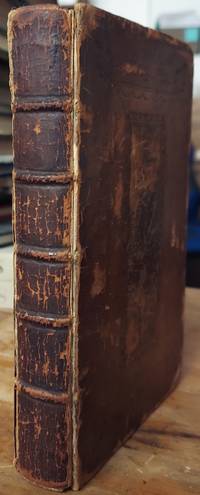
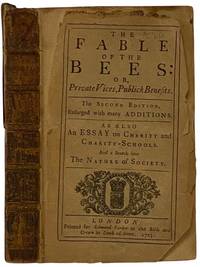
17232353259London: Printed for Edmund Parker at the Bible and Crown in Lombard-Street 1723. Second Edition. Full-Leather. Fair/No Jacket. Signed by author. Second edition. Lacks front board and spine label some loss along edges of rear board and spine leather dry and rubbed title page loose with some loss along edges. 1723 Full-Leather. vi 428 11 pp. Full calf with hand-tooled design five raised spine bands. A collection of essays including discussion of the origin of moral virtue the nature of charity and society etc. The work comprises a satirical poem entitled The Grumbling Hive: or Knaves turn'd Honest which was first published anonymously in 1705; a prose discussion of the poem called 'Remarks'; and an essay An Enquiry into the Origin of Moral Virtue. In 1723 a second edition the one offered here was published with two new essays 'An Essay on Charity and Charity-Schools' and 'A Search into the Nature of Society'. In the original portion of the work Mandeville controversially asserts that self-interest is the lynchpin of a properly functioning society and that practicing honesty and virtue while objectively desirable in practice leads to negative outcomes. His theories influenced Scottish Enlightenment thinkers like Francis Hutcheson David Hume and Adam Smith as well as economic constructs like the division of labor laissez-faire capitalism etc. Mandeville also wrote A Treatise of the Hypochondriack and Hysterick Passions which Garrison-Morton 10703 describes as: "Probably the first psychiatric self-help book. Hunter and Macalpine call Mandeville's work 'the first book on minor mental maladies 'writ by way of Information to Patients' rather than 'to teach other Practitioners'. Mandeville gave a graphic account of his own attack of melancholy when he developed the delusion that he had syphilis' Hunter & Macalpine p. 296. Printed for Edmund Parker at the Bible and Crown in Lombard-Street hardcover
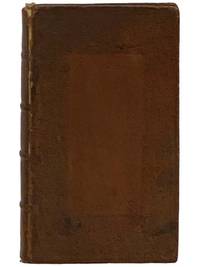
17292329103London: Jonh Brotherton at the Bible in Cornhill 1729. Second Edition. Full-Leather. Very Good/No Jacket. Second edition ESTC T106235. Both joints beginning to split front more so than rear with minor loss from spine head and foot quarter-sized spot on rear board which appears to be some sort of clear lacquer. Text clean and unmarked binding tight and holding firmly. 1729 Full-Leather. xiv 2 409 1 xxii 4 pp. Full calf four raised spine bands speckled edges blind stamped rules and inner board decoration. This second edition published nine years after the first includes substantial additions and corrections and is about twenty-five percent longer than the original. It was influential particularly in Germany where it was printed in several editions. Routledge in reference to a recent scholarly reissue of the text states "Bernard Mandeville was best known for The Fable of the Bees in which he demolishes the supposed moral basis of society by a Hobbesian demonstration that civilization depends on vice. Today Mandeville is seen as a trenchant satirist of the manners and foibles of his age. He is also seen as a precursor of some of Adam Smith's doctrines a forerunner in the field of sociology. A prescient analyst of the dynamics of our modern consumer society Mandeville is author of a striking naturalistic account of the gradual evolution of modern society from its primitive antecedents. His literary signature in a manner of speaking is his famous paradox 'private vices public benefits.' To understand Mandeville's Free Thoughts one needs to situate it within the context of the religious and political controversies ongoing subversion fear and dormant warfare of his times. Those would eventually erupt again and for the last time in the bloody Jacobite rebellion of 1745-46. The first five chapters of the book explore religious and theological issues including the nature of belief and knowledge the significance of rites and ceremonies and controversies about Christian mysteries such as the Trinity and free will and predestination. The next five chapters explore controversial issues of church politics including persecution and toleration across the centuries the basis of Mandeville's anticlericalism. In the eleventh chapter he turns aside from matters of religion to review the balance of powers in Britain's government a mixed or limited monarchy. The final chapter is essentially a repetition of Mandeville's pleas for civil and religious peace through mutual toleration by opposing religious parties. Mandeville's work is of continuing interest to students of culture and history religion and theology and political science. Jonh Brotherton, at the Bible in Cornhill hardcover
1740ZNC-112A Londres, Aux dépens de la compagnie, 1740, 4 volumes in-12°, XXII-333, 267, XLVIII-282 et 270 pages, cartonnage marron, dos lisses ornés de filets dorés.
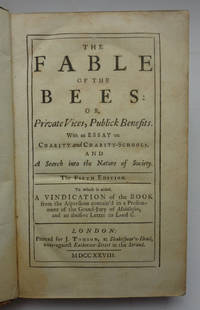
1728211271London: J. Tonson 1728. hardcover. very good. With an Essay on Charity and Charity Schools and A Search into the Nature of Society. Also A Vindication of the Book from the Aspersions contained in a Presentment of the Grand Jury of Middlesex and an Abusive Letter to Lord C-. 2 volumes published 1 year apart and by different publishers 8vo original calf; rubbed spine labels partially present. London: J. Tonson 1728 Fifth Edition and James Roberts 1729. First Edition. Very Good.<br/><br/> This is one of many editions of the famous and popular satire on the true causes of social welfare and riches Mandeville suggesting that base behavior produces positive economic effects. The conspiratorial theory of the origin of society so prominent in Part I was widely criticized after the publication of the 1723 edition. In the second volume probably in response to his critics Mandeville moved towards a more evolutionary account of society. This had an influence on the thinking of David Hume. Mandeville also adumbrated the division of labour theory subsequently developed by Adam Smith.<br/><br/> J. Tonson unknown books
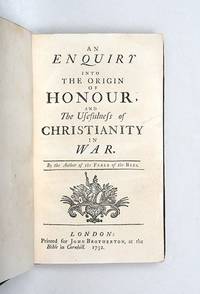
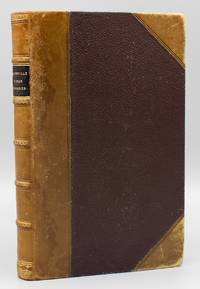
1732158809London: Printed for John Brotherton 1732. First edition of the author's last book; the final instalment of a long string of incendiary treatises which incensed his contemporaries. Following his tracts attacking Christian ethics defending brothels and opposing charity schools Mandeville here turns to the readiness with which Christianity can be perverted to militarism and asserts that honour is no more than pride. As with his Fable of the Bees Part II 1729 an entirely different work to the first part the treatise takes the form of a dialogue between two interlocutors Cleomenes and Horatio. "Mandeville repeated his view that the passions of pride and shame are both forms of self-liking. Honour and worldly religion are treated as devices that are useful for socializing humans. Honour is discovered to be even less demanding than virtue or the artificial courage discussed in the Fable of the Bees. The work again reveals Mandeville's anti-clericalism in his account of how a perverted version of the truly peaceful doctrine of Christianity can be used to motivate soldiers" ODNB. Octavo 184 x 115 mm. Late 19th-century half sheep and pebble-grain cloth spine ruled gilt in compartments black leather label sprinkled edges. Joints and corners rubbed head of spine with tiny chip. Margins trimmed a little close; a crisp clean copy. ESTC T59021; Kaye pp. 440ff. hardcover
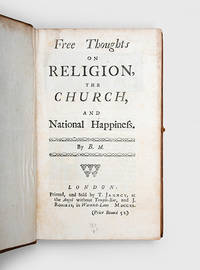
1720168926London: Printed and Sold by T. Jauncy and J. Roberts 1720. First edition of the author's forceful argument for the secularization of British politics his most substantial and wide-ranging political tract. This copy comes from the library of John Wallop Lord Viscount Lymington 1690-1762 a Whig politician who was an ally of Robert Walpole and bears his armorial bookplate on the front pastedown. Bernard Mandeville 1670-1733 grew up and studied in the Netherlands before settling in England at some point after the Glorious Revolution. Free Thoughts walks a fine line between advocating religious toleration and criticising the practices of the English priesthood advocating a Whiggish support of secularized constitutional government. "Despite the objections of the pious history and a growing segment of influential opinion were on Mandeville's side; and the ensuing years of the eighteenth century were to see an increasing acceptance in practice if not always in theory of the secularization of politics he so forcefully advocated in the Free Thoughts on Religion the Church and National Happiness" Cook p. 92. Two variants of the first edition are known. This example contains page xix correctly numbered - no priority has been identified. The book was reissued in 1721 and 1723 with new editions in 1729 and 1731 and was translated into French Dutch and German. The shelf label reads "Dr Mandevi Works Vol:1" indicating that this volume originally formed part of a collected set. Octavo 190 x 114 mm. Wood-engraved head- and tailpieces. Contemporary panelled calf spine with raised bands forming six compartments brown morocco label lettered in gilt edges sprinkled red. Light bumping and wear slight cracking to front joint holding firm minor browning to endpapers and outer margins of contents: a very good copy. ESTC T59022. Richard Cook Bernard Mandeville 1974. hardcover
1750262982Londres: Jean Nourse 1750. hardcover. very good. 4 volumes 12mo 2 396 4 62lxv1 339 et 4 362 pages original mottled calf; rubbed rubricated edges. Londres: Jean Nourse 1750. Very good.<br/> <br/> Translated from the sixth English edition. This is one of many editions of the famous and popular satire on the true causes of social welfare and riches Mandeville suggesting that base behavior produces positive economic effects.<br/> <br/> Jean Nourse unknown
1750262982Londres: Jean Nourse 1750. hardcover. very good. 4 volumes 12mo 2 396 4 62lxv1 339 et 4 362 pages original mottled calf; rubbed rubricated edges. Londres: Jean Nourse 1750. Very good.<br/><br/> Translated from the sixth English edition. This is one of many editions of the famous and popular satire on the true causes of social welfare and riches Mandeville suggesting that base behavior produces positive economic effects.<br/><br/> Jean Nourse unknown books
172417434<p>London: Printed and sold by G. Strahan. 1724 Second edition of Mandeville's first prose work in English and his first foray into social commentary. Originally published in 1709. The second edition was the last published during Mandeville's lifetime. All editions are scarce in commerce. Late nineteenth century half calf over brown pebbled cloth. Black leather spine label titled in gilt. . Octavo. Slight edgewear. Marbled endpapers. Two contemporary ink ownership signatures to title-page. Toning and some staining and foxing. A good copy. Bernard Mandeville 1670 – 1733 was born in Dordrecht Holland. After attending the University of Leiden and earning a medical degree he came to England to learn the language but ended up staying. He is best known for The Fable of the Bees which was first published as a 433-line poem The Grumbling Hive or Knaves Turn'd Honest in 1705 and was expanded into a prose work in 1714. The work was controversial upon its publication being criticized as cynical and degrading but it was popular for years and has since been praised by critics for the cuteness of Mandeville's perceptions and the strength of his style. It influenced George Berkeley who responded to it in the Alciphron as well as Samuel Johnson Adam Smith and the Utilitarians.</p> Printed, and sold by G. Strahan.. hardcover
1727244219London: Woodman Lyon and C. Davis 1727. Reissue of the 1725 edition with cancel title-page. xvi 8 384 8 pp. 1 vols. 8vo. Half dark brown polished calf and cloth red leather spine label. Title and final leaf backed title page a little toned otherwise a clean crisp copy. Reissue of the 1725 edition with cancel title-page. xvi 8 384 8 pp. 1 vols. 8vo. Translation of a French manuscript of Mandeville's Itinerarium. and for centuries a standard book for travellers. "Mandeville is said to have set out on his travels in 1322 and after visiting Egypt Palestine Tartary India the Indian isles etc. returned home in 1355. His death is set at 1371." Cox I 319. This is the second issue of the "best English edition" Lowndes and "the completest edition up to date" Cox. Woodman, Lyon and C. Davis unknown
1727244219London: Woodman Lyon and C. Davis 1727. Reissue of the 1725 edition with cancel title-page. xvi 8 384 8 pp. 1 vols. 8vo. Half dark brown polished calf and cloth red leather spine label. Title and final leaf backed title page a little toned otherwise a clean crisp copy. Reissue of the 1725 edition with cancel title-page. xvi 8 384 8 pp. 1 vols. 8vo. Translation of a French manuscript of Mandeville's Itinerarium. and for centuries a standard book for travellers. "Mandeville is said to have set out on his travels in 1322 and after visiting Egypt Palestine Tartary India the Indian isles etc. returned home in 1355. His death is set at 1371." Cox I 319. This is the second issue of the "best English edition" Lowndes and "the completest edition up to date" Cox. Woodman, Lyon and C. Davis unknown books
1732158851London: Printed for John Brotherton 1732. First edition of the author's last book. The final instalment of a long string of incendiary treatises which so incensed his contemporaries following his tracts attacking Christian ethics defending brothels and opposing charity schools Mandeville here turns to the readiness with which Christianity can be perverted to militarism and asserts that honour is no more than pride. As with his Fable of the Bees Part II 1729 an entirely different work to the first part the treatise takes the form of a dialogue between two interlocutors Cleomenes and Horatio. "Mandeville repeated his view that the passions of pride and shame are both forms of self-liking. Honour and worldly religion are treated as devices that are useful for socializing humans. Honour is discovered to be even less demanding than virtue or the artificial courage discussed in the Fable of the Bees. The work again reveals Mandeville's anti-clericalism in his account of how a perverted version of the truly peaceful doctrine of Christianity can be used to motivate soldiers" ODNB. Octavo 197 X 123 mm. Contemporary panelled speckled calf red morocco label sprinkled edges. Ownership inscription of J. Arscott dated 1732 to title engraved armorial bookplate of Sir William Molesworth to front pastedown. Small chip to head of spine joints and corners a little rubbed; a crisp clean copy. ESTC T59021; Kaye pp. 440ff. unknown
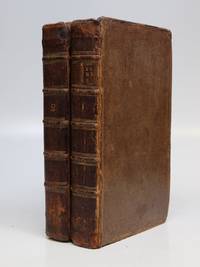
1732158464London: Printed for J. Tonson 1732 & 1733. Private vices as public virtues Seventh edition stated sixth of the first part second edition of the second part of Mandeville's best-known work demonstrating through a parable of bees renouncing all luxury and seeing their hive collapse that the Christian ascetic philosophy cannot lead to a prosperous economy and social system and consequently that individual vices of vanity and greed are virtues for the community. The work originated in 1705 as a poem titled The Grumbling Hive expanded into the first book-length edition in 1714 and revised by Mandeville in further editions. Part II first published in 1729 matches the length of the first part and comprises six dialogues in which Cleomenes instructs Horatio as to the Fable's true meaning. Mandeville's implication that religion was damaging to social welfare was contentious and in 1723 the work was declared a public nuisance by the grand jury of Middlesex and Mandeville himself accused of blasphemy. Undeterred he addressed his accusers in the London Journal and published a pamphlet defending himself against such charges; the contents of this "Vindication" are included in the present edition of Part I along with Mandeville's Essay on Charity Schools claiming that educating the poor above their station was in nobody's interest and his Search into the Nature of Society further espousing the Fable's themes. Mandeville would spend the rest of his life justifying his work to its many critics yet it was still characterized well after his death as "the wickedest cleverest book in the English language" in the diary of Henry Crabb Robinson June 1812. The book had an enduring influence on the science of economics in pointing out what was self-evident to many but never before put so boldly - that expenditure on luxuries the incentives created by the desire for social betterment and the need for profit all form the basis of the economic system and social order around it. Adam Smith though denouncing Mandeville in his Theory of Moral Sentiments followed his central thesis that the individual's self-interest works to the good of the whole. Keynes was influenced by Mandeville in his notion of the "paradox of thrift" that withholding spending reduces demand and harms the economy. Friedrich Hayek in a lecture of 1966 to the British Academy called Mandeville a "Master Mind" in recognising that individuals seeking to advance their own interests create a "spontaneous order" which can form a society without the need for a controlling state. 2 vols octavo 191 x 121 mm. Contemporary calf ruled in gilt with vol. numbers to third compartments vol. I with manuscript label in second compartment. Contemporary ownership signature of one Alexander Duff to title pages. Light rubbing and slight chip at head of spine of vol. II small loss bottom fore corner of Part I leaf L1 2D7. Very good copies. ESTC N8073 & T77578. unknown
1750CLL-647Londres, Jean Nourse, 1750 "4 volumes n-12 de (1) f., XXXIII, 396 pp. ;(2) ff., 362 pp. ; (1) f., LXVI pp., 1 fb., 339 pp. ; (2) ff., 361, (1) pp., veau moucheté, filet à froid en encadrement sur les plats, dos à nerfs ornés de caissons de fleurons dorés, pièces de titre et de tomaison de maroquin rouge et vert, armes dorées en pied, filet doré sur les coupes, bordures dorées, tranches rouges (reliure de l'époque)."