2 résultats
1738263095N.p. 1738. Each signed possibly in anoher hand lower left in ink "Gravelot". 1 vols. 9.3 x 7.4 cm. The two matted together and framed. Both drawing slightly toned but very good. Each signed possibly in anoher hand lower left in ink "Gravelot". 1 vols. 9.3 x 7.4 cm. The first illustration of a Monkey addressing a Lion and a Wolf is almost certainly from Gravelot's English period 1733-1746 and could well be a preliminary sketch for Gay's FABLES; yet the second drawing depicting a female figure driving a chariot displays an allegorical style reminiscent in style and theme to his illustratons for ICONOLOGIE PAR FIGURES ca. 1789. unknown books
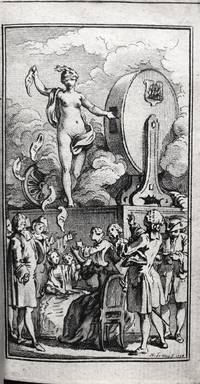
17592999Amsterdam & Paris: chez Prault père and Laurent-Fr. Le Clerc 1759. <p>16mo 113 x 62 mm. viii 97 1 pp. folding table counted as 4 pages. ninety-one etchings after Gravelot including an allegorical frontispiece signed by N. Le Mire and dated 1758 and 90 etched plates of girls and women engaged in various activities of daily life. Text within double rule border throughout. Small marginal loss to pl. 34 pl. 90 with an old crease from paper flaw very occasional slight soiling overall in fine condition. Contemporary French red morocco covers paneled with triple gilt fillets spine gold-tooled and -lettered green gilt dominoté endpapers with repeating star pattern; modern morocco two-part pull-off case by Riviere & Son. Provenance: Sir David Lionel Goldsmid-Stern-Salomons 1851-1925 armorial bookplate.<br /><br />The first French lottery almanac and the most abundantly illustrated of any single eighteenth-century almanac. "One of the loveliest and rarest of all 18th-century almanacs" Savigny de Moncorps this celebrated little book is illustrated with no fewer than ninety-one etchings designed by Gravelot who also wrote the epigrammatic quatrains accompanying each etching. Gravelot's delightful scenes of little girls teenage girls and young women busy with pastimes or chores or shown at moments of emotional intensity were intended as is explained in the preface to represent the spirit of France while encouraging its citizens to play the new national lottery established in 1757 to finance construction of the Ecole royale militaire a military academy founded by Louis XV in 1751 to train 500 young noblemen from impoverished families.<br /><br />Besides the usual calendar and a 12-month table of gains and losses the text contains a history and description of the new lottery and its Italian antecedents explanations of its principles and mechanics and a guide to playing advantageously using "mathematical reasoning." The lottery for which bureaus were to be established throughout France was planned to last for 30 years with monthly drawings. It was an early form of today's Lotto. Tickets containing numbers from 1 to 90 were spun in a "wheel of fortune" pictured in the frontispiece from which five winning tickets were selected. Players were allowed to place bets on up to five numbers at once the variously sized bets being provided with arcane names an extrait for one number ambe for two terne for three etc. <br /><br />The pictures' role was to help the lottery player choose his numbers functioning somewhat in the manner of the traditional Italian smorfia but without the exclusive focus on dreams and portents which are referred to in the preface as an optional method of inspiration. Like the lottery itself the concept of thematic images linked to lottery numbers was based on the Italian model as explained in the preface and the historic chapter but while in Italy each city chose their own motifs - in Rome it was the arts in Naples animals in Genoa flowers and in Venice trades - for France it was decided without hesitation that la galanterie was a natural fit for the nation p. iv. One might read a rather Freudian or Jungian motivation into the presumably subconscious choice by the lottery committee of the very opposite of a warlike theme - sweet young girls domesticity and intimations of intimacy - for the financing of a military school. Whether or not this was Gravelot's idea his contribution was major: as stated in the publishers' preface and in his own Avertissement on the penultimate verso he designed the figures and wrote the verses. The plates were etched by Noël Le Mire 1724-1801 "one of the most prominent engravers of the 18th century . whose best work was in his book illustrations after Boucher Cochin Gravelot Eisen Gravelot Monnet Moreau and others" Thieme-Becker 23:27.<br /><br />The frontispiece depicts blindfolded fate drawing tickets from the "wheel of fortune" and dropping them into a crowd of eager ladies and gentlemen. The first 28 plates portray young girls and the rest adolescents and young women. Each etched scene is set within a gracious rococo frame with cartouches for the title the number and at the foot Gravelot's rhyming quatrain. Shown are girls at play with dolls or heaven forbid spinning tops with the boys Gravelot disapproves learning their ABC's being slapped by their mother or governess for laziness teaching the dog to dance playing badminton alone on a swing pushed by a brother crying as the cat makes off with the pet sparrow painting dreamily at a table and even building a house of cards. As she ages the teenage girl is given more work - she embroiders knits studies but also prepares for parties flirts gossips is jealous. Many of the etchings tell stories. Portraits of the now adult young women include a reader the quatrain warns to choose one's books as one does one's friends: wisely a gambler a coquette a "savante" surrounded by books a dreamer personifications of boredom and religious devotion but also working women shown gardening milking cows harvesting grapes spinning cooking sewing doing hair selling knickknacks etc. On the bottom rung of the social ladder a laundry woman and a maidservant are shown the latter making a bed and admonished to be "flattering supple patient and never to tell certain secrets." The final plate depicts fatefully a wedding and there is nothing left to show the bride having ceased to be the property of la Galante France and become that of her husband.<br /><br />This copy is in very fine condition. The edition is a notorious rarity. There are two copies at the Bibliothèque nationale de France of which at least one is incomplete a defective copy at the Bibliothèque Ste. Genièvieve copies at the Morgan Library Boston Museum of Fine Arts and the British Library. The Morgan also has four of Gravelot's original drawings for the almanac and Houghton Library has six others. The almanac had only this one year of issue. The plates were re-issued once in an edition of Les Jeux de la petite Thalie Paris: Desnos s.d. which is almost as scarce as this volume. Because of its rarity this almanac is far less known than Gravelot's 17-volume Almanach iconologique which contained like most French almanacs 12 plates per volume. John Grand-Carteret who devoted 5 full columns to the edition knew of only the Baron Pichon copy.  The amateur Savigny de Moncorps included this almanac "one of the prettiest and rarest" in his very "choisi" collection of almanacs; and the frères Goncourt called it a trifle condescendingly "un vrai petit bijou et joujou" which perfectly suited Gravelot's talents.<br /><br />Inventaire du fonds français graveurs du XVIIIe siècle vol. 10 Gravelot 983-1073 and vol. 14 Lemire 159-248; Grand-Carteret Les Almanachs français 277; Cohen-de Ricci Guide de l'amateur de livres à gravures du XVIIIe siècle 1912 col. 28-29; Savigny de Moncorps Coup d'oeil sur les almanachs illustrés du XVIIIe siècle 1891 11-12; Savigny de Moncorps Almanachs illustrés du XVIIIe siècle 1909 no. 6 pp. 35-39.</p> chez Prault père [and] Laurent-Fr. Le Clerc unknown books