3 807 résultats
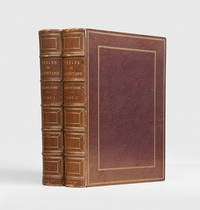
1877ST20670Stuttgart: Edward Hallberger ca. 1877. Fourth Edition. 430 x 315 mm. 16 3/4 x 12 1/4". Two volumes. Translated into German by Dr. Joseph Franz Allioli. <br/> PUBLISHER'S SPLENDID RED CLOTH VERY ELABORATELY STAMPED IN GILT AND BLIND covers with bevelled edges thick and thin gilt-rule border enclosing ornate blind-stamped frame large central oval containing a lobed gilt frame with gilt lettering inside spine divided into blind-stamped panels by decorative and plain gilt rules two large panels with gilt lettering and volume number original cloth hinges white moiré paper endpapers all edges gilt. IN THE ORIGINAL PRINTED GRAY DUST JACKETS jacket of second volume with small very expert repairs at bottom and the original black cardboard clamshell boxes solidly reinforced with black tape. WITH 230 DRAMATIC PLATES BY GUSTAVE DORÉ. Volume I with four leaves for recording family members marriages births and deaths each with a decorative frame all unused. Malan "Doré" p. 85. Isolated spots of minor foxing due to paper content one cover of the very rarely seen dust jackets with red offsetting from the frame on the cover but AN UNSURPASSABLE COPY--clean fresh and bright internally the bindings and jackets IN SPARKLING CONDITION.<br/> <br/> This is a time-capsule copy of perhaps the most popular illustrated Bible ever issued and one of the very few Bibles which has always been known by the name of its illustrator. According to his biographer the artist was excited by the "almost endless series of intensely dramatic events" he would get to portray; the results originally created for the 1866 Grand Bible of Tours are so evocative that the critic Bouchot called them "the terror of frail readers." Doré 1832-83 makes remarkable use of light shadow and composition to convey the full range of splendor horror pathos and ecstasy contained in the Scriptures. Because he was so prolific it is estimated that he made more than 100000 designs in his lifetime Doré inevitably had his detractors but Ray says simply that he was "one of the greatest of all illustrators." Taine says that "every imagination appeared languid in comparison with his. For energy force superabundance originality sparkle and gloomy grandeur I know of only one equal to his--that of Tintoretto." The Doré Bible was translated into at least 24 languages; ours is the German version by Catholic theologian Joseph Franz Allioli 1793-1873. According to Malan "The Roman Catholic Church has never diminished its praise of these illustrations." And these illustrations endured in many Catholic and Protestant Bibles especially during the last third of the 19th century but actually until the present. The Bible was such a cultural phenomenon that Mark Twain even mentioned it in “Tom Sawyer†as a motivating prize for students to learn Scripture. The Bible’s success prompted Doré to reinterpret his illustrations in huge paintings that were displayed at Doré Gallery in London. Malan says that the exhibition “was considered the greatest collection of religious paintings in the world." The boxes that were issued with our set have clearly weathered some blows over the years but they did their job perfectly as the volumes they protected hardly seem to have been opened in their lifetime and their dust jackets even considering the minor repair are also in a breathtaking state of preservation. Edward Hallberger unknown
Il codice è stato realizzato come dono di nozze di Alessandro de’ Medici per sua moglie Margherita d’Austria. Formato 11x19 cm. di 300 pagine con sette miniature a piena pagina (attribuibili a Giovanni e Francesco Boccardi) e numerose iniziali decorate, in foglia d’oro. Nel cofanetto, in pelle, nel doppio scomparto oltre al codice (piatti in velluto verde, chiusure in argento e medaglione centrale) è conservato il commentario con saggi storici e paleografici. Tiratura limitata di 750 copie numerate.
18671562# AUTEUR: La Fontaine # ILLUSTRATEUR: Doré Gustave # ÉDITEUR: Hachette L. & Cie - Paris # ANNÉE ÉDITION: 1867 # ENVOI, BEAUX PAPIERS: Edition de luxe avec les grandes compositions tirées sur papier de Chine - encadrements et titres imprimés en rouge # COUVERTURE: 1/2 chagrin citron à coins - dos à nerfs finement décoré doré - pièce de titre en maroquin rouge - tête dorée - non rogné # DÉTAILS: 2 volumes in folio reliés T1. 2ff ( faux titre et titre) + LX ( notice sur Jean de La Fontaine, dédicace à monseigneur le Dauphin, préface, la vie d'Esope le Phrygien) + 317pp + 1ff. 43 grandes gravures sur Chine. T2. 2ff + 383pp. 43 grandes gravures sur Chine. Page 133 ” le renard et les raisins”, montées sur Chine sont en 2 tirages: l'une gravée par Hildebrand l'autre par Pannemaker. Belle reliure signée Raparlier. Est joint une lettre autographe signée de 2 pages in 8°, du 29 Octobre 1875, de Gustave Doré: ” A cher monsieur, il regrette de ne pouvoir lui confier l'impression de son livre. Il dit le travail de chaque instant qu'exigent les planches sous la presse. Mais dit cependant la haute estime qu'il a pour ”l'art et le talent typographique de la maison Grant ”. Romain Raparlier relieur à Paris dès 1855 exerça jusqu'en 1880; vers 1885 son fils Paul Romain était installé lui-même 7 rue des Canettes. # PHOTOS visibles sur www.latourinfernal.com
6644Paris, Garnier frères, [sans date]. Deux forts volumes in-folio (325 x 254 mm), 2 ff. n. ch., XLVIII pp., 584 pp.; 2 ff. n. ch., 632 pp. Percaline rouge, filets d’encadrement noirs sur les plats, décor doré entourant le titre sur le plat supérieur, rosace au centre du plat inférieur, dos lisses ornés, non coupé (reliure de l’éditeur).
185484305Au bureau du journal amusant | Paris S.d (1854) | 34.50 x 26.50 cm | relié
18600030601860 Paris, Hachette, 1860. In-8 (172 X 250 mm) demi-chagrin havane, dos cinq nerfs filetés, caissons double encadrement de filet doré, auteur et titre dorés, date en queue, tête dorée sur témoins, plats et dos de la couverture conservés (Petitot) ; (1) f. blanc, VI (dont faux-titre et titre)-554 pages (dernière page chiffrée par erreur « 354 »), (1) f. (nom de l'imprimeur). Rousseurs claires éparses, essentiellement dans les marges. Dos à peine éclairci avec petites taches sombres sans gravité.
191467749Shanghai: Tusewei Printing Press 1914. 18 volumes mixed editions; 8vo extensively illustrated throughout with plates facsimiles halftones etc. much in color lithography after drawings by the author; original string-bound printed paper-covered boards; stamps from the library of St. Joseph's Priory on covers and title pages else generally a very good to fine set. Henry Doré was a French missionary and scholar of Asia. His 18-volume major work "Recherches sur les Superstitions en Chine" was one of the earliest 20th century European writings on Chinese culture and religion. Doré studied in Central China for more than two decades and was also an exceptionally talented illustrator who reproduced many pieces of Chinese art for his books. Originally published in French in a set of eighteen volumes from 1914-1938 these texts are notable for their colorful illustrations. Only volumes I through X and XIII were translated into English. The First Part in 5 volumes covers "Superstitious Practices" 1914-1918; the Second Part in 7 volumes covers "The Chinese Pantheon" 1918-1933 - the last two volumes in French; and the Third Part in 6 volumes covers Confucianism Buddhism and Taoism 1919-1938 all but volume XIII in French. Tusewei Printing Press unknown
1856302070Paris: Michel Lévy frères 1856. First Edition. 12 plates on wood after the designs of Gustave Doré. 1 vols. Folio. Quarter publisher's black morocco and pebbled cloth small loss at bottom of spine. Doré Gustave. First Edition. 12 plates on wood after the designs of Gustave Doré. 1 vols. Folio. "Le chef-d'oeuvre de Doré dans le genre fantastique.et puis le format est formdable!" Beraldi. Renonciat p. 92; Leblanc 217 Michel Lévy frères unknown
1856302070Paris: Michel Lévy frères 1856. First Edition. 12 plates on wood after the designs of Gustave Doré. 1 vols. Folio. Quarter publisher's black morocco and pebbled cloth small loss at bottom of spine. Doré Gustave. First Edition. 12 plates on wood after the designs of Gustave Doré. 1 vols. Folio. "Le chef-d'oeuvre de Doré dans le genre fantastique.et puis le format est formdable!" Beraldi. Renonciat p. 92; Leblanc 217 Michel Lévy frères unknown books
63493Paris: Furne Jouvet & Cie. 1877. FIRST EDITION THUS. 2 vols. Large folio 42 x 32 cm. pp.424; 376. Publisher's binding signed Ch. Magnbier of quarter richly gilt stamped red morocco over matching cloth boards stamped in gilt and black marbled endpapers a.e.g. 100 full page engraved illustrations by Doré engraved by Bellanger Pannemaker Doms Gusman Jonnard Pannemaker Pisan and Quesnel. Contents exceptionally clean slight fading to spine of second volume generally a most handsome set. Michaud's Histoire des croisades was published in its final form in six volumes in 1840 under the editorship of his friend Jean Joseph François Poujoulat. It covers the beginning of the crusades through the Council of Clermont. It covers the departure of crusaders after the Council of Nicee the Siege of Antioch Election of Godefroy Battle of Ascalon reign of Baudouin II and the conquests of Saladin. "With this set of 100 full-page folio engravings Doré for once restrained his wild imagination to do a straight historical subject and he showed once again that there was no field of visual expression at which he did not excel… Though the Crusades engravings are historical they lose none of Doré's normal personality and vigor. They are simply the best set of illustrations ever done on the Crusades" Malan 137. Paris: Furne, Jouvet & Cie., 1877. hardcover
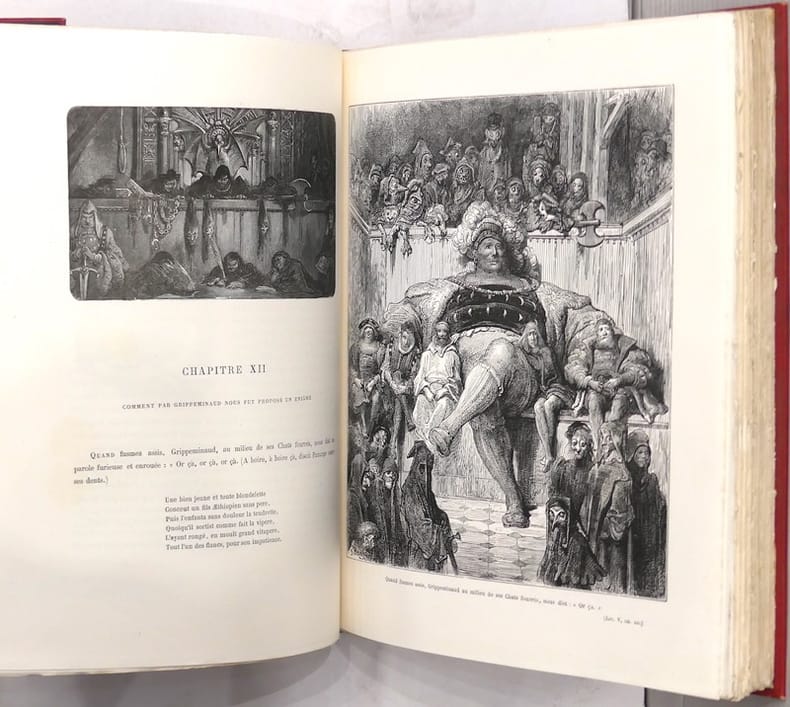
1867189937Paris: Librairie de L. Hachette et Cie 1867. Masterfully illustrated fables First Doré edition this set including the additional plate "Les devineresses" bound in Volume II. In this period Doré went from being "virtually unknown in England to being the most famous illustrator in the world" Malan 67. His illustrated edition was serialized in 60 parts from 1866 to 1868 and published in book form simultaneously in Paris and London. 2 vols folio 300 x 420 mm. Steel-engraved portrait frontispiece of the author by Delannoy after Sandoz 85 plates with grey border and tissue guard steel engravings in text by Doré. Titles and headings printed in red and black contents printed within red double-rule border. Early 20th-century brown morocco spines lettered in gilt compartments framed in gilt two sets of quadruple gilt rules bordering covers gilt fillet to board edges turn-ins with gilt fillets and crosses at corners red moiré silk doublures and free endpapers edges gilt. Spines and front cover edges lightly sunned gilt bright small chip to spine foot of vol. II rubbing and slight wear to extremities couple marks to covers sporadic foxing. A very good set. Beraldi VI 151. unknown
185632735Michel Lévy Frères Couverture rigide illustrée Paris 1856 Edition originale
191122701Shanghai mprimerie de la Mission Catholique à l'Orphelinat de T'Ou-Sè-Wè, ZI-KA-Wei 1911/18 -in-8 cartonné 13 volumes, cartonnage à la chinoise avec lacets reliant les plats, rouge et gris-jaune in-octavo Editeur (paperback in-octavo Editor) (25 x 17,5 cm), dos imprimé en noir, plats décorés à la chinoise : mors de toile rouge, plats décorés à froid (plaque spéciale Editeur), 1er plat orné d'une illustration en rouge (différente sur chaque volume), toutes tranches lisses jaspées rouges, abondamment illustré en couleurs : - PREMIERE PARTIE - Premier volume. TOME I N° 1. V. S. n° 32, 1911, XII+VI+146 pages+75 illustrations+10 photos. - Deuxième volume. 1ERE PARTIE - TOME I N° 2. V. S. n° 33, 1911, 70 pages+88 illustrations+1 photo. - Troisième volume. 1ERE PARTIE - TOME II N° 3. V. S. n° 34, 1912, X+106 pages+35 illustrations+2 photos, - Quatrième volume.1ERE PARTIE - TOME II N° 4. V. S. n° 35, 1912, 166 pages+55 illustrations+3 photos, - Cinquième volume.1ERE PARTIE - TOME V V. S. n° 36, 1913, XVII+92 pages+104 illustrations:La lecture des talismans chinois. Explication de ceux qui ont paru dans les N° 1 et n° 2 - 2EME PARTIE - TOME VI: Variétés Sinologiques n° 39, 1914, XII+196 pages+54 illustrations+3 photos.Recherches sur les superstitions en Chine. Deuxième partie, Le panthéon chinois. - 2EME PARTIE - TOME VII.:Variétés sinologiques n° 41, Imprimerie de la Mission catholique, Zi-ka-wei, 1914, VI+102 pages+53 illustrations. - 2EME PARTIE - TOME VIII.: Variétés sinologiques n° 42, Imprimerie de la Mission catholique, Zi-ka-wei, 1914, VIII+164 pages+40 illustrations. - 2EME PARTIE - TOME IX: CHAPITRE IV : Taoïsme : Dieux, Immortels, Génies.: Variétés sinologiques n° 44, Imprimerie de la Mission catholique à lorphelinat de Tou-sé-wé, Zi-ka-wei, 1915, X+218 pages+76 illustrations. -2EME PARTIE - TOME X: CHAPITRE V : Ministères transcendants -Variétés sinologiques n° 45, Imprimerie de la Mission catholique à lorphelinat de Tou-sé-wé, Zi-ka-wei, 1915, VIII+180 pages+39 illustrations. 2EME PARTIE - TOME XI: Chap. VI, Dieux protecteurs et Patrons. Variétés sinologiques n° 46, Imprimerie de la Mission catholique à lorphelinat de Tou-sé-wé, Zi-ka-wei, 1916, XII+192 pages+59 illustrations. 2EME PARTIE - TOME XII. Chapitres VI, Dieux protecteurs et Patrons ; VII, Dieux composites ; VIII, Divinités stellaires. Variétés sinologiques n° 48. Zi-ka-wei, 1918, VIII+234 pages+57 illustr.-TROISIEME PARTIE : Popularisation des trois religions -Section II : Confucius, ses disciples, le confucéisme - A. VIE DE CONFUCIUS ILLUSTRÉE - B. LES 144 SAGES DU TEMPLE DE CONFUCIUS d'après les documents chinois - Recherches sur les superstitions en Chine, TOME XIII.: Variétés sinologiques n° 49, Zi-ka-wei, 1918. XVI+262 pages + 81 illustrations, 1911/1918 Chang-Hai, Imprimerie de la Mission Catholique à l'Orphelinat de T'Ou-Sè-Wè, ZI-KA-Wei EDITEUR
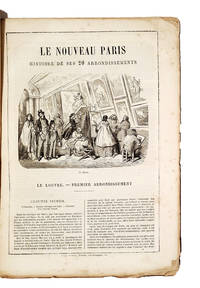
18601681711860. DORE Gustave. LA BEDOLLIERE Emile de. Le Nouveau Paris. Histoire de ses 20 arrondissements. 440 pp. Illustrated with a frontispiece and 66 wood-engravings throughout the text by Doré. Plus 21 double-page coloured maps of the arrondissements designed by Desbuissons and engraved by Erhard. Large 8vo. 300 x 210 mm in the original publisher's illustrated and printed wrappers. Preserved in a new dark blue cloth folding box. Paris: Gustave Barba n.d. 1860. First Edition first issue with the address of Barba on the rue Cassette. This copy includes all of the original parts in their illustrated publisher's wrappers the complete compliment of coloured maps of Paris with a copy of the general plan of Paris which was not included with the publication in parts laid in. The original first printing is nearly a different work in terms of quality and visual impact compared to the later reprints. This wonderful guide captures Paris in a moment of astounding transformation. The "modernization" of the city of Paris by Baron Haussmann was in the middle period when the Doré guide to Paris was issued. Much of the old Paris and a bit of the brand new Paris is captured in the wood-engraved illustrations of Doré the maps by Desbuissons and the text by La Bedollière. There are parts devoted to: Le Louvre La Bourse L'Hotel-de-Ville Le Pantheon Le Luxembourg Le Palais-Bourbon L'Elysee L'Opera Les Gobelins Vaugirard Passy Les Buttes de Montmartre etc. plus 2 parts of Dictionnaire de Besoins Usuels two parts of Dictionnaire des Rues de Paris and one final part on Histoire Géneral de Paris. "Les transformations de Paris décidées par Haussmann furent radicales notamment par l'annexion des communes limitrophes portant le nombre d'arrondissements de 12 à 20. "Le livre de La Bédollière est conçu comme un guide touristique de ce nouveau Paris. Contrairement à ce que l'on pourrait attendre Gustave Doré ne s'attache pas à une description topographique de la ville. Dédaignant l'enveloppe il s'intéresse à son contenu et il adopte un ton humoristique et plein de fantaisie pour décrire les détails piquants et pittoresques de l'histoire ou de la vie quotidienne qui animait chaque arrondissement. La bonhomie et la bonne humeur qui s'expriment dans les illustrations de Gustave Doré n'augurent en rien la prise de conscience sociale que l'artiste éprouvera lors de son pélerinage londonien" Strasbourg Exhibition nº 605. Some wear to the wrappers but nevertheless sound and desirabble in the rare original wrappers. Leblanc 195. Vicaire IV 732. hardcover books
18601681711860. DORE Gustave and Emile de la BEDOLLIERE. Le Nouveau Paris. Histoire de ses 20 arrondissements. 440 pp. illustrated with a frontispiece and 66 wood-engravings by Doré throughout the text plus 21 double-page coloured maps of the arrondissements designed by Desbuissons and engraved by Erhard. Large 8vo 300 x 210 mm in the original publisher's illustrated and printed wrappers preserved in a new cloth folding box. Paris: Gustave Barba 1860. First edition first issue with the address of Barba on the rue Cassette. This copy includes all of the original parts in their illustrated publisher's wrappers the complete compliment of coloured maps of Paris with a copy of the general plan of Paris which was not included with the publication in parts laid in. The original first printing is nearly a different work in terms of quality and visual impact compared to the later reprints. This wonderful guide captures Paris in a moment of astounding transformation. The "modernization" of the city of Paris by Baron Haussmann was in the middle period when the Doré guide to Paris was issued. Much of the old Paris and a bit of the brand-new Paris is captured in the wood-engraved illustrations of Doré the maps by Desbuissons and the text by La Bedollière. There are parts devoted to: Le Louvre La Bourse L'Hotel-de-Ville Le Pantheon Le Luxembourg Le Palais-Bourbon L'Elysee L'Opera Les Gobelins Vaugirard Passy Les Buttes de Montmartre etc. plus 2 parts of Dictionnaire de Besoins Usuels two parts of Dictionnaire des Rues de Paris and one final part on Histoire Géneral de Paris. "Les transformations de Paris décidées par Haussmann furent radicales notamment par l'annexion des communes limitrophes portant le nombre d'arrondissements de 12 à 20. Le livre de La Bédollière est conçu comme un guide touristique de ce nouveau Paris. Contrairement à ce que l'on pourrait attendre Gustave Doré ne s'attache pas à une description topographique de la ville. Dédaignant l'enveloppe il s'intéresse à son contenu et il adopte un ton humoristique et plein de fantaisie pour décrire les détails piquants et pittoresques de l'histoire ou de la vie quotidienne qui animait chaque arrondissement. La bonhomie et la bonne humeur qui s'expriment dans les illustrations de Gustave Doré n'augurent en rien la prise de conscience sociale que l'artiste éprouvera lors de son pélerinage londonien" Strasbourg Exhibition nº 605. Some wear to the wrappers but nevertheless sound and desirable in the rare original wrappers. Leblanc 195. Vicaire IV 732. hardcover
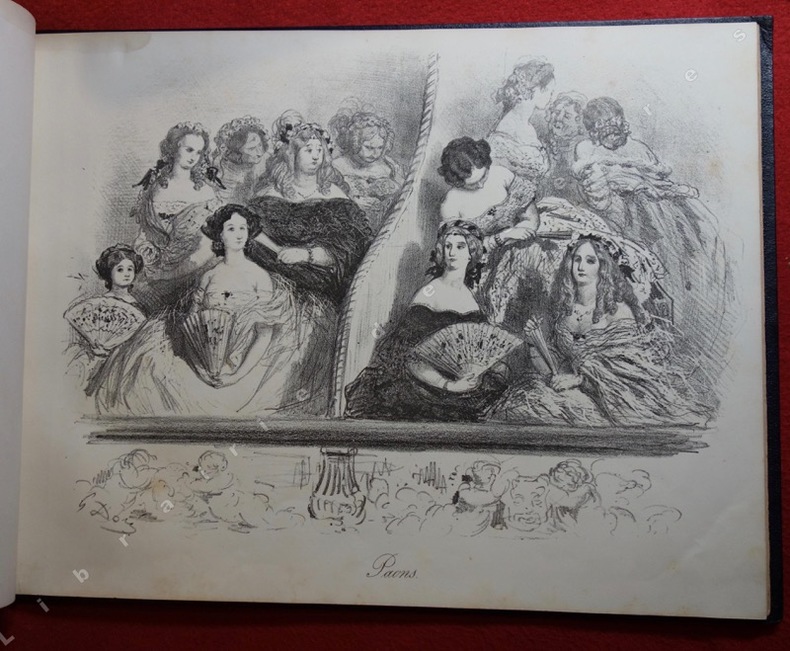
186084302Paris: Féchoz & Letouzey 1860. Fine. Before the golden age of comics the ""Age of Doré"" Féchoz & Letouzey Paris s. d. 1860 36 x 27.50 cm relié Album of lithographed plates in third state first cover printed in 3 tones black bistre with gradients and white highlights followed by 24 lithographs in black on 12 double-sided pages. Gray half calf binding smooth spine some foxing original soft cover preserved binding signed by Charles Septier. Created in 1851 this youthful work influenced by Rodolphe Töppfer's style is now considered an incunabulum of comic strips. Féchoz & Letouzey paperback
1911CLL-857Shangaï, Impr. de la Mission catholique, 1911-1938 18 volume in-4, cartonnages imprimés de l'éditeur bordés de percaline rouge reliés à la mode chinoise (dos du livre simplement broché, premier et second plat non solidaires mais fixés au corps de l'ouvrage par des cordons) de façon uniforme à l'époque.
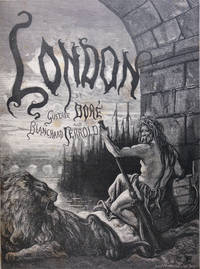
187234677London: Grant & Co. 1872. First Edition of “Doré’s chef d’oeuvre†Bland. With one hundred and eighty truly brilliant engraved illustrations by Gustave Doré including many folio size plates each with descriptive tissue guard. Large Folio in a stately and handsome binding of three-quarter blue-black polished calf over blue cloth covered boards the spine with raised bands ruled in gilt the compartments fully gilt decorated with panels incorporating double gilt fillet rules corner and central tooling gilt one compartment with a red morocco label gilt lettered turnovers and borders of the calf ruled in gilt the upper cover with gilt titling and authorship decoration marbled endpapers all edges gilt. xii 191 10 Table of Contents and Table of Illustrations pp. A handsome and stately copy very sturdy and the binding strong and well preserved the thick paper generally clean and crisp and solid. Some occasional foxing to some leaves as is normal with the book more to the front preliminary leaves some rubbing to the extremities some age . A very well preserved copy. FIRST EDITION IN A STATELY BINDING OF WHAT MANY CONSIDER TO BE DORE'S GREATEST MOST IMPORTANT AND FANTASTIC WORK. This is also one of Doré’s less common works rarely encountered and a superb example of his talent. It is a great book especially because it is the work of an artist capturing what he sees of the London of the streets and of the backs a place seldom encountered by the public at large. It is a book that rocked the book world and English sensibilities when it first appeared. <br> "Doré produced the drawings for this work under great emotional strain. France was involved in the Franco-Prussian War and his brother was a soldier in it. With Jerrold he had walked the streets of London like Dickens and Wilkie Collins before at night and viewed the working of the City the London labourers and the London poor. At this period he had also attended a garden party with Queen Victoria with whom he had a long conversation. He experienced all the delights of the London Season from the Boat Race the Derby and various Balls and Salons. His work was criticised for its exposure of the less salubrious side of the city from its Opium dens the homeless and the ugly back streets at the same time gently mocking Society Ladies admiring monkeys in cages from the animals point of view and the prisoners exercise yard which inspired Van Gogh.<br> The British public were not amused with what had promised to be a light and entertaining work. Instead came a work of uncomfortable social reflection of the juxtaposition between wealth and poverty the upper classed the work and dispossessed. The text by Blanchard Jerrold is light and amusing hardly reflecting the grim realities of Doré's representation.<br> “Doré’s devastating realization of the contrast of wealth and poverty in a modern metropolis makes LONDON one of the great illustrated books of the world. The English edition antedates the French by four years and indeed it is a handsomer book†Ray. Ruari McLean in his book VICTORIAN BOOK DESIGN says of it: “.perhaps the finest and most original book of monochrome wood engraving published in London during this period was the work of a Frenchman Gustave Doré. This was his LONDON A PILGRIMAGE. Doré’s illustrations make the English illustrations of the sixties look puny.â€<br> The engraved illustrations and accompanying text show many aspects of the city but dwell on the picturesque clutter and the squalor of the poorer districts. ‘Jerrold whose text accompanies the plates was a well known London journalist who conceived the work and accompanied the artist in exploring London--sometimes with special police protection. Doré was able to explore the vitality and ruthlessness of Victorian London and depict these conditions through his extraordinary graphics.’ Grant & Co. hardcover
1877008666New York: Harper & Brother Publishers 1877. SCARCE in collectible condition. A lovely copy in original gilt-stamped grey beveled cloth boards all edges gilt grey end papers 12 numbered pages plus 38 plates with tissue guards illustrated frontispiece and title vignette. Very Good Plus small loss of cloth at spine ends and tips rear covers stained and soiled small tear to edge blank front end page. Copies this lovely uncommon in recent commerce. . Second American Edition . Decorative Cloth. Very Good Plus/No Jacket As Issued. Elephant Folio - over 15" - 23" tall. Harper & Brother Publishers Hardcover books
187576484London:: Dore Gallery 1875. First edition thus; presentation copy inscribed by Dore on the original plain front wrapper to a contemporary publisher "A Monsieur Goupil Hommage Affectueux G. Dore.". rebound inappropriately in 20th c. gilt-lettered leatherette but with the original plain wrappers bound in. Custom clamshell box. Some scattered foxing and slight marginal waterstaining to a few leaves. Oversised folio. Illustrated by Gustave Dore: title page vignette frontispiece and 38 black and white plates. Additional postage charge applicable for this oversized book. Dore Gallery, hardcover
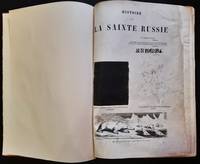
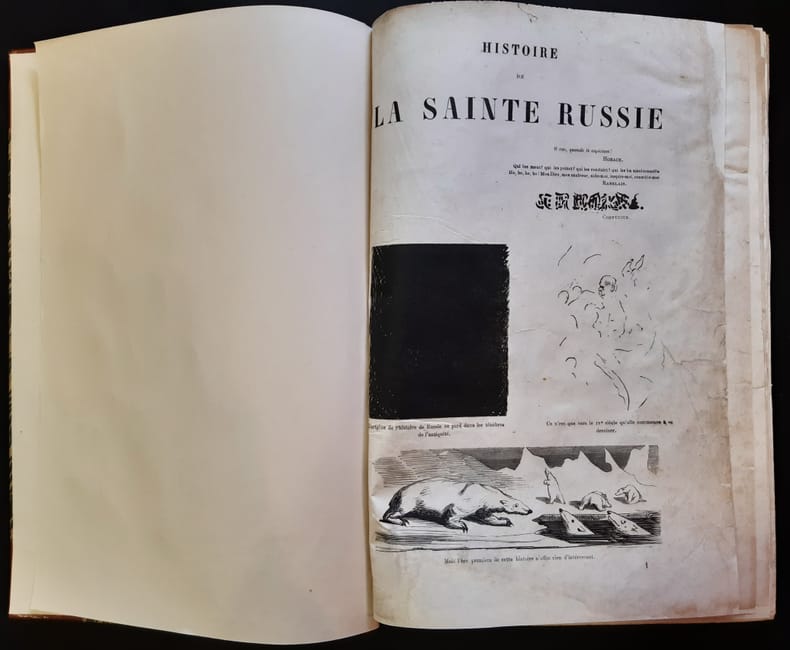
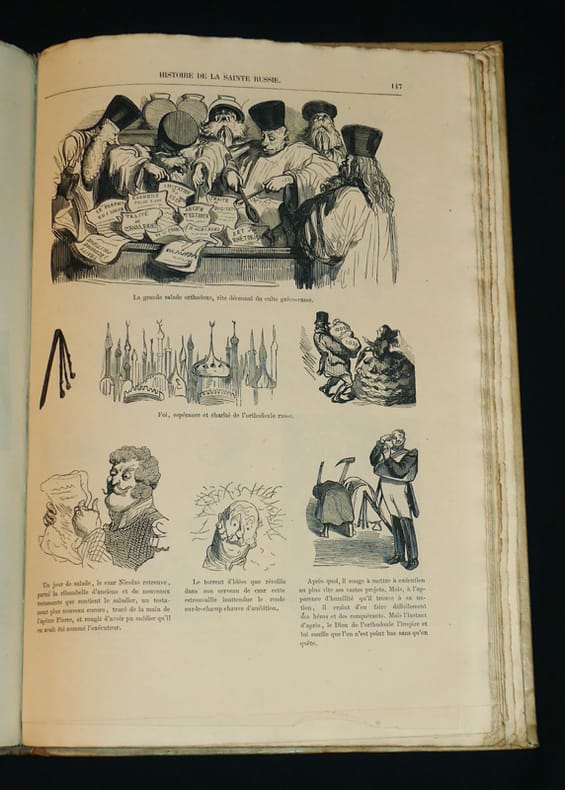
lom-MS001919In French. Short description: Gustave Dore. Histoire pittoresque dramatique et caricaturale de la sainte Russie. Paris: J. Bry aine 1854. The French painter Gustave Dor 1832-1883 is known to many primarily as an illustrator of the Bible and works of classical literature. However he was also a talented cartoonist. During the Crimean War when France together with Great Britain and the Ottoman Empire fought against Russia Dor like some other European artists of that era touched on the topic of anti-Russian propaganda in his work. In 1854 his book-album The History of Holy Rus' was published in Paris. It was an anti-Russian military pamphlet in graphic novel format. The album contains over 500 cartoons. All illustrations are provided with comments written by Dore himself. The History of Holy Rus' depicted Russia as a terrible country inhabited by crazy savages. The album was replete with all sorts of propaganda clichs negative clichs stereotypes and myths. The book showed the entire history of Russia from Rurik to the Crimean War in an acutely satirical vein. Dore paid especially close attention to the key figures of Russian history - Ivan the Terrible methodically destroying his own subjects and Peter the Great paving the way for reforms over the mountains of the corpses of his fellow citizens. However Nicholas I his domestic and foreign policy got the most of course. In the Russian Empire History of Holy Rus' for obvious reasons was immediately banned. For the first time as a separate edition in Russian it was published only in 2012. Please feel free to contact us for a detailed description of the copies available. SKUMS001919 unknown
lom-MS001919In French. Short description: Gustave Dore. Histoire pittoresque, dramatique et caricaturale de la sainte Russie. Paris: J. Bry aine, 1854. The French painter Gustave Dor? (1832-1883) is known to many primarily as an illustrator of the Bible and works of classical literature. However, he was also a talented cartoonist. During the Crimean War, when France, together with Great Britain and the Ottoman Empire, fought against Russia, Dor?, like some other European artists of that era, touched on the topic of anti-Russian propaganda in his work. In 1854, his book-album The History of Holy Rus' was published in Paris. It was an anti-Russian military pamphlet in graphic novel format. The album contains over 500 cartoons. All illustrations are provided with comments written by Dore himself. The History of Holy Rus' depicted Russia as a terrible country inhabited by crazy savages. The album was replete with all sorts of propaganda clich?s, negative clich?s, stereotypes and myths. The book showed the entire history of Russia from Rurik to the Crimean War in an acutely satirical vein. Dore paid especially close attention to the key figures of Russian history - Ivan the Terrible, methodically destroying his own subjects, and Peter the Great, paving the way for reforms over the mountains of the corpses of his fellow citizens. However, Nicholas I, his domestic and foreign policy, got the most, of course. In the Russian Empire, History of Holy Rus', for obvious reasons, was immediately banned. For the first time, as a separate edition in Russian, it was published only in 2012. Please feel free to contact us for a detailed description of the copies available. SKUMS001919
1854190121854 Paris, Au Bureau du Journal pour Rire, sans date (1854), in-4 oblong à l'italienne, de 26 cm x 33,5 cm, 1er plat de couverture conservée, imprimée sur papier glacé vert reproduisant le titre en lettes or (très frais), elle remplace la page de titre qui manque ici, 24 lithographies légendées à pleine page, rel. d'ép. de demi-chagrin brun foncé, dos lisse orné de larges filets à froid soulignés de filets dorés, sans la page de titre mais avec le 1er plat de couverture qui lui est exactement identique, mais imprimé or sur papier glacé vert, 2 légendes ont été coupés à la reliure, sinon bon ex. sans rousseurs.
1854es293J. Bry Ainé, éditeur Sélection Le Seanachi, Sélection Abraxas-libris Relié 1854 "EDITION ORIGINALE--LETTRE MANUSCRITE DE GUSTAVE DORE. ""Histoire dramatique, pittoresque et caricaturale de la sainte Russie, d'après les chroniqueurs et historiens Nestor, Nikan, Sylvestre, Karamsin, Ségur, etc. commentée et illustrée de 500 magnifiques gravures de Gustave Doré gravées sur bois par toute la nouvelle école sous la direction générale de Sotain, graveur de l'histoire de Russie, de batailles, de protraits, de paysages, de genre, de fleurs, d'animaux, de crustacés et de plantes rares"". Un volume in-4 (20,8 x 31 cm), reliure pleine toile beige de Behrends, dos lisse orné d'une pièce de titre et d'un fer estampé à froid, ex-libris de Maurice Decroix, couverture conservée, 207 pages imprimées uniquement au recto, la page 89 porte la tache rouge caractéristique de l'édition originale rare et recherchée de cet ouvrage satirique critiquant les menées de la Russie en Europe, notamment en Crimée, qui fut par la suite censuré par le gouvernement de Napoéon III en 1856. Il est aussi considéré comme la première bande dessinée française. Notre exemplaire est en outre doté d'une lettre manuscrite de Gustave Doré à son éditeur. ""Cher Monsieur, je vous prie de croire que je ne donnerais pas un dessin à un graveur sans que vous le vissiez et sans qu'il vous l' [apporte?]. Aussi je m'empresse de vous écrire pour vous exprimer mon étonnement de ce que M. Viand n'ait pas, comme je le lui ai recommandé expressément, été vous porter son bois. Il [demeure?] 133 avenue de Châtillon au Grand Montrouge. Vous aurez demain deux nouveaux dessins sans faute. Votre bien dévoué, Gustave Doré ; dos bruni, rousseurs et taches aux plats, manque dans le coin inférieur de la page 49 avec légère atteinte de quelques mots au texte et sans atteinte à l'illustration, par ailleurs intérieur frais et bien conservé, bel exemplaire. Livraison a domicile (La Poste) ou en Mondial Relay sur simple demande."
186084302Féchoz & Letouzey | Paris s. d. [1860] | 36 x 27.50 cm | relié