70 résultats
186947528Paris, 1869. 8vo. Contemporary green half cloth with gilt red leather title-label to spine. A bit of wear to extremities and title-label with wear. A bit of brownspotting to first and last leaves. VII, (1), 238 pp. Illustrated.
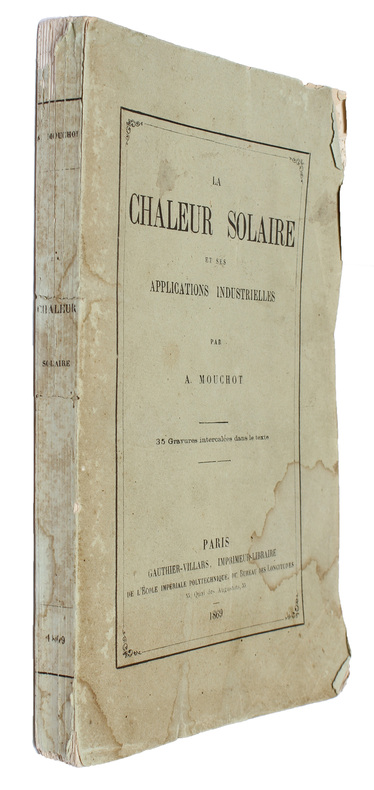
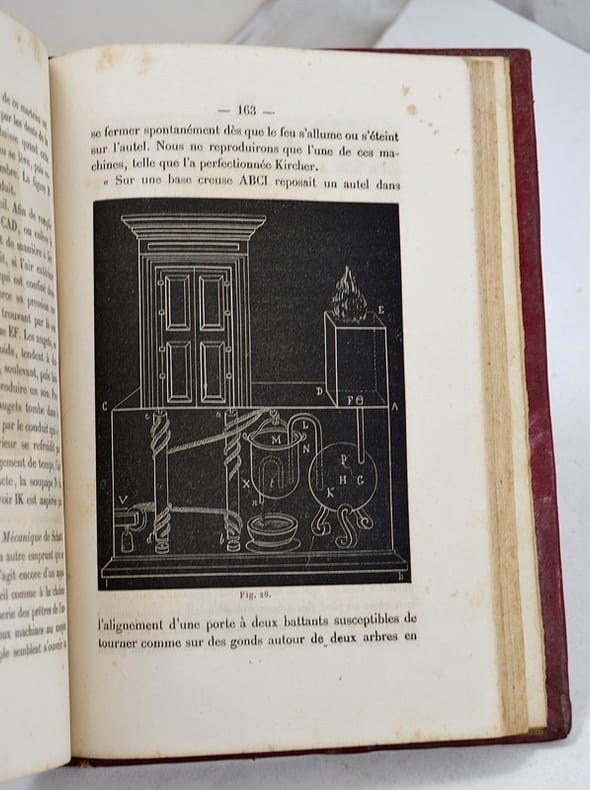
186947528Paris 1869. 8vo. Contemporary green half cloth with gilt red leather title-label to spine. A bit of wear to extremities and title-label with wear. A bit of brownspotting to first and last leaves. VII 1 238 pp. Illustrated. <br/><br/><em>Scarce first edition presentation-copy of the first book explicitly devoted to solar energy "Solar Energy and its Industrial Applications" which coincided with the unveiling of Mouchot's largest solar steam engine the so-called "Sun Engine" in 1869 which caused a revolution in the development of solar thermal power. His 1869 work constitutes a milestone of what we now call "green energy" as it laid the foundation for our understanding of the conversion of solar radiation into mechanical power driven by steam.The PRESENTATION-INSCRIPTION to the half-title reads: "a Monsieur Burdallot/ hommage de l'auteur/ A. Mouchot". Auguste Mouchot was a French mathematics teacher who in the 1860'ies became famous as the designer and patent-taker of the first machine that generated electricity with solar thermal energy electricity by the exposure of the sun. Mouchot began his work with solar energy in 1860 after expressing grave concerns about his country's dependence on coal. His work on solar energy and on the development of his sun machine forms the basis for the later developments on solar energy. "The work of Adams Ericsson and Shuman had been directly influenced by the solar conceptions of Augustin Mouchot a man who arrived on the scene in nineteenth century France at precisely that moment when his ideas were likely to attract the most attention. It was a time when French industrial might was at a peak and her leaders open to new ideas none more so than her emperor. In 1867 to commemorate the explosion of technology that had accompanied the industrial and artistic carnival over which he had presided for 15 years France's Napoleon III decided to invite the whole world to an international exposition that he would host in Paris." Kryza The Power of Light p. 147. "His initial experiments involved a glass-enclosed water-filled iron cauldron in which sunlight passed through a glass cover heating the water. This simple arrangement boiled water but it also produced small quantities of steam. Mouchot added a reflector to concentrate additional radiation onto the cauldron thus increasing the steam output. He succeeded in using his apparatus to operate a small conventional steam engine. Impressed by Mouchot's device Emperor Napoleon III offered financial assistance which Mouchot used to produce refinements to the energy system. Mouchot's work help lay the foundation for our current understanding of the conversion of solar radiation into mechanical power driven by steam.The publication of his book on solar energy "La Chaleur solaire et ses Applications industrielles" 1869 coincided with the unveiling of the largest solar steam engine he had yet built. This engine was displayed in Paris until the city fell under siege during the Franco-Prussian War in 1871 and was not found after the siege ended." The Energy Library. </em> hardcover
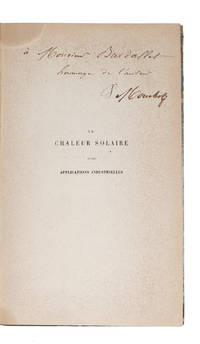
186949338Paris, 1869. 8vo. Uncut in the original printed wrappers. Wrappers frayed at edges, a bit soiled, and with some stains. A bit of brownspotting. Last leaves with a, mostly marginal, damp stain. First few leaves a bit frayed at edges. VII, (1), 238 pp. Illustrated.
186949338Paris 1869. 8vo. Uncut in the original printed wrappers. Wrappers frayed at edges a bit soiled and with some stains. A bit of brownspotting. Last leaves with a mostly marginal damp stain. First few leaves a bit frayed at edges. VII 1 238 pp. Illustrated. <br/><br/><em>Scarce first edition of the first book explicitly devoted to solar energy "Solar Energy and its Industrial Applications" which coincided with the unveiling of Mouchot's largest solar steam engine the so-called "Sun Engine" in 1869 which caused a revolution in the development of solar thermal power. His 1869 work constitutes a milestone of what we now call "green energy" as it laid the foundation for our understanding of the conversion of solar radiation into mechanical power driven by steam.Auguste Mouchot was a French mathematics teacher who in the 1860'ies became famous as the designer and patent-taker of the first machine that generated electricity with solar thermal energy electricity by the exposure of the sun. Mouchot began his work with solar energy in 1860 after expressing grave concerns about his country's dependence on coal. His work on solar energy and on the development of his sun machine forms the basis for the later developments on solar energy. "The work of Adams Ericsson and Shuman had been directly influenced by the solar conceptions of Augustin Mouchot a man who arrived on the scene in nineteenth century France at precisely that moment when his ideas were likely to attract the most attention. It was a time when French industrial might was at a peak and her leaders open to new ideas none more so than her emperor. In 1867 to commemorate the explosion of technology that had accompanied the industrial and artistic carnival over which he had presided for 15 years France's Napoleon III decided to invite the whole world to an international exposition that he would host in Paris." Kryza The Power of Light p. 147. "His initial experiments involved a glass-enclosed water-filled iron cauldron in which sunlight passed through a glass cover heating the water. This simple arrangement boiled water but it also produced small quantities of steam. Mouchot added a reflector to concentrate additional radiation onto the cauldron thus increasing the steam output. He succeeded in using his apparatus to operate a small conventional steam engine. Impressed by Mouchot's device Emperor Napoleon III offered financial assistance which Mouchot used to produce refinements to the energy system. Mouchot's work help lay the foundation for our current understanding of the conversion of solar radiation into mechanical power driven by steam.The publication of his book on solar energy "La Chaleur solaire et ses Applications industrielles" 1869 coincided with the unveiling of the largest solar steam engine he had yet built. This engine was displayed in Paris until the city fell under siege during the Franco-Prussian War in 1871 and was not found after the siege ended." The Energy Library. </em> unknown
187963860Paris, Gauthier-Villars, 1879, in-8, de VI, 294 pages et 2 planches repliées, demi-chagrin cerise à coins de l'époque, dos à nerfs, Seconde édition, augmentée par l'auteur, et pour la première fois illustrée de deux planches finales qui représentent le Grand générateur solaire industriel exposé lors de l'Exposition Universelle de 1878 dans le Parc du Trocadéro. La première planche en est la description technique, la seconde une mise en scène avec passants et visiteurs du temps. Mouchot fut le premier à s'intéresser de manière systématique à l'utilisation et à l'exploitation industrielle et humaine de l'énergie solaire. Bon exemplaire, Tampon de l'Institut catholique de Paris annulé. Couverture rigide
186912860Paris, Gauthier-Villars, 1869. 1 vol. in-8. Plein veau rouge, dos à nerfs orné, titre et auteur dorés.
187547456(Paris, Gauthier-Villars), 1875. 4to. The entire issue (vol. 81, nr. 14) of Comptes Rendus present. Unbound, and without wrappers. Very light brownspotting. Pp. 571-574. [Entire issue: pp. (545)- 604].
187547456Paris Gauthier-Villars 1875. 4to. The entire issue vol. 81 nr. 14 of Comptes Rendus present. Unbound and without wrappers. Very light brownspotting. Pp. 571-574. Entire issue: pp. 545- 604. <br/><br/><em>First printing of the paper in which Mouchot presents his seminal solar generator. Auguste Mouchot was a French mathematics teacher who in the 1860'ies became famous as the designer and patent-taker of the first machine that generated electricity with solar thermal energy electricity by the exposure of the sun. Mouchot began his work with solar energy in 1860 after expressing grave concerns about his country's dependence on coal. His work on solar energy and on the development of his sun machine forms the basis for the later developments on solar energy. "The work of Adams Ericsson and Shuman had been directly influenced by the solar conceptions of Augustin Mouchot a man who arrived on the scene in nineteenth century France at precisely that moment when his ideas were likely to attract the most attention. It was a time when French industrial might was at a peak and her leaders open to new ideas none more so than her emperor. In 1867 to commemorate the explosion of technology that had accompanied the industrial and artistic carnival over which he had presided for 15 years France's Napoleon III decided to invite the whole world to an international exposition that he would host in Paris." Kryza The Power of Light p. 147. "His initial experiments involved a glass-enclosed water-filled iron cauldron in which sunlight passed through a glass cover heating the water. This simple arrangement boiled water but it also produced small quantities of steam. Mouchot added a reflector to concentrate additional radiation onto the cauldron thus increasing the steam output. He succeeded in using his apparatus to operate a small conventional steam engine. Impressed by Mouchot's device Emperor Napoleon III offered financial assistance which Mouchot used to produce refinements to the energy system. Mouchot's work help lay the foundation for our current understanding of the conversion of solar radiation into mechanical power driven by steam.The publication of his book on solar energy "La Chaleur solaire et ses Applications industrielles" 1869 coincided with the unveiling of the largest solar steam engine he had yet built. This engine was displayed in Paris until the city fell under siege during the Franco-Prussian War in 1871 and was not found after the siege ended.In September 1872 Mouchout received financial assistance from the General Council of Indre-et-Loire to install an experimental solar generator at the Tours library. He presented a paper on the generator to the Academy of Sciences on 4 October 1875 and in December of the same year he presented to the Academy a device he claimed would in optimal sunshine provide a steam flow of 140 liters per minute. The Energy Library.Mouchot is the first author to write explicitly about solar energy and how to convert solar radiation into usable energy thus laying the foundation for what we now call "green energy". </em> unknown
187557118(Paris, Gauthier-Villars), 1875. 4to. No wrappers. In: ""Comptes Rendus Hebdomadaires des Séances de L'Academie des Sciences"", Tome 81, No 14. [Mouchot's paper:] Pp. 571-574. (Entire issue offered). (1), 546-604 pp. Clean and fine.
187557118Paris Gauthier-Villars 1875. 4to. No wrappers. In: "Comptes Rendus Hebdomadaires des Séances de L'Academie des Sciences" Tome 81 No 14. Mouchot's paper: Pp. 571-574. Entire issue offered. 1 546-604 pp. Clean and fine. <br/><br/><em>First printing of the paper in which Mouchot presents his seminal solar generator. Auguste Mouchot was a French mathematics teacher who in the 1860'ies became famous as the designer and patent-taker of the first machine that generated electricity with solar thermal energy electricity by the exposure of the sun. Mouchot began his work with solar energy in 1860 after expressing grave concerns about his country's dependence on coal. His work on solar energy and on the development of his sun machine forms the basis for the later developments on solar energy. "The work of Adams Ericsson and Shuman had been directly influenced by the solar conceptions of Augustin Mouchot a man who arrived on the scene in nineteenth century France at precisely that moment when his ideas were likely to attract the most attention. It was a time when French industrial might was at a peak and her leaders open to new ideas none more so than her emperor. In 1867 to commemorate the explosion of technology that had accompanied the industrial and artistic carnival over which he had presided for 15 years France's Napoleon III decided to invite the whole world to an international exposition that he would host in Paris." Kryza The Power of Light p. 147. "His initial experiments involved a glass-enclosed water-filled iron cauldron in which sunlight passed through a glass cover heating the water. This simple arrangement boiled water but it also produced small quantities of steam. Mouchot added a reflector to concentrate additional radiation onto the cauldron thus increasing the steam output. He succeeded in using his apparatus to operate a small conventional steam engine. Impressed by Mouchot's device Emperor Napoleon III offered financial assistance which Mouchot used to produce refinements to the energy system. Mouchot's work help lay the foundation for our current understanding of the conversion of solar radiation into mechanical power driven by steam.The publication of his book on solar energy "La Chaleur solaire et ses Applications industrielles" 1869 coincided with the unveiling of the largest solar steam engine he had yet built. This engine was displayed in Paris until the city fell under siege during the Franco-Prussian War in 1871 and was not found after the siege ended.In September 1872 Mouchout received financial assistance from the General Council of Indre-et-Loire to install an experimental solar generator at the Tours library. He presented a paper on the generator to the Academy of Sciences on 4 October 1875 and in December of the same year he presented to the Academy a device he claimed would in optimal sunshine provide a steam flow of 140 liters per minute. The Energy Library.Mouchot is the first author to write explicitly about solar energy and how to convert solar radiation into usable energy thus laying the foundation for what we now call "green energy". </em> unknown
1879341301879 Paris - Gauthier-Villars et Atelier de Constructions des appareils solaires - 1879 - 1 volume in8 de 294 pages - Reliure demi chagrin noir - Dos orné de fleurons - Déchirure avec petit manque de texte à l'angle supérieur droit de la page de titre - Rousseurs habituelles -
188416112100 dessins sur bois. Compositions de MM. BRUN - CHAPUIS - CICERI - GUYOT Clair - MOUCHOT.Gravure de F. MÉAULLE.Paris, Paul Ducrocq - non daté (1884) - xii et 492 pages.Reliure demi-chagrin brun de l'époque. Plats percaline brune. Dos à nerfs orné et doré. Tranches dorées. Pas de rousseur. Très bon état. Format in-8°(27x18).
1989BN145047Action Culturelle Municipale 1989. 1989. Softcover. Le Musée d'archéologie Nice-Cimiez <br/><br/>Le Musée d'archéologie Nice-Cimiez Danièle Mouchot Action Culturelle Municipale paperback
188755052Les Plaies et les Baumes, 1 vol. in-8 reliure de l'époque demi-basane bordeaux, Auguste Ghio, Paris, 1887, 2 ff., VI-123 pp.
6017in 8 broché,faux-titre,titre,179 pages,non coupé,Paris Gauthier Villars et fils libraires imprimeurs 1892 très pâle mouillures sur le premier plat de couverture,sans gravité,édition originale.
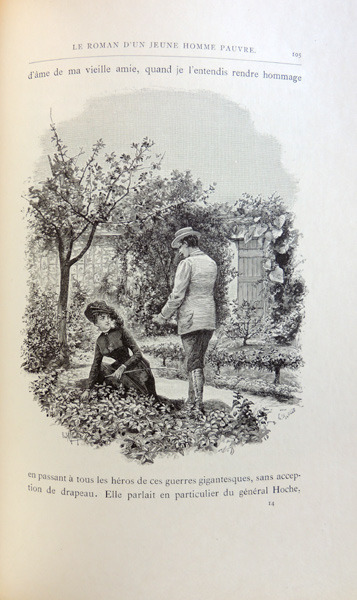
12900Maison Quantin Collection Calmann Lévy, Paris, s.d., in-4 broché, couverture rempliée illustrée en couleurs par Mouchot 1887, 227pp. Tâche brune au dos de la couverture, dos légèrement frotté. Portrait frontispice sous serpente de l'auteur gravé par E. Wallet en deux états. 35 in-texte et 11 hors-texte dessinés par Mouchot et gravés par Méaulle en noir et blanc. Tirage à 100 exemplaires, tous numérotés sur Japon, le notre est le n°3. Intérieur très frais. Bon état.
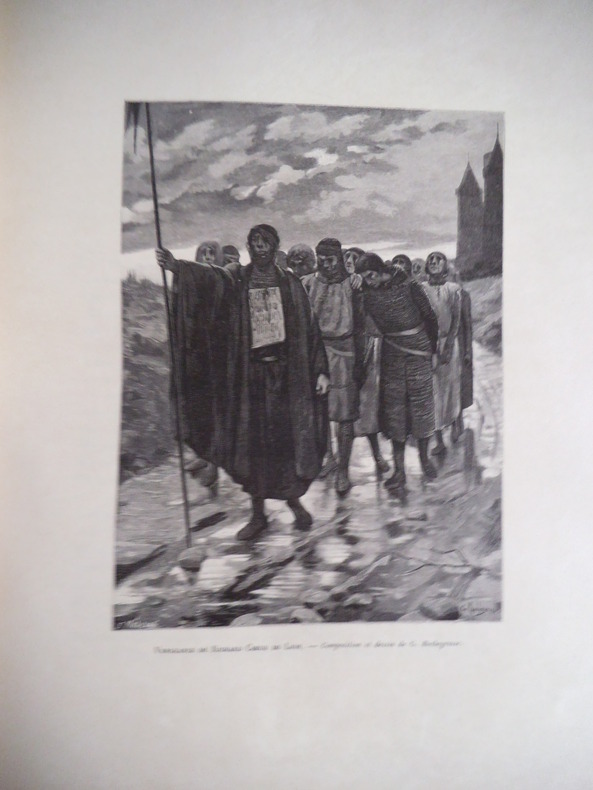
5885Grand in 4 demi-toile à la bradel et à coins,titre,fer, filet dorés.Titre,315 pages,sur beau papier vergé,60 illustrations hors-texte,sous serpente,sur beau papier( façon papier japon)par Grasset,Rochegrosse,Moreau,Georges Cain,Delort,Mouchot,Flameng,Luc Olivier Merson,Cormon, Laurens.Gravure exécutée par M. MEAULLE.Armand Colin & Cie éditeur 1891,couverture conservée.Très bon état
19203235Paris, Ernest Flammarion, 1920. In-4 broché de 204-[2] pages, couverture illustrée à larges rabats. Très bel état, à part un nom de possesseur sur garde.
594089Paris, Quantin, [vers 1885]. In-4, rel. demi-maroquin à coins marine de l'époque, dos à cinq nerfs ornés à la roulette dorée, caissons dorés fleuronnés, tête dorée, couverture illustrée en couleurs conservée ; [3] ff., 227 pp., [1] f., illustrations gravées sur bois dans le texte, certaines à pleine page, portrait de l'auteur à l'eau-forte en frontispice.
18873183Paris Maison Quantin 1887 In-4 ( cm.) 227 pp. plein maroquin prune, dos lisse, étui. Un des 100 exemplaires sur japon. Le portrait de l'auteur en frontispice est en double état, dont celui avant la lettre. Nombreuses illustrations dans le texte et hors texte gravées en noir.
201625714Editions Connaître Chott / Documents pour l'Histoire de la BD 2016. In-8 cartonnage éditeur non paginé au format 21,5 x 30,5 cm. Couverture de Laurent Lefuvre. Restauration et lettrage par Reed Man. Dos toilé rouge avec titre et numérotation en jaune. Tome 6 de l'intégrale de Fantax, le Gentleman Fantôme qui contient les numéros 6 à 9 de la nouvelle série, avec Rémy au dessin sauf pour le 9 puis les numéros 1 à 5 de " Reportages Sensationnels ", publiés en 1951. Fascicules en fac-similés avec couvertures reproduites. Couvertures et illustrations de Pierre Mouchot sous le pseudonyme de Chott et de Rémi Bordelet sous le pseudonyme de Rémy. Scénarios de Chott sous pseudonyme de Lord Neighbour. Livre édité par le petit-fils de Chott, Tanguy Mouchot. Dossier avec photos et illustrations en début de BD par Jean Depelley. Reproduction des couvertures des fascicules au 4ème plat. Edition originale collective, tirée à 800 exemplaires. Etat proche du neuf. Exemplaire orné d'une dédicace autographe, signée, de Tanguy Mouchot.
2274Paris Eugène Hugues In-4 (32,5 x 22 cm.) 288 pp. couverture conservée, demi-reliure à coins, maroquin brun, dos à nerfs, , tête dorée, non rogné.
25711Editions Connaître Chott / Documents pour l'Histoire de la BD 2012. In-8 cartonnage éditeur non paginé au format 21,5 x 30,5 cm. Couverture de Jean-Yves Mitton. Restauration et lettrage par Reed Man. Dos toilé rouge avec titre et numérotation en jaune. Tome 3 de l'intégrale de Fantax, le Gentleman Fantôme qui contient les aventures 17 à 24 de Fantax. Fascicules en fac-similés avec couvertures reproduites. Couvertures et illustrations de Pierre Mouchot sous le pseudonyme de Chott. Scénarios de Marcel Navarro sous le pseudonyme de J.K. Melwyn-Nash. Livre édité par le petit-fils de Chott, Tanguy Mouchot. Dossiers avec photos et illustrations en début et fin de BD par Tanguy Mouchot et Bernard Joubert. Reproduction des couvertures des fascicules au 4ème plat. Edition originale collective, tirée à 1000 exemplaires. Etat proche du neuf.
25712Editions Connaître Chott / Documents pour l'Histoire de la BD 2013. In-8 cartonnage éditeur non paginé au format 21,5 x 30,5 cm. Couverture de Ciro Tota. Restauration et lettrage par Reed Man. Dos toilé rouge avec titre et numérotation en jaune. Tome 4 de l'intégrale de Fantax, le Gentleman Fantôme qui contient les aventures 25 à 32 de Fantax. Fascicules en fac-similés avec couvertures reproduites. Couvertures et illustrations de Pierre Mouchot sous le pseudonyme de Chott. Scénarios de Marcel Navarro sous le pseudonyme de J.K. Melwyn-Nash. Livre édité par le petit-fils de Chott, Tanguy Mouchot. Dossiers avec photos et illustrations en début et fin de BD par Hubert " Cleet Boris " Mounier et Danièle Mouchot. Reproduction des couvertures des fascicules au 4ème plat. Edition originale collective, tirée à 1000 exemplaires. Etat proche du neuf.
25713Editions Connaître Chott / Documents pour l'Histoire de la BD 2015. In-8 cartonnage éditeur non paginé au format 21,5 x 30,5 cm. Couverture de Robert Rocca et Reed Man. Restauration et lettrage par Reed Man. Dos toilé rouge avec titre et numérotation en jaune. Tome 5 de l'intégrale de Fantax, le Gentleman Fantôme qui contient les aventures 33 à 39 de Fantax puis les numéros 1 à 4 de la nouvelle série, avec Rémy au dessin. Fascicules en fac-similés avec couvertures reproduites. Couvertures et illustrations de Pierre Mouchot sous le pseudonyme de Chott et Robert Rocca, puis de Rémi Bordelet sous le pseudonyme de Rémy. Scénarios de Chott sous pseudonyme de Lord Neighbour. Livre édité par le petit-fils de Chott, Tanguy Mouchot. Dossier avec photos et illustrations en début de BD par Robert Rocca. Reproduction des couvertures des fascicules au 4ème plat. Edition originale collective, tirée à 800 exemplaires. Etat proche du neuf.