Francis, SimeonBiblio.com

2 159 résultats
0666340285.Ghardcover. Good. Access codes and supplements are not guaranteed with used items. May be an ex-library book. hardcover
62181039Harvard University Press 161 76 of lates . Hardback. New. Harvard University Press hardcover
0656900709.Ghardcover. Good. Access codes and supplements are not guaranteed with used items. May be an ex-library book. hardcover
3030411524.Gpaperback. Good. Access codes and supplements are not guaranteed with used items. May be an ex-library book. paperback
45150229like new. unknown
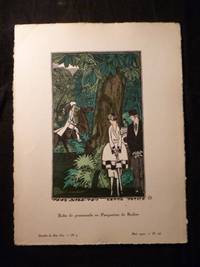
192039027Paris: Lucien Vogel éditeur 1920. Fine. Lucien Vogel éditeur Paris 1920 19.50 x 25 cm une feuille Original color print printed on vergé paper the signature does not let identify the artist. An original print used to illustrate the Gazette du bon ton one of the most attractive and influential 20th century fashion magazines featuring the talents of French artists and other contributors from the burgeoning Art Deco movement. A celebrated fashion magazine established in 1912 by Lucien Vogel La Gazette du bon ton appeared until 1925 with a hiatus from 1915 to 1920 due to the war the editor-in-chief having been called up for service. It consisted of 69 issues printed in only 2000 copies each and notably illustrated with 573 color plates and 148 sketches of the models of the great designers. Right from the start this sumptuous publication was aimed at bibliophiles and fashionable society Françoise Tétart-Vittu La Gazette du bon ton in Dictionnaire de la mode 2016 and was printed on fine vergé paper using a type cut specially for the magazine by Georges Peignot known as Cochin later used in 1946 by Christian Dior. The prints were made using stencils heightened in colors some highlighted in gold or palladium. The story began in 1912 when Lucien Vogel a man of the world involved in fashion he had already been part of the fashion magazine Femina decided with his wife Cosette de Brunhoff the sister of Jean creator of Babar to set up the Gazette du bon ton subtitled at the time: Art fashion frivolities. Georges Charensol noted the reasoning of the editor-in-chief: In 1910 he observed there was no really artistic fashion magazine nothing representative of the spirit of the time. My dream was therefore to make a luxury magazine with truly modern artists I was assured of success because when it comes to fashion no country on earth can compete with France. Un grand éditeur dart. Lucien Vogel in Les Nouvelles littéraires no. 133 May 1925. The magazine was immediately successful not only in France but also in the United States and Latin America. At first Vogel put together a team of seven artists: André-Édouard Marty and Pierre Brissaud followed by Georges Lepape and Dammicourt as well as eventually his friends from school and the School of Fine Arts like George Barbier Bernard Boutet de Monvel and Charles Martin. Other talented people soon came flocking to join the team: Guy Arnoux Léon Bakst Benito Boutet de Monvel Umberto Brunelleschi Chas Laborde Jean-Gabriel Domergue Raoul Dufy Édouard Halouze Alexandre Iacovleff Jean Émile Laboureur Charles Loupot Chalres Martin Maggie Salcedo. These artist mostly unknown when Lucien Vogel sought them out later became emblematic and sought-after artistic figures. It was also they who worked on the advertising drawings for the Gazette. The plates put the spotlight on and celebrate dresses by seven designers of the age: Lanvin Doeuillet Paquin Poiret Worth Vionnet and Doucet. The designers provided exclusive models for each issue. Nonetheless some of the illustrations are not based on real models but simply on the illustrators conception of the fashion of the day. The Gazette du bon ton was an important step in the history of fashion. Combining aesthetic demands with the physical whole it brought together for the first time the great talents of the artistic literary and fashion worlds; and imposed through this alchemy a completely new image of women: slender independent and daring which was shared by the new generation of designers including Coco Chanel Jean Patou Marcel Rochas and so on Taken over in 1920 by Condé Montrose Nast the Gazette du bon ton was an important influence on the new layout and aesthetics of that little dying paper that Nast had bought a few years earlier: Vogue. Lucien Vogel éditeur unknown
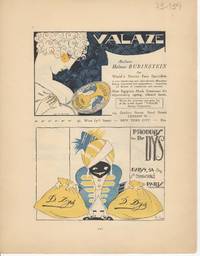
192073139Paris: Lucien Vogel éditeur 1920. Fine. Lucien Vogel éditeur Paris 1920 18 x 24 cm une feuille Original color print advertising the Verlaine shop printed on laid paper. Two advertising vignettes on the reverse about Valaze and Dr Dys products. Original engraving created for the illustration of La Gazette du bon ton one of the most beautiful and influential fashion magazines of the 20th century celebrating the talent of French creators and artists in the full bloom of art deco. Famous fashion magazine founded in 1912 by Lucien Vogel La Gazette du bon ton appeared until 1925 with an interruption during the War from 1915 to 1920 due to the mobilization of its editor-in-chief. It consists of 69 issues printed in only 2000 copies and is illustrated notably with 573 color plates and 148 sketches representing models by great couturiers. From their publication these luxurious publications ""address bibliophiles and worldly aesthetes"" Françoise Tétart-Vittu ""La Gazette du bon ton"" in Dictionnaire de la mode 2016. Printed on fine laid paper they use a typeface specially created for the magazine by Georges Peignot the Cochin character adopted in 1946 by Christian Dior. The prints are created using the metallic stencil technique heightened in colors and some outlined in gold or palladium. The adventure begins in 1912 when Lucien Vogel man of the world and fashion - he had already participated in the magazine Femina - decides to found with his wife Cosette de Brunhoff sister of Jean father of Babar the Gazette du bon ton whose subtitle was then ""Art modes et frivolités"". Georges Charensol reports the words of the editor-in-chief: ""In 1910 he observes there existed no fashion journal truly artistic and representative of the spirit of its time. I was therefore thinking of making a luxury magazine with truly modern artists . I was certain of success because for fashion no country can rival France."" ""Un grand éditeur d'art. Lucien Vogel"" in Les Nouvelles littéraires n°133 May 1925. The success of the magazine is immediate not only in France but also in the United States and South America. Originally Vogel thus brings together a group of seven artists: André-Édouard Marty and Pierre Brissaud followed by Georges Lepape and Dammicourt; and finally his friends from the École des beaux-arts who are George Barbier Bernard Boutet de Monvel or Charles Martin. Other talents quickly come to join the team: Guy Arnoux Léon Bakst Benito Boutet de Monvel Umberto Brunelleschi Chas Laborde Jean-Gabriel Domergue Raoul Dufy Édouard Halouze Alexandre Iacovleff Jean Émile Laboureur Charles Loupot Charles Martin Maggie Salcedo. These artists unknown for the most part when Lucien Vogel calls upon them will subsequently become emblematic and sought-after artistic figures. These are the same illustrators who create the drawings for the advertisements of the Gazette. The plates highlight and sublimate the dresses of seven creators of the time: Lanvin Doeuillet Paquin Poiret Worth Vionnet and Doucet. The couturiers provide exclusive models for each issue. Nevertheless some of the illustrations feature no real model but only the idea that the illustrator has of the fashion of the day. La Gazette du bon ton is a decisive step in the history of fashion. Combining aesthetic requirements and plastic unity it brings together for the first time the great talents of the world of arts letters and fashion and imposes through this alchemy a completely new image of woman slender independent and audacious also carried by the new generation of couturiers Coco Chanel Jean Patou Marcel Rochas. Taken over in 1920 by Condé Montrose Nast the Gazette du bon ton will largely inspire the new composition and aesthetic choices of the ""small dying journal"" that Nast had bought a few years earlier: Vogue magazine. Lucien Vogel éditeur unknown
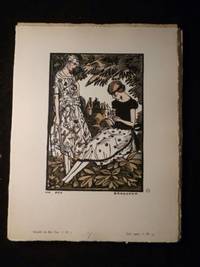
192039039Paris: Lucien Vogel éditeur 1920. Fine. Lucien Vogel éditeur Paris 1920 19.50 x 25 cm une feuille Original color print printed on vergé paper signed in the plate. An original print used to illustrate the Gazette du bon ton one of the most attractive and influential 20th century fashion magazines featuring the talents of French artists and other contributors from the burgeoning Art Deco movement. A celebrated fashion magazine established in 1912 by Lucien Vogel La Gazette du bon ton appeared until 1925 with a hiatus from 1915 to 1920 due to the war the editor-in-chief having been called up for service. It consisted of 69 issues printed in only 2000 copies each and notably illustrated with 573 color plates and 148 sketches of the models of the great designers. Right from the start this sumptuous publication was aimed at bibliophiles and fashionable society Françoise Tétart-Vittu La Gazette du bon ton in Dictionnaire de la mode 2016 and was printed on fine vergé paper using a type cut specially for the magazine by Georges Peignot known as Cochin later used in 1946 by Christian Dior. The prints were made using stencils heightened in colors some highlighted in gold or palladium. The story began in 1912 when Lucien Vogel a man of the world involved in fashion he had already been part of the fashion magazine Femina decided with his wife Cosette de Brunhoff the sister of Jean creator of Babar to set up the Gazette du bon ton subtitled at the time: Art fashion frivolities. Georges Charensol noted the reasoning of the editor-in-chief: In 1910 he observed there was no really artistic fashion magazine nothing representative of the spirit of the time. My dream was therefore to make a luxury magazine with truly modern artists I was assured of success because when it comes to fashion no country on earth can compete with France. Un grand éditeur dart. Lucien Vogel in Les Nouvelles littéraires no. 133 May 1925. The magazine was immediately successful not only in France but also in the United States and Latin America. At first Vogel put together a team of seven artists: André-Édouard Marty and Pierre Brissaud followed by Georges Lepape and Dammicourt as well as eventually his friends from school and the School of Fine Arts like George Barbier Bernard Boutet de Monvel and Charles Martin. Other talented people soon came flocking to join the team: Guy Arnoux Léon Bakst Benito Boutet de Monvel Umberto Brunelleschi Chas Laborde Jean-Gabriel Domergue Raoul Dufy Édouard Halouze Alexandre Iacovleff Jean Émile Laboureur Charles Loupot Chalres Martin Maggie Salcedo. These artist mostly unknown when Lucien Vogel sought them out later became emblematic and sought-after artistic figures. It was also they who worked on the advertising drawings for the Gazette. The plates put the spotlight on and celebrate dresses by seven designers of the age: Lanvin Doeuillet Paquin Poiret Worth Vionnet and Doucet. The designers provided exclusive models for each issue. Nonetheless some of the illustrations are not based on real models but simply on the illustrators conception of the fashion of the day. The Gazette du bon ton was an important step in the history of fashion. Combining aesthetic demands with the physical whole it brought together for the first time the great talents of the artistic literary and fashion worlds; and imposed through this alchemy a completely new image of women: slender independent and daring which was shared by the new generation of designers including Coco Chanel Jean Patou Marcel Rochas and so on Taken over in 1920 by Condé Montrose Nast the Gazette du bon ton was an important influence on the new layout and aesthetics of that little dying paper that Nast had bought a few years earlier: Vogue. Lucien Vogel éditeur unknown
0364316497.Ghardcover. Good. Access codes and supplements are not guaranteed with used items. May be an ex-library book. hardcover
20192-613842820XEditions universitaires europeennes EUE 2019. Paperback. New. French language. 8.66x5.94x0.28 inches. Editions universitaires europeennes EUE paperback
1165223481.Ghardcover. Good. Access codes and supplements are not guaranteed with used items. May be an ex-library book. hardcover
1437406807.Ghardcover. Good. Access codes and supplements are not guaranteed with used items. May be an ex-library book. hardcover
1120745373.Gpaperback. Good. Access codes and supplements are not guaranteed with used items. May be an ex-library book. paperback
0332855112.Ghardcover. Good. Access codes and supplements are not guaranteed with used items. May be an ex-library book. hardcover
0483394041.Ghardcover. Good. Access codes and supplements are not guaranteed with used items. May be an ex-library book. hardcover
0266440126.Ghardcover. Good. Access codes and supplements are not guaranteed with used items. May be an ex-library book. hardcover
2013SONG3642351573Springer 2013-06-26. 2013. paperback. Used: Good. 6.10x0.60x9.25. Buy with confidence. Excellent Customer Service & Return policy. Springer paperback
2010DADAX1556527837Brand: Chicago Review Press 2010-01-01. hardcover. New. 5.75x1.00x8.75. Buy with confidence. Excellent Customer Service & Return policy. Brand: Chicago Review Press hardcover
0483067156.Ghardcover. Good. Access codes and supplements are not guaranteed with used items. May be an ex-library book. hardcover
ria9786207309115_inpPaperback. New. New Book; Fast Shipping from UK; Not signed; Not First Edition; Our African societies are undergoing major demographic and economic changes and are faced with numerous environmental challenges such as the invasion of the environment by solid waste. Faced with these environmental challenges the ai paperback
61420579World Scientific Publishing Company Incorporated pp. xv 127 . Hardback. Used. World Scientific Publishing Company, Incorporated hardcover
1996DADAX0801090164Brand: Baker Pub Group 1996-01-01. paperback. New. 6.25x1.25x9.00. Buy with confidence. Excellent Customer Service & Return policy. Brand: Baker Pub Group paperback
3368132229.Gpaperback. Good. Access codes and supplements are not guaranteed with used items. May be an ex-library book. paperback
0483428973.Ghardcover. Good. Access codes and supplements are not guaranteed with used items. May be an ex-library book. hardcover
1528188241.Ghardcover. Good. Access codes and supplements are not guaranteed with used items. May be an ex-library book. hardcover