11 résultats
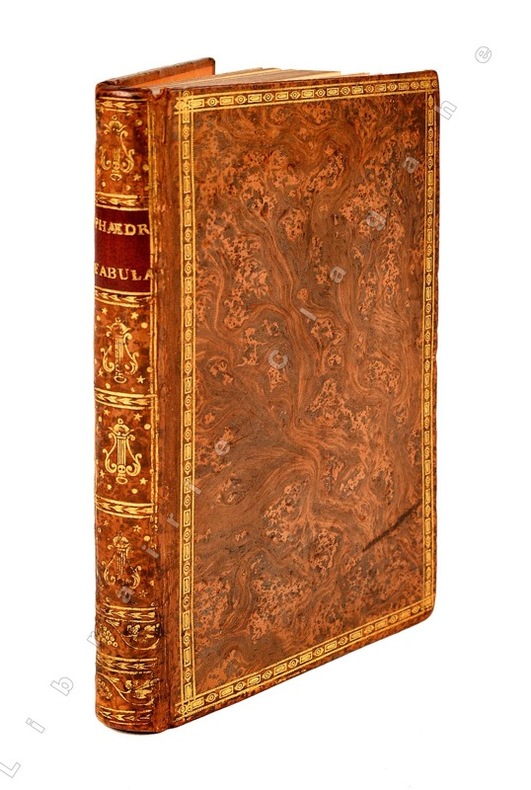
172821085A Amsterdam, chez R. & J. Wetstein, & G. Smith, 1728. 2 tomes in-12 en un volume de 210; 153-[3] pages, plein veau brun, dos à nerfs orné de filets et fleurons dorés, pièce de titre beige, tranches rouges.
1776280QUA1776 1776 escrites en Grec par Longus et translatées en Français par Jacques Amyot. Bouillon; de l 'imprimerie typographique. 1776. 1 volume in 12 . gd de marges, plein chagrin rouge; dos à 5 nerfs orné de caissons et fleurons dorés; date en pied du dos; plats décorés d 'un encadrement de filets dorés; tête dorée; gardes encadrées de filets dorés et roulettes dorées; reliure fin XIX ème. xij + 207 pp. frontispice de Coypel et 29 gravures H.T, d 'après Phillipus; gravures de Vidal, certaines à double page. Bien complet de la dernière gravure dites " aux petits pieds " qui est attribuée au Comte de Caylus. TRES BEL EXEMPLAIRE.
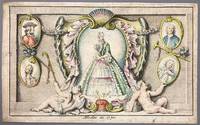
1730005802Paris: Mercure de France 1730. First Edition First Printing. Etching and Engraving. Very Good. Intaglio. Etching and engraving with fine hand coloring; print on laid paper; dimensions of print: 26 cm x 16 cm. By Caylus after a composition by Charles Antoine Coypel depicting a woman in a pannier dress. Subject matter: Woman in pannier dress with two accompanying putti lounging below her and 4 oval vignettes depicting two gentleman and two ladies one per oval. Published in the October 1730 issue of the Mercure de France. Scarce especially with the fine hand coloring. Condition of print: Very good at least; some dustiness a tiny pinhole visible only when holding the print up to the light. Mercure de France unknown
174221423Parisiis, apud Coustelier, 1742 ; in-12, veau raciné, dos lisse à faux nerfs dorés, fleurons à la lyre, palette à la grappe de raisins, pièce de titre rouge, belle roulette d’encadrement et roulette sur les coupes, tranches dorées, gardes oranges (reliure de l’époque) ; [24], 132 pp., frontispice de Coypel gravé par Fessard, bandeau répété cinq fois, par Pierre, gravé par Fessard.
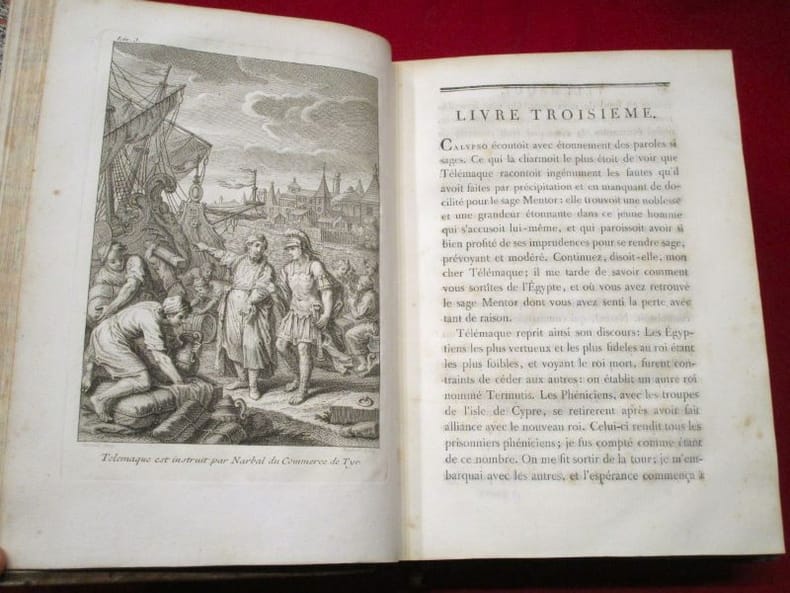
1787117068Didot (aîné) 1787 9 in-4 A Paris, De l'Imprimerie de Franç.-Amb. (François Ambroise) Didot, 1787, 9 volumes in-4 de 195x260 mm, 771 - 728 - 697 - 350 - 623, XXIV - 569 - 567 - 587 - 531 pages, (6) ff. (Table), complet des 2 portraits en frontispice par St. Aubin d'après Vivien et le volume de Télémaque contient 24 planches (d'après Souville, Coypel, Cazes, Humblot gravées par Favanne, Scotin, Haussart, Lebas, Dupuy, Beauvais, Pacquois). Plein cuir granité, dos lisses portant titres et tomaisons dorés sur pièces de cuir rouge et vert bouteille, fers dorés, large roulette dorée en encadrement sur les plats, doubles filets dorés sur les coupes, tranches jaspées, gardes de beau papier marbré caillouté. Bel ensemble malgré les défauts de reliure (3 coiffes manquantes, certaines arasées, coins et mors frottés, rares et discrets trous de vers, mors interne restauré au tome 4), ex-libris papier sur les contregardes, certains feuillets brunis (particulièrement tome 7) ou avec rousseurs mais intérieur frais en général.
17463897In’s Hage, By Pieter de Hondt, 1746. In-4 de XXVI, 420 p. Plein vélin ivoire, dos à nerfs, plats encadrés à froid et ornés d’un médaillon central à froid. Manque au dos, mors fendus, intérieur en bel état.
1746163900Pierre de Hondt A La Haie (La Haye), chez Pierre de Hondt, 1746. In-4 relié plein veau de l'époque, dos à nerfs très orné, pièce de titre de maroquin rouge, triples filets d'encadrement sur les plats, gardes de papier marbré, toutes tranches dorées. VIII + 330 pages + 2 pages pour l'avis au relieur. Exemplaire bien complet des 31 gravures hors-texte, avant les numéros dont 25 par Charles Antoine COYPEL et bandeau gravé en tête d'ouvrage par Jacob Van der SCHLEY daté 1746. Manque de cuir à la coiffe et en queue, mors du premier plat fragilisé et partiellement fendu, frottements à la reliure, coins émoussés, des rousseurs parfois importantes, papier bruni à plusieurs pages. Les gravures sont en bel état, de belle qualité, même si quelques unes présentent des rousseurs ou brunissures en marge. Malgré les défauts signalés, dont notre prix tient compte, reste un exemplaire correct.
172312287Paris, Chez Pierre-Louis Surugue, 1723-1724. 1 vol. grand in-folio. Demi-chagrin brun à coins, titre doré sur le premier plat, dos lisse, tranches dorées. Gravures à la cuvette de 31,5 x 30,7 cm sur des feuillets de 52,8 x 39,5 cm.
17460044741746 La Haie, Pierre de Hondt, 1746. In-quarto (274 X 232 mm) veau blond, encadrement de double filet à froid sur les plats, dos six nerfs orné de larges roulettes et fleurons dorés, tranches rouges (Reliure de l'époque) ; VIII-330 pages, (1) f. d'avis au relieur, 31 planches hors-texte. Ex-libris gravé « Caroli ducis Brunsvicensium et Luneburgensium » collé au premier contreplat. Petite tache d'encre noire en marge de la page de titre et du premier feuillet blanc, décharge des gravures sur le feuillet de texte en regard.
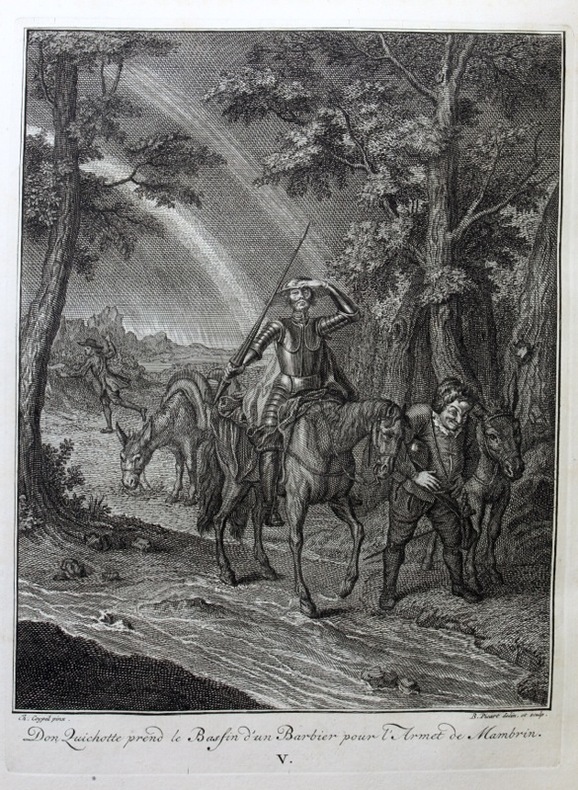
17461669411746. CERVANTES. Les Principals Aventures de Don Quichote. Complete suite of 31 plates 1 headpiece and 1 vignette by Coypel Picart et al. some mounted on strong paper. Folio 368 x 252 mm bound in nineteenth-century French red half morocco over embossed paper boards embossed white endpapers. The Hague: De Hondt 1746. A rare suite in first issue of the Coypel-Picart engravings produced to illustrate Cervantes text of 1746. The original paintings by Charles Coypel 1694-1752 illustrating Don Quixote now hanging at Compiègne-French Royal residence of Louis XV are considered his greatest works; the paintings were first reproduced in a large-folio suite of 25 prints issued in Paris in 1723. The above volume belongs to the reduced format edition issued in 1746 by De Hondt French and Dutch texts were available. This project was begun by Picart who died in 1733 necessitating the participation of Schley. Twenty five plates were executed after Coypel's designs; the others were after Boucher Cochin Le Bas and Tremolière. "It is not too much to say that the pictorial tradition associated with Cervantes' masterpiece owes as much to Coypel as to any other artist" Ray p. 13. PROVENANCE: Lenormand du Coudray 1712-1789 famed Orléans print-collector to whom Lugt nos. 1704-1706 devotes more than a column. Lugt's assertion that Lenormand du Coudray affixed his signature to the verso of nearly every print he owned holds true in the present volume: each plate is elaborately inscribed with his monogram and date of acquisition "2 Feb. 1756" i.e. only ten years after they were published. It makes sense that Lenormand du Coudray would purchase the suite without text as he was interested in graphic art and further they are consecutively numbered by him in contemporary MS. Ashbee Iconography of Don Quixote no. 43. Ray French no. 4 error in collation: the "frontispiece" is a ghost. hardcover books
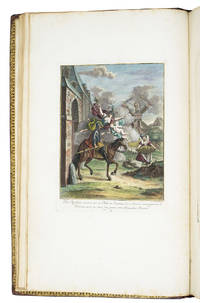
1746M2HB4ES5PXB4The Hague: Pieter de Hondt 1746. Contemporary richly gold-tooled dark red morocco by the so-called Van Damme bindery in Amsterdam sewn on 7 supports each board with Van Dammes typical hourglass- or vase- or flask-shaped central cartouche with a starry sky on a black ground here showing a short-stemmed chalice or goblet with fire or flame-like leaves like a snake plant Dracaena trifasciata in the cartouche and a basket of flowers topping the cartouche the whole in an elaborate frame built up from hundreds of impressions of numerous small tools the spine-title in gold on a black ground in the 2nd of 8 compartments each of the other 7 with flowers other decorations and a small flower in a pot gilt edges. With a tissue guard-leaf before each plate. Large folio 42 x 27 cm. Title in red and black with an engraved vignette Quixote and the windmill and 31 engraved illustration plates all coloured by a contemporary hand heightened with gold and set in in a gilt frame. Further with large woodcut initials and tailpieces and each text page in an ornamental frame built up from typographic ornaments the frames not in the 4to issue. Very rare large-paper copy of the first and only edition of a "free and joyous" Dutch translation of Cervantes's Don Quixote with 31 rococo style plates in spectacular contemporary hand colouring and with gold highlights. The plates have been engraved by leading Dutch artists Bernard Picart 12 Jacob van der Schley 13 Pierre Tanjé 5 and Simon Fokke 1 after paintings by leading French artists Antoine Coypel 25 Charles-Nicolas Cochin 2 Pierre-Charles Trémolières 2 François Boucher 1 and Jacques-Philippe le Bas 1. The impressions are crisp and the hand colouring is bright and of the highest quality with subtly graded tones and highlights in gold. Antoine Coypel 1694-1752 responsible for the design of most of the illustrations was one of the most important French history painters of the early 18th century. His Don Quixote paintings are highlights in his oeuvre and can be found in several museum collections.The Dutch edition was translated by Jacob Campo Weyerman 1677-1747 one of the foremost Dutch authors of the Enlightenment who was known for his merry style. He added to this edition a Dutch translation of the biography of Cervantes by Gregorio Mayans 1737 and explanatory texts to the plates. De Hondt issued the present edition in at least three formats: 4to folio on ordinary paper and folio on large paper. The present copy is the large-paper folio issue which is indeed very rare: several libraries have folio editions on ordinary paper usually about 35 cm tall but we have not located a copy of the large folio issue in any library. The only other large-paper copy we have been able to trace is slightly smaller.Cervantes's Don Quixote first published in Spanish 1605-1615 was first translated into Dutch in the early 17th century and went through several editions until 1732. Engraved prints after Coypel's famous Don Quixote paintings started circulating in 1734. De Hondt took this opportunity to publish a new Dutch translation with the Coypel illustrations and some others. He asked Weyerman who was already a famous writer but was imprisoned for slander to translate the text. He also commissioned new plates after Coypels paintings from the leading Dutch engravers. This came together in what became a masterpiece of rococo book production and the present hand-coloured copy of the large folio issue is the outstanding result.The Van Damme bindery was the "most important Amsterdam workshop of the 18th century" and is praised for the "high quality of its work" Storm van Leeuwen: 89 bindings are attributed to it. Although its earliest dated binding is from 1747 the present work and two others in similar Van Damme bindings in the British Library were printed in 1746 so these bindings may be among Van Dammes earliest work made in or soon after that year. Three of the six Van Damme bindings in the British Library as well as several examples in Storm van Leeuwen have a similar cartouche with a black interior but none includes the present vase or goblet of flames or flame-like leaves: we have not identified the patron.The boards are very slightly rubbed the corners and head and foot of the spine have been reinforced. A few small spots in the foot margin of the title page and slight browning of the paper of 2 quires. Otherwise in very good condition.l Arents Cervantes in het Nederlands 27: "Kneppelhout nr. 2587 gr. fol. rood verg. marok. verg. op sn. Zeer fraai ex. op gr. papier. Het titelvignet en de 30 prtn. allen alleruitmuntendst uit de hand gekl. en met goud afgezet. In oud-Holl. prachtbd. van rood marokyn. De rug verg. in afdeel. De platten met een zeer breed verguldsel randwerk en verg. middenfig. op zwart leder. Verg. op sn. Gekocht door Hr. Elte voor fl. 420."; Cohen & De Ricci 216 "superbes illustrations; livre tres recherche"; Van Gorp pp. 161-162; Mededelingen van de Stichting Jacob Campo Weyerman 18 1995 passim; Rius I 806; STCN 197115810 8 copies; Marleen de Vries Aanzet tot een bibliografie van Jacob Campo Weyerman 1990; cf. for the binding: Storm van Leeuwen I pp. 460-499. Pieter de Hondt, unknown