Livre Rare Book

180 résultats
197214455Très belle documentation sur la reliure ancienne. Bibliothèque de premier ordre. Nombreuses reproductions en couleurs; Une vente qui a fait date. Bien complet du supplément au tome 2: 12 tableaux synoptiques sur la reliure au XVIIè siècle. Cartonnage d'éditeur Très bon Paris 1972 2 volumes fort in-8°
193013128Carteret II, pp. 102-103 : "Cette collection très remarquable, l'une des plus importantes dans les annales de la bibliophilie … Vouloir donner en résumé une idée des trésors contenus …" Rien à ajouter ! Préface importante de Barthou. Illustration somptueuse parfois en couleurs. On joint 2 numéros de la Gazette de l'Hôtel Drouot de l'époque relatant à cette vente. Brochés Très bon Paris Drouot 1930-1938 6 olumes in-4°
1994107861Adelaide: Warwick 1994. Very Good. Adelaide Warwick circa 1994 to 2004. Large oblong folio 365 × 450 mm 42 pages with 292 mounted samples plus technical data printed on the rear pastedown. Gilt-lettered black post-binder with metal corner tips and a carrying handle built into the spine; covers a little scuffed and bumped; foot of the spine a little worn with slight loss; a very good copy the contents are in fine condition. Offered with 'Warwick. Colour Story 4' cover title the subsequent edition from 2004. Large oblong folio 420 × 450 mm 52 pages containing 548 mounted samples plus technical data printed on the rear pastedown. Blue-lettered grey post-binder with four fabric samples set into the front cover and a carrying handle built into the spine; covers slightly rubbed; an excellent copy the contents are in fine condition. 'Warwick is one of the world's leading fabric and textile wholesalers providing premium quality materials to industry specialists since 1966. From its humble beginnings in Adelaide as a boutique family-owned company Warwick has grown to include showrooms in Australia the United Kingdom and New Zealand and has established an extensive international network to be at the forefront of design and distribution' Warwick website. 2 items. Warwick unknown
19352976Très importante vente dont le catalogue comporte de magnifiques photos de reliures en hors texte et d'innombrables reproductions d'autographes in-texte. On joint une belle photo de Roger-Viollet, prise lors de l'exposition avant la vente. Portrait du ministre en frontispice. Extraordinaire document sur la grande bibliophilie de l'époque. Très belle condition. 1/2 chagrin caramel, dos à nerfs orné de triples caissons dorés, pièces de titre et de tomaison noires. Très bon Paris Blaizot 1935-1936 4 volumes in-4°
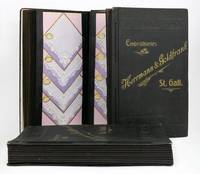
1915135087St Gallen Switzerland: Herrmann & Goldfrank 1915. First Edition. Hardcover. Very Good. St Gallen Switzerland Herrmann & Goldfrank 1915 to 1919. Folio approximately 485 × 300 mm three volumes containing 481 large samples: 44 pages with 123 lace samples predominantly mounted on green card; 40 pages with 176 lace samples predominantly mounted on pink card; and 47 pages with 182 scalloped lace handkerchief samples predominantly mounted on purple card. Cord-bound cloth covers lettered and decorated in gilt and decorated in blind the first two volumes and screw-bound plain pebble-grain cloth; covers flecked rubbed and bowed with the extremities a little bumped and worn; minimal signs of age and use; in excellent condition. All samples in these very impressive albums come with individual reference numbers sizes prices and other details; the samples in the first two volumes are loosely inserted in custom-made album leaves. 'St. Gallen embroidery sometimes known as Swiss embroidery is embroidery from the city and the region of St. Gallen Switzerland. The region was once the largest and most important export area for embroidery. Around 1910 its embroidery production was the largest export branch of the Swiss economy with 18 percent of the overall export value. More than 50 percent of the world production came from St. Gallen. <p>The decline of the embroidery industry began in 1914 with the outbreak of the First World War. The demand for luxury products - and embroidery counted among these - collapsed suddenly and also the free trade zones were disrupted. Partially neutral countries were still customers but they could only compensate in the short term. To preserve wages somewhat from the free-fall maximum working hours and minimum wages were now also fixed. In fact these measures were rather counter-productive - only workers who demanded less than the minimum wage got a job. The year 1917 still in the middle of WWI temporarily brought a surprising turn: the Entente forbade the export of cotton products to Germany but not the export of embroidery. Therefore every cloth to be sold to Germany was embroidered in some way as embroidery could be sold. A year later the sale of embroidery to Germany was forbidden too and this meant the end of the brief upturn. The last little flurry of exports came in 1919 after the end of the war when the reconstruction of the war-stricken countries brought another short rise. With the start of the economic crisis the heyday for the St. Gallen embroidery was finally ended. One sign of the extent of the crisis is that from 1910 to 1930 the population of St. Gallen was reduced by emigration as a result of unemployment from 75482 to 64079' Wikipedia. A cursory search online suggests Herrmann & Goldfrank went through a similar trajectory: the company Steines Herrmann and Goldfrank first appears in 1911; from 1915 the name was Herrmann and Goldfrank; from 1919 the name was John Goldfrank and Co.; and by 1932 the company had ceased to exist. 3 items. Herrmann & Goldfrank hardcover