(Decorative Arts)Biblio.com

1 730 résultats
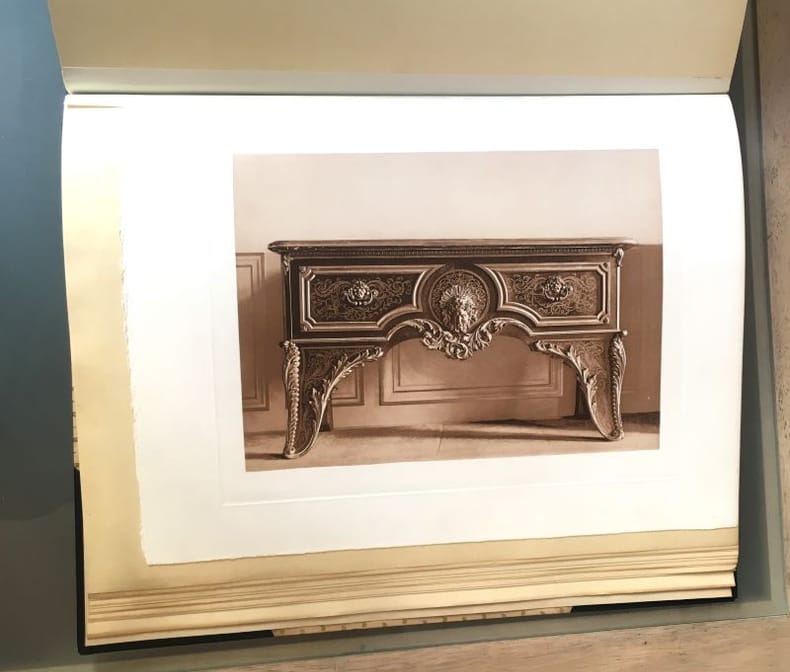
312937vp vd. Illustrated. Folio and 4to. Bound uniformly in purple morocco with "Governor Charles Edison Library" on the front pastedown t.e.g. by Bookends Bindery. Each spine is uniformly faded else fine. Illustrated. Folio and 4to. 1. English Decoration in the 18th Centrury. By John Fowler and John Cornforth. London: Barriue & Jenkins 1974<br /> 2. French Decorative Art 1638-1793. By George Savage. N.Y.: Praeger 1969<br /> 3. A Book of Distinctive Interiors. Ed. William A. Vollmer. N.Y.: McBride Nast and Company 1912.<br /> 4. Louis XVI Furniture. By Seymour De Ricci. Stuttgart: Julius Hoffmann 1913<br /> 5. Three Centuries of Furniture in Color. By H.D. Molesworth and John Kenworthy-Browne. N.Y.: Viking Press 1972.<br /> 6. Historic Midwest Houses. By John Drury. Minneapolis: The University of Minnesota Press 1947.<br /> 7. Great Palaces of Europe. Introduction by Sacheverell Sitwell. London: Weidenfeld and Nicholson 1964.<br /> 8. Le Meuble Léger en France. By Guillaume Janneau. Paris: Paul Hartmann 1952.<br /> 9. Les Ébénistes du XVIIIe Siècle. By Comte de Salverte. Paris: F. de Nobele 1962.<br /> 10. Les Ébénistes Parisiens du XIXe siècle 1795-1870. Paris: F. de Nobele 1965.<br /> 11. World Architecture: an Illustrated History. Ed. Trewin Copplestone. Secaucus N.J. 1976.<br /> 12. Furniture Clocks and Gilt Bronzes In Two Volumes Volume I. By Geoffrey de Bellaigue. London: Published for the National Trust by Office du Livre 1974.<br /> 13. Furniture Clocks and Gilt Bronzes In Two Volumes Volume II. By Geoffrey de Bellaigue. London: Published for the National Trust by Office du Livre 1974.<br /> 14. L'Art et la Manière des Maitres Ébénistes Français au XVIIIe Siècle Tome I Les Truquages. By Jean Nicolay. Paris: Editions Pygmalion 1976.<br /> 15. French Provincial Decorative Art. By Catharine Oglesby. London New York: Charles Scribner's Sons 1951.<br /> 16. Versailles. By Gérald van der Kemp. New York Paris: The Vendome Press 1978.<br /> 17. Decoration Volume I. Ed. Souren Mélikian. New York: French & European Publications Inc 1963.<br /> 18. Decoration Volume II. Ed. Souren Mélikian. New York: French & European Publications Inc 1963.<br /> 19. La Pendule Française des Origines a nos jours. Paris: Tardy 1976.<br /> 20. French Cabinetmakers of the Eighteenth Century. By Jean Meuvret. New York: French & European Publications Inc 1965<br /> 21. Furniture Treasury Mostly of American Origin. By Wallace Nutting. Volumes I and II in One. New York: Macmillan Publishing Co Inc 1977.<br /> 22. Furniture Treasury Mostly of American Origin. By Wallace Nutting. Volume Three. New York: Macmillan Publishing Co. Inc 1977.<br /> 23. Les Petits Meubles. By Guillaume Janneau. Paris: Editions d'Arts 1977.<br /> 24. French Art of the Eighteenth Century. By Stéphane Faniel. New York: Simon and Schuster 1957.<br /> 25. Le Style Louis XV. By Gérard Mabille. Paris Baschet et Cie 1978.<br /> 26. Paris Furniture by the Master Ébénistes. By Charles Packer. Newport England: The Ceramic Book Company 1956. unknown
35501Folio and 4to. Bound uniformly in purple morocco with "Governor Charles Edison Library" on the front pastedown t.e.g. by Bookends Bindery<br/> <br/> From the library of Charles Edison specially bound for him.<br/> <br/> 1. English Decoration in the 18th Centrury. By John Fowler and John Cornforth. London: Barriue & Jenkins 1974 2. French Decorative Art 1638-1793. By George Savage. N.Y.: Praeger 1969 3. A Book of Distinctive Interiors. Ed. William A. Vollmer. N.Y.: McBride Nast and Company 1912. 4. Louis XVI Furniture. By Seymour De Ricci. Stuttgart: Julius Hoffmann 1913 5. Three Centuries of Furniture in Color. By H.D. Molesworth and John Kenworthy-Browne. N.Y.: Viking Press 1972. 6. Historic Midwest Houses. By John Drury. Minneapolis: The University of Minnesota Press 1947. 7. Great Palaces of Europe. Introduction by Sacheverell Sitwell. London: Weidenfeld and Nicholson 1964. 8. Le Meuble Léger en France. By Guillaume Janneau. Paris: Paul Hartmann 1952. 9. Les Ébénistes du XVIIIe Siècle. By Comte de Salverte. Paris: F. de Nobele 1962. 10. Les Ébénistes Parisiens du XIXe siècle 1795-1870. Paris: F. de Nobele 1965. 11. World Architecture: an Illustrated History. Ed. Trewin Copplestone. Secaucus N.J. 1976. 12. Furniture Clocks and Gilt Bronzes In Two Volumes Volume I. By Geoffrey de Bellaigue. London: Published for the National Trust by Office du Livre 1974. 13. Furniture Clocks and Gilt Bronzes In Two Volumes Volume II. By Geoffrey de Bellaigue. London: Published for the National Trust by Office du Livre 1974. 14. L'Art et la Manière des Maitres Ébénistes Français au XVIIIe Siècle Tome I Les Truquages. By Jean Nicolay. Paris: Editions Pygmalion 1976. 15. French Provincial Decorative Art. By Catharine Oglesby. London New York: Charles Scribner's Sons 1951. 16. Versailles. By Gérald van der Kemp. New York Paris: The Vendome Press 1978. 17. Decoration Volume I. Ed. Souren Mélikian. New York: French & European Publications Inc 1963. 18. Decoration Volume II. Ed. Souren Mélikian. New York: French & European Publications Inc 1963. 19. La Pendule Française des Origines a nos jours. Paris: Tardy 1976. 20. French Cabinetmakers of the Eighteenth Century. By Jean Meuvret. New York: French & European Publications Inc 1965 21. Furniture Treasury Mostly of American Origin. By Wallace Nutting. Volumes I and II in One. New York: Macmillan Publishing Co Inc 1977. 22. Furniture Treasury Mostly of American Origin. By Wallace Nutting. Volume Three. New York: Macmillan Publishing Co. Inc 1977. 23. Les Petits Meubles. By Guillaume Janneau. Paris: Editions d'Arts 1977. 24. French Art of the Eighteenth Century. By Stéphane Faniel. New York: Simon and Schuster 1957. 25. Le Style Louis XV. By Gérard Mabille. Paris Baschet et Cie 1978. 26. Paris Furniture by the Master Ébénistes. By Charles Packer. Newport England: The Ceramic Book Company 1956. unknown
312937vp vd. Illustrated. Folio and 4to. Bound uniformly in purple morocco with "Governor Charles Edison Library" on the front pastedown t.e.g. by Bookends Bindery. Each spine is uniformly faded else fine. Illustrated. Folio and 4to. From the Library of Charles Edison Specially Bound for Him. 1. English Decoration in the 18th Centrury. By John Fowler and John Cornforth. London: Barriue & Jenkins 1974<br/>2. French Decorative Art 1638-1793. By George Savage. N.Y.: Praeger 1969<br/>3. A Book of Distinctive Interiors. Ed. William A. Vollmer. N.Y.: McBride Nast and Company 1912.<br/>4. Louis XVI Furniture. By Seymour De Ricci. Stuttgart: Julius Hoffmann 1913<br/>5. Three Centuries of Furniture in Color. By H.D. Molesworth and John Kenworthy-Browne. N.Y.: Viking Press 1972.<br/>6. Historic Midwest Houses. By John Drury. Minneapolis: The University of Minnesota Press 1947.<br/>7. Great Palaces of Europe. Introduction by Sacheverell Sitwell. London: Weidenfeld and Nicholson 1964.<br/>8. Le Meuble Léger en France. By Guillaume Janneau. Paris: Paul Hartmann 1952.<br/>9. Les Ébénistes du XVIIIe Siècle. By Comte de Salverte. Paris: F. de Nobele 1962.<br/>10. Les Ébénistes Parisiens du XIXe siècle 1795-1870. Paris: F. de Nobele 1965.<br/>11. World Architecture: an Illustrated History. Ed. Trewin Copplestone. Secaucus N.J. 1976.<br/>12. Furniture Clocks and Gilt Bronzes In Two Volumes Volume I. By Geoffrey de Bellaigue. London: Published for the National Trust by Office du Livre 1974.<br/>13. Furniture Clocks and Gilt Bronzes In Two Volumes Volume II. By Geoffrey de Bellaigue. London: Published for the National Trust by Office du Livre 1974.<br/>14. L'Art et la Manière des Maitres Ébénistes Français au XVIIIe Siècle Tome I Les Truquages. By Jean Nicolay. Paris: Editions Pygmalion 1976.<br/>15. French Provincial Decorative Art. By Catharine Oglesby. London New York: Charles Scribner's Sons 1951.<br/>16. Versailles. By Gérald van der Kemp. New York Paris: The Vendome Press 1978.<br/>17. Decoration Volume I. Ed. Souren Mélikian. New York: French & European Publications Inc 1963.<br/>18. Decoration Volume II. Ed. Souren Mélikian. New York: French & European Publications Inc 1963.<br/>19. La Pendule Française des Origines a nos jours. Paris: Tardy 1976.<br/>20. French Cabinetmakers of the Eighteenth Century. By Jean Meuvret. New York: French & European Publications Inc 1965<br/>21. Furniture Treasury Mostly of American Origin. By Wallace Nutting. Volumes I and II in One. New York: Macmillan Publishing Co Inc 1977.<br/>22. Furniture Treasury Mostly of American Origin. By Wallace Nutting. Volume Three. New York: Macmillan Publishing Co. Inc 1977.<br/>23. Les Petits Meubles. By Guillaume Janneau. Paris: Editions d'Arts 1977.<br/>24. French Art of the Eighteenth Century. By Stéphane Faniel. New York: Simon and Schuster 1957.<br/>25. Le Style Louis XV. By Gérard Mabille. Paris Baschet et Cie 1978.<br/>26. Paris Furniture by the Master Ébénistes. By Charles Packer. Newport England: The Ceramic Book Company 1956. unknown books
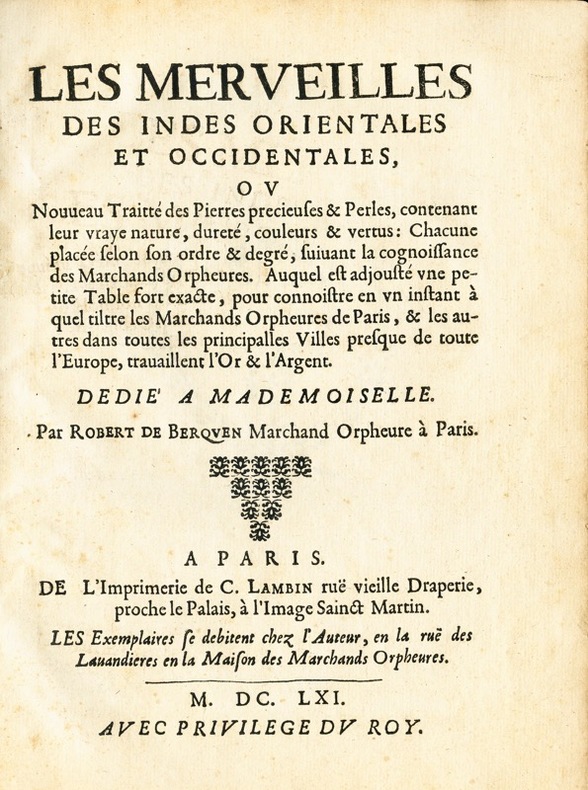
166112698A Paris, De L'Imprimerie de C. Lambin, 1661. In-4 de (12)-112 pp., 1 portrait, maroquin rouge, dos orné à nerfs, double filets doré d'encadrement sur les plats, encadrement d'un double filet doré au centre, fleurons dorés aux angles (reliure de l'époque).
01948Tokyo: Japan Art Society 1905. Setsu Kushi Hinagata Patterns of Miniature Combs<br /> An Aesthetic Window into Japanese Decorative Tradition <br /> <br /> DECORATIVE ARTS. In Japanese. Setsu Kushi Hinagata Patterns of Miniature Combs. Tokyo: Japan Art Society 37th Year of the Meiji 1905. <br /> <br /> Octavo 9 1/2 x 5 3/4 in; 242 x 140 mm. 154 pp. A unique scrapbook of over 500 charcoal rubbings on rice paper of Japanese miniature comb and hairpin koagi patterns tipped-in to the pages of three issues of Japanese Art Society Reports bound together. The original collector has crossed-out the original titles publisher etc. and provided their own manuscript title in black marking pen. Each page has two rubbed patterns each pattern with upper and lower views of each comb and the rubbings are remarkably sharp with even small details very clear.<br /> <br /> Publisher's original string-bound wrappers with losses but the integrity of interior of the book remains complete and intact. Early auction clipping for this item "Kushi Hinagata" mounted to the inside of the rear Japanese front cover. Housed in a green silk drop-back box with traditional Japanese clasps with paper label on spine lettered in Japanese.<br /> <br /> This kind of vernacular studio-generated scrapbook - mixing printed art society documents with hundreds of individually made rubbings - is exceptionally rare. It offers not only an aesthetic window into Japanese decorative tradition but also a unique document of private study and preservation by an anonymous mid-century compiler.<br /> <br /> The art of Japanese hair decoration or kushi dates back hundreds of years and has rich and varied heritage. As with much Eastern art it served to "beautify items of everyday use to make the commonplace extraordinary and to tell of the life and status of the wearers who were geisha courtesans court ladies and housewives" Ziesnitz and Momoko Combs and Hairpins Daruma: Japanese Art and Antique Magazine Summer 2002. And indeed this work is a testament to the beautiful and elegant diversity of this Japanese decorative art. <br /> <br /> A curious attractive and visually arresting book one with certain aesthetic merit given the obsessive care and attention necessary to compile such a volume which with its use of a marking pen dates this compilation to sometime post-1952 the year that marking pens were introduced. A valuable historical cultural and artistic record as well as an object that as much as its subject renders the commonplace extraordinary and takes its place along side of Hokusai's classic Imayo Kushi Hinagata 1823 as a key reference.<br /> <br /> "Women have always adorned themselves but perhaps none so subtly as the Japanese. You can reproduce the old hairstyles seen in painting and sculpture but their hair ornaments remind us of the coiffures on which they were worn. In other words hair ornaments are tangible souvenirs of ancient hairstyles.<br /> <br /> "Hair ornaments were not mere accessories to feminine coiffure and attire. In keeping with the Japanese urge to beautify items of everyday use to make the commonplace extraordinary they were turned into artistic objects mirroring cultural and and social history. They tell of the life and status of their wearers who were geisha courtesans court ladies and housewives.<br /> <br /> "They give a glimpse of the exceptional beauty of Japanese art." Ziesnitz Sharon. Combs and Hairpins. Daruma 35 vol. 9 No. 3 Summer 2002. [Tokyo]: [Japan Art Society], [1905] unknown
01948Tokyo: Japan Art Society 1905. The Art of Japanese Hair Combs<br/>A Singular Scrapbook<br/><br/>DECORATIVE ARTS. In Japanese. Setsu Kushi Hinagata Patterns of Miniature Combs. Tokyo: Japan Art Society 37th Year of the Meiji 1905. <br/><br/>Octavo 9 1/2 x 5 3/4 in; 242 x 140 mm. 154 pp. A unique scrapbook of over 500 charcoal rubbings on rice paper of Japanese miniature comb and hairpin koagi patterns tipped-in to the pages of three issues of Japanese Art Society Reports bound together. The original collector has crossed-out the original titles publisher etc. and provided their own manuscript title in black marking pen. Each page has two rubbed patterns each pattern with upper and lower views of each comb and the rubbings are remarkably sharp with even small details very clear.<br/><br/>Publisher's original string-bound wrappers with losses but the integrity of interior of the book remains complete and intact. Early auction clipping for this item "Kushi Hinagata" mounted to the inside of the rear Japanese front cover. Housed in a green silk drop-back box with traditional Japanese clasps with paper label on spine lettered in Japanese.<br/><br/>The art of Japanese hair decoration or kushi dates back hundreds of years and has rich and varied heritage. As with much Eastern art it served to "beautify items of everyday use to make the commonplace extraordinary and to tell of the life and status of the wearers who were geisha courtesans court ladies and housewives" Ziesnitz and Momoko Combs and Hairpins Daruma: Japanese Art and Antique Magazine Summer 2002. And indeed this work is a testament to the beautiful and elegant diversity of this Japanese decorative art. <br/><br/>A curious attractive and visually arresting book one with certain aesthetic merit given the obsessive care and attention necessary to compile such a volume which with its use of a marking pen dates this compilation to sometime post-1952 the year that marking pens were introduced. A valuable historical cultural and artistic record as well as an object that as much as its subject renders the commonplace extraordinary and takes its place along side of Hokusai's classic Imayo Kushi Hinagata 1823 as a key reference.<br/><br/>"Women have always adorned themselves but perhaps none so subtly as the Japanese. You can reproduce the old hairstyles seen in painting and sculpture but their hair ornaments remind us of the coiffures on which they were worn. In other words hair ornaments are tangible souvenirs of ancient hairstyles.<br/><br/>"Hair ornaments were not mere accessories to feminine coiffure and attire. In keeping with the Japanese urge to beautify items of everyday use to make the commonplace extraordinary they were turned into artistic objects mirroring cultural and and social history. They tell of the life and status of their wearers who were geisha courtesans court ladies and housewives.<br/><br/>"They give a glimpse of the exceptional beauty of Japanese art." Ziesnitz Sharon. Combs and Hairpins. Daruma 35 vol. 9 No. 3 Summer 2002. [Tokyo]: [Japan Art Society], [1905] unknown books
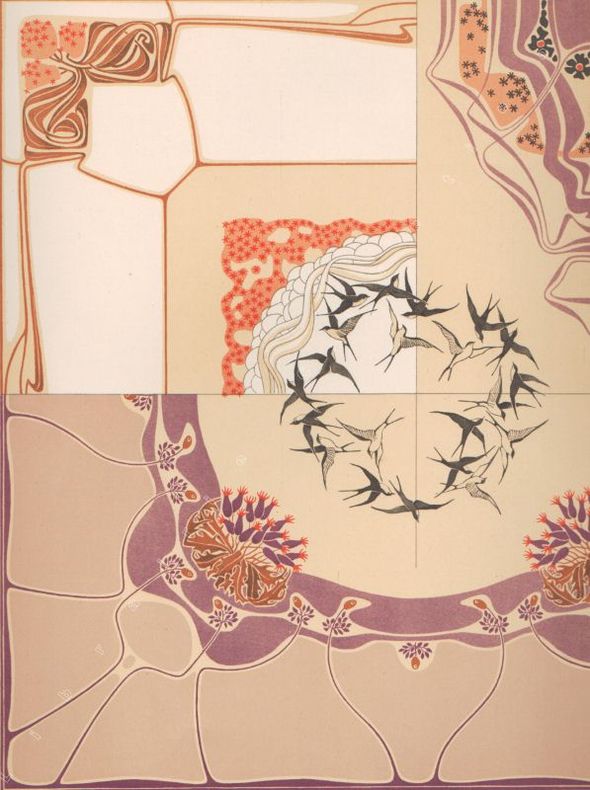
189846402690Paris, Librairie Centrale des Beaux-Arts, s.d. [1898] ; album in folio , Sous chemise de percaline rouge fermée par trois attaches. PREMIER TIRAGE des 48 planches en couleurs réunies sous leur portefeuille d’éditeur portant en lettres dorées sur le premier plat « La Plante 48 planches ». Rarissime publication Art Nouveau de planches d’inspiration florale publiées sous les auspices du peintre suisse Eugène Grasset (1841-1917). Cette publication fait suite à un premier ouvrage du même titre paru en 1896 et comportant 72 planches. Toutes les planches sont nouvelles. Le principe en est le même: tous les modèles de décoration ou de mobilier sont appuyées d’une planche de botanique dessinée d’après nature avec la plus rigoureuse exactitude. Chacun pouvant, en comparant l’étude et l’interprétation, tenter de créer son propre modèle. Pour Grasset, considéré comme un des pionniers du décor Art Nouveau, « l’art décoratif loin de chercher le trompe-l’œil doit interpréter la nature pour en faire un ornement. Cette interprétation varie suivant les ressources offertes par la matière employée. » (Paul Berthon). Sont ainsi interprétés vigne, navet, butome, gui, soleil, sorbier, ricin, persil, ronce, céleri, pommier, groseiller, poireau, chèvrefeuille, bryone et vigne vierge. La majorité des planches sont signées par Maurice Pillard Verneuil (19). Les autres sont l’œuvre de J. Milesi, E. Hervegh, Georges Bourgeot (peintre verrier et céramiste élève de Grasset), Anna Martin, Marcelle Gaudin, Ch. Dozoul et Gorain. Quelques rousseurs pâles, petites décolorations sur la chemise. Bel exemplaire.
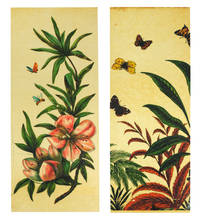
18901249111890. No imprint but presumed to be made by Fandel Phillips & Sons Newgate St. London circa 1890. <br /> <br /> 10 examples of colored transparent crystographs of varying sizes printed in lithograph on translucent paper; some displaying signs of wear and having previously been mounted; offered together with five extracted advertisements neatly cut and mounted on card together with a photocopy of the title-page of the Fandel Phillips & Sons trade catalogue; a lovely group of extremely fragile survivors. <br /> <br /> § Rare surviving specimens of imitation stained glass transparencies; an interesting and rather lovely example of the Victorian passion for illuminated spectacle and of the democratization of the arts and crafts aesthetic. <br /> <br /> A vibrant and eye-catching small collection of beautiful late-Victorian transparencies or 'Crystographs' for glass and window decoration presumably done in lithograph and we believe produced and sold by the London merchants Fandel Phillips & Sons of Newgate Street London. Described as being 'cheaper than any imitation stained glass introduced to the public' they were developed at the end of the 19th century and soon found popularity with a number of companies both in the UK and the US offering them for sale. Relatively cheap to purchase often bought in boxes "banded in dozens mostly assorted" the innovation could enable "a large surface of blank cheerless glass. to be converted into a rich artistic and antique picture for about one shilling" Fandel trade catalogue description provided in photocopy. "The material on which subjects are depicted is a new one and is unaffected by the atmospheric influence does not allow the colors to fade and so affords a scope for talent in adapting the design to any size window or other glass object that may be desired" ibid. As one of the accompanying advertisements reveals the crystographs were divided into center pieces border pieces and large sheets with all manner of themes printed the present selection including attractive images of birds flowers and butterflies a knight on his charger a medieval lady together with geometric border patterns. The present collection includes designs of various size with examples of center pieces and borders. Other advertisements included here note a series of "imitation photographs" of churches figures from folklore "scripture subjects" with more prosaic images also available for more commercial use perhaps such as "hot sausages and potatoes" and "ice creams." <br /> <br /> With regards to the provenance of this group it is our understanding that they were originally found within a Victorian trade catalogue issued by Kingsbury & Co presumably as specimen pieces accompanied by the advertisements the catalogue having sadly been broken up some time ago by a previous owner. Kingsbury & Co. seems likely to have been the Fleet Street newsagent Kingsbury & Co. which is listed at being at 7 Racquet Court in the Post Office Directory for 1891. Henry Fandel and Benjamin Samuel Phillips are listed as working together in the London Gazette of 1839 and they are later described in the Post Office Directory as 'Warehousemen importers of berlin & other wools toys fancy & japanese & oriental goods & manufacturers of every description of embroidery silks haberdashers & lace warehousemen." We are unsure as to whether the photocopy we have of their "Catalogue of Crystographs to Represent Stained Glass Windows" was bound together with the Kingsbury & Co Catalogue but it seems likely. <br /> <br /> We have found online advertisements for other producers of crystographs including John Thridgould & Co. of London who promoted them as being "the most perfect substitute for costly stained glass windows" in the journal Literary World Vol. 42 1890 and the Penfield paper manufacturing Company of Philadelphia promoting them in an 1892 Church Magazine as being of use in "Churches Schools houses Offices Libraries etc." <br /> <br /> Bearing in mind their fragility a wonderful and scarce survivor. <br /> <br /> The group includes: <br /> <br /> 1. Image of Lillies 444 x 168 mm: 'Threepenny Centre Pieces - Series 509 4 Designs of Flowers in Rich Colors.' 1 of 4 seemingly ; a little browned tail edge somewhat nicked with slight loss though not touching image; with original extracted advertisement mounted on card.<br /> <br /> 2. I. Flowers Butterfly and Bee 517 x 195 mm; with foliage and Four Butterflies 410 x 168 mm: 'Sixpenny Centre Pieces - Series 604 2 Designs of Flowers in Rich Colours' and seemingly both designs; a little browned and soiled slight cracking towards tail of second sheet; with original extracted advertisement mounted on card.<br /> <br /> 3. 'Threepenny Centre Pieces. Series 1560. 'Designed in Rich Colours. This series is arranged so that it can be cut to fit dome shape windows if required. I - The Challenge Knight on Horseback' 1 of 4. 330 x 228 mm; some discrete tape repairs to verso upper margin nicked with slight loss; with original extracted advertisement mounted on card. <br /> <br /> 4. Two penny Centre Piece Possibly Series 545 'My Lady Bountiful' depicting Lady in Waiting in Tudor Costume 190 x 178 mm some minor cracking visible with remains of old mount at tail of verso.<br /> <br /> 5. One Penny Centre Piece 'Series 208 2 designs' 1 of 2 Blue Bird flying over a lily pond 290 x 195 mm discrete tape repairs to verso; with original extracted advertisement mounted on card.<br /> <br /> 6. One Penny Centre Piece possibly Series 208 or 210 290 x 195 mm; torn and cracked with loss of image at tail with remains of old mount at tail of verso and small nick at upper margin.<br /> <br /> 7. Three geometric cords pieces 230 x 75 mm; 228 x 85 mm; 230 x 65 mm; each very good. unknown
1369699Darmstadt, Leipzig: Verlags-Anstalt Alexander Koch, 1902 in-4, (8)-340 pages, 482 illustrations en noir et blanc, 6 planches hors texte. Cartonnage d'édition, papier ivoire, dos et premier plat estampé avec titre (Moderne Dekorative Kunst Die Ausstellung zu Turin 1902) et décor doré, légèrement sali et frotté avec qq. usures aux coiffes et aux coins, sans rousseurs, bel exemplaire. "La première exposition internationale d'art décoratif moderne, en italien Prima Esposizione Internazionale d'Arte Decorativa Moderna, s'est tenue à Turin en 1902. Elle fut le détonateur de l'art nouveau en Italie. Pour la première fois y participaient tous les pays où l'art nouveau s'était développé : Allemagne, Angleterre, Autriche, Belgique, Danemark, Écosse, États-Unis, France, Hollande, Hongrie, Italie, Norvège et Suède" (wikipedia).
176515326A Paris, Chez G. Cavelier, 1765. In-12 de LII-287 pp., veau blond glacé, dos orné à nerfs, pièce de titre en maroquin rouge, tranches rouges (reliure de l'époque).
19891Paris, Goupil & Cie, 1902. 3 vol. in-plano, 4-VII-52 pp. 18 pl. + 66 pl. + 66 pl., demi-maroquin à coins bleu, plats de papier orné de fleurs de lys dorées, dos à nerfs orné de filets dorés (quelques épidermures, quelques rares taches).
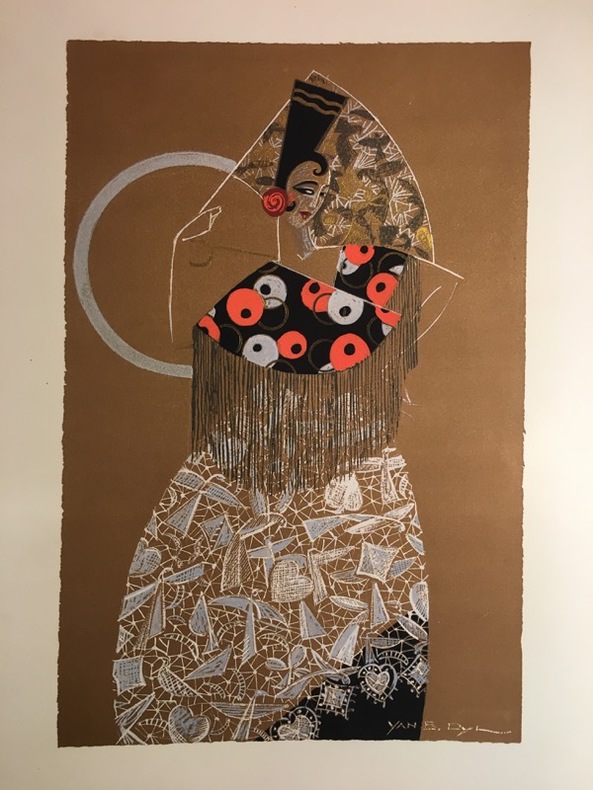
19276701927 Couverture souple Paris, Simon Kra, sans date [1927]. In-folio, cartonnage d'éditeur à rabats avec rubans d'attache (petits manques de papier sur les plats, quelques marques d'usure), chemise illustrée, en feuilles. Recueil de seize sonnets de Henri de Régnier imprimé sur les presses du maître-imprimeur Coulouma, et de seize planches hors-texte en couleurs de Yan Bernard Dyl, imprimées par Daniel Jacomet avec des rehauts d'or et d'argent. Quelques marques sur les feuillets de texte, dues à la surimpression de la planche en regard (voir par exemple les photos de la planche et du sonnet "celle de demain"). Tirage limité à 350 exemplaires, celui-ci n°142, sur papier Canson Montgolfier. Bel état des planches, dans le style art-déco. Bon exemplaire, dans son étui d'origine.
1925236691925 Gouache et crayon gras sur papier signé d'un poisson en bas à droite, (1925), 34.5 x 44 cm.
19821Paris, Editions d’art Charles Moreau, 1935 ; in folio, broché, chemise étui ; X, 272, [2] ff. de table et achevé d’imprimer, frontispice et XXVI planches hors texte en couleurs montées sur carton, avec serpente légendée, nombreuses illustrations in texte.
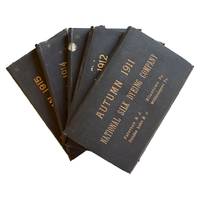
19111776Paterson New Jersey: National Silk Dyeing Company 1911 - 1915. Very Good overall. Five accordion-style books bound in brown cloth with snaps and gilt stamping containing nearly 780 samples of 800; each set of samples is approx. 5 cm long and contains five different hues of tied silk string. Each book 13 x 23 cm or approx. 23 x 75 cm opened in full. Splitting to edges of some bindings; some samples missing or bent. A rare collection of silk sample booklets from the period before and after the 1913 Paterson Silk Strike. Included are: Autumn 1911 Autumn 1912 Spring 1914 Autumn 1914 and Spring 1915. OCLC locates only incomplete holdings at Yale Spring 1915 - Spring 1918 the Fashion Institute of Technology Spring 1911 Autumn 1916 Spring 1917 and Spring 1918 and the Brooklyn Museum Spring 1913. National Silk Dyeing Company hardcover
235136Paris, Lucien Laveur, Marseille, Alex. Jouvène, 1913 2 volumes in-4, VIII-319 et [6]-368 pp., avec des figures dans le texte et 128 planches hors-texte, demi-chagrin brun, dos à nerfs, filets dorés, couv. cons. (reliure de l'époque). Bon exemplaire.
237599Paris, Lucien Laveur, Marseille, Alex. Jouvène, 1913 2 volumes in-4, VIII-319 et [6]-368 pp., avec des figures dans le texte et 128 planches hors-texte, chagrin violine, dos à nerfs orné, décor à la Duseuil sur les plats, fleurons d'angles, fer doré au centre, tête dorée, couv. cons. (reliure de l'époque). Dos passé. Bon exemplaire.
18758Amsterdam, Redactie Vademecum der Bouwvakken, s.d. (1900), 2 volumes in-folio, broché, couverture décorée d'ornements "Art Nouveau" ; vol. I, 1 f. de texte et 8 planches en couleurs ; vol. II, 8 planches en couleurs.
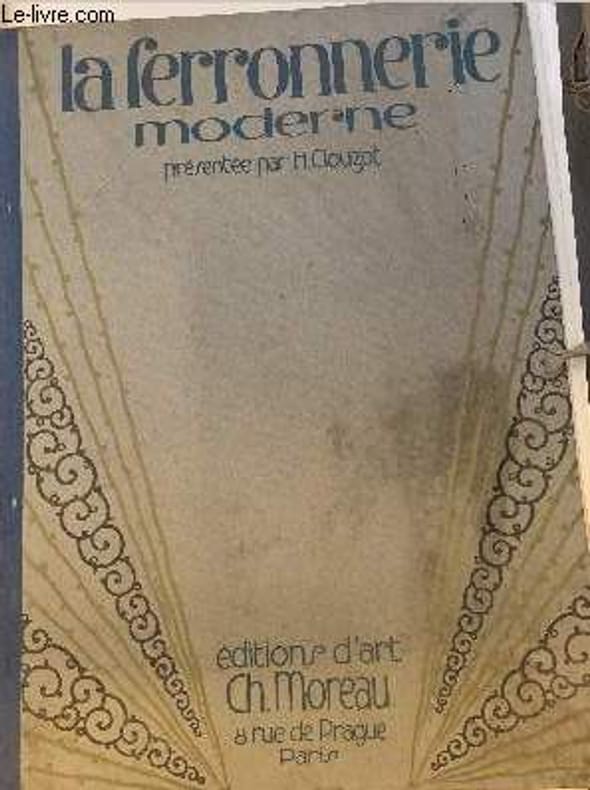
RO30368660Editions d'art Ch. Moreau. Non daté.. In-Folio. En feuillets. Etat d'usage, Plats abîmés, Dos abîmé, Papier jauni. 36 planches de photos en noir et blanc. Couverture cartonnée. Tâches, accrocs en plats. Rousseurs. Coins frottés. Légères mouillures.. . . . Classification Dewey : 745-Arts décoratifs, arts mineurs
188871741888 Paris, Calavs, 1888-1898. 10 portefeuilles demi toile et cartonnage rouge de l'éditeur, titre doré sur les plats supérieurs, feuillets de titre et de tables, bien complet de ses 960 planches. Dos un peu faibles, néanmoins bon état.
Small quarto in b&w photo-illus jacket; 189 pages : illustrations (chiefly color) ; 28 cm Signed by both Putman and author on title page. English translation of: Le style Putman. || Contents: Introduction to harmony -- Testimony: Emmanuel Santarromana -- The abbey at Fontenay -- Early successes and hardships -- Testimony: Didier Grumbach -- Michel Guy and AndrÈe Putman -- Ecart/tracE -- Rob. Mallet-Stevens' little chair -- Testimony: Bernard-Henri LÈvy -- Eileen Gray -- The appointed artist -- Testimony: Jack Lang -- Testimony: Jean-Louis Froment -- New York temptation -- Testimony: Louise Bourgeois -- Morgans: the first boutique hotel -- Concorde -- All about luxury -- Ebel -- Karl Lagerfeld -- Testiomony: Patricia Turck-Paquelier -- My place, your place -- House in Grimaud (France) -- Loft in Saint-Germain-des-PrÈs (Paris) -- Manor House (Paris) -- House in Tangiers -- Testimony: Arielle Dombasle -- Hotels and restaurants -- Hotel Im Wasserturm -- Lo Suchi I & II -- The designer of the sclectic -- The Christofle Vertigo Collection -- Les prÈparations -- Trophy for the French soccer championship -- The allure -- Testimony: BenoÓt Jacquot. || Interior decoration -- France -- History -- 20th century. Interior decoration -- France -- History -- 20th century. Interior decoration. Putman, AndrÈe -- Criticism and interpretation. Putman, Andree -- Criticism and interpretation. Putman, AndrÈe. Putman, AndrÈe.
1368883Bruxelles: G.S.K. & L., c. 1900 in-4 (30,5 x 22 cm), 294 pages, nombreuses illustrations. Répertoire in fine. Demi reliure toile d'édit. un peu défraichie, bon état général. Importante documentation comprenant de plus de 700 illustrations de lampes, lanternes, lustres, suspensions, plafonniers, etc. de différents styles dont le style "Art Nouveau". Rare catalogue industriel manquant à WorldCat.
19905230Paris Richer / Editions de l'Amateur 1990 In-4 (h. 32 cm.) 206 pp. reliure cartonnée, jaquette illustrée.
179357Paris, Léonce Laget, 1976 2 parties en un vol. in-4, IX-233 pp. en numérotation continue, texte français, puis traduction anglaise se suivant, avec des vignettes en-tête en noir et en couleurs, et 86 planches réunissant 467 figures en noir ou en couleurs, légendées chacune d'une page en regard, demi-chagrin bleu, dos à nerfs, tête mouchetée, couverture et dos conservés (reliure moderne). Dos insolé, mais bon exemplaire.
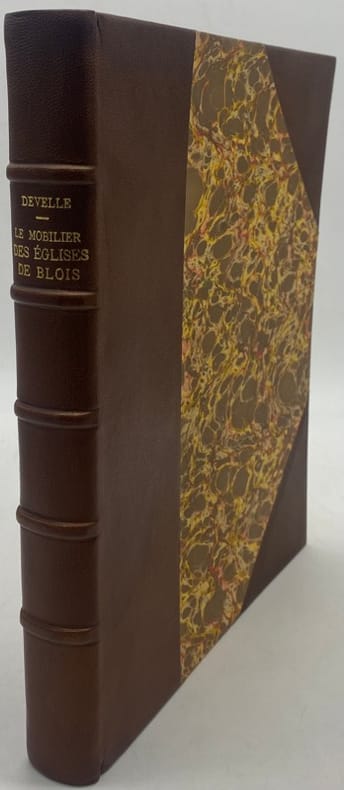
195131Blois, Imprimerie R. Sille, 1933 in-4, 249 pp., illustrations h.-t., demi-chagrin brun à coins, dos à nerfs, couv. et dos cons. (rel. moderne).