2 résultats
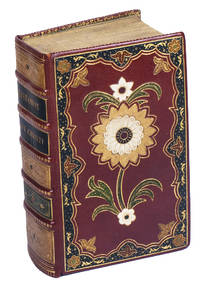
1696ABC_48370Antwerp 1696. 8vo. Hieronymus Verdussen for Niclaes Braau in Haarlem Exquisite 18th-century gold-tooled multi-colour morocco mosaic binding. The basis of the binding is red morocco the boards show a large flower executed in gold-tooled white green yellow and black morocco onlays with small brown morocco leaf shaped corner pieces within a cusped and scalloped gold-tooled double fillet frame. The outer frame is a gold-tooled black morocco onlay with detailed floral and leaf shaped gold-tooled brown and green morocco onlays. The binding is sewn on 5 supports with corresponding raised bands on the spine. The six compartments are beautifully decorated with gold-tooled yellow 1st 4th and 6th compartment black 2nd and 3rd and green 5th morocco onlays with the title lettered in gold on the black morocco of the 2nd and 4rd compartments the other compartments are show detailed gold-tooling and a small green or red morocco small circular onlay. Further with gold-tooling on the raised bands the head and foot of the spine the board edges and the turn-ins. Gilt edges and green silk covered end papers. With 39 detailed woodcut illustrations in the text and woodcut decorated initials and small printed manicules. The text is set in a Gothic letter with incidental use of Roman type. 1 1 blank 14 837 27 pp. Very rare late-17th-century Antwerp edition of the New Testament edited by Henricus van den Leemputte 1588-1657 in a magnificent 18th-century mosaic binding. The binding is made by or in the style of the French Parisian binders Le Monnier. "The delicate construction finesse of tooling and delineation and the fantasy of these bindings render them veritable jewels." see The History of bookbinding 525-1950 A.D. no. 456.Van den Leemputte was a highly educated cleric from a noble family in the Southern Netherlands. He held high offices within the diocese bishopric of 's Hertogenbosch. Aside from the present version of the New Testament first published in 1622 he wrote several treatises on the Holy Sacraments published 1624 and edited two works one manual for explaining the Holy Scripture and one defence of the Catholic church against the Reformed church.From the library of Carlo de Poortere 1917-2002 a director of the family tapestry business and a Belgian bibliophile with a large collection of 17th- and 18th-century book bindings and illustrated books from the 16th-20th centuries. It had previous been part of the collection of English Baptist minister and book collector Andrew Gifford 1700-1784. The "of the Museum" below his name in the engraved bookplate seems to refer to his position as assistant keeper of books and manuscript at the British Museum from 1757 until his death. Curiously he bequeathed his collection of books manuscripts pictures and other curiosities not to the British Museum but to the Bristol Baptist College. In the 1970s the Trustees of this college decided to sell all copies of the Gifford collection to pay for renovations to the chapel.With the gold-tooled red morocco bookplate of Carlo de Poortere on the verso of the blank fly leaf and a near contemporary engraved paper bookplate on the verso of the title-page possibly of Andrew Gifford 1700-1784. The binding shows minor signs of wear at the outer corners of the boards and spine otherwise it is in fine condition. The bottom outer corner of the first blank flyleaf and the title-page have been restored a slight water stain in the bottom margin of the first half of the work some occasional slight browning. Quire 24 has been mis-bound at the end of the work in quire 3H4 but the collation is complete. Otherwise in very good condition. A very rare late 17th-century edition of the New Testament in an exquisite 18th-century mosaic binding.l STCV 12918655 1 copy; USTC 1535523 1 copy same as STCV; WorldCat 66131050 4 copies including the STCV copy; cf. The history of bookbinding 525-1950 A.D. An exhibition held at the Baltimore Museum of Art November 12 1957 to January 12 1958 no. 456 plate XC. ABE CAT Art History ABE CAT Bibles Sermons & Psalmbooks hardcover
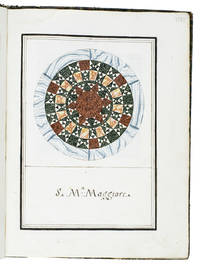
168222076Rome 1682. Contemporary boards covered with later ca. 1840 Storemont on shell marbled paper. Small folio 26 x 19.5 cm. 40 ink and watercolour drawings 28 round and 12 square each ca. 11 x 11 cm showing the decorative patterns and coloured marbles from the floors of 5 churches. Each has a triple-rule border in black ink with a panel at the foot containing the name of the church. A book of 40 detailed colour drawings showing the elaborate patterns in the mosaic marble tile floors of five different churches with eight examples from each church: Santa Maria Maggiore 1-8 Santi Giovanni e Paolo 9-16 San Marco 17-24 Sant' Alessio 25-32 and Sant' Ivo 33-40. All probably refer to the Roman churches of these names though the Basilica di San Marco in Venice also has elaborate mosaic floors. Some of the mosaics are in the Mediaeval Italian style called Cosmatesque but some may date from the Renaissance. Besides a wide variety of triangular square rectangular diamond hexagonal and octagonal tiles there are many cut with circular edges and a few irregular quadrilaterals. Some are assembled to form stars in a hexagonal grid round sunburst patterns and an endless variety of other patterns. All patterns show a rotational symmetry around the centre point or a repeating pattern in a square or hexagonal grid. The colouring of many of the tiles shows various styles and colours of marble veins.The drawings are difficult to date exactly. The leaves used for the drawings show a single paper stock very close to Piccard VI watermarks V.423 & V.424 Rome 1662. The drawings could have been made as early as ca. 1662 but the lettering of the names of the churches seems more likely to date from the 18th century. In 1752 Monsignor Giuseppe Alessandro Furietti a prelate from Bergamo published an illustrated book on mosaics from classical Rome to his own day: De Musivis Rome 1752. This marked a new interest in such antiquities but he illustrates mainly earlier examples and we find little link with the present examples which were probably drawn before his book appeared. With smudges on a few pages one slightly affecting the edge of one drawing but otherwise in very good condition with only a light marginal water stain in the last few leaves. The front hinge is broken and the spine and edges of the binding are somewhat tattered. Since many floor mosaics have been destroyed or damaged over the centuries the present book provides a unique historical record of some of the designs. hardcover