Morse, Peter; Jean CharlotBiblio.com

257 résultats
1976C102098Univ of Hawaii Pr. As New. 1976. Hardcover. 0824803647 . FREE UPGRADE to Courier/Priority Shipping Upon Request - IN STOCK AND IMMEDIATELY AVAILABLE FOR SHIPMENT - Flawless copy brand new pristine never opened -- ONE OF 200 NUMBERED COPIES WITH SIGNED ETCHING BY ARTIST. 472 pages. Catalogue Raisonne Catalog Raisonné Complete Works Life and Work Raisonnee -- with a bonus offer-- - May be EITHER: out of print OOP and extremely rare in this pristine condition; signed by author or contributor; or a first or special edition; inquire for details . Univ of Hawaii Pr hardcover
197691362Univ of Hawaii Pr. New. 1976. Hardcover. 0824803647 . FREE UPGRADE to Courier/Priority Shipping Upon Request - IN STOCK AND IMMEDIATELY AVAILABLE FOR SHIPMENT - Flawless copy brand new pristine never opened -- 472 pages. Catalogue Raisonne Catalog Raisonné Complete Works Life and Work Raisonnee -- with a bonus offer . Univ of Hawaii Pr hardcover
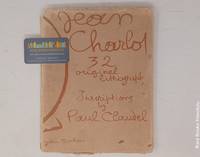
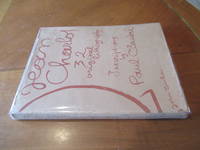
193319331JCNew York Los Angeles: John Becker 1933. 1st editions SIGNED LIMITED. see individual items. see individual items. JEAN CHARLOT Lot consisting of: <br /> <br /> 1/ PICTURE BOOK - 32 Original Lithographs by Jean Charlot<br /> <br /> New York: John Becker 1933. First Edition. 8.75 x 11 inches bound in printed wrappers with dust jacket. With inscriptions by Paul Claudel. Illustrated with 32 original lithographs in color drawn on zinc plates rather than stones by Jean Charlot and printed under the technical supervision of Will A. Kistler. Copy #315 of an edition limited to 500; all signed on the colophon page by the Jean Charlot typesetter Lynton R. Kistler and designer Merle Armitage. <br /> <br /> "The beautiful illustrations in this book typical of Charlot's Mexican figure style are these lithographs drawn by the artist on zinc plates rather than stones." The Artist and the book<br /> <br /> Condition: The rare dust jacket has repairs and damage along the spine and heavy edge wear. Four of the originally 6 inside flaps are missing. The damaged and faded spine has been stabilized with a paper strip in the inside. <br /> Book and plates are Very Good. In all Very Good<br /> <br /> 2/ Set of 9 original printers proofs for the book "32 Original Lithographs by Jean Charlot. All individually signed.<br /> <br /> several of the photos show a page from "Picture Book" and the corresponding proof next to each other.<br /> <br /> For "Picture Book" New York: John Becker 1933 the 32 color lithographs were drawn directly on large zinc plates and printed using new techniques that allowed for brilliant color separations. Present here are nine of the printer's proofs used to test the color separations. Most have slightly different color registrations than eventually appeared in the published book. All are pencil-signed by Charlot as well as signed in the plate. Two have the temporary drawing number and title printed in the plate; the others are only the printed images. interesting is that the proof of plate no. 29 is called 'Solitude' which was then changed to 'The Brass Bed' in the book. Individual copies of several of the book's lithographs occasionally appear on the market -- either unsigned removed from a broken copy of the book or one of several "artist's proofs" reserved for Charlot. However these are very rare and several have never been seen for sale individually. Sizes vary because of trimming but are generally 8-1/2"x10-1/2". <br /> <br /> Condition: Good-Very Good. Several have light edge-wear one with a few nicks one with some paper-clip transfer but all of the margins are wide and none of the flaws affect the images. All had been mounted at some time and have brown paper tape residue on the versos not affecting the rectos.<br /> <br /> 3/ Original 4-page prospectus for Picture Book with a signed original lithograph "La Malinche"<br /> <br /> The prospectus is pencil signed by Charlot. The prospectus is good with toning at the fold and a few small nicks. Ex libris Stendahl Art Galleries Los Angeles which was one of the book's distributors with the gallery stamp on the ordering blank inside the prospectus. Until its closure several years ago the Stendahl Gallery was one of America's oldest continuously operating private art galleries and a major provider of avant-garde works to major institutions throughout the world. Condition: FINE. John Becker unknown
1976102098Univ of Hawaii Pr. New. 1976. Hardcover. 0824803647 . FREE UPGRADE to Courier/Priority Shipping Upon Request - IN STOCK AND IMMEDIATELY AVAILABLE FOR SHIPMENT - Flawless copy brand new pristine never opened -- ONE OF 200 NUMBERED COPIES WITH SIGNED ETCHING BY ARTIST. 472 pages. Catalogue Raisonne Catalog Raisonné Complete Works Life and Work Raisonnee Univ of Hawaii Pr hardcover
1933028506New York: John Becker / Merle Armitage / Will And Lynton R. Kistler 1933. 1st Edition 1st Printing. Soft cover. Fine/Very Good Dust Jacket. #243 Of 500 Copies Signed By Armitage Kistler And Charlot With 32 Original Lithographs By Charlot Signed In Color On The Plates And A Dj By Charlot. True Lithographs Drawn By Charlot Directly On 34" X 44" Zinc Plates In A Color Separation Process That Charlot Had Learned From Ben Shahn. Text Hand-Set By Kistler In Castellon Old Style With Heads In Bodoni Ultra-Bold. A Fine As New Example No Wear Or Damage No Browning Or Fraying. With The Original Light Brown Dust Jacket Lettered And Illustrated In Red On Front And Rear Covers And On Spine With Unprinted Upper And Lower Flaps On Front Panel Side Flap On Rear Panel; The Dust Jacket Has Light Edge Wear And Spine Wear With Very Short Tears At Corners And A 1/8" X 1/16" And Another 1/8" X 1/4" Light Brown Stain Or Mark At Lower Front Spine Corner Otherwise Very Clean And Unfaded. An Exceptional Example. With The Four Page Prospectus For The Book With Another Original Zinc Lithograph By Charlot Signed In Pencil #25 In The Book But With A Completely Different Color Scheme From That In The Book; The Prospectus Had A Small Printing For Circulation Amongst Printers In Los Angeles And Is Rare No Institutional Holdings Identified In Worldcat. <br/> <br/> John Becker / Merle Armitage / Will And Lynton R. Kistler paperback
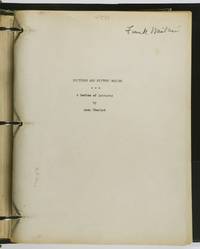
193847856Los Angeles: NP 1938. First edition. Ring_bound. vg. Quarto. 183 individual single-sided mimeographed leaves 22 additional leaves of photographic negative prints. Scarce mimeographed document printed from typescript with all leaves and negatives three-hole punched along the left side housed in modern black three-ring binder 11.5x 11". The pagination throughout is only on a per lecture basis and is non-continuous. Printed pages with occasional manuscript corrections. The versos of most of the leaves throughout contain mounted small cutouts from b/w photographic prints either reproducing relevant images from art history or being original technical hand-drawings by Charlot serving as relevant illustrated figures on the rectos for the corresponding text pages opposite 275 in total. An additional thirteen of these images have been directly mimeographed onto the rectos. The 22 leaves of compiled photographic negatives found at the rear of the binder contain most of the same images seen throughout and are organized according to lecture.<br /> <br /> In 1938 Walt Disney invited the French-born Mexican-American artist Jean Charlot 1898-1979 to deliver a series of eight lectures on art history and technique to the staff of the Disney Animation Studios over the course of two months from April 12th - May 31st of that year. Though Charlot was adamant against having any kind of lecture plan as he states in his opening remarks each of the lectures were still always themed Natural vision composition two-dimensional composition color and subject planes and space etc. Each was accompanied by a series of slides reproduced and mounted here both of Charlot's original impromptu drawings and reproductions of historic works of art. Fortunately a stenographer or recording device was present and took down each lecture including the questions and answers posed by his audience. This extremely scarce mimeographed binder serves as a complete and systematic documentation of those important and significant lectures.<br /> <br /> At the time of these lectures the company had just come off the massive and groundbreaking success of Snow White and the Seven Dwarfs 1937 and was at work on the shorts "Mickey's Toothache" and the ultimately scrapped "Pluto's Robot Twin". Although there does not seem to be direct evidence or documentation pointing to the affect these lectures ultimately had on the future work of the studio its diffuse influence can be surmised. At the very least these in depth lectures provided a continued boost to the morale and confidence of the Disney staff in placing the relatively new and sometimes belittled art form of animated films on the vast continuum of the fine arts from prehistoric times through classical antiquity and until the present. This reassured the staff of their visual storytelling abilities and the relevance of their chosen work. These assertions have since been reinforced by the the fact that in the wake of these lectures a number of these animators stayed in contact with Charlot and over the years since have asserted the personal impact these lectures had on their outlook.<br /> <br /> Although the discussions here range widely from all historical periods of art incorporate examples from the relevant work of many of the most famous international figures and touch upon countless technical and specific qualities of the fine arts arguably the most significant and unique aspect the text is Charlot's discussions of art in Mexico where he lived most of the time beginning in 1921. Specifically the art of Mexican murals and the work of Jose Guadeloupe Posada nearly forgotten during this period who had just recently died in 1913 were of interest to Charlot. It is known that he began buying Posada prints and the original printing blocks from Posada's print shop reviving interest which has never abated. Though we could find no specific reference to Posada in any of his lectures the speaker does incorporate Rivera's murals noting in passing that "a man like Rivera has absolutely to shun all textural qualities all brush stroke qualities because all things appear at a distance" Lecture V p. 12. Going further into the influence of Mexico's divergent populations and its effect on art Charlot describes in his following lecture "This static rectangle to me became assimilated to the Indian for a number of reasons and one of them is that the true verticals and true horizontals are admirably fitted to the Indian character; the Indian is always in close contact with the ground which is a true horizontal and the man in squatting takes a very different shape and different proportions from the White man. If you have a white man sitting on a chair you have those two little tooth picks under him and he has no correct relation with the so-called Mother Earth" Lecture VI p. 7. <br /> <br /> Only in the final lecture does Charlot finally speak on animation humbly noting "I told you the other time I would talk on animation tonight and I felt silly the whole week long because after all you are the people who know most about it; but it will be a good result to me by clearing my mind about it and I hope you won't hiss" Lecture VIII p. 1. The lecturer then goes on to sympathetically compare a close-up of Grumpy's face to a portrait by Raphael.<br /> <br /> According to Ruel Denny in "A Tale of Two Studios: Artist Jeans Charlot in Walt Disney's Atelier" taken from Feast of Strangers: Selected Prose and Poetry 1999 these lectures although never published "are provocative because they provide a partial but unique record of five concurrent artistic encounters in the twentieth-century: first the intellectual collaboration in artistic research by Disney and Charlot; second the encounter between the fine artist Charlot and a group of craftsmen in popular art; third the connections and disconnections between the visual arts of the pre-cinematic period and those of the cinematic age; four the marriage between cinematic animation techniques of storytelling and our inherited and folkloristic narrative of the oral and print traditions; and five the migration into modern media from primordial sources and picturizations of anthropomorphized animal figures".<br /> <br /> Some leaves throughout with minor age toning along edges as well as some occasional light stains or adhesive residue <br /> from the images pasted on the rectos. Some of the pasted on plates are loosening from the original drying adhesive and it is clear that in a very few instances images have come loose or are missing. Binder and interior in very good condition overall. Extremely scarce. Provinence:<br /> It is not known how many of these scarce mimeographed copies were printed but there is another known copy held in the collections of the University of Hawaii the state where Charlot spent his final years. It is known that the content of these lectures was never formally published. This copy bears the name of American television actor comedian and Soupy Sales sidekick Frank Nastasi 1923 – 2004 at the top of the title leaf. There is no evidence of Nastasi's connection to Disney or that he had ever attended these lectures he would have been 15 years old at the time so it is not known how he came to be in possesion of the piece. NP unknown
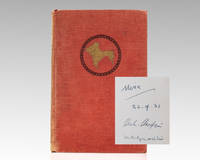
1929150889New York: Lewis Copeland Company 1929. First edition of this political critique of British colonial rule in India. Octavo original publisher's cloth with gilt titles to the spine vignette of India stamped in gilt to the front panel frontispiece of Nobel Prize-winning Indian author Rabindranath Tagore illustrated with black and white photographs throughout. Boldly signed by Mohandas Gandhi and comic actor filmmaker and composer Charlie Chaplin on the recto of the frontispiece in fountain pen. Additionally signed and dated by Mirabehn on the recto of the frontispiece "Mira 22.9.31." Mirabehn was the name adopted by Madeleine Slade 1892-1982 an Englishwoman who became a devoted follower of Mahatma Gandhi and an influential figure in India's independence movement. In very good condition. On September 22 1931 in a modest house on East India Dock Road in London's East End Charlie Chaplin met Mahatma Gandhi during the latter's visit to Britain for the Second Round Table Conference - a series of high-profile negotiations on India's constitutional future. Gandhi had come as the sole representative of the Indian National Congress hoping to press the case for Indian self-rule. Although Gandhi had never heard of the film star he agreed to meet him only after learning how profoundly Chaplin's work resonated with ordinary people. Their conversation turned to machinery and its social impact: Chaplin argued that machines could free workers from drudgery while Gandhi countered that under colonialism mechanization had only deepened India's economic dependence on Britain. Before India could enjoy the benefits of technological progress he insisted it first needed freedom. The encounter made a lasting impression on Chaplin. According to recollections he joined Gandhi in prayer during the visit and afterward described him as 'one of the most brilliant men' he had ever met. Five years later Chaplin released Modern Times widely regarded to be one of the best films of his career one of the last great silent movies and the last outing for his Little Tramp character. The themes of the movie - concern for workers skepticism toward unrestrained industrialization and an interest in human dignity - echo the conversation he shared with Gandhi that afternoon. Accompanied by a typed holiday greeting card from Doctor Katial which reads in full "With best wishes for Christmas and the New Year from Doctor Katial." Together with a handwritten letter of provenance from the original recipient W. Stuart Masters. The letter reads in full "'India in Bondage' by Prof. J.T. Sunderland. Autographed by Charles Chaplin and Mohandas Gandhi. This book was a gift to me by my friend Dr. C. L. Katial sometime mayor and alderman of Clerkenwell. At the time of the abortive 1931 All-India Conference Chaplin was visiting London and wished to meet Gandhi privately for a talk. The result of the talk was the film Modern Times. News of the impending meeting have 'leaked' to the Press a 'secret' meeting place was sought and found in the East End home of Dr. Katial who was acting as Gandhi's personal physician during his London visit. Dr. Katial phoned me the place and time to give an 'exclusive' interview; and I obtained the autographs at that time. W. Stuart Masters." Both are in near fine condition and laid in. Jabez T. Sunderland 1842–1936 was an American Unitarian minister reformer and writer whose work engaged prominently with international social and political issues particularly the cause of Indian self-government. Trained in theology and active in liberal religious circles Sunderland combined clerical leadership with advocacy for education peace and anti-imperial reform. He became especially known for his criticism of British colonial rule in India articulated most fully in India in Bondage 1928. Drawing on economic data historical analysis and contemporary political developments Sunderland contends that British administration imposed structural economic hardship and curtailed India’s political and moral autonomy. Lewis Copeland Company hardcover