8 résultats
15875180AG1587. Holzschnitt aus "Cosmographia" (4. Buch, deutsche Ausgabe, "Von Italia") von Sebastian Münster, Darst. S. 335 12,8 x 16; Bll. 22,5 x 37. Auf Wunsch Digitalaufnahme in jpg-Format erhältlich- photo in jpg-format available. Je nach Versandart können die Portokosten bis zu 2 ? weniger als angegeben betragen.
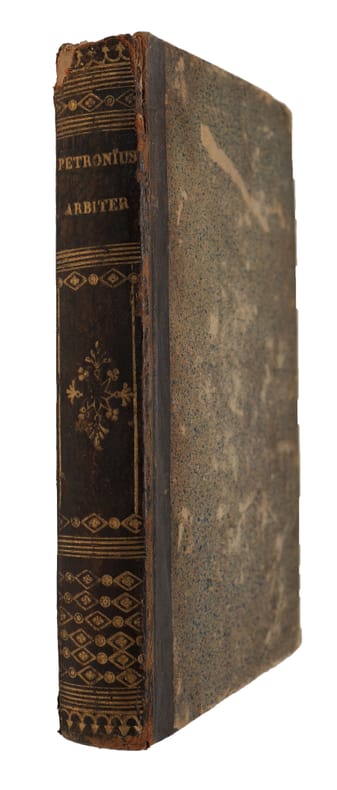
158549961Lutetiae Parisior Guilielmum Linocerium 1585 Part Sec. erraneously dated 1535. 8co. Later 19th century hcalf. Gilt spine. Wear to top of spine. Both title-page with printers woodcut device as well as on last leaf in part II. 1614416 pp. 18316 1 leaf with printers large woodcut device. The first intial letters in both parts in contemp. coloured in red. Internally clean and fine. <br/><br/><em>Vwery scarce early edition of Satyricon with the commentary by Janus Dousa.Adams P 870. </em> unknown
158549961Lutetiae Parisior, Guilielmum Linocerium, 1585 (Part Sec. erraneously dated 1535). 8co. Later (19th century) hcalf. Gilt spine. Wear to top of spine. Both title-page with printers woodcut device as well as on last leaf in part II. (16),144,(16) pp. + 183,(1),(6) + 1 leaf with printers large woodcut device. The first intial letters in both parts in contemp. coloured in red. Internally clean and fine.
1541AQ19652Lugundi i.e. Lyon: Seb. Gryphium 1541. 150 153-154 151-349pp 16. Leaf K4 misbound. Later gilt-tooled diced russia all edges red. Rubbed joints starting some scoring to boards; but an attractive copy. Endpapers browned ink-stamp of the Lawes Agricultural Trust to FEP contemporary ownership inscription to title page: 'Johannis Alardi x Armcoruf / Gronopol. 1544. empts.' marginal worm- track throughout the majority of text-block closed tear to lower corner of final leaf of index. The Rothamsted library copy of an early edition of the first complete Latin translation by Saxon humanist Janus Cornarius c. 1500-1558 of the Geoponica: the only extant Byzantine agricultural treatise first published in 1538. A twenty-book compendium of agricultural lore the Geoponica was compiled in the tenth-century at Constantinople during the Macedonian Renaissance and dedicated to emperor Constantine VII Porphyrogenitus. The anonymous work is often erroneously ascribed to seventh-century author Cassianus Bassus whose collection also titled Geoponica itself derived from a fourth- century text by agricultural compiler Vindonius Anatolius was integrated into the extant work. The primary sources for the text include Pliny's Naturalis Historia the now lost writings of various Hellenistic and Graeco-Roman agriculture and veterinary authors Carthaginian agronomist Mago and works purporting to originate with Persian prophet Zoroaster. The Geoponica embraces all manner of 'agricultural' information inter alia celestial and terrestrial omina viticulture oleoculture apiculture veterinary medicine and the construction of fish ponds. . 8vo. Seb. Gryphium hardcover
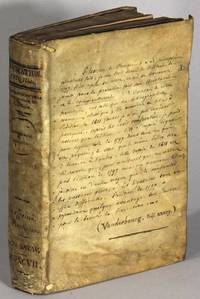
159770284Lugduni Batavorum: ex officina Plantiniana apud Franciscum Raphelengium 1597. 4to pp. 16 695 17; collating: â´ 4 A-Zâ´ a-3uâ´; printer's woodcut device on title page; woodcut initials; text in double column; contemporary full limp parchment with extensive ink notation on upper cover and titling on spine; early ownership inscription at the bottom of the title page of Zanius Dacier dated 1602. The cover notes quote Martin Marie Charles de Boudens Vanderbourg who edited an edition of Horace in 1812 so this quote likely dates to after 1812. The complete annotated Horace by the humanist Cruquius 1520-1584 who was Latin schoolmaster at Bruges. The 'commentator vetus' known as Commentator Cruquianus "is a collection of scholia published by Cruquius from various mss. notably the four codices blandinii which were destroyed by fire in 1566 with the Benedictine abbey Blandigny near Ghent" OCLC. "'Cruquius' says Dr. Harwood 'is deservedly esteemed one of the best commentators on Horace. Consult the notes in these editions on any of the difficult passages in Horace and you will have your doubts satisfactorily solved.' Barthius and Tanaquil Faber think but slightly of Cruquius: they observe and in this observation Mitscherlich seems to concur that he has performed little more than the old commentators Acro and Porphyrio. Harles thinks that Cruquius is not equal to Lambinus in research ingenuity and general critical knowledge: yet Baxter has not scrupled to call Lambinus Cruquius and Torrentius the 'tria Horatii lumina'" Dibdin. Adams H-946; Dibdin Greek and Latin Classics 4th ed. II 96; Graesse III 352; Mills College Check List 250; Riedel-Horatiana A-61. ex officina Plantiniana, apud Franciscum Raphelengium unknown
1585164455Ex Officina Ioannis Paetsij Lugduni Batavorum, Ex Officina Ioannis Paetsij, 1585.Omnia & ampliora & emendatiora, ex recognitione Iani Douase, additis eiusdem Praecidaneis cum auctario. 2 volumes in-8 relié plein vélin de l'époque, dos muet. 1ff blanc, titre, 7ff non chiffrés + 144 pages. Relié en suivant : Inani Douase Nordovicus, pro Satyrico Petronii Arbitri, viri consularis, praecidaneorum libri tres. Lugduni Batavorum, Ex officina Ioannis Paetsij, 1583. Titer, 230 pages, 2 ff blancs. "Ecrivain et poète latin du 1er siècle de l'ère chrétienne, sur la vie duquel on a que des renseignemetns incertains. Il nous est parvenu sous son nom des fragments d'un des ouvrages les plus curieux et en même temps les plus obcènes de la littérature latine Le Satyricon, roman de moeurs qui offfre évidemment la peinture de la corruption romaine sous Claude et Néron" : Larousse XIXeme Tome 12 pages 727. Petit manque sur le haut du vélin, écritures manuscrites sur le premierer denier feuillet blanc. Bel exemplaire peu courant.
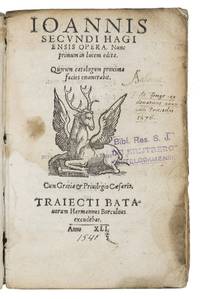
1541ABC_49905Utrecht: Herman van Borculo 1541. 18th-century limp vellum sewn on 4 supports laced through the joints with the manuscript name of the author on the spine remnants of ties. 8vo. With Borculo's woodcut device on the title page and full-page woodcut device with the motto Felici genio vivax liber arte per orbem/Chalcographa missus non minus volat. on the verso of the last leaf. First edition of the collected works of Janus Secundus or Jan Everaerts 1511-1536 the most celebrated Neo-Latin poet of the Netherlands author of the world famous Basia Kisses. Apart from some scattered occasional poems see: Dekker Janus Secundus nothing of his work had been printed during his lifetime. In this 1541 edition edited by his brothers Grudius and Marius all the works by Secundus are printed for the first time including his Elegies epithalamia funeral poems odes epigrams and above all his Basia: a collection of 19 poems in various metres in which he explores the theme of the kiss in relation to his Spanish lover Neaera. The Basia are really extended imitations of Catullus and some poems from the Anthologia Graeca. Montaigne considered the Basia the equivalent of Rabelais or the Decameron.With a small bookplate "Bibliothecae Petri Buoninsegni Senis Siena 1805" below the imprint on the title page. The vellum is slightly stained the vellum around the spine is slightly damaged the top two supports have broken at the front hinge slightly browned throughout some occasional insignificant marginal staining. Otherwise in good condition.l Adams S-837; BL STC Dutch p. 185; Dekker Janus Secundus. De tekstoverlevering van het tijdens zijn leven gepubliceerde werk. Thesis UU 1986; Secundus Oeuvres complètes W. Gelderblom & P. Tuynman eds. daprès le ms. Rawlinson G. 154 Oxford Bodl. Libr. et lédition de 1541 avec trad. notes et études littéraires 2022; ; Stevenson I 2 1777; Typogr. Batava no. 2673. Herman van Borculo, hardcover
1541M23NGJ7IKRQ5Utrecht: Herman van Borculo 1541. Contemporary vellum wrapper straight-sewn on 3 tanned calf straps laced through the wrapper with the authors name in large textura lettering reading up the spine. Small 8vo 16 x 10.5 cm. With Van Borculos winged stag couchant regardant and book device on the title page and another salient regardant with 2 books on the verso of the otherwise blank last leaf; and 3 vine-leaf ornaments Vervilet 7 8 & 43. Set in an Aldine-style italic type with upright capitals; 92 mm/20 lines with roman capitals for occasional words phrases and 2-line initials. Rare first edition in the original Latin of the collected poetic works of the humanist and neo-Latin poet Janus or Joannes Secundus Jan Everaerts 1511-1536 who "ranks among the foremost poets of the world" as "the only famous 16th-century Dutch poet" Guépin p. 231: "one of the most significant and enduring poets of the Renaissance" and "the outstanding Latin love poet of the northern Renaissance" Price p. 1. Although not quite twenty-five when he died he published numerous poetic works from 1532 to 1536 but left most of his work unpublished at his premature death. Much of his poetry appeared for the first time in the present posthumous edition. Janus is most famous for his "Basia" kisses: 19 lyric love poems influenced by Catullus. Janus's three books of elegies especially the first book comprising 11 love poems to his possibly fictional first love Julia are also masterpieces of neo-Latin poetry.Although revered internationally in his own century and influential throughout the 17th and 18th centuries among his avid readers were Ronsard Fleming Huygens Milton and Goethe Janus's name has been eclipsed in the Netherlands by those of Cats and Vondel in part because they wrote in Dutch.Janus Secundus was born in The Hague. His father was a lawyer at the leading courts of the Low Countries and the family moved to Maastricht when Janus was sixteen. He studied law there and later studied at Bourges and at the University in Louvain. Though a native Dutch speaker and fluent in French Janus had learned Latin with his older brothers at an early age and corresponded with them in Latin.With 3 French verses in a near contemporary hand on the endleavesFurther with a near contemporary donation inscription on the title-page; a 19th-century bookplate on the inside front wrapper and blue ink stamp on the title-page. With the title-page somewhat worn and with stains in its margins plus a water stain in the first 10 leaves and a fainter marginal one some of the last few leaves but otherwise in good condition. The sewing supports have broken at the front hinge and the velum wrapper is somewhat soiled with a small corner of the back wrapper lost. Rare first edition of a seminal work of neo-Latin poetry by the first great Dutch poet Janus Secundus.l Adams S837 1 copy; BMC STC Dutch p. 185; G. Joos Uitgaven van Janus Secundus 10; Netherlandish books 27713 10 copies; USTC 421142 same 10 copies; Valkema Blouw Typ. Batava 2673 13 copies; not in Oberlé Poètes néo-Latins; for Secundus: J.P. Guépin "Tres fratres Belgae: brothers poets and civil servants in the sixteenth century" in: The Low Countries 8 2000 pp. 231-238; David Price Janus Secundus 1996. Herman van Borculo, hardcover