Arthur KOESTLERLivre Rare Book
Aulus Janus ParrhasiusBiblio.com
Auli Jani Parrhasii Consentini Quaesita Per Epistolam 1771
A9781165937264New. unknown
The Saint Bookstore · Royaume-Uni38,35 £GB≈ 43,79 €
800 résultats
1979AUB-2314Paris, Calmann-lévy 1979. Bon in-8 broché, couverture ornée d'éd., 348 pages avec annexes dont index.
A9781165937264New. unknown
B9781165937264New. unknown
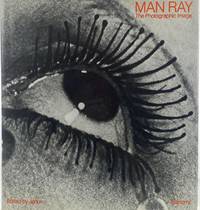
198066497N.Y.: Barron's 1980. 1st American edition. Binding firm and intact. Near Fine/Near Fine. Square 4to. Hardcover with price-clipped DJ. 160 B/W illustrations. DJ with tanning around the edges and two small nicks to head of spine. Boards slightly lifted from textblock. Clean and unmarked interior. Barron's unknown
2010DADAX1160753113Kessinger Publishing 2010-03-19. paperback. New. 6.00x1.26x9.00. Buy with confidence. Excellent Customer Service & Return policy. Kessinger Publishing paperback
2010DADAX1168156939Kessinger Publishing 2010-09-10. paperback. New. 6.00x1.26x9.00. Buy with confidence. Excellent Customer Service & Return policy. Kessinger Publishing paperback
1160753113.Gpaperback. Good. Access codes and supplements are not guaranteed with used items. May be an ex-library book. paperback
1168156939.Gpaperback. Good. Access codes and supplements are not guaranteed with used items. May be an ex-library book. paperback
0267585330.Gpaperback. Good. Access codes and supplements are not guaranteed with used items. May be an ex-library book. paperback
036427347X.Ghardcover. Good. Access codes and supplements are not guaranteed with used items. May be an ex-library book. hardcover
197166134Krefeld: Verlag der Galerie am Bismarckplatz 1971. [42] Seiten. Mit zahlreichen Illustrationen. 8° (18,5 x 13 cm). Orig.-Broschur. [Softcover / Paperback].
2017__0714874736Phaidon Inc Ltd 2017. Hardcover. New. 271 pages. 11.00x8.50x1.25 inches. Phaidon Inc Ltd hardcover
73794Amstelodami Ex Officina D. Groebe 1834. 140 p. Paperback cover damaged Amstelodami, Ex Officina D. Groebe 1834 paperback
#[35262]Diss. Amsterdam rechtsgeleerdheid 13-12-1834 ; 8 14 95 p. Exemplaar in geheel leren band unknown
2009DADAX1104859440Kessinger Publishing 2009-08-10. paperback. New. 6.00x1.19x9.00. Buy with confidence. Excellent Customer Service & Return policy. Kessinger Publishing paperback
In -4°, cc. 58, piena pergamena e titolo manoscritto al dorso. Frontespizio in cornice xilografica, iniziali e marca editoriale di Mazzocchi in fine. Prima edizione della traduzione in latino di quest’opera di Senofonte fatta da Bessarione (Trebisonda 1403 - Ravenna 1472), Cardinale, teologo e umanista, intorno agli anni ’40 del secolo precedente. Si presume che a scoprire il manoscritto sia stato lo stesso Giano Vitale, autore della lettera dedicatoria che apre il volume. L’opera di Bessarione contribuisce in maniera decisiva alla rivalutazione delle opere di Senofonte, autore pressoché dimenticato nel Medioevo, avvenuta nel Rinascimento, opere che forniranno, relativamente al mondo socratico, una cospicua alternativa alla rappresentazione che ne dà Platone nei suoi Dialoghi. Bellissimo il frontespizio incorniciato (riprodotto in Mortimer, “Italian 16th century books”, p. 583). Adams X-43 Title page in a xilographic frame, initials and Mazzocchi’s printer’s mark at the end. The first edition of the latin translation of this Xenophon’s work, made by Bessarion (1403-1472), a Cardinal and a humanist, in the first half of the XV century. The manuscript was probably discovered by the very Giano Vitale, author of the dedication letter at the beginning of the volume. Bessarion’s work is a crucial contribution to the revaluation of Xenophon’s work, happened in the Renaissance. A very charming title page (reproduced in Mortimer, “Italian 16th century books”, p. 583) Adams X-43
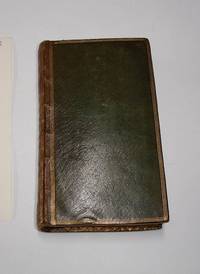
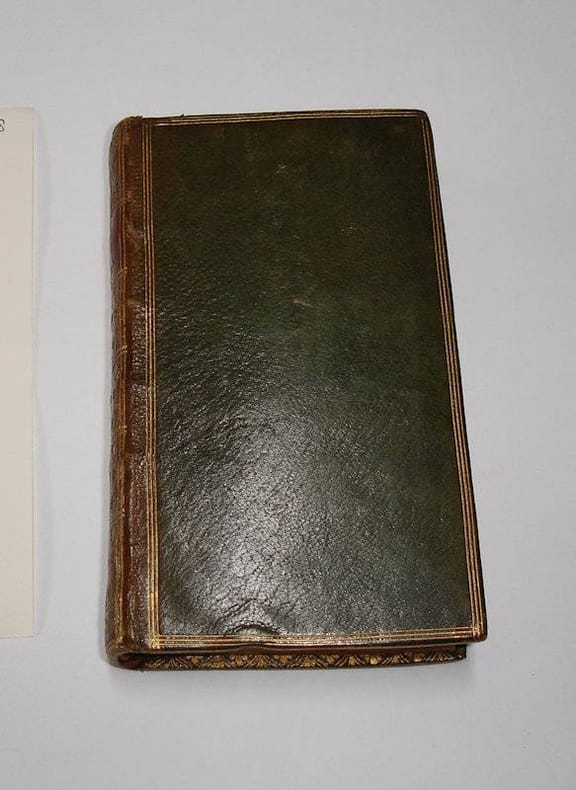
120208Leiden Lugduni Batavorum 1757. 12mo in 8 & 4 sheets. 3 volumes in 1: IVIV124 p. a portrait of Beza; X106 p. a portrait of Muretus; IV3-156 p. Green morocco 16 cm Ref: Brunet 1239; Graesse cf 1359 where we find the imprint Paris 1757 Details: Green morocco; red morocco shield on the back; gilt floral decoration on the back; boards with gilt triple fillet borders; inside dentelles gilt; marbled endpapers; edges of the bookblock gilt; woodcut printers' mark of Joseph Gérard Barbou on all three titles depicting an old man who stands in the shade of a vine-entwined elmtree. The motto is 'Non solus'. The 2 portraits have been etched by Fiquet Condition: Some wear to the extremes. A small bump in the bottom edge of the front board. Two tiny and almost invisible wormholes in the front joint Note: All three titles in this book have a false imprint 'Lugduni Batavorum' i.e. Leiden in the Dutch Republic. It was according to Brunet actually published in Paris by Barbou. He does not explain but the printer's mark paper printing and layout looks indeed very Barbou. The Short Title Catalogue Netherlands STCN is not sure either about Leiden it adds 'printed in France' § In Latin elegiac and epigrammatic poetry from Roman times to the Renaissance there is constant reference to the 'poetry of youth' as 'standing in contrast to a kind of poetry suitable to be written in old age. The poets characterize the latter poetry as serious moral and austere touching on wars and politics and patriotism. The former is filled with passion and exuberance concerned not with weighty national issues but with jokes and laughter and erotic affaires'. K.M. Summers 'The Iuvenilia of Marc-Antoine Muret' Columbus 2006 p. XXV-XXVI § The first edition of 'poemata juvenilia' of the young Calvinist theologian Theodore de Bèze or Theodorus Beza 1519-1605 was published in Paris in 1548. 'It had certain rather free pieces printed which were afterwards made a matter of bitter reproach against him. He therefore suppresed them in the following editions'. Ebert This first edition including the erotic love poems which Beza later regretted having ever published was clandestinely reprinted. Beza was considered to be among the best Neo-Latin poets of his time. He is however best known for his Latin translation of the New Testament his critical Greek edition of the New Testament and for being the founder of the University of Geneva. § The Frenchman Marc Antoine Muret latinized as Marcus Antonius Muretus 1526-1585 'exemplifies the essence of French Renaissance humanism. A master of Latin and student of Classical Antiquity he not only engaged in the recovery and exposition of ancient texts he also actively employed the old genres and skills in the contemporary ecclesiastical and public spheres. He wrote Latin poetry both sacred and profane delivered public orations in Latin and lectured in various schools throughout France and Italy on authors as diverse as Catullus and Tacitus and on topics as varied as Greek philosophy and Roman law'. K.M. Summers 'The Iuvenilia of Marc-Antoine Muret' Columbus 2006 p. XIII His 'Iuveninlia' were first published in 1552. § The Dutch neolatin poet Janus Secundus Nicolai Hagiensis was born on the 15th of november 1511 the day of the martyr Secundus in The Hague. He died very young in 1536. In 1528 he moved to Mechelen the residence of the Austrian vicequeen Margaretha of Parma. The southern part of the Netherlands was in this time the center of a florishing urban civilization. In May 1530 Secundus met a young prostitute from Mechelen called Julia and fell in love with her. Julia became the subject of his first book of elegies his 'Julia Monobiblos' in which he tells how he won and lost his love. During his studies in Bourges under the famous jurist Alciati he wrote his first 'Basia'. Alciati introduced Secundus there also to the newest Italian poetry. A humanist poet often started his career with erotic poetry like Piccolomini and Beza. Secundus' 'kiss-poems' are a variation on two 'kiss-poems' of the Latin poet Catullus ca. 84-54 B.C who became during the Renaissance a model for love-poetry. Secundus wrote in his short life 6835 lines of poetry of which only 425 lines were printed during his lifetime. He wrote 'with equal fluency all kinds of lyrical heroic and elegiac verse. Down to the present day Secundus lives in literary history as the kissing poet' . 'Until far in the 18th century Secundus is mentioned as one of the classics of love poetry' IJsewijn Companion to Neo-Latin studies I Leuven 1990 p. 152 The first edition of his collected works was posthumely published in 1541 in Utrecht and was edited by Secundus brother Marius. § After the poems of Janus Secundus we find 46 pages with the 'Pancharis Joan. Bonefonii Averni ad Jacobum Guellium p. 111-156 Provenance: On the verso of the front flyleaf: 'John Wordsworth Edinburgh 1827'. This is the English classical scholar John Wordsworth 1805-1839 nephew of the Romantic poet William Wordsworth. 'In October 1824 he entered Trinity College Cambridge. His university career was distinguished. In 1825 he obtained the Bell scholarship in 1826 a scholarship at his own college and was second for the Porson prize; in 1827 he obtained it. In 1828 he proceeded to the B.A. degree but was disqualified for classical honours through distaste for mathematics. In 1830 he was elected fellow of his college. . In 1834 he was appointed a classical lecturer in Trinity College and undertook to edit Richard Bentley's Correspondence afterwards completed by his brother Christopher Wordsworth'. Source Wikipedia Collation: pi4 plus portrait; A8 B4 C8 D4 etc. K4 L2; Portrait A8 B4 etc. X8 Y4 Photographs on request hardcover
120208Leiden (Lugduni Batavorum), 1757.
1980R260254464Au bureau du journal. 1980. In-8. Broché. Bon état, Couv. convenable, Coiffe en tête abîmée, Intérieur frais. 208 pages.. . . . Classification Dewey : 400-LANGUES
1665581883.Gpaperback. Good. Access codes and supplements are not guaranteed with used items. May be an ex-library book. paperback
#[33512]Diss. Leiden rechtsgeleerdheid 28-7-1755 ; 35 1 p. l Opdracht aanvader Cornelius Wilhelmus Blankert. unknown
#[33221]Diss. Groningen rechtsgeleerdheid 23-6-1860 ; 12 186 6 p. unknown
33513Diss. Leiden rechtsgeleerdheid 19-6-1778 ; 8 56 2 p. Opdracht aan vader Janus Christianus de Blocquery. unknown
#[36346]Diss. Wittenberg 14-10-1716 ; 4 36 p. l Opdracht: aan J.G. von Ponickau unknown
71318°: pi 4 A-I 8 K 4 gepagineerd: 8 70; 81 1 pp. Titelpagina in zwart en rood. Oorspr. papieren omslag. Lit.: Zie over Gerhard Alting: NNBW I 94. Waller 302 Jean Bonnefons d'Auvergne 1554-1614 schreef zijn Neolatijnse minnezangen onder de naam Janus Bonefonius. Volgens een onder het voorbericht ingeplakte notitie in handschrift is de Nederlandse vertaler Gerhard Alting. Achter de gedichten van Bonefonius volgt nog een aantal erotische gedichten zo overzettingen als eige vindingen om de overeenkomst van stoffe bygevoegt schrijft de vertaler in het voorbericht. Gerhard Alting geboren in Groningen in 1694 studeerde rechten in Groningen. Hij heeft veel Latijnse gedichten geschreven die meest op losse bladen zijn gedrukt. unknown