800 résultats
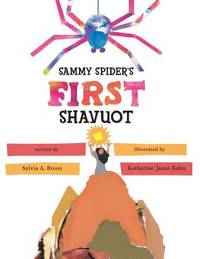
2012Q-0761366644Kar-Ben Publishing ® 2012-08-01. Paperback. New. New. In shrink wrap. Looks like an interesting title! Kar-Ben Publishing ® paperback
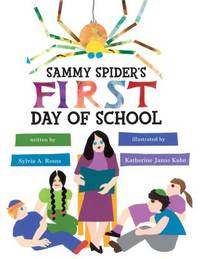
2010Q-0761339663Kar-Ben Publishing ® 2010-08-01. Paperback. New. In shrink wrap. Looks like an interesting title! Kar-Ben Publishing ® paperback
2008Q-0822572257Kar-Ben Publishing ® 2008-01-01. Paperback. New. New. In shrink wrap. Looks like an interesting title! Kar-Ben Publishing ® paperback
2009Q-0822585847Kar-Ben Publishing ® 2009-01-01. Paperback. New. In shrink wrap. Looks like an interesting title! Kar-Ben Publishing ® paperback
1993Q-0929371461Kar-Ben Publishing ® 1993-08-01. Paperback. New. New. In shrink wrap. Looks like an interesting title! Kar-Ben Publishing ® paperback
1994Q-0929371828Kar-Ben Publishing ® 1994-01-01. Paperback. New. New. In shrink wrap. Looks like an interesting title! Kar-Ben Publishing ® paperback
1996Q-0929371992Kar-Ben Publishing ® 1996-08-01. Paperback. New. In shrink wrap. Looks like an interesting title! Kar-Ben Publishing ® paperback
2013Q-1467719161Kar-Ben Publishing ® 2013-08-01. Board book. New. New. In shrink wrap. Looks like an interesting title! Kar-Ben Publishing ® unknown
2006Q-1580131476Kar-Ben Publishing ® 2006-01-01. Paperback. New. New. In shrink wrap. Looks like an interesting title! Kar-Ben Publishing ® paperback
2013Q-0761391959Kar-Ben Publishing ® 2013-08-01. Library Binding. New. In shrink wrap. Looks like an interesting title! Kar-Ben Publishing ® unknown
2010Q-0761339655Kar-Ben Publishing ® 2010-08-01. Library Binding. New. In shrink wrap. Looks like an interesting title! Kar-Ben Publishing ® unknown
2009Q-0822585839Kar-Ben Pub 2009-03-01. Hardcover. New. New. In shrink wrap. Looks like an interesting title! Kar-Ben Pub hardcover
#[32477]Diss. Leiden rechtsgeleerdheid 14-6-1854 ; ; 12 132 p. fluwelen band met goudstempeling snede rondom verguld unknown
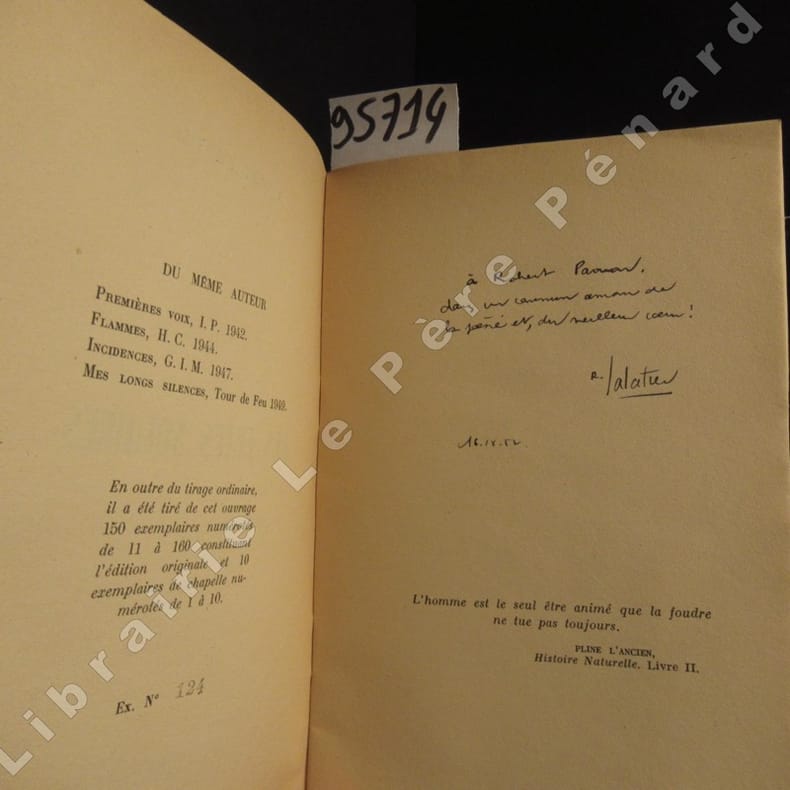
1951957141951 Janus - 1951 - petit In-8 broché - 30 pages - N° 124/150 - envoi (dédicace) de l'auteur
1660236711660. ... Vicino a qello al segno .A. si uede un arco piccolo di forma quadra ornato di otto pilastri d'opera Corinthia, fu drizzato quest' arco dalli argentieri et mercanti di detto foro boario in honore di Settimio et Marco Aurelio Imperatori, Vedesi ancor nel segno.B.un condotto d'acqua antico che fu ritrouato sotto terra, doue per beneficio publico iui si sono fatte bellissime fontane con un lauatore et si chiama quella piazza la fontana di santo Giorgio per esser iui la chiesa di questo Santo." Kupferstich von Marco Sadeler. Blattmaß: 32x23 cm, Plattengröße: 27x16 cm. - Das Bild zeigt den Janus-Tempel in Rom und dessen Umgebung, darunter ein unterirdischer Wasserkanal. Marco Sadeler (1614-1660) war Teil der Sadeler-Familie, welche eine der berühmtesten Druckerfamilien der Zeit war. Im weißen Rand etwas angeschmutzt. Insgesamt schönes und sauberes Exemplar.
879764000X.Ghardcover. Good. Access codes and supplements are not guaranteed with used items. May be an ex-library book. hardcover
51528915like new. unknown
8797640034.Ghardcover. Good. Access codes and supplements are not guaranteed with used items. May be an ex-library book. hardcover
6396283445pp. 143 . Papeback. New. unknown
159134Leiden Lugduni Batavorum Apud Franciscum Hegerum 1631. Colophon at the end: 'Impressa Lugduni Batavorum in nova officina typographica Wilhelmi Christiani 1631' 12mo. XXVIII384 recte 3821 colophon1 blank p. Vellum. 13.5 cm 'The kissing poet' Ref: STCN ppn 833698613; Brunet 5257; Willems 1669; Graesse 6339; Ebert 20786 Details: 5 thongs laced through the joints. Short title in ink on the back. Engraved title with the portrait of the first love of the neolatin poet Janus Secundus Julia locked within a kind of medallion and surrounded by 2 cornucopiae; the text reads: 'Vatis amatoris Iulia sculpta manu' i.e. 'a portrait sculped by the hand of the author'. On p. 10 verso an almost full-page engraved portrait of Janus Secundus himself holding in his hand the medal or medallion he made with the portrait of Julia; underneath the portrait a 4 line poem by his brother Hadrianus Marius Condition: Vellum age-tanned. Front pastedown detached. Some irregular pagination Note: The Dutch neolatin poet Janus Secundus Nicolai Hagiensis was born on the 15th of november 1511 the day of the martyr Secundus in The Hague. He died very young in 1536. In 1528 he moved to Mechelen where his father was appointed president of the 'High Council'. This town was the residence of the Austrian vicequeen Margaretha of Parma. The southern part of the Netherlands was in this time the center of a florishing urban civilization. In May 1530 Secundus met a young prostitute from Mechelen called Julia and fell in love with her. Julia became the subject of his first book of elegies his 'Julia Monobiblos' in which he tells how he won and lost his love. During his studies in Bourges under the famous jurist Alciati he wrote his first 'Basia'. Alciati introduced Secundus there also to the newest Italian poetry. A humanist poet often started his career with erotic poetry like Piccolomini and Beza. Secundus' 'kiss-poems' are a variation on two 'kiss-poems' of the Latin poet Catullus ca. 84-54 B.C who became during the Renaissance a model for love-poetry. Secundus wrote in his short live 6835 lines of poetry of which only 425 lines were printed during his lifetime. He wrote 'with equal fluency all kinds of lyrical heroic and elegiac verse. Down to the present day Secundus lives in literary history as the kissing poet' . 'Until far in the 18th century Secundus is mentioned as one of the classics of love poetry' IJsewijn Companion to Neo-Latin studies I Leuven 1990 p. 152 The first edition of his collected works was posthumously published in 1541 in Utrecht and was edited by Secundus brother Marius. All later editions are based on this edition. The manuscript with the collected works used for this edition came later in the possession of the Dutch classicist Petrus Scriverius 1576-1660. He produced a new edition in 1612 in which he also incorporated poems of Secundus which had been omitted in the 1541 edition because they were thought to be disagreeable to the French and English king. In this second edition of 1631 Scriverius incorporated more material from other sources and manuscripts. Best source for Secundus is J.P. Guépin 'De kunst van Janus Secundus' Amst. 1991. It opens with 18 page with 'testimoni'a and 'iudicia' on Secundus. After the poems of Secundus Scriverius added some poems of his brother Marius: 'Cymba amoris et alia poemata'. p. 249/266 This is followed by Secundus' prose letters though with some poetry that he wrote during his 3 voyages through France and his trip to Spain. p. 269/345 At the end have been added some letters and a treatise on the family of Secundus 'De Nicolao Patre & gente Nicolaia' Collation: 8between leaf 4 and 5 have been inserted the leaves pi5 and pi6 4; A-Q12 Between the gatherings C and D the pagination of 72/79 is skipped.Leaf H11 p. 195/96 misnumbered 159/196 is a cancel. Leaves K11 & K12 have also irregular pagination the numbers of the pages 244/45 are doubly used. Leaf L8 is a blank leaf. Leaf Q12 verso blank Photographs on request hardcover
120511Paris Parisiis Sumtibus Societatis 1748. 12mo. II3821 corrigenda p. portrait. Vellum 14.5 cm Ref: cf. Willems 1669 Details: 5 thongs laced through the joints. An engraved portrait on the title of the first love of Janus Secundus Julia locked within a kind of medallion and surrounded by 2 cornucopiae; the text reads: Vatis amatoris Iulia sculpta manu i.e. a portrait sculped by the hand of the author; opposite the title is a full-page engraved portrait of Janus Secundus himself holding in his hand the medal or medallion he made with the portrait of Julia; underneath the portrait a 4 line poem by his brother Hadrianus Marius Condition: Binding soiled. Old ownership entry on the first flyleaf. Outer margin of the portrait & the title thumbed. Paper yellowing Note: The Dutch neolatin poet Janus Secundus Nicolai Hagiensis was born on the 15th of november 1511 the day of the martyr Secundus in The Hague. He died very young in 1536. In 1528 he moved to Mechelen where his father was appointed president of the High Council. This town was the residence of the Austrian vicequeen Margaretha of Parma. The southern part of the Netherlands was in this time the center of a florishing urban civilization. In May 1530 Secundus met a young prostitute from Mechelen called Julia and fell in love with her. Julia became the subject of his first book of elegies his Julia Monobiblos in which he tells how he won and lost his love. During his studies in Bourges under the famous jurist Alciati he wrote his first Basia. Alciati introduced Secundus there also to the newest Italian poetry. A humanist poet often started his career with erotic poetry like Piccolomini and Beza. Secundus' kiss-poems are a variation on two kiss-poems of the Latin poet Catullus ca. 84-54 B.C who became during the Renaissance a model for love-poetry. Secundus wrote in his short live 6835 lines of poetry of which only 425 lines were printed during his lifetime. He wrote 'with equal fluency all kinds of lyrical heroic and elegiac verse. Down to the present day Secundus lives in literary history als the kissing poet' . 'Until far in the 18th century Secundus is mentioned as one of the classics of love poetry' IJsewijn Companion to Neo-Latin studies I Leuven 1990 p. 152 The first edition of his collected works was posthumely published in 1541 in Utrecht and was edited by Secundus' brother Marius. All later editions are based on this edition. The manuscript with the collected works used for this edition came later in the possession of the Dutch classicist Petrus Scriverius 1576-1660. He produced a new edition in 1619 in which he also incorporated poems of Secundus which had been omitted in the 1541 edition because they were thought to be disagreeable to the French and English king. In his second edition of 1631 Scriverius incorporated more material from other sources and manuscripts. Best source for Secundus is J.P. Guépin De kunst van Janus Secundus Amst. 1991 § The book on offer here is a reissue of the third edition of 1651. Willems says about the edition of 1651: 'L'édition de 1651 reproduit textuellement la précédente' id est that of 1631. The book opens with 18 pages testimonia and iudicia on Secundus. After these preliminary pages and before Secundus' text we find on page 27 a kind of half title: Joannis Secundi poemata quae reperiri potuerunt omnia. Ex tertia editione Petri Scriverii anno 1650. The year 1650 seems to be a printing error of the French printer. At the end are added some letters and a treatise on the family of Secundus De gente Nicolaia Provenance: on front flyleaf the old ownership entry of 'Frid. Guil. von Knebel'. We found on the internet a Friedrich Wilhelm von Knebel 1735-1799 who seems to have been a rigid and at the same time sloppy Prusian state official. § On the front pastedown is written in a different hand 'Ostheide'. Ostheide might refer to the Samtgemeinde collective municipality in the district of Lüneburg south of Hamburg in Lower Saxony Germany. Ostheide is also a German family name Collation: pi1 = A12 A12 minus leaf A12 B-Q12 R1 corrigenda Photographs on request hardcover
1334375569.Gpaperback. Good. Access codes and supplements are not guaranteed with used items. May be an ex-library book. paperback
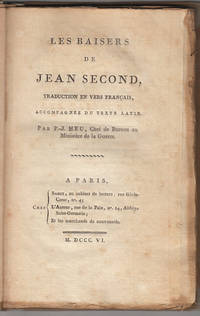
0098-10Paris de Vuel 1806. gr.-8°. 2 Bll. 96 S. spät. HLn. Namenszug am Vortit. Johannes Secundus eigentlich Johann Nico Everaerts 1511 in Den Haag - 1536 bei St. Amand war ein niederländischer Dichter. Sein Vater war ein Freund des Erasmus von Rotterdam. 1532 ging er nach Bourges um Rechtswissenschaften zu studieren. Er erwarb dort seine Lizenz und ging im Jahr 1533 nach Madrid an den spanischen Hof Karl V. Secundus verfasste zahlreiche Bücher mit Elegien Epigrammen Oden Versepisteln etc . in neulateinischer Sprache. Sein wichtigstes Werk war die Basia eine kurze Zusammenstellung von 19 Gedichten in verschiedenen Versmaßen in denen er in Nachahmung Catulls das Sujet des Kusses behandelt. Paris, de Vuel 1806. unknown
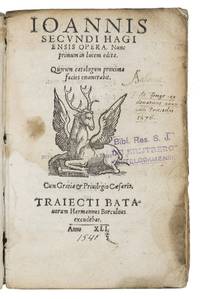
1541ABC_49905Utrecht: Herman van Borculo 1541. 18th-century limp vellum sewn on 4 supports laced through the joints with the manuscript name of the author on the spine remnants of ties. 8vo. With Borculo's woodcut device on the title page and full-page woodcut device with the motto Felici genio vivax liber arte per orbem/Chalcographa missus non minus volat. on the verso of the last leaf. First edition of the collected works of Janus Secundus or Jan Everaerts 1511-1536 the most celebrated Neo-Latin poet of the Netherlands author of the world famous Basia Kisses. Apart from some scattered occasional poems see: Dekker Janus Secundus nothing of his work had been printed during his lifetime. In this 1541 edition edited by his brothers Grudius and Marius all the works by Secundus are printed for the first time including his Elegies epithalamia funeral poems odes epigrams and above all his Basia: a collection of 19 poems in various metres in which he explores the theme of the kiss in relation to his Spanish lover Neaera. The Basia are really extended imitations of Catullus and some poems from the Anthologia Graeca. Montaigne considered the Basia the equivalent of Rabelais or the Decameron.With a small bookplate "Bibliothecae Petri Buoninsegni Senis Siena 1805" below the imprint on the title page. The vellum is slightly stained the vellum around the spine is slightly damaged the top two supports have broken at the front hinge slightly browned throughout some occasional insignificant marginal staining. Otherwise in good condition.l Adams S-837; BL STC Dutch p. 185; Dekker Janus Secundus. De tekstoverlevering van het tijdens zijn leven gepubliceerde werk. Thesis UU 1986; Secundus Oeuvres complètes W. Gelderblom & P. Tuynman eds. daprès le ms. Rawlinson G. 154 Oxford Bodl. Libr. et lédition de 1541 avec trad. notes et études littéraires 2022; ; Stevenson I 2 1777; Typogr. Batava no. 2673. Herman van Borculo, hardcover
1541M23NGJ7IKRQ5Utrecht: Herman van Borculo 1541. Contemporary vellum wrapper straight-sewn on 3 tanned calf straps laced through the wrapper with the authors name in large textura lettering reading up the spine. Small 8vo 16 x 10.5 cm. With Van Borculos winged stag couchant regardant and book device on the title page and another salient regardant with 2 books on the verso of the otherwise blank last leaf; and 3 vine-leaf ornaments Vervilet 7 8 & 43. Set in an Aldine-style italic type with upright capitals; 92 mm/20 lines with roman capitals for occasional words phrases and 2-line initials. Rare first edition in the original Latin of the collected poetic works of the humanist and neo-Latin poet Janus or Joannes Secundus Jan Everaerts 1511-1536 who "ranks among the foremost poets of the world" as "the only famous 16th-century Dutch poet" Guépin p. 231: "one of the most significant and enduring poets of the Renaissance" and "the outstanding Latin love poet of the northern Renaissance" Price p. 1. Although not quite twenty-five when he died he published numerous poetic works from 1532 to 1536 but left most of his work unpublished at his premature death. Much of his poetry appeared for the first time in the present posthumous edition. Janus is most famous for his "Basia" kisses: 19 lyric love poems influenced by Catullus. Janus's three books of elegies especially the first book comprising 11 love poems to his possibly fictional first love Julia are also masterpieces of neo-Latin poetry.Although revered internationally in his own century and influential throughout the 17th and 18th centuries among his avid readers were Ronsard Fleming Huygens Milton and Goethe Janus's name has been eclipsed in the Netherlands by those of Cats and Vondel in part because they wrote in Dutch.Janus Secundus was born in The Hague. His father was a lawyer at the leading courts of the Low Countries and the family moved to Maastricht when Janus was sixteen. He studied law there and later studied at Bourges and at the University in Louvain. Though a native Dutch speaker and fluent in French Janus had learned Latin with his older brothers at an early age and corresponded with them in Latin.With 3 French verses in a near contemporary hand on the endleavesFurther with a near contemporary donation inscription on the title-page; a 19th-century bookplate on the inside front wrapper and blue ink stamp on the title-page. With the title-page somewhat worn and with stains in its margins plus a water stain in the first 10 leaves and a fainter marginal one some of the last few leaves but otherwise in good condition. The sewing supports have broken at the front hinge and the velum wrapper is somewhat soiled with a small corner of the back wrapper lost. Rare first edition of a seminal work of neo-Latin poetry by the first great Dutch poet Janus Secundus.l Adams S837 1 copy; BMC STC Dutch p. 185; G. Joos Uitgaven van Janus Secundus 10; Netherlandish books 27713 10 copies; USTC 421142 same 10 copies; Valkema Blouw Typ. Batava 2673 13 copies; not in Oberlé Poètes néo-Latins; for Secundus: J.P. Guépin "Tres fratres Belgae: brothers poets and civil servants in the sixteenth century" in: The Low Countries 8 2000 pp. 231-238; David Price Janus Secundus 1996. Herman van Borculo, hardcover