Salvation ArmyBiblio.com

64 résultats
1417949198.Gpaperback. Good. Access codes and supplements are not guaranteed with used items. May be an ex-library book. paperback
0548036454.Ghardcover. Good. Access codes and supplements are not guaranteed with used items. May be an ex-library book. hardcover
1163347752.Ghardcover. Good. Access codes and supplements are not guaranteed with used items. May be an ex-library book. hardcover
1498010652.Gpaperback. Good. Access codes and supplements are not guaranteed with used items. May be an ex-library book. paperback
1494155710.Ghardcover. Good. Access codes and supplements are not guaranteed with used items. May be an ex-library book. hardcover
2007DADAX0548036454Kessinger Publishing 2007-07-25. hardcover. New. 6.00x0.75x9.00. Buy with confidence. Excellent Customer Service & Return policy. Kessinger Publishing hardcover
1921016168London England: Salvation Army 1921. Landscape two stapled cloth cover pages 23 to 34 missing red cover with black lettering insignia on cover tanned rubbed slight fraying Any picture found beside this listing may NOT actually be a picture of this book but a stock photo used by the listing site. 3 R's Used Books and Hannelore Headley Old & Fine Books Inc. are committed to saving the trees one leaf at the time!. Paperback. Good/No Jacket. Salvation Army
1902050627Toronto Ontario Canada: The Salvation Army 1902. Book. Very Good. Soft cover. 1st Edition. 8vo - over 7¾ - 9¾" tall. 64 Pages Illus. Introduction By Evangeline Booth. Sign Of Previous Stain O/W Sound Copy Of Rare Insight Into The Early Years Of The Army In Canada Including The Western Provinces And Territories. Only One Copy Located. The Salvation Army Paperback
0340862513.Gpaperback. Good. Access codes and supplements are not guaranteed with used items. May be an ex-library book. paperback
1919814271919. SALVATION ARMY. THE WAR ROMANCE OF THE SALVATION ARMY. By Evangeline Booth and Grace Livingston Hill. Philadelphia: J.B. Lippincott 1919. Illustrated. Some foxing one plate sprung. About very good. unknown books
1904206381904. 31 pp with illustrations from photographs in original wrappers. Spine covered with archival tape line in ink on the margin of one page otherwise clean and sound. In 1898 the Salvation Army undertook a project intended to relocate urban working poor people to rural areas and enable them to become productive farmers. The idea for the project came from Salvation Army founder William Booth who described the concept in his book In Darkest England and the Way Out 1890. General Booth's daughter Emma and son-in-law Fredrick St. George de Lautour Booth-Tucker took charge of the Salvation Army in the United States in 1896 and they took it upon themselves to put General Booth's plan into action. The plan was characterized by Frederick Booth-Tucker as an experiment in "domiculture" or the cultivation of families on family farms. The Booth-Tuckers appointed Col. Thomas Holland as the National Colonization Secretary and together they chose sites in California Colorado and Ohio for the colonies. Source: Schemp Fort Amity An Experiment in Domiculture 2011. The Amity colony was settled by thirty families from Chicago and Iowa each of whom received ten acres of land livestock and tools. By 1903 the colony had 450 residents. In 1904 when this collection of testimonials was produced--presumably as both a fundraising tool and a response to naysayers--the project still seemed like it might succeed. That it did not closing in 1909 was apparently not due to any failure in selecting worthy colonists but because the Salvation Army officials had purchased land that was so alkaline that sustainable farming was impossible. Three copies located in OCLC. unknown books
Inscribed by author to his daughter Alice, signed "from her father, Xmas 1910" upon front free endpaper. [Documentation supporting this provenance will be provided.] xiii, [1], 375 pages. Index of Subjects. List of Authorities. Complete with 82 black and white plates, several of which fold out. Gilt lettering and decoration upon olive cloth. Top edge gilt. "Explains where we fall short, and suggests how the true remedies for individual, anti-social and collective misconduct or communal misunderstandings may be best applied". - Introductory Preface. Chapters include: Humanity, Normal and Abnormal; The Degenerate; The Criminal; How Criminals are Made; Responsibility; Sin and Crime; British Methods and Results; The Relations of Physiology to Justice; Development and Its Dangers; The Physiology of the Brain; Where is Mind?; The Physical Basis of Mind and Personality; Social Hygiene in Holland; The Treatment of Vagabonds and Crime in Belgium; Treatment; The Way Out - General William Booth of the Salvation Army offers a message for England. Wilson was "A genius before his time. The blatant truths of his observations are staggering. Political correctness was in the long distant future so he told it like it was. Open this book at random and you will find yourself drawn into the narrative, without fail." - online review. Light foxing. Unmarked with average wear. Binding intact. A special copy of this landmark study. Book
242 p. + Portrait illustrations. 8vo. Original red publisher's cloth binding, soiled. Spine faded. PA 07B.
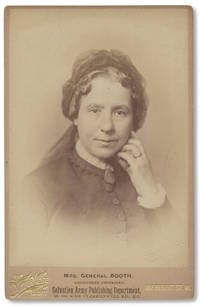
3730856<p>London: Salvation Army Publishing Department 98 100 & 102 Clerkenwell Rd. E.C. c.1882–1891. 6½ x 4¼ inches. Very Good.</p> <p>Cabinet card photograph of evangelist Catherine Booth 1829–1890 wife of General William Booth founder of the Salvation Army. She was a prolific writer for the Salvation Army a temperance lecturer anti-prostitution activist and an advocate of women preachers. Photographer Henry Van der Weyde 1838–1924 was the first to take portraits by electric light.</p> unknown