C HooykaasBiblio.com
32 résultats
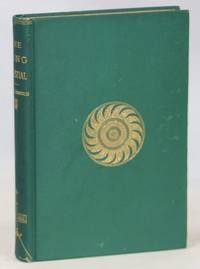
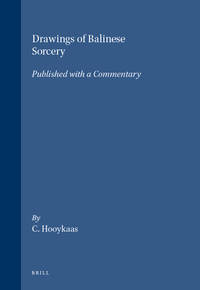
198018648<p>1st edition. Very Good softcover. Green and white cloth-reinforced card covers with black and white titles and design. Clean square covers and spine; slight fading along edges of front cover; lightly scuffed rear cover; tightly bound; light clean interior with very slight age darkening at page edges; supple leaves. 8vo 209 pp; biblio. See OCLC #469113698. "Iconography of religions Supplement 1".</p> E.J. Brill paperback
19774590New York: Alfred A. Knopf 1977. Second printing. Hardcover. Fine/fine. 8vo 191 pages cloth; in blue cloth custom slipcase. <br/><br/>Inscribed by the author to James O. Freedman a former President of Dartmouth College. Naipaul was awarded an honorary doctorate at Dartmouth in 1997. This is the second volume in Naipaul's India trilogy. Signed copies of the Knopf edition are quite scarce. Alfred A. Knopf hardcover
1896000013187Boston: Roberts Brothers 1896. Later edition. Hardcover. Very near Fine. 8vo. 7 8-185 1 6 pages of publisher's advertisements 2 pp. Green publisher’s cloth with a gilt wheel with feathers in gilt and gilt floral design on the front board gilt lettering a gilt harp and publisher’s device in gilt on the spine. Translated from the Sanskrit text by Edwin Arnold M.A. The preface contains an overview of the recent publication history of the Gîtâ. An inscription that reads "To Annie Russell with All Good Wishes Always these four words underlined." Annie Russell Yorke's bookplate on the front pastedown. Encyclopedia.com "Russell Annie 1864–1936". Rollins College "Annie Russell 1864-1936: Actress and Theater Legend". Annie Russell was an American stage actress who began her career at the early age of 8 and went on to star in numerous plays. In 1912 she founded and ran the Annie Russell Old English Comedy Company and staged revivals of a few classic English stage comedies. Rollins College has a theater named after her funded by Russell's friend Mary Louise Curtis Zimbalist. A fascinating association copy of the Gîtâ. A touch of rubbing the cloth. Roberts Brothers hardcover
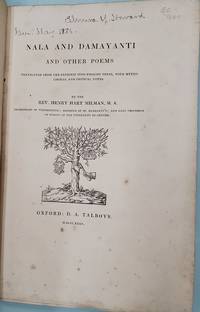
183574915Oxford: D. A. Talboys 1835. First separate edition in English. Quarto. 146 pp. Publisher's mustard cloth with printed paper spine label. Extremities with some wear paper label somewhat soiled though still legible tips bruised. Nonetheless a very good clean and complete copy of this scarce translation in the publisher's binding. No copies at auction according to RBH.The love story of Nala and Damayanti is part Vana Parva of the great Hindu epic the Mahabharata. It is a love story and is quite complex with Kali making an appearance but it ends on a happy note. The Mahabharata itself was translated into English just one year prior though for all practical purposes this is the first portion of it to become available to the reading public in England. Henry Hart Milman was an English historian and ecclesiastic. The son of Baronet he was educated at Oxford and had a brillan career. He won the Newdigate prize with a poem on the Apollo Belvidere in 1812 was elected a fellow of Brasenose in 1814 and in 1816 won the English essay prize with his Comparative Estimate of Sculpture and Painting. In 1816 he was ordained and two years later became parish priest of St Mary's Reading. In 1821 Milman was elected professor of poetry at Oxford; and in 1827 he delivered the Bampton lectures on The character and conduct of the Apostles considered as an evidence of Christianity. In 1835 Sir Robert Peel made him Rector of St Margaret's Westminster and Canon of Westminster and in 1849 he became Dean of St Paul's. He was elected a Foreign Honorary Member of the American Academy of Arts and Sciences in 1864. Milman was buried in the crypt of St. Paul's Cathedral where his grave was marked by an elaborate tomb. D. A. Talboys hardcover
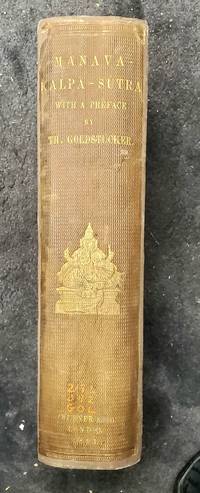
186175210London: N. Trubner and Co. 1861. The first edition in Sanskrit and first edition in English. Oblong folio 12 3/4 x 10 3/4 inches printed in the landscape manner the spine is actually the top of the book. xi 1 268 pp. preface by Theodor Golsdstucker with text printed in two columns plus the 121-page facsimile of the original Sutra at rear. Publisher's ribbed brown cloth with blind-stamped borders nicely rebacked a great while ago retaining almost all of the original spine spine with gilt lettering and a gilt Ganesh device pale yellow endpapers Smallish call letters in orange at base of spine library accession stamp and two previous owner's signatures on front pastedown and endpaper tips bumped. The major part of the sutra is unopened. Overall a very good copy of quite a scarce title.Kalpa means "proper fit" and is one of the six disciplines of the Ved nga or ancillary science connected with the Vedas – the scriptures of Hinduism. This field of study is focused on the procedures and ceremonies associated with Vedic ritual practice. Kalpa is a Sanskrit word that means "proper fit competent sacred precept" and also refers to one of the six Vedanga fields of study. The Manava Sutra is classed as a being in the Yajurveda discipline and concerns ritual instructions and formula. This particular texts deals with the sacred geometry of altars. Manava would have not have been a mathematician in the sense that we would understand it today. Nor was he a scribe who simply copied manuscripts like Ahmes. He would certainly have been a man of very considerable learning but probably not interested in mathematics for its own sake merely interested in using it for religious purposes. Theodor Goldstücker was a German Sanskrit scholar professor of Sanskrit in University College London and founder of the Sanskrit Text Society. He dedicated the book to the great German physician Rudolf Virchow. N. Trubner and Co. hardcover
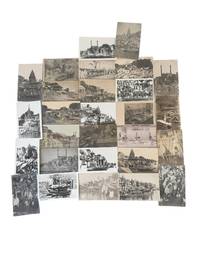
1900235081900. Hindu religious life in India photo archive showing temple approaches Ganges riverfront ghats public ritual bathing cremation rites ascetic practice and pilgrimage activity at Benares around the turn of the twentieth century. Benares now Varanasi has long been one of Hinduism's sacred cities with miles of steps descending to the Ganges for religious bathing and temple access from the river. The Ganges is regarded by Hindus as the holiest river and ashes of the dead have traditionally been placed in its waters as part of beliefs concerning release after death. <br /> <br /> Photo archive of 28 black and white real photo postcards each measuring 3.5" x 5" India circa 1900s. The verso inscription on one card reads "Benares India" and "Burning Ghat Ganges River" anchoring the group to the sacred riverfront where funeral rites bathing temple visits and river traffic occurred in close proximity. A captioned card reading "Hindu Cremation" shows men standing around a raised pyre with a shrouded body while another scene shows a funeral pyre and stacked wood at a riverside burning ghat. Other cards show pilgrims gathered densely at the water men and women washing at the riverbank temple spires rising above crowded steps boats moored before ghats a procession moving along a road a holy man associated with fakir practice on a bed of nails and repeated views of Benares temples and riverfront architecture.<br /> <br /> At Benares religious bathing cremation pilgrimage temple worship and daily commerce shared the same riverfront making the ghats one of the most concentrated sacred landscapes in South Asia. Light edge wear toning corner wear scattered soiling and occasional fading; several cards show stronger surface wear and mounting traces. Overall in good condition. The archive shows turn of the century Hindu ritual practice through cremation ascetic discipline river ablution temple approach and pilgrimage crowds along the Ganges. unknown
1855189632Hertford: Stephen Austin 1855. First edition of this early translation into English published while the translator 1834-1860 was still an undergraduate studying Sanskrit at Oxford. The first English translation of Bhagavad-gítá was completed in 1785 by Charles Wilkins. Octavo. Original blue cloth spine lettered in gilt boards panelled in blind yellow coated endpapers edges untrimmed. Title page with 1884 ownership inscription likely that of Henry J. Hood officer of the London Lodge of the Theosophical Society; partially erased 1928 ownership signature on front free endpaper recto. Spine toned and ends fraying boards bright: very good. hardcover