Reverend Daniel E BrownBiblio.com
328 résultats
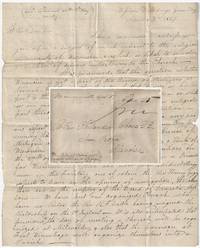
1837010705Menomoneville Wiconsin Territory 1837. Envelope or Cover. Very good. This two-page stampless letter sent from the Reverend Daniel E. Brown at Menomoneville to the Reverend Philander Chase "near Peoria / Illinoise" measures 16" x 9.75" unfolded. It is datelined "Mission Buildings Green Bay / April 3rd 1837" and bears an especially scarce manuscript postmark "Menomoneville Apr 5" of which only one other example is recorded by the Wisconsin Postal History Society. In nice shape</p> <br /> <br /> <p>In this letter Brown requests clarification as to whether the few churches that had been established in Wisconsin would remain part of the newly formed Diocese of Michigan or form into a separated organization. It reads in part</p> <br /> <br /> <p style="margin-left:5%; margin-right:10%;">"I have presumed to address you upon a subject of much interest to the religious community of Wisconsin which . . . is of serious importance to the Church. It is presumed that the question whether Wisconsin is yet a part of the Diocese of Michigan as claimed by the worthy Prelate of that Diocese . . . or are we separated & no longer for and integral part thereof. . . This question is now assuming a very serious aspect for the Vestry of Christ's Church Green Bay. . . There are now four resident Clergymen in this Territory . . . three in the employ of the Board of Domestic Missions. We have but one organized Church who has no Rector the Rev R. F. Cadle having resigned. . . It is also anticipated that . . . a church will be organized at Milwaukee & also that the Garrison at Fort Winnebago will organize themselves into a Parish. I have felt . . . as if it was unwise to agitate the question in our present situation & particularly as it regards questions of jurisdictions with Michigan but I would wish your advice. For if we are fully separated from Michigan & have the right to form a new Diocese . . . it would be prudent to do so. . . Will you be kind enough my Dear Father to give me your views upon the claim set forth by the Rt Rev Prelate of Michigan & whether . . . it is right now expedient to organize at this time. . ."</p> . When Wisconsin was part of the Michigan Territory from 1818 until 1836 Episcopalian fell under the purview of Missionary Bishop of the Northwest. Its first mission the Oneida Duck Creek Mission originally under the Diocese of New York at Green Bay was the beginning of Church work in the MIdwest. After the Diocese of Michigan was formed in 1834 Wisconsin activities were place under the temporary supervision of the Bishop of Ohio and did not come under the oversight of the Bishop of Michigan until 1836 after which he maintained that the establishment of the Wisconsin Territory had should not divide his diocese successfully thwarting the establishment of a Diocese of Wisconsin until 1847.</p> <br /> <br /> <p>For more information see Ford's A Brief History of the Diocese of Michigan and "Oneida History" at the Milwaukee Public Museum website.</p> <br /> <br /> <p>A first-hand document attesting to the religious competition that sprang into being with the establishment of the Wisconsin Territory. At the time of listing nothing similar is for sale in the trade nor has appeared at auction per the Rare Book Hub. OCLC shows no similar items held in institutional collections. We have another lot for sale regarding the Oneida Duck Creek Mission.</p> . unknown
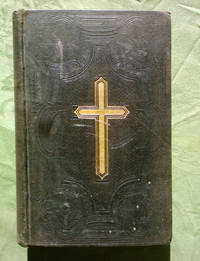
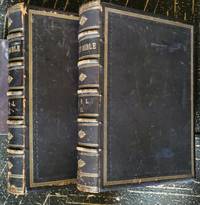
1844biblio1769<p>New York: P. J. KENEDY EXCELSIOR CATHOLIC PUBLISHING HOUSE 1844 5 BARCLAY STREET. The HOLY BIBLE translated from the Latin Vulgate: Diligently Compared with the Hebrew Greek and other Editions in Divers Languages; The OLD TESTAMENT First published by the English College in Douay A.D. 1609; and The NEW TESTAMENT First published by the English College at Rheims a.d. 1582. With Annotations References and An Historical and Chronological Index. From the Last London and Dublin Editions. The whole revised and diligently compared with the Latin Vulgate. Published with approbation of the Most Reverend John Hughes Archbishop of New York Given at the Episcopal residence this 27th of January 1844. Hardly discernable hints of wear to the corners. No more imperfections or wear detected. DimGray cloth with Gilt Gross in front and title on the spine. Also elaborate embossed decoration all over boards and spine. Frontispiece with ST. PATRICK'S CATHEDRAL in NEW YORK and Facsimile of Approbation by Most Rev. JOHN HUGHES got 1.0"x3.0" pale stain in the right margin area. Voume iclean unmarked throughout Family Pages still unused. Strong unshaken binding excellent hinges. 968 pages. 9.6"x6.4"x1.6". ab44272. For International and/or Expedited shipping contact seller.</p> P. J. KENEDY, EXCELSIOR CATHOLIC PUBLISHING HOUSE hardcover
1822631<p>2-volume set 1822 first editions</p><p>John Campbell 1766-1840 was a Scottish missionary and traveler. He was passionate about Christian philanthropy which led to his founding of the Magdalene Society in 1793 and the Missionary Magazine Edinburgh in 1796. He travelled to preach in neglected villages promoting the establishment of Sunday schools. The Magdalen Asylum to help prostitutes in England and Glasgow founded by Campbell was one of several societies he created to help those in need. He opposed the slave trade and became involved in the Society for the Education of Africans. Through collaboration with James Alexander Haldane he brought 30-40 African children to England to be educated. In 1812 he was sent by the London Missionary Society to inspect mission stations at the Cape. His account of the trip was published in 1815 on his return titled "Travels in South Africa undertaken at the request of the Missionary Society". Campbell returned to the Cape in 1819 this time to improve those mission stations that had fallen into neglect. In 1820 he travelled north from Cape to Mosega in Barotseland and the Kaditshwene settlement near the Limpopo River. He left Cape for England in 1821 and published two further volumes covering his journey.</p> Francis Westley hardcover
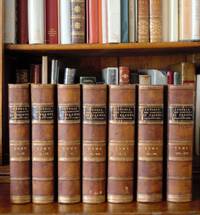
184018262Prato: Giachetti 1840-1845. In-8 mm. 236x146 18 volumi mz. pelle coeva verde piccolo spacco al dorso del volume XI fregi e titolo oro ornati da testate e finali xilografati molto ben illustrati fuori testo da complessive 152 su 156 tavole 2 non segnalate in Indice inc. in acciaio da vari artisti alcune a colori: sono vedute carte geografiche raffiguraz. delle popolazioni locali nei loro usi e costumi ritratti dei vari navigatori fatti storici monumenti ecc. Alcune tavole sono precedute da velina con didascalia nel ns. esemplare per lo più brunite. La raccolta comprende le relazioni dei più importanti esploratori e viaggiatori arricchite da documenti e note critiche di viaggi effettuati nel Nuovo Continente - in Oriente - in Asia e in Africa. Cfr. BrunetIII1439 che la cita solo in 15 volumiNel ns. esemplare alcune tavole presentano aloni al margine inferiore; circa 30 pp. del volume X con brutti restauri qualche fioritura. Complessivamente un buon esemplare. Giachetti, unknown
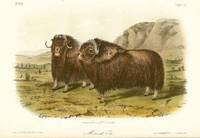
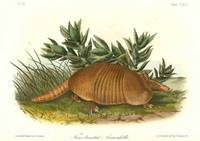
18494369New York:: V.G. Audubon 1849-54. First Royal Octavo Edition. Fine with original hand-coloring. A fine original hand-colored lithograph on paper. Royal Octavo 10.5 x 7 inches. Drawn from nature by John Audubon drawn on stone by William E. Hitchcock and lithographed printed and colored by JT Bowen Philadelphia. Accompanied by the original text written by the Reverend John Bachman DD. The Quadrupeds of North America; portrayals of 155 four-legged mammals native to North America depicted in their natural environment was a collaborative effort between the premier nineteenth century American Ornithologist Naturalist Artist and Frontiersman John James Audubon 1785-1851 his sons John Woodhouse Audubon and Victor Gifford Audubon and the naturalist Reverend John Bachman. The four men were unified in their desire to document and portray what they recognized as a dwindling resource; America's native animals amidst the natural beauty of the untouched American landscape. Their collective wisdom predicted the impending effects of Manifest Destiny- man's encroachment on the wilderness and natural landscape of North America- and as such was the impetus for the journey. To document and then portray America's native animals in the splendor and majesty of the uninhabited North American landscape the team traveled westward from Audubon's home in Mill Grove Pennsylvania up the Missouri River and through territory just previously explored by Lewis and Clark; from the Canadian border of the Northern Russian Territories- now Alaska- then southward to Mexico. Arduous and monumental the journey is recognized in the pathos of the compositions. However the true legacy of the work rests on John James Audubon's prolific vision and mastery of his subject and medium. Heretofore unseen The Quadrupeds of North American is a wildlife classic: an essential and timeless contribution to both Early American culture and the Art of American Wildlife Painting. The American Review a Whig journal heralded the national origin of the Quadrupeds: "We have at last have a Great National Work; originated and completed among us- authors artists and artisans of which are our own citizens the Bible of Nature!" John James Audubon in the West. New York: Henry H. Abrams 2000. Sabin 2368. Wood 208. Matted in Ivory Rag Board 12 x 16 inches. V.G. Audubon, unknown
18494396New York:: V.G. Audubon 1849-54. First Royal Octavo Edition. Fine with original hand-coloring. A fine original hand-colored lithograph on paper. Royal Octavo 10.5 x 7 inches. Drawn from nature by John Audubon drawn on stone by William E. Hitchcock and lithographed printed and colored by JT Bowen Philadelphia. Accompanied by the original text written by the Reverend John Bachman DD. The Quadrupeds of North America; portrayals of 155 four-legged mammals native to North America depicted in their natural environment was a collaborative effort between the premier nineteenth century American Ornithologist Naturalist Artist and Frontiersman John James Audubon 1785-1851 his sons John Woodhouse Audubon and Victor Gifford Audubon and the naturalist Reverend John Bachman. The four men were unified in their desire to document and portray what they recognized as a dwindling resource; America's native animals amidst the natural beauty of the untouched American landscape. Their collective wisdom predicted the impending effects of Manifest Destiny- man's encroachment on the wilderness and natural landscape of North America- and as such was the impetus for the journey. To document and then portray America's native animals in the splendor and majesty of the uninhabited North American landscape the team traveled westward from Audubon's home in Mill Grove Pennsylvania up the Missouri River and through territory just previously explored by Lewis and Clark; from the Canadian border of the Northern Russian Territories- now Alaska- then southward to Mexico. Arduous and monumental the journey is recognized in the pathos of the compositions. However the true legacy of the work rests on John James Audubon's prolific vision and mastery of his subject and medium. Heretofore unseen The Quadrupeds of North American is a wildlife classic: an essential and timeless contribution to both Early American culture and the Art of American Wildlife Painting. The American Review a Whig journal heralded the national origin of the Quadrupeds: "We have at last have a Great National Work; originated and completed among us- authors artists and artisans of which are our own citizens the Bible of Nature!" John James Audubon in the West. New York: Henry H. Abrams 2000. Sabin 2368. Wood 208. Matted in Ivory Rag Board 12 x 16 inches. V.G. Audubon, unknown
1824262161London: Printed for Harding Triphook and Lepard Finsbury-Square and J. Major Fleet Street 1824. Large paper copy of the first edition. li i 400; 512 pp. 1 vols. 8vo 9-3/4 x 6 inches. Full tree calf a.e. g. by Riviere. Labels reads "Dibdin's Work." Bookplates of Henry William Poor Marinus Willet Dominick Francis J. Gagliandi and Stuart B. Schimmel. Large paper copy of the first edition. li i 400; 512 pp. 1 vols. 8vo 9-3/4 x 6 inches. Pagination not as called for in Pippin and Windle who call for continuous pagination. Printed for Harding, Triphook, and Lepard, Finsbury-Square and J. Major, Fleet Street unknown
1857010266Bowmanville Ontario Canada 1857. Book. Very Good. Flexible Leather. 12mo - over 6¾ - 7¾" tall. Bound in contemporary embossed flexible leather approx. 256 pages 8 blank 25 lines per page approx. 225 words per page manuscript writing each page mostly unpaginated. Sermons begin with a phrase of Biblical Scripture each sermon dated with place given as Bowmanville. Signed by Slater at front end page with Bowmanville 1857-58 in ink. James C. Slater b. England 1824- was a Wesleyan Methodist Minister whose ministry began in 1847 and was active as late as 1874. He was Chairman of the Bowmanville Circuit in 1860. Very Good loss of leather at base of spine hinges starting. An historically important and RARE contribution to an understanding of Methodist Church teachings and thought in mid-nineteenth century Canada. . Hardcover
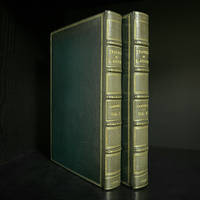
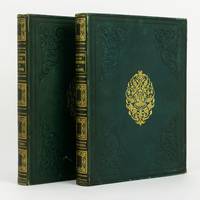
183987631London: Fisher Son & Co 1839. First Edition. Hardcover. Fair. London Fisher Son & Co. 1839 and 1840. Quarto two volumes iv xxxvi 84 pages plus a map 46 full-page plates including an unlisted plate facing page 54 'Ancient Archway of Cavern in the Balkan Mountains' and an engraved vignette title page; and iv 100 pages including the cumulative index plus a double-page map 48 full-page plates and an engraved vignette title page. Most plates have the original tissue-guards. Matching full dark green morocco the spines lettered and decorated in gilt in compartments all sides decorated in gilt and blind; all edges gilt; covers a little bumped and lightly worn at the corners; leather a little scuffed and marked; scattered foxing and minor signs of handling more so in the first volume which is inexpertly reinserted in its binding with a rear endpaper that would be greatly improved by removing and replacing it and a front free endpaper that appears to be original but salvaged from the rear and amateurishly lined with tissue; overall a decent set which certainly presents well on the shelf. Provenance: John Michael Skipper 1815-1883 artist solicitor and South Australian pioneer with his ownership initials on the engraved title page of the first volume and his signature and most interesting inscription of the front free endpaper of the second volume: 'J M. Skipper from Mrs. Thomas March 14th. 1841' his mother-in-law. <p>Skipper was born in Norwich the son of a solicitor; 'he was intended for the law but was more interested in art in which he was encouraged by his uncle. In 1833 he abandoned his studies to become a midshipman in the East India Co.'s "Sherbourne" bound for Calcutta. On his return deciding to migrate he arranged to be articled to Charles Mann the new South Australian advocate-general and sailed in the "Africaine" arriving at Holdfast Bay on 6 November 1836. He sketched scenes on the voyage and met Frances Amelia eldest daughter of Robert Thomas; he married her on 28 December 1839' 'Australian Dictionary of Biography'. <p>Accordingly these volumes not only date from the foundation years of British settlement in the colony they also come from two of the first settlers. They are offered together with a copy of 'The Diary and Letters of Mary Thomas 1836-1866. Being a Record of the Early Days of South Australia. Edited by Evan Kyffin Thomas' Adelaide 1925 revised and enlarged third edition/ 1915. It is an account of the Thomas family's journey to South Australia on the 'Africaine' in 1836 and the fascinating early years of colonization as described in Mary's letters to her brother in England. Her husband Robert was the first newspaper publisher in South Australia and important details of the practical difficulties involved in the printing business are included. <p>This is one of 300 unbound copies of the original 1925 edition discovered in the family attic in 1985; the entire cache has now been attractively bound in full reconstituted morocco. It comes in a slipcase with a fine copy of the first edition of a companion family volume 'Maisie. Her Life in her Letters from 1898 to 1902' edited by Joan Kyffin Willington Adelaide 1992. Each book in this 'collectors' duo' contains a numbered certificate of authenticity signed by Joan Kyffin Willington Maisie's granddaughter and Mary's great-great-granddaughter. 4 items. Fisher, Son & Co hardcover
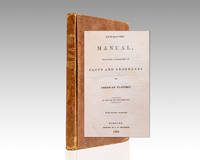
1839152017New York: Printed by S.W. Benedict 1839. Rare early improved edition of this prominent religious leader's influential call for America to end slavery. Duodecimo contemporary brown paper boards. In very good condition signatures to the front free endpaper. Anti-Slavery Manual Containing a Collection of Facts and Arguments on American Slavery 1837 is a foundational document of the American abolitionist movement written by the Reverend La Roy Sunderland 1802-1885 a Methodist Episcopal minister and one of the most energetic and theologically grounded anti-slavery agitators of the antebellum period. Published at a moment of intense national controversy over the question of slavery the volume assembles a systematic compendium of factual evidence statistical documentation legal analysis and moral argument designed to equip abolitionists with the intellectual armament necessary to counter proslavery arguments in the public arena. Sunderland who had co-founded the American Anti-Slavery Society alongside William Lloyd Garrison and Theodore Weld and edited the Methodist abolitionist journal Zion's Watchman approached the subject with the disciplined rhetoric of a preacher trained to marshal Scripture and evidence in service of a moral cause making the Anti-Slavery Manual simultaneously a work of theological argument and empirical documentation. The volume was sufficiently influential to be issued in multiple editions and printings in 1837 alone and is today held in the collections of Harvard University and the Library of Congress. Printed by S.W. Benedict hardcover
18450001254ERZROOM ERZURUM TURKEY. Very Good with no dust jacket. 1845. Non-Book. On offer is an original manuscript extract handwritten dated Erzurum Turkey Mar. 3 1854 it is believed to be in the hand of Rev. Josiah Peabody 1807-1873. Peabody served under the American Board of Commissioners for Foreign Missions A. B. C. F. M. . He and his wife Mary Lawrence Herbert Peabody 1817-1899 lived in Turkey for his missionary work from 1941-1955 see BIO NOTES at the end of the listing. The writings are a superb relic of the times; what historians and collectors of Turkish-Russian relations era will recognize as pivotal being only mere months after Russia destroyed Turkey's fleet and this note reports the Turks' struggle to gain any advantage the handwriting describes: "As to the war everything is still dark. Immense efforts are made by the Turks in this region and hopes are entertained that they may be able to withstand the Russians especially as they have a number of European officers "The letter also includes content regarding some of the new officers the Sultan and further analysis of Turkey's chances against Russia. While unsigned this extract was found amongst the letters sent by his wife Mary L. H. Peabody to her brother Rev. Charles D. Herbert 1818- in Missouri. Timelines and genealogical records indicate that this letter extract can be confidently attributed to Josiah. Condition: Handwritten on 7.5 x 5.5 inch scrap of paper. Overall VG. BIO NOTES: Reverend Josiah Peabody 1807-1873 was born in Topsfield Mass. He graduated from Dartmouth College in 1936 and Andover Theological Seminary in 1840. In March 1841 he married Mary Lawrence Herbert 1817-1899 of Ellsworth Maine. About a month after their wedding Peabody and his bride sailed to Smyrna on route to Ezroum Turkey for his missionary work under the direction of A. B. C. F. M. He served in Turkey until his transfer to Constantinople in 1855. The Peabodys returned to the USA in 1860. They had three children that survived beyond infancy: Mary Charlotte Anne Lucy and Josiah Charles. Mary Lawrence Herbert 1817-1899 and Charles D. Herbert 1818-1893 were born to George Herbert 1778-1820 and Charlotte Tuttle 1782-1869. They were two of six children born to George and Charlotte. George Herbert was educated at Dartmouth and became a well-known lawyer in Ellsworth Maine sometimes referred to as the first lawyer in Ellsworth. Reverend Charles D. Herbert was the youngest son of the family. He graduated from Bowdoin College in 1841 and from Bangor Theological Seminary in 1843. Following a few years doing home missionary work "in the west" he became the pastor of the West Newbury Church in Mass. He married and had two sons George Herbert and Rev. C. E. Herbert. ; Manuscripts; 12mo - over 6¾" - 7¾" tall; 1 pages; ANATOLIA CITY OF KARIN MISSIONARY MISSIONARIES CHRISTIAN CHRISTIANITY OTTOMAN EMPIRE OUTREACH TURKEY ERZROOM ERZURUM TURKISH MIDDLE EAST THE LEVANT POLITICS Russia War HANDWRITTEN MANUSCRIPT DOCUMENT LETTER AUTOGRAPH DIARY JOURNAL LOG KEEPSAKE WRITER HAND WRITTEN DOCUMENTS SIGNED LETTERS MANUSCRIPTS HISTORICAL HOLOGRAPH WRITERS DIARIES JOURNALS LOGS AUTOGRAPHS PERSONAL MEMOIR MEMORIAL PERSONAL HISTORY TRAVEL 19TH CENTURY antiquité contrat vélin document manuscrit papier Antike Brief Pergament Dokument Manuskript Papier oggetto d'antiquariato atto velina documento manoscritto carta antigüedad hecho vitela documento manuscrito Papel . unknown
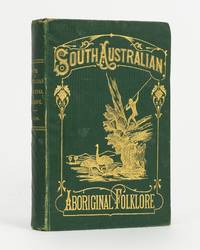
1879144271Adelaide: E. Spiller Acting Government Printer 1879. First Edition. Hardcover. Very Good. Adelaide E. Spiller Acting Government Printer 1879. Octavo viii 174 2 24 'The Grammar of the Narrinyeri Tribe' xii lithographed 'Facsimiles of Letters Written by Aborigines' one leaf folding 2 25-28 index pages including a page of lithographed music plus 9 lithographs from drawings by Aboriginal artists and 7 original albumen silver photographs 3 are approximately 105 × 145 mm; 4 are approximately 115 × 95 mm mounted on captioned leaves. Original green cloth attractively blocked in gilt on the front board and in blind at the rear; spine ruled and lettered in gilt; covers a little worn and marked with the binding a little shaken; acidic paper tanned with the folding facsimile document splitting at one fold; mounts a little cockled; trifling loss to the corner-tip of one photograph; page 29 printed close to the right-hand edge an imposition error during production; a few mild signs of age and handling; a very good copy of a rare and important work with the photographs in excellent condition. An early ownership signature on an initial blank is proving difficult to decipher Ruppard Sheppard. The original photographs that illustrate the book are almost certainly the work of Captain Samuel Sweet see Robert Holden: 'Photography in Colonial Australia. The Mechanical Eye and the Illustrated Book' 1988. We have handled a number of copies of this work and this copy conforms with what we suggest might be called the first and most desirable issue of these photographs. The substance of the book was derived from a 48-question circular compiled by George Taplin and 'distributed to all the keepers of aborigines' depots throughout the colony and to all persons who are known to be acquainted with the manners customs and languages of the aborigines'; the value of the work may be judged by the editor's remark in the introduction 'that much information has been elicited and that most of the papers show that the writers have used their powers of observation in an intelligent manner'. The untimely death of Taplin in June 1879 at the early age of 47 may account for the failure of further volumes in the series to materialize. <p>Ferguson 16711; Holden 105 and pages 49-51. E. Spiller, Acting Government Printer hardcover
188065901J. S. Virtue & Co. Limited London n.d. circa 1880. 1880. Hardcover. Folio. hardcovers. rebound in leather with marbled endpapers all edges gilt.Complete 3 volumes Dictionary volumes 23 & dictionary bound together. pp.994 558 4616. 47 full page b/w engravings on steel with tissue guards in text illus. Very good condition with some foxing mainly on prelims & page edges. Some rubbing to cover edges. Very heavy set extra post will apply if being sent outside of Australia. . J. S. Virtue & Co., Limited, London, n.d. circa 1880 hardcover
1802000560Venezia: Dalle Stampe Di Giacomo Zannardi Con Regia Permissione & Privilegio 1802. 1st Edition Thus . Hardcover. Very Good/Not called for>. 8vo - over 7¾ - 9¾" tall. Complete set of this rare edition of this classic work on the Council of Trent which was held in three parts between 1545 to 1563. The Ecumenical council of the Roman Catholic Church was prompted by the Reformation. The Council of Trent was highly important for its sweeping decrees on self reform and for its dogmatic definitions that clarified virtually every doctrine contested by the Protestants. The Council was a key part of the Counter Reformation and played a vital role in revitalizing the Catholic Church.Fourteen volumes in seven all ltitle pages present Bound in 19th c half calf over buckram covered boards. No foxing present but there is some light toning throughout. Odd volumes of this edition turn up occasionally but a full set is rare. Volumes 1-1V published in 1802 Volumes V -X1V published in 1803. There is some scuffing and shelf wear to bindings otherwise firm. No stamps or otherwise to indicate that this set is Ex Libris Contact seller regarding shipping <br/> <br/> Dalle Stampe Di Giacomo Zannardi (Con Regia Permissione & Privilegio) hardcover
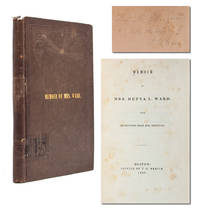
18434025Berkeley: T.R. Marvin 1843. First edition. Very Good . Original publisher's cloth binding with gilt to front board. Minor loss of cloth to crown of spine. Faint residue of removed library label to spine and front board. Peach endpapers. Light scattered foxing as is typical of the period. Inscribed on the front endpaper by Ward's husband the compiler: "Reverend Mr. Ellingwood with the respects of J.W. Ward." Bookplate on the front pastedown reveals that the recipient Rev. Ellingwood went on to donate the volume to the Theological Seminary of Bangor Maine. A scarce and important example of a published American elegiac volume produced in this case by an eminent family to mourn the loss of an educated woman. Memoirs is unrecorded by OCLC and has never appeared at auction. <br /> <br /> In their marriage James Wilson Ward and Hetta Lord Hayes Ward united two prominent Northeastern families. A senator and Congregationalist minister James descended from the founders of Plymouth and had attended Andover and Amherst. Hetta the daughter of a judge and niece of a Dartmouth president was herself a graduate of Miss Grant's Seminary Academy. The present volume released "exclusively for private circulation among the friends of the deceased" is a testament to Hetta's value not as a daughter who married well or a wife who effectively managed a house but as a companion an intellectual and an individual. In this sense it deconstructs the period's expectations of separate spheres or hierarchy between sexes. With an opening letter by Susan Hayes Hetta's mother as well as a copy of the eulogy conducted by her husband the book reveals vast details about who Hetta was as a person. Both describe her as tender and affectionate; but time and again emphasis is placed on her mind. Though Hetta was skillful with a needle as a child according to her mother "her numberless questions interested and surprised me.She acquired a fondness for poetry.She became as much interested in the in the study of the exact sciences as in the works of imagination making herself acquainted with the higher branches of Mathematics Algebra Geometry etc." James similarly eulogizes his wife. What becomes clear is that he is grieving the loss of a companion and equal. "If we have found a friend of distinguished excellence and for years rejoiced with that friend in mutual interchange and warm affections it is natural when death intervenes and separates us from the dear object of our love to contemplate their virtues.First characteristic which I would notice which she possessed in an eminent degree is an ardent love of truth.She possessed great powers of abstraction.She saw with great clearness the point of an argument and was quick to distinguish between sophistry.She loved to trace the workings of the human mind." Not satisfied simply to have their own testaments to Hetta's extraordinary mind the compilers included to the last half of the book a collection of her own poetry and prose.<br /> <br /> A scarce work in a genre underappreciated in American literature and history. Such coterie publications of intimate mourning were uncommon for the time particularly for a woman.<br /> <br /> National Cyclopedia of American Biography 148. Very Good . T.R. Marvin unknown
182712350London: Printed for Harding and Lepard Pall-Mall East; and G.B. Whittaker Ave-Maria-Lane 1827. Fourth Edition Greatly Enlarged and Corrected. 3/4 modern brown leather with gilt lettering and 5 raised bands to spine with 4 ornaments. Dark cloth over boards. Very Good. Imperial octavo oversized. Boards are 117/8" by 8 1/2" paper is 11"x 7 1/2" with wide margins. Lovely marbeled endpapers with 2 new blank preliminary leaves in both volumes. Original half-titles in both volumes. Plate and specimen leaf p. 166 present in vol. 1. Some foxing to first and last few original pages diminishing quickly a bit more noticeable on v 2. Light fingermarks on upper corners of some pages. vol. 1 xiii 562 p. vol. 2 579 p. w/ 1 p. corrigenda. Large paper copies limited to 250 Dibdin's Reminscences p. 213. Considered the best of the editions of this work adding the best of both Hebrew bibles and editions of the early church fathers. An attractive set. <br/><br/> Printed for Harding and Lepard, Pall-Mall East; and G.B. Whittaker, Ave-Maria-Lane hardcover
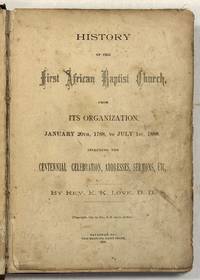
188840926Savannah Ga.: The Morning News Print. 1888. 20 360 pp. Frontis illustration of the First African Baptist Church and another full-page illustration preceding the table of Contents. Well-used with contemporary ownership signatures of "Mr. Cornelious Adams 1819 Reynolds." Inner hinges cracked and some loosening from binding scattered foxing. Text portraits of the pastors. In original cloth binding some spotting and extremity wear. Gilt-lettered title stamped on front cover. Good.<br /> <br /> "The oldest colored Baptist church in America" it was organized in January 1788 at "Brampton's barn three miles west of Savannah by Rev. Abraham Marshall white and Jesse Peter colored." Its trials triumphs schisms relations with their Caucasian co-religionists and biographies of its ministers are chronicled here by the Church's black Pastor Reverend Love. <br /> FIRST EDITION. De Renne 868. Work 405. LCP Supp. 1320. Not in Blockson. The Morning News Print. unknown
189339492London England: Seeley & Co. Limited. As New. 1893. Hardcover. FREE UPGRADE to Courier/Priority Shipping Upon Request IN STOCK AND IMMEDIATELY AVAILABLE FOR SHIPMENT - TEXT PRISTINE - 15 stories including "The Brothers" and The Girl of Andros" by Menander "The Shipwreck" by Diphilus and "The Buried Treasure" by Philemon -- with a bonus offer-- . Seeley & Co. , Limited hardcover
1817261849London: Printed for the author by W. Bulmer and Co. Shakespeare Press 1817. First edition with half-titles and errata. Hundreds of engravings and examples of type etc. some tinted in red and blue and slip of gold printing with directions to binder slip at vol. II p. 417. 3 vols. Imperial 8vo 9-3/4 x 6 inches. Bound in contemporary three quarters blue pebbled morocco spine gilt and marbled boards and edges. Fine small bump to some pages in Vol. I. Bookplate of The Right Hon. Charles Abbot prob. Charles Abbot 1st Baron Colchester in Vols II & III. First edition with half-titles and errata. Hundreds of engravings and examples of type etc. some tinted in red and blue and slip of gold printing with directions to binder slip at vol. II p. 417. 3 vols. Imperial 8vo 9-3/4 x 6 inches. Windle & Pippin A28; Jackson no.40; Hart no.186; Bigmore and Wyman pp. 169-70 Printed for the author by W. Bulmer and Co. Shakespeare Press unknown
1880130343Mexico: J. M. Andrade 1880. First edition. 535p; 177p; 65p Complete set with the third volume being the complete atlas volume of 66 engraved plates. Ex-library: numbers painted on spines; bookplates; library stamps on endpapers - title pages - foredges. Bound with leather spines and cloth boards. Corners of covers worn; leather spine labels wearing off slightly. Pages of Vols. I-II are yellowed but otherwise unmarked and clean. Volume III shows evidence of water damage and many pages have a severe dark stain. Three pages have some loss to the margins but the images of the plates are completely intact. A history of Indians of the new world detailing their life and culture at the time of the Spanish Conquest. A classic and important study of Native American culture and offered here in a damaged but still useful example of the rare first edition. J. M. Andrade unknown
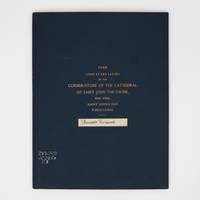
1892376201New York: Feast of Saint John the Evangelist 1892. Printed on pure vellum. Title page with seal printed in red. Vignette of eagle at head of first page of service. Artist's rendering of the cathedral on last page. 6 pp. Printed by the DeVinne Press. 1 vols. 4to. Blue cloth upper cover titled in gilt with paper label for J. Roosevelt Roosevelt lower cover with eagle in blind a.e.g. Fine. Bookplate of General Theological Seminary. Printed on pure vellum. Title page with seal printed in red. Vignette of eagle at head of first page of service. Artist's rendering of the cathedral on last page. 6 pp. Printed by the DeVinne Press. 1 vols. 4to. Order of service for the start of the construction of the New York City landmark. <br /> Just a few copies were printed on vellum.<br /> With a presentation inscription from the original owner "To the Rev. Howard C. Robbins Dean of the Cathedral of St. John the Divine J. Roosevelt Roosevelt May 16 1922"<br /> James Roosevelt Roosevelt 1854-1927 was half brother of Franklin Delano Roosevelt.<br /> Uncommon and beautiful. Feast of Saint John the Evangelist unknown
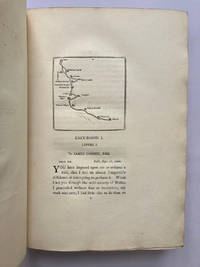
18013865<p>A scarce book of country excursions taking in some of the most striking landscapes and great houses within a day's journey of Bath. Three excursions are presented in the course of four letters with each excursion illustrated with a small part-page engraved map. The author describes in detail the landscapes cities and great houses along the way with plentiful information about the history of the towns gardens and architecture visited. Of particular note are Longleat Stourhead Fonthill and Wardour Castle. 'I am now to introduce you to one of the most splendid mansions in the kingdom Fonthill the seat of Mr. Beckford; where expence has reached its utmost limits in furniture and ornaments; where every room is a gold mine and every apartment a picture-gallery' p. 119. The description of Beckford's library is alas rather brief: 'The library is a large room filled with choice and expensive books; and decorated with appropriate paintings on the ceiling' p. 126.</p><p>Warner also visits 'new' Wardour Castle - it was built in the 1770s - and gives a room by room commentary of the architecture furniture and paintings. Or particular interest is his description of the chapel: 'From this apartment we are carried into the western gallery of the <em>chapel</em>; a structure that displays superlative taste and magnificence. Crimson furniture and gilded ornaments produce an immediate striking <em>coup d' œil; </em>but when the decorations are examined individually the splendour and expence become more perceptible. Three immense pictures by Rubens cover the southern wall of the chapel; and one by this artist and another by Guido of the same majestic size are their opposite companions. The altar-piece is a Dead Christ by Cades. A large gallery is constructed at the western end superbly fitted up for Lord Arundel and his party; a second at the east end of the north side for the choir; and a third at the east end of the north side for the accommodation of visiters sic. Benches occupy the middle of the chapel for the reception of the domestics and such of the villagers as profess the Romish faith; for there is a Catholic seminary here the pupils of which punctually attend at morning and evening prayers. The eastern end of the chapel recedes into a semi-circular form through the windows of which light is admitted; but as these are placed high and consist of coloured glass the effect is extremely striking and solemn. The central window exhibits Angels and the awful Tetragrammaton from which is an emanation of glory. Brought forward from the eastern end sufficiently to allow the processions around it stands the Altar a most costly piece of workmanship fixed on a splendid sarcophagus of ebony; and constructed of porphyry agate and amber. A magnificent crucifix of silver surmounts the altar; and two censers of solid gold embossed with silver suspended over it pour through the chapel odiferous clouds of ever-burning frankincense. Every thing around indeed evinces that the Romish ritual is observed here with the utmost vigour and magnificence; and doubtless the celebration of its higher offices amid such seducing objects must act with infinite force upon the imagination. The effect produced by the <em>externals</em> of worship every man experiences who attends our Cathedral service which has not been stripped of so much of its <em>lace</em> as the common parochial ritual; how much then must this be increased when aided by exquisite examples of sculpture and painting; amid the strains of angelical music the glare of unnumbered lights and the Hallelujahs of numerous multitudes! The tamest fancy must be roused by such a scene and the coldest heart warmed into transport … It is but proper to add that the attendance of strangers at the service in Wardour chapel is considered as a compliment and every convenience provided for their accommodation' pp. 137-141.</p><p>Richard Warner was an antiquary and an Anglican clergyman originally from the coastal town of Lymington in Hampshire. He became curate to Wililam Gilpin whose influence can be clearly seen in the present work dedicated to walking and the natural beauties of the west country. Warner obtained his first position in Bath in 1794 and remained there for some years writing a number of topographical works and a gothic novel <em>Netley Abbey</em> 1795 inspired by local ruins. He was a friend of Wordsworth who collected Warner's picturesque writings alongside those of Gilpin and who is known to have dined with him in Bath. In his lifetime Warner was mostly known for his controversial pacifist sermons and writings: it is thought that Blake was referring to Warner in the lines 'ask him if he is Bath or if he is Canterbury' in Jerusalem as claimed by David Erdman.</p><p>Although this copy is in a later nineteenth century binding and was bound without the half-title a previous owner - possibly from the 1840s or 1850s perhaps contemporaneous with the binding and the newspaper cutting - has added an engraved portrait a Latin celebration of Bath an engraving of Farleigh Castle and a newspaper cutting referring to Paul Methuen of Corsham.</p><p>OCLC lists BL University of Edinburgh the Natural History Museum and the Rubenianum in Antwerp only.</p> Crutwell & G.G. and J. Robinson
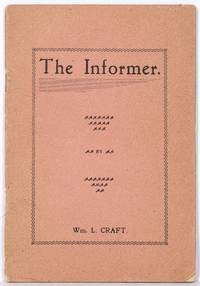
1900592001Savannah 1900. Softcover. Very Good/Near Fine. First edition. Frontispiece portrait of Craft. 16mo. 24pp. With five illustrations. Stapled in rose-colored printed wrappers. Loose chip from one rear corner laid in light wear at the edges including a few shallow chips and light creases. A pamphlet published by Rev. William L. Craft field secretary of The National Baptist Young Peoples Union Board used for recruitment efforts in the early 1910s. It provides a brief history of the church from its foundation as the Negro Baptist Church by George Leile in 1777 to the then present day under the leadership of Rev. Richard Henry Boyd; lists the organization's various presidents board members and officers; provides an overview of domestic and international missionary work; and prints a selection of various "don'ts" from spreading gossip and chewing tobacco to casting judgment and harming others. Also of interest is a small section on the importance of the number seven "a mystical and symbolic number in the Bible" likely to attract the attention of fellow African descendants who still retained spiritual belief in numerology. A rare pamphlet that we've not seen before. OCLC locates no copies. unknown
18240009038MANCHESTER UK ROTTERDAM HAGUE NETHERLANDS HOLLAND. Good. 1824. On offer is a short but fascinating travel book of one wealthy young Englishmans journey to Rotterdam and The Hague Holland in 1824. It is a unique and rare look at the travel of English aristocracy in the first half of the 19th century the last great age of the English landed gentry. The book is 30 pages in length of which writing is on every single page. Every page is filled with excursions observations and examples of lavish living for William Money his father and his cousin as they travel first to Rotterdam and then spend over a month in The Hague living at quite a fancy hotel exploring the city itself and taking day trips to landmarks around the country. The little book also includes descriptions of lavish dinners and days being waited on driven and doted on by servants and friends. It begins in the Summer 1824: June 25 1824. To commence my narrative I will give a short account of the two last days before our embarkation to Holland. I went to bed rather late on Sunday and was very tired. I had been running about Town the whole day had my teeth filed By the abominable dentist which is one of the Miserries of human life. My head was distracted in short I was a picture of misery.; June 26. The servants awoke me rather early this morning about five OClock however I was much refreshed and went to work like one who had done nothing but I forgot to state that I went to dine at a Gentlemans house on Friday and after all when I came home I had to prepare my things for Holland. Well to go on with my story we get off from No. 9 Manchester Street Manchester Square at 6 oclock this was Saturday morning June 26th 1824 our Party consisted of three my precious Father my cousin and myself. We had a gentleman's carriage to take us about town and a hackney coach to carry our luggage to the Tower that place which has executed French of the greatest and has been destroyed with Royal blood by the hoards of unnatural rebellion. The next day they are on a sailboat going from the East Coast of England and then landing in the Netherlands the next day: June 27th. Went on deck. I was expecting to see nothing but blue skies and the watery ocean but was pleasantly astonished at seeing land all around. This was lacey land I Know it by that name because the Dutch gobble so. We soon got into the river Maas after a fine voyage. We then eat our hearty breakfast.We here took up a pistol and tacked along at a fine rate saw plenty of Tony-legged bison which they called Storks. We got to Rotterdam at 12. From the instant of arrival Money is taken aback by how clean and orderly the Dutch cities are and how kind and lovely the Dutch people are as well. The layout of the cities with the canals and bridges also is commented on quite frequently. June 28th1824. We took Breakfast at Home. we went out with with and enjoyed the town. It is an elegant clean looking place. Trees shaded the walk from the burning sun and canals divide the Principal Streets. However we saw nothing no hous as they call it but came home to dinner at 4. Here we had a bottle of Mousel for dinner we went out again so that I was very tired we then came home and had tea at Mr. Mackplats where we had another Prayer and a delightful conversation. He accompanied us home where I soon got to bed and fast asleep.; After two days in Rotterdam it is off to the Hague where Money and his father and cousin will spend the rest of their time in Holland. Drove off to the Hague with which Place we are most highly delighted. I the beauty of it. It far surpassed my places that I have seen. We walked everywhere the People the PLace and all are so clean. We came to the Hotel de Belle where we have so very nice rooms that had attendance the man who drove us here cheated as that. We were not long here before . Of the gentleman who got these rooms for Papa he took us out to Table d`ote d`hotewhere we dined . This was 4 oclock and had an excellent dinner and a bottle of vin ordinaire called Bordeau.after dinner we went to Mr. Ls house to get him to show us the Place. He showed us everything in the wood.` The `wood` is most probably the Haagse Bos a rectangular neighbourhood and forest in the Haagse Hout district of The Hague Netherlands. This was simply called Die Hout The Woods Mr. L.made a capital bargain with the man only one Golden to go to that sweet Ducking Place the old man of the Place has fishing boats to go over to England for something or other. We came back after a good bathe.We then came home and prepared for dinner and went to Table Doht d`hote and after that we came back and then went to the Wood where we had tea.; After early June there are no entries until late July. July 23 1824. We got up at seven and had breakfast. We set off at 8 in a caravan with Mr. London and Mr. Tosc. We reached Leyden at 9 very much interested.We first went to the University where we saw all of plenty Indians what from all parts of the globe. We saw there a tree which was brought from Egypt in 1573 just about the time when Leyden was besieged. It was made a present by William the first and planted there We then went to the museum and saw curious specimens of all types. Mr. London went to the Anatomy Hall to gut us to see a Head. He came back saying we could only see one which was most beautiful all the views of the Head Neck and parts of the body it was very interesting.; Money also has a deep regard for the engineering works of the day and has a special fascination for the canals and waterways of Holland. We had dinner and then went to to see the sluis the most Beautiful work I ever saw. It was begun in 1784 and finished in 1787. The whole country was inundated by the overflowing of the Bacchus of the Nile. It was like a sea but now these are houses where there was formerly nothing but water. This formed so when the sea is very boisterous there's a good deal of sand connected to the side of the gate so that it is had to clear away as it is on the sea side. The way they do it is the precipe overflows then they lift the gates all of a sudden which goes with such force that it forces the sand away.`` This is accompanied by a page-length drawing of the canal with it`s locks and steps and houses on each sides. The drawing is amateur but well done. The book is in very good shape structurally. The writing is clear and concise script done in black ink. A few pages have some smudging and one page in particular has a good bit of ink fading but which impedes legibility but does not make it impossible. The front cover of the journal states: `Short account of a holiday spent in The Hague by William Money later Rev. William in the summer of 1824 when he was 22 years old.` This is not in Money`s handwriting and was added later by an unknown person.; Manuscript; 8vo - over 7¾" - 9¾" tall; KEYWORDS: HISTORY OF REVEREND WILLIAM MONEY ENGLISH GENTLEMAN LANDED GENTRY 19TH CENTURY ROTTERDAM MANCHESTER ENGLAND UNITED KINGDOM THE HAGUE DEN HAAG DIE HOUT LEYDEN LEIDEN THE NETHERLANDS HOLLAND CANALS IN THE NETHERLANDS FLOOD CONTROL EXTRAVAGANT TRAVEL TABLE DHOTE SLUICE GATE AGE OF BRITISH NOBILITY COLONIAL ERA ENGLAND BRITANNICA HANDWRITTEN MANUSCRIPT DOCUMENT LETTER AUTOGRAPH WRITER HAND WRITTEN DOCUMENTS SIGNED LETTERS MANUSCRIPTS HISTORICAL HOLOGRAPH WRITERS AUTOGRAPHS PERSONAL MEMOIR MEMORIAL ANTIQUITÉ CONTRAT VÉLIN DOCUMENT MANUSCRIT PAPIER ANTIKE BRIEF PERGAMENT DOKUMENT MANUSKRIPT PAPIER OGGETTO DANTIQUARIATO ATTO VELINA DOCUMENTO MANOSCRITTO CARTA ANTIGÜEDAD HECHO VITELA DOCUMENTO MANUSCRITO PAPEL . unknown
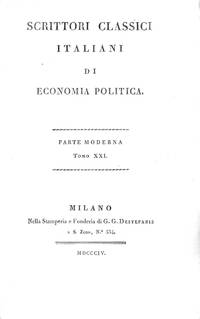
180323804Milano: De Stefanis 1803-1805. In-8 p. mm. 221x146 brossura originale 50 volumi. Importante collana di economia curata da Pietro Custodi e composta di due serie: "Parte Antica" tomi I-VII - "Parte Moderna" tomi I-XLI 1 volume di Supplimento n. IL 1 volume di Indici generali n. L. E' questa la prima raccolta completa di notizie e studi sull'economia l'agricoltura i tributi e la moneta nonchè appendici legislative del Sette e Ottocento.La "Parte antica" raccoglie i seguenti autori: Serra Turbolo 1 volume - Davanzati Scaruffi 1 volume - Montanari 1 volume - Broggia 2 volumi - Neri 2 volumi.La "Parte moderna": Bandini Algarotti 1 volume - Belloni Pagnini 1 volume - Galiani 4 volumi - Genovesi 4 volumi - Beccaria 2 volumi - Carli 2 volumi - Verri 3 volumi - Zanon 2 volumi - Paoletti 1 volume - Ortes 7 volumi - Briganti 2 volumi - D'Arco 2 volumi - Filangeri 1 volume - Vasco 3 volumi - Mengotti 1 volume - Palmieri 2 volumi - Delfico Coriani Solera 1 volume - Cantalupo Caracciolo Scrofani 1 volume - Ricci 1 volume.Cfr. "Catalogo della Biblioteca Einaudi"5193.Nel ns. esemplare una ventina di brossure con piccoli strappi o piccole mancanze un volume ingiallito e con aloni sulle ultime 18 carte altrimenti tutti i testi con barbe sono ben conservati. De Stefanis, unknown