8 résultats
1593350931593 Petit in-4, plein vélin ancien, dos doublé, (8), 184 p., vignette de titre, bandeaux, lettrines sur fond criblé et sceau du pape Sixtus V gravé sur bois. Romae, Typographia Gabiana, 1593.
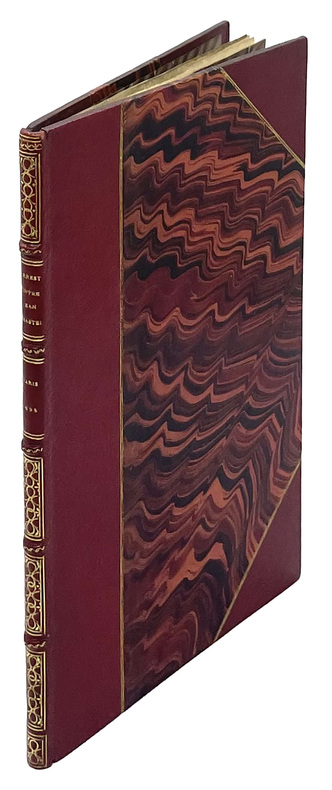
15951254Paris, Frédéric Morel, 1595 ; plaquette petit in-8 de 8 pp., reliure du Second Empire demi-maroquin rouge à coins, deux filets dorés, dos à nerfs finement orné.
158665712Tübingen bzw. ohne Ort, Georg Gruppenbach bzw. ohne Verlag, 1585-1586. 4°. Flex. Manuskript-Pgmt. d. Zt. m. (tlw. gekürzten) Bindebändern.
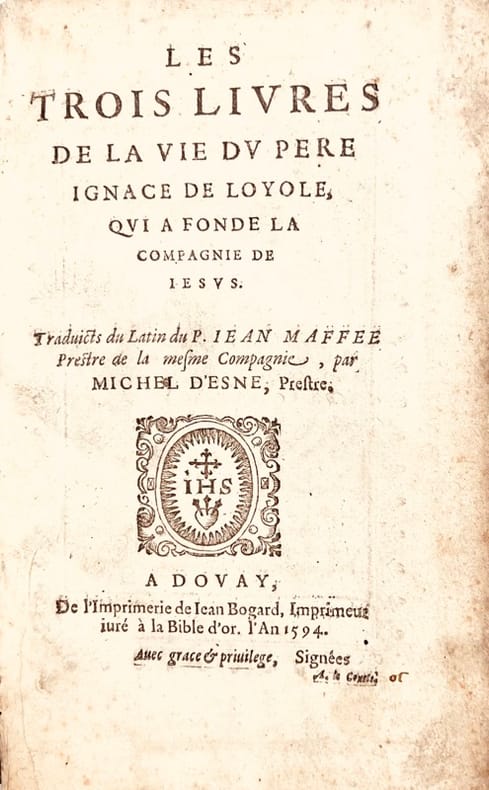
159443513A Douay, De l'imprimerie de Jean Bogard, 1594. Petit in-8 de (4)-298-(2) pages, vélin souple de l'époque.
15852438<p>Venice: Appreso I Gioliti 1585. </p><p>Price: $8500.00 </p><p>Octavo: 16 x 10.5 cm. 188 11 pp. Collation: A-M8 N4</p><p>One of several 1585 editions first ed. 1584</p><p>Bound in modern cartoncino. A very good copy with some minor repairs lightly washed. With a fine woodcut headpiece and Jesuit emblem on the title page and numerous decorative head- and tailpieces and initials including one of a dragon throughout.</p><p>This collection contains the following letters from the Jesuit missions in Japan and Goa: Francesco Carreón writing from Kuchinotsu 1 Dec. 1579; Gregorio de Céspedes 1579; Lorenço Mexia at Bungo 20 Oct. 1580; three letters by LuÃs Fróis Miyako 14 April 1581; 19 May 1581; and 29 May 1581; Francesco Cabral 15 Sept. 1581; and Alessandro Valignano Goa 28 Dec. 1583.<br /><br />The Salsette Martyrs:<br /><br />This collection concludes with Valignano's important letter from Goa –one of only five Jesuit letters from India published between 1570 and 1585- detailing the deaths of the Jesuit Martyrs of Cuncolim who were killed on Monday 25 July 1583 in the village of Cuncolim in the district of Salsette territory of Goa India. The "martyrs" were the Italian Rudolph Acquaviva the Spaniard Alphonso Pacheco the Swiss Peter Berno the Portuguese Anthony Francis and Brother Francis Aranha also a Portuguese. In addition the Portuguese layman Gonçalo Rodrigues and some Indian youths Dominic Alphonso Francis Rodrigues Paul da Costa and ten others were also killed.<br /><br />While prosecuting their mission of Conversion in Cuncolim the Jesuits and their companions desecrated a Hindu temple by urinating in it a relatively mild if repugnant form of desecration; on an earlier excursion Father Berno had set fire to another temple and destroyed a sacred anthill. In addition they killed a cow that was also an object of worship and hurled its entrails into a sacred well thereby defiling it. The understandably outraged citizenry set upon the Jesuits and their companions killing them with scimitars lances and arrows. They then threw their bodies into a well. The five Jesuits quickly achieved great fame as martyrs and at last in the 19th century were elevated to sainthood while the lay Indians who were slaughtered with them were ignored. <br /><br />It should be remembered that three of the five Jesuit martyrs were in Cuncolim as chaplains to a force of Portuguese soldiers sent to exact harsh reprisals for indigenous resistance to Portuguese rule and the Jesuit campaign of forced conversion. In this context the killing of the Jesuits is remembered by the people of modern day Cuncolim as one of the first acts of revolutionary resistance to European rule in India.<br /><br />Of course the letter written in December of 1583 by the Jesuit Provincial of India Alessandro Valignano glorifies the "martyrs" and in true martyrological style vividly describes the deaths of Acquaviva and his companions.<br /><br />"The Pagans then fell upon them; Father Rudolph received five cuts from a scimitar and a spear and died praying God to forgive them and pronouncing the Holy Name. Father Berno was next horribly mutilated and Father Pacheco wounded with a spear fell on his knees extending his<br />arms in the form of a cross and praying God to forgive his murderers and send other missionaries to them.</p><p>Streit Bibliotheca Missionum IV. 1639; Sommervogel II col 492; Cordier Sinica 75; Laures 170</p> Appreso I Gioliti, books
15854676<p>ENTRY NO. 1 IN BOSCARO<br />THE FIRST REFERENCE TO THE JAPANESE EMBASSY OF 1585 PRINTED ON THE TITLE-PAGE</p><p>Venice I Gioliti 1585.</p><p>Small 8vo 15.3 x 10 cm 103 pp. Bound in old vellum. Discrete former ownership stamp on title. Gutter margin of title reinforced; inconsequential toning otherwise excellent.</p><p>Rare early edition of this Jesuit letter containing news of missions and activity in Japan from the year 1582 the only edition of 5 printed that year to contain a title-page advertising the famous Japanese embassy of 1584-86. Significantly the work also discusses the embassy the participants and their noble lineage and expresses the hope that the embassy will prove a convincing sign of the Jesuit's spectacular success in Japan p. 7. The present imprint of this edition comprises the first entry in Boscaro's bibliography of printed works related to the embassy. It thus stands at the head of nearly 50 works printed in 1585 alone to record and commemmorate an event that-in addition to providing a public relations coup for the Jesuits-became a watershed moment in cross-cultural exchange between the Orient and the West: "no Japanese emissaries to Europe either before or since aroused comparable interest or enthusiasm" Lach.</p><p>In the annals of international relations between Europe and Japan in the 16th C it is particularly noteworthy "how the physical presence of the Japanese in Europe stimulated an unexpected number of typographical presentations" Boscaro of which this particular Gioliti edition with the titlepage advertising the embassy-Portata de Novo Dal Giapone Dai Signori Ambasciatori-is the very first. Boscaro notes that there were four other editions of Coehho's letter published in Italy in 1585 around the time the embassy arrived in Venice on June 25 including another by Gioliti but none of these uses the embassy as a way to market itself.</p><p>The report itself is also a significant document of the embassy's genesis: Coelho composed it in February 1582 the month that the embassy of four Japanese Christian converts departed from Nagasaki. In it he describes the ongoing missionary activity across the country: e.g. in Hirado Amasuka Bungo and especially Funai Oita City the home of a thriving Jesuit college. Presumably the contents of this letter as the title suggests were "brought from Japan by the eminent ambassadors" as the latest news on the Jesuits current success in that faraway land.</p><p>Though the embassy did not reach Lisbon until August 1584 it eventually was as Coelho had hoped a resounding success: from 1584-86 the four young Japanese nobles were the object of intense curiosity wherever they traveled and they were treated to lavish receptions in Lisbon Madrid Florence Rome Venice and other cities throughout Catholic Europe.</p><p>Provenance: Alfred Hamy 1838-1904 French Jesuit historian and prolific author of books relating to the history of the members of the Company of Jesus.</p><p>OCLC: Cornell NYPL HU and Newberry. Boscaro 1; Alt-Japan 812; Sommervogel II.1267; Cordier 78; Laures 169; Pagès 22; Lach I.2.690.</p><p> Boscaro 1; Alt-Japan 812; Sommervogel II.1267; Cordier 78; Laures 169; Pagès 22; Lach I.2.690.</p> I Gioliti
15854676Venice: I Gioliti 1585. Hardcover. Very Good. 8vo - over 7¾ - 9¾" tall. 8vo. 103 pp. Bound in old vellum. Discrete former ownership stamp on title. Gutter margin of title reinforced; inconsequential toning otherwise excellent. Rare early edition of this Jesuit letter containing news of missions and activity in Japan from the year 1582 the only edition of 5 printed that year to contain a title-page advertising the famous Japanese embassy of 1584-86. Significantly the work also discusses the embassy the participants and their noble lineage and expresses the hope that the embassy will prove a convincing sign of the Jesuit's spectacular success in Japan p. 7. The present imprint of this edition comprises the first entry in Boscaro's bibliography of printed works related to the embassy. It thus stands at the head of nearly 50 works printed in 1585 alone to record and commemmorate an event that-in addition to providing a public relations coup for the Jesuits-became a watershed moment in cross-cultural exchange between the Orient and the West: "no Japanese emissaries to Europe either before or since aroused comparable interest or enthusiasm" Lach. In the annals of international relations between Europe and Japan in the 16th C it is particularly noteworthy "how the physical presence of the Japanese in Europe stimulated an unexpected number of typographical presentations" Boscaro of which this particular Gioliti edition with the titlepage advertising the embassy-Portata de Novo Dal Giapone Dai Signori Ambasciatori-is the very first. Boscaro notes that there were four other editions of Coehho's letter published in Italy in 1585 around the time the embassy arrived in Venice on June 25 including another by Gioliti but none of these uses the embassy as a way to market itself.The report itself is also a significant document of the embassy's genesis: Coelho composed it in February 1582 the month that the embassy of four Japanese Christian converts departed from Nagasaki. In it he describes the ongoing missionary activity across the country: e.g. in Hirado Amasuka Bungo and especially Funai Oita City the home of a thriving Jesuit college. Presumably the contents of this letter as the title suggests were "brought from Japan by the eminent ambassadors" as the latest news on the Jesuits current success in that faraway land.Though the embassy did not reach Lisbon until August 1584 it eventually was as Coelho had hoped a resounding success: from 1584-86 the four young Japanese nobles were the object of intense curiosity wherever they traveled and they were treated to lavish receptions in Lisbon Madrid Florence Rome Venice and other cities throughout Catholic Europe.OCLC: Cornell NYPL HU and Newberry. Boscaro 1; Alt-Japan 812; Sommervogel II.1267; Cordier 78; Laures 169; Pagès 22; Lach I.2.690. I Gioliti hardcover books
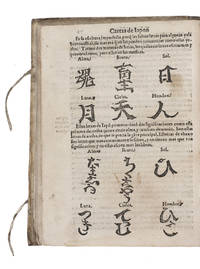
15755741Alcalá der Henares Spain: Juan Iniguez de Lequerica 1575. Contemporary limp vellum with ties. 4to in 8s. With woodcut of the Crucifixion on verso of the colophon 2R4v woodcut Japanese characters in the text I8v and woodcut decorated initials throughout. First Spanish edition of 87 Portuguese letters by Jesuit missionaries in Japan very valuable for the history of the Jesuits in Japan India and other parts of Southeast Asia. The work was first published in Portuguese in Coimbra in 1570 and contains 10 additional important Jesuit letters which had never published before. Noteworthy are the woodcut Chinese and Japanese characters included in the text on leaf I8v. Cordier gives a list of these additional letters dating from 1567 to 1571. Other newly added were: the life of Francis Xavier Relacion de las cosas de la India by Manuel Acosta with remarks on in order of appearance Goa Cochin Daman Ceylon Comorin Bassein Ormuz Ethiopia Inambay and Manomotapa Malaca the Moluccas Ambonia Solor Macassar etc. and Breve relacion de la Isla y Reynos del Iapon.Lacking 2 leaves ¶7 and ¶8 from the preliminaries containing the "Indulgencias que nuestro Sancto Padre el Papa Pio. 4 ". With 18th-century manuscript annotations in brown ink on the recto of the first free flyleaf the title-page at the start of the text on fol. 1r the recto of the final leaf and in the margins throughout; the margins show only marks to highlight certain passages the other annotations are variations of the same owner's inscription most elaborate on the front flyleaf: "Ex icDn. Francesco et Paula Caveda Costo 15 . Mad. a 4 . Octobre 1786". The vellum of the binding is somewhat creased and stained water stained throughout the first and last few leaves are frayed and slightly damaged in the margins without affecting the text somewhat browned throughout. Otherwise in good condition.l Alt-Japan-Katalog 298; Cordier Japonica cols. 67-68; Iberian Books 54608; Laures 140; Palau 46311; Porbase 363133 1 copy; Salva 3282; Streit IV 1519 with a full list of all letters; USTC 337147. Juan Iniguez de Lequerica, hardcover