359 résultats
17184988Turin ie Paris: Jacques Daniel 1718. Soft cover. Very Good. Small 8vo. 2 ff 66 pp 1 ff. Title page printed in red and black. Bound in contemporary marbled wrappers. Slightly dog-eared otherwise a very good copy. Rare compilation of anti-Jesuit apocrypha: the famous 'Monita secreta' is found here alongside a purported condemnation of the Jesuits by the Faculty of Theology in Paris in 1554 as well as a translation of a prophecy of Saint Hildegaarde commonly seen as fortelling the fall of the Order. The present work bears a transparently false imprint "chez Jacques Daniel a good subject of the Prince at the Sign of Truth"; we have been unable to trace any other record of the publisher Daniel in Turin. While the place of printing was almost certainly Paris the foreign imprint corroborates the polemicist's allegation that France had become such a Jesuit stronghold that the work could not be published there. The Monita Secreta was a guide allegedly written by the Jesuits explaining how to gain riches and make influential friends; bibliographers often attribute it to a Pole Jerome Zaorowsky exiled from the Society in 1611. The work was first printed in 1614 and enjoyed numerous printing couched under various suggestive titles - 'Jesuit intrigues' 'the cabinet of the Jesuits secrets opened' etc. As a forged work of slander for both its widespread dissemination and influence it may be compared to the anti-Semitic Protocols of the Elders of Zion. The editor of the present edition again introduces the work as a clandestine publication - "I do not know by what means it fell into the hands of Printers". The work is written in a straightforward and factual way and instructs members of the Order to court wealthy widows gain promotions and discredit members of other orders. Alexandre Brou for example attributes the printings of the late 17th century to the Jansenists in their ongoing political struggle against the Order; whether the present 'Turin' printing falls into that category remains to be determined. 1708 saw the forced dissolution of the Jansenist stronghold Port-Royal; in the years which followed many Jansenists were excommunicated by Papal bulls for their beliefs. The remarkable rise of the Jesuit Order from its founding in 1540 provoked both suspicion and envy in the religious world: as the editor of the present edition states "the rise of the Jesuits is the object of admiration of the entire world. One cannot understand precisely how in less than two centuries these clerics have managed to become so powerful making themselves formidable to all other Orders and wielding influence in both the Old and New Worlds. It is a mystery for many people." OCLC shows no US copies of this title which appeared again in 1729 without an imprint. OCLC 459214162. Cf De Backer-Sommervogel V: 491-5 p 493 for this edition on the Monita secreta. Cf also Brou Les Jesuites de la Legende I: 290 1906. Jacques Daniel paperback
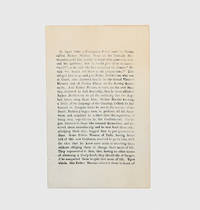
1863187084Middle Hill: Middle Hill Press 1863. They saw him often drinking with these Women and Girls and joking with them A letterpress transcription of one of the manuscripts in the famous collection of Thomas Phillipps printed at his Middle Hill Press for distribution to acquaintances. The source manuscript the location of which is now unknown tells a witty anecdote concerning a hypocritical Jesuit. It no doubt appealed to Phillipps's staunch anti-Catholicism. According to the story Father Nicolas who may be fictional preaches to the prostitutes of Macao to turn to the Christian life even though he could often be seen "drinking with these Women and Girls and joking with them till 9 or 10 at night" p. 2. We have traced four other copies of this pamphlet: one each at the Bodleian Library and the University of Macau and two in the library of the Grolier Cub in New York. Bifolium 168 x 105 mm letterpress on first 2 pages only old sewing holes. Outer pages toned: a well-preserved copy. Grolier Middle Hill 415. unknown
164021706Antwerp 1640. Folio. Ex Officina Plantiniana Balthasar Moretus Contemporary calf over wooden boards gold-tooled spine blind-tooled boards; rebacked with the original backstrip laid down remnants of clasps 4 small brass corner pieces. With an engraved title page and 126 engraved emblems including the Leo Belgicus map. 8 952 22 pp. First and only edition of the Jubilee masterpiece of the renowned Provincia Flandro-Belgica administrative region of the Society of Jesus and one of the finest books of the Officina Plantiniana under Balthasar Moretus. The Imago primi saeculi was the celebration of the celebration the triumphal arch erected by the Jesuits of the Flemish-Belgian province for the victories of Ignatius of Loyola 1491-1556 and also for the greater glory of God. All the emblems depict scenes of life but also the world map a compass the Leo Belgicus and the printer printing Jesuit propaganda are depicted. The first emblem in this work is the sun shining on the world.With a partially erased manuscript shelfmark label mounted on the front pastedown only "131 A 12" remains legible a manuscript inscriptions at the head of the half-title "Collegii Soc. Jesu Gandaui = Ghent" and "LL. Susanna de Hont" and "T 21". The binding shows signs of wear mainly around the spine and the edges and corners of the boards lacking the clasps some foxing and slight staining throughout. Otherwise in good condition.l De Backer-Sommervogel I col. 1625-6 i.v. Bollandus no. 5; Landwehr Emblem and fable books p. 378; Praz pp. 185-227; STCV 6609299; USTC 1003318. hardcover
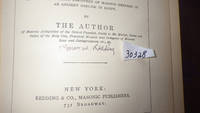
188030328<p>HARDBACK NODJ ISSUED 1880 ON COPYRITE PG 1ST Edition THICK Embossed boards with gilt lettering and decoration. Spine cover ends and corners show very little wear. Spine cover is faded SLITELY.Text block is clean and unmarked. All OUTER edges are red stained with lettered Gold Gilt Titles Interior VG/ VG AS-IS WITH RED THIN STAIN TO OUTER EDGE FEW PGS NOJACKET THICK BROWN PURPLE embossed Cover with Bright Gold Gilt DECORATIONS CVR LITE rub wear Scuffing 517 pgs Interior nice condition light Wear FOX Interior nice tight Clean light Fox OUTER PGS EDGES LITE RED</p><p>.</p><p>& Tragic Death of Philosopher Pythagoras. Roman Catholic Church has relentlessly persecuted Tortured & Burnt them at the Stake. Recent remarkable discovery of Masonic emblems on an ancient obelisk in Egypt."</p> Redding & Co. Publ, NY, Masonic publishers hardcover
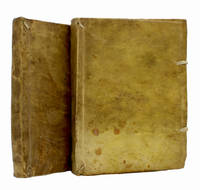
17726489Lima: Oficina de la calle de San Jacinto 1772. First Edition — Primera edición. Hardcover — Tapa dura. 190x135mm. 7½x5¼". Lima Oficina de la calle de San Jacinto 1772-1773. 2 volúmenes. En 4º menor 190 x 135mm. -I: 54 2 207 i.e. 133 5 pp. 14 hojas de portadillas. -II: 158 306 i.e. 318 4 pp. 5 hojas de portadillas. Encuadernación en pergamino de época. Primera edición de los cuadernos de desamortización de los bienes de la CompañÃa de Jesús en Perú con motivo de su expulsión según las reglas que prescribe la Real Cédula dada en Madrid a 9 de julio de 1769. Los Jesuitas fueron expulsados de Perú asà como de otras posesiones de España en América por orden de Carlos III en 1767. El libro también incluye las Constituciones de diferentes colegios peruanos que estaban bajo la supervisión de los jesuitas. Obra extraordinariamente rara de encontrar completa de sus dos volúmenes especialmente un ejemplar hermoso como el nuestro. Tiene en total 19 portadillas fuera de la paginación. En España sólo he encontrado completos 2 ejemplares institucionales Ministerio de Justicia y Biblioteca Nacional. Oficina de la calle de San Jacinto hardcover
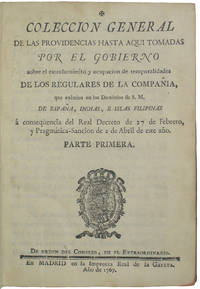
178444155Madrid: En la Imprenta Real de la Gazeta 1784. First edition. Contemporary mottled calf compartments decorated in gilt red morocco spine label titled in gilt sewn in green silk ribbon marbled endpapers. A very good copy head band worn with a small chip and a tiny split at the joint owner's bookplate and booksellers engraved plate on front pastedown contents quite bright and clean. 104 91 135 144 4 74 pp. 4to. Five volumes bound in one. Parts 1 2 3 set in condensed type; parts 4 and 5 in expanded type. <br /> <br /> Royal decrees from Charles III and instructions decisions and regulations issued by the Consejo en el Extraordinario and its president the Conde de Aranda and others--concerning the expulsion of the Jesuits. "These collections contain the documents relative to the expulsion of the Jesuits from the Spanish dominions and the confiscation of their property including the names of the colleges and houses of the order the application of the confiscated property &c. A complete series consists of five parts which are rarely found together. Our collation is of parts I. to III. only" Sabin 14304. Part 4 p. 75-127 contains the papal brief "Dominus ac Redemptor" by Clement XIV in Latin and Spanish. <br /> <br /> Earlier versions containing parts or all of the first three sections are not all that uncommon but those containing all five parts remain relatively rare. Other than this copy only two others have appeared in the auction records of ABPC and RBH since 1953 the first at the John B. Stetson sale at Parke Bernet and the second at Bonhams in a modern binding and dampstained. Palau 56516. See Sabin 14304. Medina BHA: IV 4228. En la Imprenta Real de la Gazeta unknown
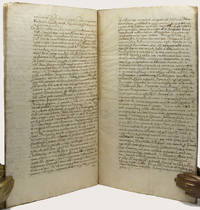
162134518Lisbon and Hangzhou China: Manuscripts ca.1623 and 1621. Very Rare A Similar Manuscript Exists in Brussels. We know of no others. The Latin text of both letters is written in a neat uniform cursive hand in brown. Folio leaves 33 x 20.5 cm The transcripts bound in 18th Century stiff blue wrappers the blank paste-downs and endpapers are late 18th century most likely the third quarter between 1745/1753 and 1776 since they contain a clear "lion/vryheit/pro patria" watermark with a crowned GR countermark which resembles Heawood 3148 3149 and 3154. The paper used for the manuscript contains a faint double-headed eagle watermark and it has been reinforced in the gutters. A very pleasing survival very well preserved edges slightly mellowed the wrappers show some signs of wear. VERY RARE MANUSCRIPT TRANSCRIPTS. Chrysostomus Johann Gall 1586-1643 was a German Jesuit and scholar. He left Ingolstadt Germany to teach astronomy mathematics and navigation in Lisbon fro 1620to 1627 before leaving to work in the Jesuit missions in India. The Colégio de Santo Antŕo benefitted from the arrival of many foreign mathematicians and other scholars as Lisbon serves as a gateway for all missionaries departing for Asia. The original letter by Gall was written in Lisbon September 1623 and concerns a newspaper style description of various events including details of the perseution of Christians in Japan particularly the execution of large numbers of the Christian community in Nagasaki in 1622.<br> The second letter in the present work is especially interesting as the original was written by Johannes Terentius also known as Johannes Schreck an Deng Yuhan Hanpo 1576-1630. Terentius was a prominent Jesuit scholar specialized in natural science and mathematics. Before joining the Jesuits as a novice1611 he already enjoyed a grea reputation in Germany as a scholar. In 1621 Terentius left for China to join the Jesuit mission. The original letter by Terentius was written in Hangzhou China on 30 August 1621 to the rector of teh Jesuit College in Munich Jakob Keller 1568-1631. He discusses his journey to China which he started in 1618 his intentions to participate in the planned calendar reform in China and his impressions of the city of Hangzhou which he reached in 1621 Terentius wrote several works on european medicine mathematics and technology in Chinese and together with Johann Adam Schall von Bell and G. Roho introduced European tigonometry and European astronomical instruments to China. In 1629 he began to reform the calendar which J.A. Schall von Bell ocmpleted after Terentius' early death a year later.<br><br>Backer & Sommervogel VII col. 1929-F<br> Manuscripts unknown
15854676<p>ENTRY NO. 1 IN BOSCARO<br />THE FIRST REFERENCE TO THE JAPANESE EMBASSY OF 1585 PRINTED ON THE TITLE-PAGE</p><p>Venice I Gioliti 1585.</p><p>Small 8vo 15.3 x 10 cm 103 pp. Bound in old vellum. Discrete former ownership stamp on title. Gutter margin of title reinforced; inconsequential toning otherwise excellent.</p><p>Rare early edition of this Jesuit letter containing news of missions and activity in Japan from the year 1582 the only edition of 5 printed that year to contain a title-page advertising the famous Japanese embassy of 1584-86. Significantly the work also discusses the embassy the participants and their noble lineage and expresses the hope that the embassy will prove a convincing sign of the Jesuit's spectacular success in Japan p. 7. The present imprint of this edition comprises the first entry in Boscaro's bibliography of printed works related to the embassy. It thus stands at the head of nearly 50 works printed in 1585 alone to record and commemmorate an event that-in addition to providing a public relations coup for the Jesuits-became a watershed moment in cross-cultural exchange between the Orient and the West: "no Japanese emissaries to Europe either before or since aroused comparable interest or enthusiasm" Lach.</p><p>In the annals of international relations between Europe and Japan in the 16th C it is particularly noteworthy "how the physical presence of the Japanese in Europe stimulated an unexpected number of typographical presentations" Boscaro of which this particular Gioliti edition with the titlepage advertising the embassy-Portata de Novo Dal Giapone Dai Signori Ambasciatori-is the very first. Boscaro notes that there were four other editions of Coehho's letter published in Italy in 1585 around the time the embassy arrived in Venice on June 25 including another by Gioliti but none of these uses the embassy as a way to market itself.</p><p>The report itself is also a significant document of the embassy's genesis: Coelho composed it in February 1582 the month that the embassy of four Japanese Christian converts departed from Nagasaki. In it he describes the ongoing missionary activity across the country: e.g. in Hirado Amasuka Bungo and especially Funai Oita City the home of a thriving Jesuit college. Presumably the contents of this letter as the title suggests were "brought from Japan by the eminent ambassadors" as the latest news on the Jesuits current success in that faraway land.</p><p>Though the embassy did not reach Lisbon until August 1584 it eventually was as Coelho had hoped a resounding success: from 1584-86 the four young Japanese nobles were the object of intense curiosity wherever they traveled and they were treated to lavish receptions in Lisbon Madrid Florence Rome Venice and other cities throughout Catholic Europe.</p><p>Provenance: Alfred Hamy 1838-1904 French Jesuit historian and prolific author of books relating to the history of the members of the Company of Jesus.</p><p>OCLC: Cornell NYPL HU and Newberry. Boscaro 1; Alt-Japan 812; Sommervogel II.1267; Cordier 78; Laures 169; Pagès 22; Lach I.2.690.</p><p> Boscaro 1; Alt-Japan 812; Sommervogel II.1267; Cordier 78; Laures 169; Pagès 22; Lach I.2.690.</p> I Gioliti
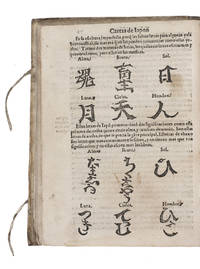
15755741Alcalá der Henares Spain: Juan Iniguez de Lequerica 1575. Contemporary limp vellum with ties. 4to in 8s. With woodcut of the Crucifixion on verso of the colophon 2R4v woodcut Japanese characters in the text I8v and woodcut decorated initials throughout. First Spanish edition of 87 Portuguese letters by Jesuit missionaries in Japan very valuable for the history of the Jesuits in Japan India and other parts of Southeast Asia. The work was first published in Portuguese in Coimbra in 1570 and contains 10 additional important Jesuit letters which had never published before. Noteworthy are the woodcut Chinese and Japanese characters included in the text on leaf I8v. Cordier gives a list of these additional letters dating from 1567 to 1571. Other newly added were: the life of Francis Xavier Relacion de las cosas de la India by Manuel Acosta with remarks on in order of appearance Goa Cochin Daman Ceylon Comorin Bassein Ormuz Ethiopia Inambay and Manomotapa Malaca the Moluccas Ambonia Solor Macassar etc. and Breve relacion de la Isla y Reynos del Iapon.Lacking 2 leaves ¶7 and ¶8 from the preliminaries containing the "Indulgencias que nuestro Sancto Padre el Papa Pio. 4 ". With 18th-century manuscript annotations in brown ink on the recto of the first free flyleaf the title-page at the start of the text on fol. 1r the recto of the final leaf and in the margins throughout; the margins show only marks to highlight certain passages the other annotations are variations of the same owner's inscription most elaborate on the front flyleaf: "Ex icDn. Francesco et Paula Caveda Costo 15 . Mad. a 4 . Octobre 1786". The vellum of the binding is somewhat creased and stained water stained throughout the first and last few leaves are frayed and slightly damaged in the margins without affecting the text somewhat browned throughout. Otherwise in good condition.l Alt-Japan-Katalog 298; Cordier Japonica cols. 67-68; Iberian Books 54608; Laures 140; Palau 46311; Porbase 363133 1 copy; Salva 3282; Streit IV 1519 with a full list of all letters; USTC 337147. Juan Iniguez de Lequerica, hardcover