Pascal, BlaiseLivre Rare Book
60 résultats
1659YRG-2231 Volume (16.5x11 cm), Reliure veau brun de l'époque, dos à cinq nerfs, usures, excellente édition. Divisée en 5 parties. Schoute. Cologne.
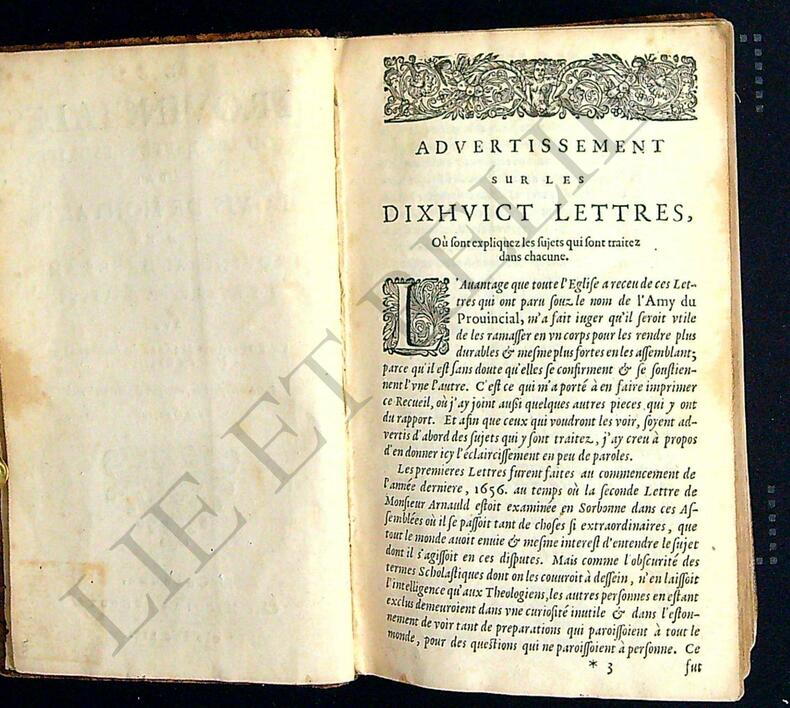
165799081657 veau brun, dos à n., tr. dorées. pet. in-12, (12ff.), 396pp., 108pp., Cologne chés Pierre de La Vallée 1657, (Amsterdam Louis et Daniel Elzévier),
170042989Lisboa, Miguel Manescal, 1700. In-4 de (12)-458-(2) pp., veau granité, dos orné à nerfs, pièce de titre en maroquin rouge (reliure de l'époque).
160126584Anvers ( Antwerpen ) Ex Officina Plantiniana 1601 Petit in-4° Suite de 100 planches numérotées de 1 à 100 sans discontinuer. Gravures sur Cuivres contrecollées sur un vergé bleuté et le Frontispice du Chemin de la vie éternelle de Sucquet ( 1622) La légende des vignettes est en trois langues, Latin, Néerlandais et Français. D'après la collation il pourrait s'agir du premier Livre d'Emblèmes du XVIIème siècle Du père Jrean David intitulé veridicus Christianus et non de Sucquet comme induit de façon erronnée le titre du Frontispice ( de 1622 ). La planche 66 reproduite dans Emblèmes Devises Iconologie de la " Librairie Paul Jammes " ( N° 50 Page 40 ) laiise penser que cette suite pourrait constituer les illustrations du livre du Père Jésuite Jean David planches gravées de Galle .( 100 vignettes (18x11 cm) à emblèmes du XVIIe siècle, numérotées de 1 à 100, légendées en latin, flamand et français. La première gravure porte : Ioan Galle excudit. Les suivantes, de facture similaire, ne sont pas signées. Les vignettes sont précédées d'un titre gravé : en Wech des eeuwich levens beschreven int latÿn, door P. Antonius Sucquet, over-gelet door P. Gerardus Zoes,[...] Met Beelden verlicht door Boëtius A. Bolsvert. T'Antwerpen, by Hendrick Aertssens, 1622.
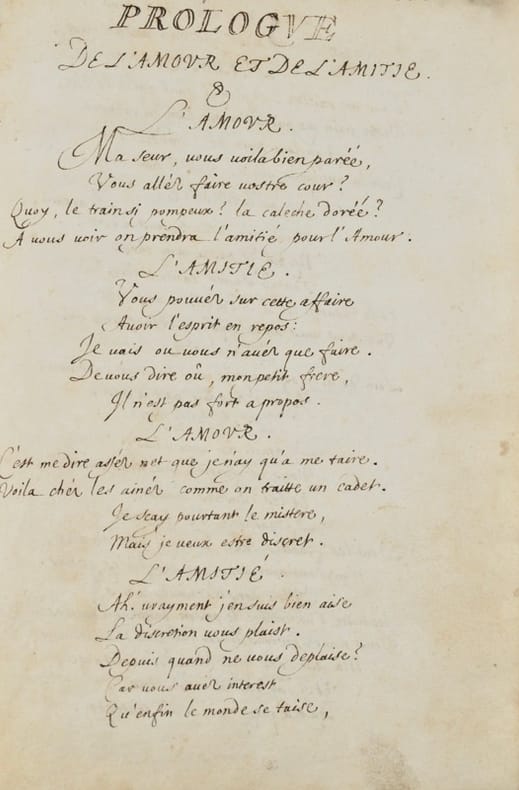
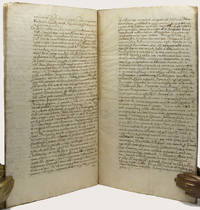
167742685S.l.n.d. (Paris, , c.1677). Manuscrit petit in-4 (16 x 23 cm) de 91 pp., veau brun, dos orné à nerfs (reliure de l’époque).
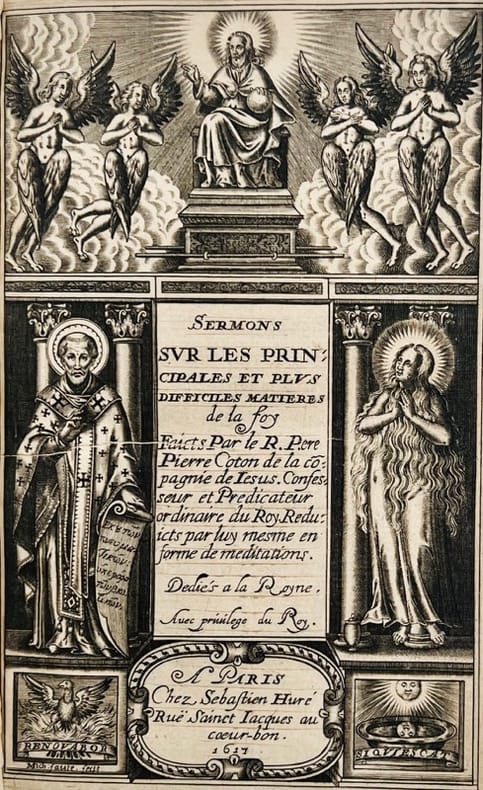
161743423Paris, Sébastien Huré, 1617. In-8 de (16)-922-(20) pp., titre gravé, maroquin olive, dos lisse orné de caissons en long à multiples fleurons échelonnés, frise, roulette et double encadrement de triple filet doré sur les plats, simple filet doré sur les coupes, tranches dorées (reliure de l'époque).
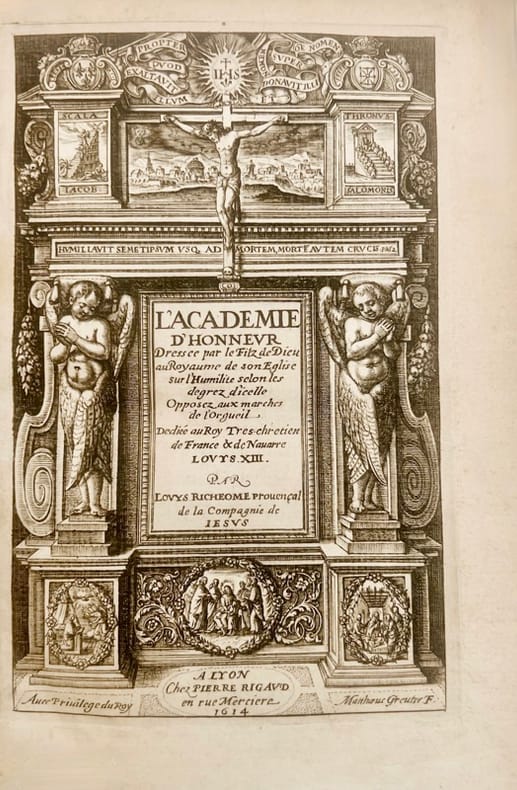
161444389Lyon, Pierre Rigaud, 1614. In-8 de (16) ff. dont le titre-frontispice, 670 pp., (29) ff., tables, veau fauve, dos lisse muet, double filet doré d'encadrement sur les plats et le dos, tranches dorées (reliure de l'époque).
164021706Antwerp 1640. Folio. Ex Officina Plantiniana Balthasar Moretus Contemporary calf over wooden boards gold-tooled spine blind-tooled boards; rebacked with the original backstrip laid down remnants of clasps 4 small brass corner pieces. With an engraved title page and 126 engraved emblems including the Leo Belgicus map. 8 952 22 pp. First and only edition of the Jubilee masterpiece of the renowned Provincia Flandro-Belgica administrative region of the Society of Jesus and one of the finest books of the Officina Plantiniana under Balthasar Moretus. The Imago primi saeculi was the celebration of the celebration the triumphal arch erected by the Jesuits of the Flemish-Belgian province for the victories of Ignatius of Loyola 1491-1556 and also for the greater glory of God. All the emblems depict scenes of life but also the world map a compass the Leo Belgicus and the printer printing Jesuit propaganda are depicted. The first emblem in this work is the sun shining on the world.With a partially erased manuscript shelfmark label mounted on the front pastedown only "131 A 12" remains legible a manuscript inscriptions at the head of the half-title "Collegii Soc. Jesu Gandaui = Ghent" and "LL. Susanna de Hont" and "T 21". The binding shows signs of wear mainly around the spine and the edges and corners of the boards lacking the clasps some foxing and slight staining throughout. Otherwise in good condition.l De Backer-Sommervogel I col. 1625-6 i.v. Bollandus no. 5; Landwehr Emblem and fable books p. 378; Praz pp. 185-227; STCV 6609299; USTC 1003318. hardcover
160540266Limoges, Jacques Barbou, 1605. In-16 de 130 pp. chiffrées 30 par erreur (sign A-H8, I1), trigramme IHS sur le titre, vélin souple (reliure de l'époque).
162134518Lisbon and Hangzhou China: Manuscripts ca.1623 and 1621. Very Rare A Similar Manuscript Exists in Brussels. We know of no others. The Latin text of both letters is written in a neat uniform cursive hand in brown. Folio leaves 33 x 20.5 cm The transcripts bound in 18th Century stiff blue wrappers the blank paste-downs and endpapers are late 18th century most likely the third quarter between 1745/1753 and 1776 since they contain a clear "lion/vryheit/pro patria" watermark with a crowned GR countermark which resembles Heawood 3148 3149 and 3154. The paper used for the manuscript contains a faint double-headed eagle watermark and it has been reinforced in the gutters. A very pleasing survival very well preserved edges slightly mellowed the wrappers show some signs of wear. VERY RARE MANUSCRIPT TRANSCRIPTS. Chrysostomus Johann Gall 1586-1643 was a German Jesuit and scholar. He left Ingolstadt Germany to teach astronomy mathematics and navigation in Lisbon fro 1620to 1627 before leaving to work in the Jesuit missions in India. The Colégio de Santo Antŕo benefitted from the arrival of many foreign mathematicians and other scholars as Lisbon serves as a gateway for all missionaries departing for Asia. The original letter by Gall was written in Lisbon September 1623 and concerns a newspaper style description of various events including details of the perseution of Christians in Japan particularly the execution of large numbers of the Christian community in Nagasaki in 1622.<br> The second letter in the present work is especially interesting as the original was written by Johannes Terentius also known as Johannes Schreck an Deng Yuhan Hanpo 1576-1630. Terentius was a prominent Jesuit scholar specialized in natural science and mathematics. Before joining the Jesuits as a novice1611 he already enjoyed a grea reputation in Germany as a scholar. In 1621 Terentius left for China to join the Jesuit mission. The original letter by Terentius was written in Hangzhou China on 30 August 1621 to the rector of teh Jesuit College in Munich Jakob Keller 1568-1631. He discusses his journey to China which he started in 1618 his intentions to participate in the planned calendar reform in China and his impressions of the city of Hangzhou which he reached in 1621 Terentius wrote several works on european medicine mathematics and technology in Chinese and together with Johann Adam Schall von Bell and G. Roho introduced European tigonometry and European astronomical instruments to China. In 1629 he began to reform the calendar which J.A. Schall von Bell ocmpleted after Terentius' early death a year later.<br><br>Backer & Sommervogel VII col. 1929-F<br> Manuscripts unknown