359 résultats
0259042390.Gpaperback. Good. Access codes and supplements are not guaranteed with used items. May be an ex-library book. paperback
3386667104.Ghardcover. Good. Access codes and supplements are not guaranteed with used items. May be an ex-library book. hardcover
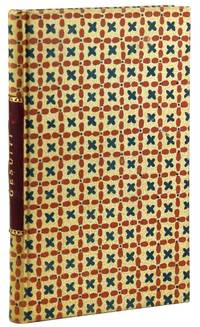
176031129Lugano CH: A Spese di Giuseppe Bettinelli di Venezia / Nella Stamperia Privilegiata della Suprema Superiorita' Elvetica nelle Prefetture Italiane 1760. Near Fine. Lugano CH: A Spese di Giuseppe Bettinelli di Venezia / Nella Stamperia Privilegiata della Suprema Superiorita' Elvetica nelle Prefetture Italiane 1760. First Edition. Two octavo volumes bound together. 44; 94pp. 20th-century binding with patterned paper-covered boards and red leather spine label; top edge stained red; new endpapers. Touch of edgewear with toning to spine. Binding sound and interior unmarked. A Near fine copy of two uncommon Swiss Jesuit-related tracts the former appearing more densely theological and the latter discussing the work and thoughts of Plato Seneca and Lucretius among other ancients. A Spese di Giuseppe Bettinelli di Venezia / Nella Stamperia Privilegiata della Suprema Superiorita' Elvetica nelle Prefetture It unknown
15854676<p>ENTRY NO. 1 IN BOSCARO<br />THE FIRST REFERENCE TO THE JAPANESE EMBASSY OF 1585 PRINTED ON THE TITLE-PAGE</p><p>Venice I Gioliti 1585.</p><p>Small 8vo 15.3 x 10 cm 103 pp. Bound in old vellum. Discrete former ownership stamp on title. Gutter margin of title reinforced; inconsequential toning otherwise excellent.</p><p>Rare early edition of this Jesuit letter containing news of missions and activity in Japan from the year 1582 the only edition of 5 printed that year to contain a title-page advertising the famous Japanese embassy of 1584-86. Significantly the work also discusses the embassy the participants and their noble lineage and expresses the hope that the embassy will prove a convincing sign of the Jesuit's spectacular success in Japan p. 7. The present imprint of this edition comprises the first entry in Boscaro's bibliography of printed works related to the embassy. It thus stands at the head of nearly 50 works printed in 1585 alone to record and commemmorate an event that-in addition to providing a public relations coup for the Jesuits-became a watershed moment in cross-cultural exchange between the Orient and the West: "no Japanese emissaries to Europe either before or since aroused comparable interest or enthusiasm" Lach.</p><p>In the annals of international relations between Europe and Japan in the 16th C it is particularly noteworthy "how the physical presence of the Japanese in Europe stimulated an unexpected number of typographical presentations" Boscaro of which this particular Gioliti edition with the titlepage advertising the embassy-Portata de Novo Dal Giapone Dai Signori Ambasciatori-is the very first. Boscaro notes that there were four other editions of Coehho's letter published in Italy in 1585 around the time the embassy arrived in Venice on June 25 including another by Gioliti but none of these uses the embassy as a way to market itself.</p><p>The report itself is also a significant document of the embassy's genesis: Coelho composed it in February 1582 the month that the embassy of four Japanese Christian converts departed from Nagasaki. In it he describes the ongoing missionary activity across the country: e.g. in Hirado Amasuka Bungo and especially Funai Oita City the home of a thriving Jesuit college. Presumably the contents of this letter as the title suggests were "brought from Japan by the eminent ambassadors" as the latest news on the Jesuits current success in that faraway land.</p><p>Though the embassy did not reach Lisbon until August 1584 it eventually was as Coelho had hoped a resounding success: from 1584-86 the four young Japanese nobles were the object of intense curiosity wherever they traveled and they were treated to lavish receptions in Lisbon Madrid Florence Rome Venice and other cities throughout Catholic Europe.</p><p>Provenance: Alfred Hamy 1838-1904 French Jesuit historian and prolific author of books relating to the history of the members of the Company of Jesus.</p><p>OCLC: Cornell NYPL HU and Newberry. Boscaro 1; Alt-Japan 812; Sommervogel II.1267; Cordier 78; Laures 169; Pagès 22; Lach I.2.690.</p><p> Boscaro 1; Alt-Japan 812; Sommervogel II.1267; Cordier 78; Laures 169; Pagès 22; Lach I.2.690.</p> I Gioliti
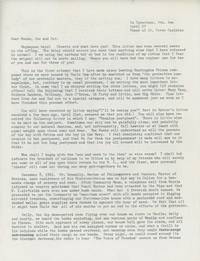
1945List2748Philippines 1945. Single letter; five 8.5 x 11†pages. Pinhole at top of first page missing final pages overall fine. The unknown author of this letter was an American Jesuit missionary in the Philippines who before the war was a novice living in Novaliches just outside Manila. He apparently had not written a significant letter home for a long time: in this letter written in April of what is likely 1945 he recounts his experiences from between December 8 1941 and early January of 1945 shortly before the civilian POW camp in which he was interned was liberated.<br /> <br /> After the “Nips†bomb Pearl Harbor “A feverish month ensuedâ€:<br /> <br /> “We proceeded to put the Community on ‘war-time alert’ with all hands occupied in digging air-raid trenches camouflaging our fortress-like house with a garlanded roof and mud-daubed walls; grain supplies were rushed in against the hour of need. We felt that all it might take Uncle Sam all of six months to put an end to the efforts of the pretender.â€<br /> Around Christmas they evacuated to the Jesuit Ateneo Grade School then in Intramuros as the Japanese were advancing quickly towards Novaliches. Of course this did not prove to be much safer:<br /> <br /> “When darkness came the Japs began their bombing of the Port Area. The bombs began to bounce off the pavement; bombers just skimming our roof-top on their way. We spent the night on our tummies and how we prayed. We thought that each decade of the beads would be our last this side of Purgatory. . When the church sto Domingo was hit the floor beneath us did some tricks and we were lifted up a bit and let down amidst the dust and smoke that poured in from above.â€<br /> <br /> The missionaries try to “salvage important papers and other valuables from the Mission House prior to abandoning it to the fire which threatened the entire Walled City.†During this time they and “a thousand refugees†live in the Ateneo while “Dawn and night raids were supplied by the Japs with nary an American plane to say to them no†– American forces had taken a serious hit and withdrawn outside Manila. It was declared an open city before “the little scrawny but arrogant Japs came into the city and took over†in January of 1942.<br /> <br /> The missionaries persuade the Japanese to let them stay in the Ateneo:<br /> <br /> “We convinced them that it was impossible for us to give up the building because it belonged to the Pope and the Vatican State would hold us responsible. This argument with many ingenious trimmings enabled us to hold on to the Ateneo until June ‘43 when the main building was taken for a military hospitalâ€.<br /> <br /> The author describes how despite what he calls his “partial internment†in Manila he is able to get around checkpoints by pretending to be Belgian. He finishes his studies and begins work at a Belgian convent in Paranaque in February of 1943 living between there and Manila:<br /> <br /> “Incidentally none of this would have been possible if the Japs had gumption enough to find out that I was one of the hated Americans. . All vehicles were obliged to stop here a checkpoint at Baclaran and all passengers get down and file between a Jap sentry and a Filipino constabulary soldier to be searched for hidden arms etc. Since several Belgian Fathers not considered enemy aliens frequently passed this way I was able to walk through unmolested as an unoffending Belgian. . I carefully kept my helmet covering the tell-tale red arm-band which was worn on the arm furtherest away from the Jap. The Filipino would do no more than give me a knowing grin.â€<br /> <br /> On July 10 1944 all of the American civilian POWs are taken to internment camps in Santo Tomas and then Los Baños. In Los Baños the POWs cut wood repair roads and farm. Los Baños would be liberated in February of 1945; the author paints a slightly confusing picture of the leadup to this:<br /> <br /> “Conditions generally ‘worsened’ when on Jan. 8th about the time that the American troops landed at Mindero an island just across from Batangas the Japs got jittery believing that the Yanks were going to do the obvious and cross over the bay to Batangas and they the Japs at Batanga decamped! ‘You are free but remain in camp until the Americans come. Outside your camp Japanese troops will shoot any who leave.’ Great was the joy in Mudville. From nowhere came flag poles on which we quickly unfurled American and British flags .; a short-wave radio was set up and we enjoyed daily Frisco broadcasts .â€<br /> <br /> It sounds as if the missionary was reporting contrary to the usual narrative of the Los Baños raid that the Japanese had essentially given up control of the camp and were like the prisoners simply waiting for the Americans to come get their people. Perhaps something further happened in the nearly two intervening months; however the remainder of the letter is missing.<br /> <br /> Of interest to scholars of modern Jesuit history and of the civilian POW experience during the Second World War. unknown
1021761478.Gpaperback. Good. Access codes and supplements are not guaranteed with used items. May be an ex-library book. paperback
B9781020238420Hardback. New. hardcover
ria9781020238420_inpHardcover. New. New Book; Fast Shipping from UK; Not signed; Not First Edition; N/A hardcover
1758317<p>FIRST EDITION. 12mo. bound in full havanan speckled calf smooth back decorated with golden fillets and florins title piece red slices binding of the time XXVI 588 pp. An excellent copy. Original edition of this anonymous charge against the Society of Jesus proposing to expose "the seditious doctrine of the Jesuits that authorizes attacks on the sacred person of kings. The author trumps up a global conspiracy theory in which Jesuits murdered kings and emperors including an organized plot to kill King Henry IV and the execution of Emperor Kangxi of China by missionaries. The text systematically moves from one country to the next reporting on the supposed crimes that Jesuit residents or visitors committed there: seduction fraud homicide theft & libel. Bibliotheca Brasiliense 1316; see Goldsmiths' -Kress 9442.</p> La Haye chez les frères Vaillant hardcover
1175253332.Gpaperback. Good. Access codes and supplements are not guaranteed with used items. May be an ex-library book. paperback
18952310050001Letouzey et Ane Paris 1895. Hardcover. Good. Indians Missions of North America 3 volume set. Bound in publisher's green cloth. Hardcover. Generally good bindings and covers. v.3 has a split on spine hinge and has been reglued. Clean unmarked pages. French. Letouzey et Ane, Paris hardcover
17184988Turin ie Paris: Jacques Daniel 1718. Soft cover. Very Good. Small 8vo. 2 ff 66 pp 1 ff. Title page printed in red and black. Bound in contemporary marbled wrappers. Slightly dog-eared otherwise a very good copy. Rare compilation of anti-Jesuit apocrypha: the famous 'Monita secreta' is found here alongside a purported condemnation of the Jesuits by the Faculty of Theology in Paris in 1554 as well as a translation of a prophecy of Saint Hildegaarde commonly seen as fortelling the fall of the Order. The present work bears a transparently false imprint "chez Jacques Daniel a good subject of the Prince at the Sign of Truth"; we have been unable to trace any other record of the publisher Daniel in Turin. While the place of printing was almost certainly Paris the foreign imprint corroborates the polemicist's allegation that France had become such a Jesuit stronghold that the work could not be published there. The Monita Secreta was a guide allegedly written by the Jesuits explaining how to gain riches and make influential friends; bibliographers often attribute it to a Pole Jerome Zaorowsky exiled from the Society in 1611. The work was first printed in 1614 and enjoyed numerous printing couched under various suggestive titles - 'Jesuit intrigues' 'the cabinet of the Jesuits secrets opened' etc. As a forged work of slander for both its widespread dissemination and influence it may be compared to the anti-Semitic Protocols of the Elders of Zion. The editor of the present edition again introduces the work as a clandestine publication - "I do not know by what means it fell into the hands of Printers". The work is written in a straightforward and factual way and instructs members of the Order to court wealthy widows gain promotions and discredit members of other orders. Alexandre Brou for example attributes the printings of the late 17th century to the Jansenists in their ongoing political struggle against the Order; whether the present 'Turin' printing falls into that category remains to be determined. 1708 saw the forced dissolution of the Jansenist stronghold Port-Royal; in the years which followed many Jansenists were excommunicated by Papal bulls for their beliefs. The remarkable rise of the Jesuit Order from its founding in 1540 provoked both suspicion and envy in the religious world: as the editor of the present edition states "the rise of the Jesuits is the object of admiration of the entire world. One cannot understand precisely how in less than two centuries these clerics have managed to become so powerful making themselves formidable to all other Orders and wielding influence in both the Old and New Worlds. It is a mystery for many people." OCLC shows no US copies of this title which appeared again in 1729 without an imprint. OCLC 459214162. Cf De Backer-Sommervogel V: 491-5 p 493 for this edition on the Monita secreta. Cf also Brou Les Jesuites de la Legende I: 290 1906. Jacques Daniel paperback
0366384392.Ghardcover. Good. Access codes and supplements are not guaranteed with used items. May be an ex-library book. hardcover
1019339888.Ghardcover. Good. Access codes and supplements are not guaranteed with used items. May be an ex-library book. hardcover
elala2582Montreal: J.M.Valois 1892. Second Edition. A fire at the press destroyed all but some 65 copies of the first edition of 1871. Here printed for the first time from a manuscript now at Laval University the first section covering the years 1645-1668 of a private daily journal kept by the Jesuit superior at Quebec; with its spontaneous expression and considerable detail an indispensable companion to the official Relations. TPL cfDionne I 1131. cfGagnon I 1788. cfTPL 60. folio. pp. x 24 403. with half-title. title in red & black. original blind-stamped cloth extremities worn Montreal: J.M.Valois, 1892 hardcover
0364510986.Ghardcover. Good. Access codes and supplements are not guaranteed with used items. May be an ex-library book. hardcover
0656747080.Gpaperback. Good. Access codes and supplements are not guaranteed with used items. May be an ex-library book. paperback
1017684146.Gpaperback. Good. Access codes and supplements are not guaranteed with used items. May be an ex-library book. paperback
1017674957.Ghardcover. Good. Access codes and supplements are not guaranteed with used items. May be an ex-library book. hardcover
1331590728.Gpaperback. Good. Access codes and supplements are not guaranteed with used items. May be an ex-library book. paperback
0331929538.Ghardcover. Good. Access codes and supplements are not guaranteed with used items. May be an ex-library book. hardcover
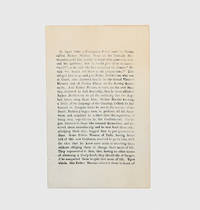
1863187084Middle Hill: Middle Hill Press 1863. They saw him often drinking with these Women and Girls and joking with them A letterpress transcription of one of the manuscripts in the famous collection of Thomas Phillipps printed at his Middle Hill Press for distribution to acquaintances. The source manuscript the location of which is now unknown tells a witty anecdote concerning a hypocritical Jesuit. It no doubt appealed to Phillipps's staunch anti-Catholicism. According to the story Father Nicolas who may be fictional preaches to the prostitutes of Macao to turn to the Christian life even though he could often be seen "drinking with these Women and Girls and joking with them till 9 or 10 at night" p. 2. We have traced four other copies of this pamphlet: one each at the Bodleian Library and the University of Macau and two in the library of the Grolier Cub in New York. Bifolium 168 x 105 mm letterpress on first 2 pages only old sewing holes. Outer pages toned: a well-preserved copy. Grolier Middle Hill 415. unknown
164021706Antwerp 1640. Folio. Ex Officina Plantiniana Balthasar Moretus Contemporary calf over wooden boards gold-tooled spine blind-tooled boards; rebacked with the original backstrip laid down remnants of clasps 4 small brass corner pieces. With an engraved title page and 126 engraved emblems including the Leo Belgicus map. 8 952 22 pp. First and only edition of the Jubilee masterpiece of the renowned Provincia Flandro-Belgica administrative region of the Society of Jesus and one of the finest books of the Officina Plantiniana under Balthasar Moretus. The Imago primi saeculi was the celebration of the celebration the triumphal arch erected by the Jesuits of the Flemish-Belgian province for the victories of Ignatius of Loyola 1491-1556 and also for the greater glory of God. All the emblems depict scenes of life but also the world map a compass the Leo Belgicus and the printer printing Jesuit propaganda are depicted. The first emblem in this work is the sun shining on the world.With a partially erased manuscript shelfmark label mounted on the front pastedown only "131 A 12" remains legible a manuscript inscriptions at the head of the half-title "Collegii Soc. Jesu Gandaui = Ghent" and "LL. Susanna de Hont" and "T 21". The binding shows signs of wear mainly around the spine and the edges and corners of the boards lacking the clasps some foxing and slight staining throughout. Otherwise in good condition.l De Backer-Sommervogel I col. 1625-6 i.v. Bollandus no. 5; Landwehr Emblem and fable books p. 378; Praz pp. 185-227; STCV 6609299; USTC 1003318. hardcover
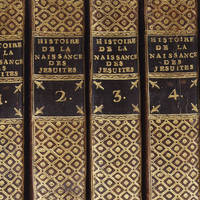
1764316736Rouen; Paris: s.n. 1764. viii. 499 6; vi 516 4; vi 447 3; vi 509 5; viii 4 311; 4 309-688 pp. 12mo. First four volumes in decorative brown paste-paper boards and sheep backs and corners other 2 volumes in full stained sheep with paste-paper endpapers backs of all six volumes uniform and richly gilt. A fine set in attractive dress. viii. 499 6; vi 516 4; vi 447 3; vi 509 5; viii 4 311; 4 309-688 pp. 12mo. Volumes I-III contain the history of the Society of Jesus from its origin until the end of the eighteenth century and the first analysis of its constitutions and privileges. Volume IV continues that analysis and has an index of the four-volume set. Barbier assigns the analysis chapters to Lois-Adrien Le Paige. Christophe Coudrette 1701-1774 was a Jansenist and the author of several anti-Jesuit works. Cioranesco 21317. Provenance: Fürstlich-Starhemberg'sche Familien Bibliothek Schloss Eferding ink stamp on front endpapers off all volumes; Loyola Reference Library stamp on lower edges call numbers in pencil on title-pages s.n. unknown
A9781165438174New. unknown