Luther MartinABAA
348 résultats
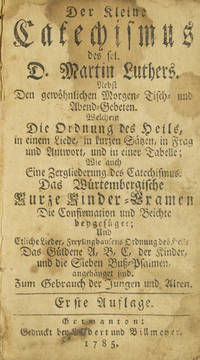
17855187Germanton Germantown Pa.: Leibert und Billmeyer 1785. First edition of the authorized version of the Pennsylvania Ministerium catechism. iv 127 1 pp. 1 vols. 12mo. Original boards. Binding worn front cover and initial blank nearly detached rear cover split at joint leaves browned pp. 87-94 are torn without any loss of text. In cloth slipcase. First edition of the authorized version of the Pennsylvania Ministerium catechism. iv 127 1 pp. 1 vols. 12mo. Rare Pensylvania Children's Catechism. The German American catechisms played an important role in education in addition to their obvious role in the moral training of the young they were also used for instruction in reading and writing. This is the first edition of the authorized version of the Pennsylvania Ministerium catechism whose source was Henrich Miller's 1774 and Johann Christoph Kunze's 1781 editions of the catechism. "This newly adopted catechism continued to be the official German text of the Ministerium for some 72 years until it was replaced by a revision in 1857 . During the long period in which it served as the official catechism it was printed by some 25 different printers in more than 70 years." - Repp. Arndt & Eck The First Century of German Language Printing in the USA I 632 2 copies one of which is incomplete; Shipton & Mooney 44712; Bristol B6095; Repp Luther's Catechism Comes to America p. 222; OCLC 62831685 3 copies Leibert und Billmeyer unknown books
1784100872Philadelphia: Gedruckt und zu haben bey Carl Cist in der Zweyten-Strasse 1784. Fifth American Edition. 41391p. Sm. 12mo. Contemporary calf-backed boards. Rubbed spine worn text browned but a sound copy with contemporary ownership inscription in German on the endpapers dated 1787. A good copy in brown cloth slipcase. Fifth American Edition. 41391p. Sm. 12mo. One of two known copies. A very popular catechism for children. Charles or Carl Cist was born in St Petersburg Russia and came to America in 1769 where according to Thomas he translated English into German for Henry Miller. Through Miller he gained knowledge of printing and with Melchior Steiner he published works in English and German. Steiner left the business and Cist continued later moving the business from Philadelphia to Washington. Shipton & Mooney 44550; Bristol B5917. Locations: 1 copy at Penn. Hist. Society Gedruckt und zu haben bey Carl Cist, in der Zweyten-Strasse unknown books
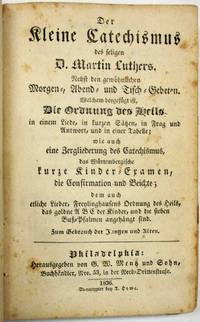
183635638Philadelphia: Herausgegeben von G.W. Mentz und Sohn Buchhändler. Stereotypirt bey J. Howe 1836. 12mo. 144pp. Frontispiece woodcut illustration of Martin Luther. Bound in contemporary decorated paper over boards rubbed with cloth spine some fraying and wear. Text with light to moderate foxing endpapers tanned. An attractive 19th century decorative binding slightly rubbed. Else Good.<br/><br/> A Lutheran catechism evidencing the strong German Lutheran presence in Pennsylvania in the 19th century in an attractive contemporary binding<br/>AI 38608 1-OHi. OCLC 15088950 7 as of July 2019. Herausgegeben von G.W. Mentz und Sohn, Buchhändler... Stereotypirt bey J. Howe unknown books
184843412Philadelphia: Mentz und Rovoudt 1848. 12mo pp. 251 1; woodcut frontispiece within the pagination dampstain pervades the first dozen leaves otherwise a very good copy in original sheep-backed decorative paper-covered boards green clover-leaf design on a pink brick-motif background green and pink decorations to page edges; yellow bookseller's ticket of W. A. Leary & Co. Philadelphia. Three copies only in OCLC: Michigan Columbia and German Society of PA. <br/><br/> Mentz und Rovoudt hardcover books
17606044Halle: Zu Finden im Waysenhause 1760. Sm. 8vo. 40pp. Old marbled boards paper on spine chipped away. Some text soiling. Zu Finden im Waysenhause hardcover books
1890JC12740Berlin: Haupt-Bibelgesellschaft 1890. Hardcover. Very Good. Full black morocco lettering stamped in silver in second spine compartment 4 raised bands metal cross mounted to upper board a.e.g. fore-edge clasp; 8vo; pp. 30 vi 916163 311 1 40 plus 2 maps. Spine joints and corners scuffed. Extensive notes in a contemporary hand on front flyleaf. <br/><br/> Haupt-Bibelgesellschaft hardcover books
2006ULUTHYM00LASHard Press 2006. Fine. Luther Martin. Hymns of Martin Luther Set to their Original Melodies with an English Version. NP: Hard Press 2006. 132pp. 8vo. Paperback. Book condition: Near fine. Hard Press paperback books
028247Berlin: Walter De Gruyter & Co. Unter Mitwirkung von Albert Leitzmann herausgegeben von Otto Clemen. 6e durchgesehene Auflage. 1959-1966. 8 volumes complete original cloth. Contents: Bd. 1 Schriften von 1517 bis 1520. Bd. 2 Schriften von 152 bis 1524. Bd. 3 Schriften von 1524 bis 1528. Bd. 4 Schriften von 1529 bis 1545 5e verbesserte Auflage. Bd. 5 Der junge Luther herausgegeben von Erich Voegelsang 3e Auflage. Bd. 6 Luthers Briefe herausgegeben von Hanns Rückert 3. verbesserte Auflage. Bd. 7 Predigten herausgegeben von Emanuel Hirsch 3e Auflage. Bd. 8 Tischreden herausgegeben von Otto Clemen 3e Auflage. Walter De Gruyter & Co unknown books
1983039685Frankfurt am Main: Insel Verlag 1983. 1e Auflage. 243 1p. b/w facs. titlespages original stiff printed wrappers editor's signed presentation copy Insel Almanach auf das Jahr 1983. Insel Verlag unknown books
1962042419Berlin: Verlag Walter de Gruyter & Co 1962. Sonderdruck aus der Lutherausgabe von O. Clemen. Herausgegeben von Kurt Aland. 26p. original stiff printed wrappers Kleine Texte für Vorlesungen und Ãbungen 142. Verlag Walter de Gruyter & Co unknown books
17931337937Marburg und Frankfurt: Heinrich Ludwig Bronner 1793. Hardcover. Octavo 24 773 19 24 32 160 pages; G; bound in contemporary full leather plain paneled spine; moderate wear and rubbing including leather rubbed off of tail of spine chipping to head of spine; remnants of leather clasps and hooks remaining; embossed pattern to gilt edges; patterned paper pastedowns; with engraved frontispiece of Martin Luther and an engraved title page; mild age-toning to interior; text in German; shelved case 4. 1337937. Shelved Dupont Bookstore. Heinrich Ludwig Bronner hardcover books
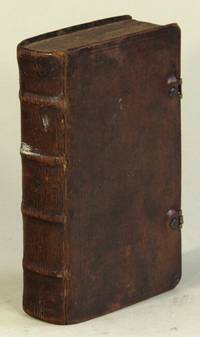
177053202Germantown: Gedruckt und zu finden bey Christoph Saur 1770. 12mo pp. 14 490 15 13 82 i.e. 83 1; woodcut frontispiece portrait; contemporary full calf brass clasps and catches preserved; a nice copy. The fourth printing of Saur's edition of 1757 "the first Lutheran hymnbook printed in the United States" Evans. Evans 11714; Bötte & Tannhof 384. <br/><br/> Gedruckt und zu finden bey Christoph Saur unknown books
18731334864Coln: Agentur des Britischen und Auslandischen Bibelgesellschaft 1873. Hardcover. Octavo; G-; Ex-library; Hardcover; Spine black with gold print raised bands blemish from removed call number label; Boards in black leather with gold print brass edges to boards two brass clasps on fore edge wear to hinges and spine caps mild shelfwear "Zum Andenken an die goldene Hochzeit ." printed with names of wedded couple and date of wedding on front; Text block has gilt edges white silk moire endpapers bookplate and remains of torn away bookplate on front pastedown library label and pocket on rear endpapers names in ink on front endpaper foxing to front and rear endpapers and title page library markings and stamp to title page verso and contents page significant age-toning to paper; Text in German fraktur typeface; 788 263 pages. 1334864. FP New Rockville Stock. Agentur des Britischen und Auslandischen Bibelgesellschaft hardcover books
18409027386Philadelphia: Miller & Burlock 1840. Hardcover. Fine. Bound in half leather with spine stamped in gilt marbled paper on boards and marbled endpapers. Frontispiece lithograph of Luther by P. S. Duval. Text block is tight. Pages are clean with a minimum of foxing. 749 pages. <br/><br/> Miller & Burlock hardcover books
184439278New York: Amerikanischen Bibel-Gesellschaft 1844. 2 volumes in 1 thick 8vo; text printed in double columns; full contemporary calf black gilt spine label; considerable wear leather rubbed several losses to spine label hinges weak; endpapers soiled lacking front flyleaf; contemporary signature on title page; interior fine. American Imprints 44-646. <br/><br/> Amerikanischen Bibel-Gesellschaft hardcover books
1926CNJL743Munich: Bremer Presse 1926-1928 1926. Limited Edition. Hardcover. Fine. Simons Anna. One of 365 copies folio size 5 volumes complete in German. An extraordinary publication by the Bremer Press of the "Martin Luther Bible". Translated by Luther directly from the Greek during his enforced sequestration in Wartburg Castle 1521-22 it was first published in 1545 and he continued to edit and refine his translation up to his death the following year. Translating directly from the Greek was a marked departure for the academics of the day who relied on the Latin Vulgate translation and used Latin for their studies with Greek seldom used or even taught. <br/><br/>Luther chose to translate from the Greek into the vernacular German language of the day making the scriptures accessible to everyday people and at the same time providing a vehicle for a more unified German language. The Bremer Press known for its interrelation of scholarship type design and book design has provided a version of the Luther Bible edited by Professor Carl von Kraus 1868-1952 Professor of German Philology at the Ludwig Maximilian University of Munich. n. b. above info from Wiki and Ransom.<br/><br/>___DESCRIPTION: Set of five volumes complete; Volume I: Die Bucher Mose; Volume II: Das Ander Teil des Alten Testaments; Volume III: Das Dritte Teil des Alten Testaments; Volume IV: Die Propheten; and Volume V: Das Neue Testament. The text is continuous with no chapter or verse indications save in the bottom margin of each page; each book of text is delineated with its own sectional title page each opens with a four- or five-line initial capital letter designed by Anna Simons. This set is bound in ivory tinted boards with the single word "Biblia" in gilt on the front black leather spines double raised bands single gilt rule at the head and tail "Biblia" and the volume number in gilt; top edges gilt fore- and bottom edges rough-cut; endpapers of light tan laid paper; in the style of the Bremer Press as with the Doves Press the interior is free of illustration or ornamentation the focus is on the integrity of design of the type and the overall work. Folio size almost 14" tall with the volumes unpaginated printed on Zanders hand-made paper special black-letter cut for this edition. Limited edition of 365 copies per Ransom with each volume in this set numbered differently Vol. I unnumbered Vol. II - no. 56 Vol. III - no. 142 Vol. IV - no. 300 and Vol. V - no. 289. All text in German.<br/><br/>___CONDITION: Fine as new the set appears never to have been used. Each volume has a strong square text block solid hinges perfectly straight corners with no rubbing the interiors are clean and bright and all volumes are entirely free of prior owner markings. The slipcases are very good with overall minor soiling and edgewear one of the five has a single split seam approximately 3 inches long.<br/><br/>___CITATION: Ransom Bremer Press no. 36.<br/><br/>___POSTAGE: Please note that due to the size and weight of this set additional postage will apply; we are happy to ship at cost to both domestic and international addresses please contact us for details.<br/><br/>___Swan's Fine Books is pleased to be a member of the ABAA ILAB and IOBA and we stand behind every book we sell. Please contact us with any questions you may have we are here to help. Bremer Presse [1926-1928] hardcover books
1919219615Berlin: Furche-Verlag 1919. hardcover. very good. Durer Albrecht. 14pp of text in German 16 nicely printed plates blank on verso. Short slim 4to parchment-backed boards a few spots; spine well-rubbed but sound; internally very clean. Berlin: Furche-Verlag 1919. Very good copy of this uncommon book.<br/><br/> Furche-Verlag unknown books
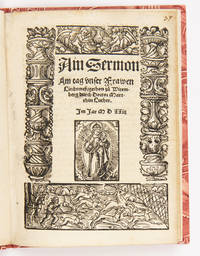
15233029<p>Augsburg: Melchior Ramminger 1523. </p><p>Price: $5500.00 </p><p>Quarto: 20 x 15 cm. 8 pp. Collation A4</p><p>One of five editions all printed in 1523.</p><p>Modern boards. A fine copy with a beautiful four-part title page border the lower register of which shows a stag hunt. There is also a small woodcut of the Virgin balancing on the crescent moon and holding the infant Christ.</p><p>A sermon for Lichtmeß Candlemas the feast of the presentation of the infant Jesus in the temple and the purification of Mary February 2. Jesus takes as his text Luke 2:22-39.<br /><br />For the complexities of Luther's evolving Mariology see Thomas O'Meara Mary in Protestant and Catholic Theology 1966. "Luther's attitude toward the theology of Mary and toward the devotion which a Christian should have to the Mother of God is a small-scale representation of his entire religious accomplishment. During any discussion of Luther and the Blessed Virgin we must keep uppermost in our minds that there was a development in his ideas a change more or less drastic in each aspect of Marian theology. This development has its beginning in Catholicism; it passes through contradictions struggles and uncertainties and terminates in a new Marian viewpoint one which Luther decided was Christocentric biblical unexaggerated and edifying."p. 123.</p><p>Benzing 1746; VD16 L-6084</p> Melchior Ramminger, books
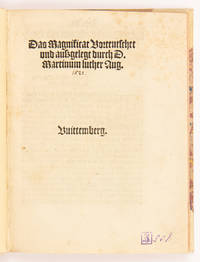
15213036<p>Wittenberg: Melchior Lotter 1521. </p><p>Price: $5600.00 </p><p>Quarto: 19 x 13 cm. 88 pp. a-l4</p><p>FIRST EDITION.</p><p>Modern marbled boards vellum spine and corners. A fine copy with contemporary marginalia in red and black. Provenance: Alain Moirandat Switzerland.</p><p>Luther wrote his "The Magnificat Translated into German and Explained" in two parts the first composed before his appearance at the Diet of Worms and the second part while he was in hiding in the Wartburg in May and June 1521. Given that Luther's vision of the church and of Mary's nature and place within Christianity were evolving and were to evolve much further over time and the fact that Luther left the Diet a changed man living in changed circumstances it is no wonder that Luther's exposition of the Magnificat has been the subject of numerous conflicting interpretations.<br /><br />In Albert Steinhaeuser's view the work "is a classical discussion of the place that the Virgin Mary occupies in the Protestant system. Although Luther regards her in one place as sinless and invokes her aid and intercession at the beginning and close of his work these are isolated instances; the whole tenor of the exposition is evangelical and as far removed from the Mariolatry of Rome as from an ultra-protestant depreciation of the Mother of our Lord. 'She does not want you to come to her but through her to God.' There is something very human and altogether unlike the radiant Queen of Heaven in the Mary who 'goes about her household tasks milking the cows cooking the meals washing pots and kettles sweeping out the rooms.' It is Luther's contribution to the German Madonna and the Weimar editors well compare this and similar passages of the Magnificat with Albrecht Durer's Marienleben a series of quaint woodcuts portraying the life of the Virgin 1503-10."<br /><br />But Hartmann Grisar one of the leading Catholic writers on Luther writes "Luther's 'Exposition of the Magnificat' has frequently been taken as a proof of Luther's great piety. It indeed contains many good thoughts even apart from those relating to Mary but in numerous passages the author uses his pen for a highly prejudiced vindication of his new teachings on the state of grace. It should also be borne in mind that the printers started on the book just before the Diet of Worms and that it was intended to attract and secure the support of the future rulers of the Saxon Electorate. Luther was also engaged at that time on his exceedingly violent screed against Catharinus in which he attempts to reveal the Pope in his true character as Antichrist. When after the Diet of Worms he continued his work on the Magnificat he was certainly in no mood to compose a book of piety on Mary. The result was that the book became to all intents and purposes a controversial tract which cannot be quoted as a proof of his piety or serenity of mind during those struggles. Luther's Magnificat is as little a serious work of edification and piety as his exposition of certain of the Psalms which appeared almost simultaneously and was also directed " against the Pope and the doctrine of men.".</p><p>VD16 L-5453; Benzing Luther 855; Kuczynski 1431</p> Melchior Lotter, books
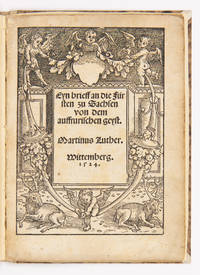
15243177Wittenberg:: Cranach and Döring 1524. FIRST EDITION. Quarto:. 21 x 15 cm. . 20 pp. A4 B2 C4 Bound in marbled boards. With an excellent woodcut title page by Lucas Cranach Luther 43c cut from a single block with putti cornucopiae architectural motifs and stags. A good copy light soiling a few stains. First edition of Luther’s response to the growing danger posed by the radical preacher Thomas Münzer who was ultimately executed the following year for leading the violent open revolt that came to be known as the Peasants’ War. In 1523 Thomas Münzer formerly the leader of the radical “Zwickau Prophets†began to radicalize the area of Allstedt where he was then pastor preaching that the ungodly were to be eliminated and the elect would establish a kingdom of Christ on earth and threatening the political rulers of the area with rebellion. In early 1524 as Münzer “grew bolder in his denunciation of the authorities and called for an elimination of the enemies of God†he divided the citizenry into military units in order to resist any outside interference in his activities. Münzer openly challenged and attacked Luther who was openly opposed to Münzer’ ministry of the elect as one of “our mad debauching pigs which are horrified by the windstorm the raging billows and by all the waters of wisdom.†In his “Letter to the Princes of Saxony Concerning the Rebellious Spirit†written in July 1524 in response to the recent violence and Münzer’s mystical theology Luther “appealed to the rulers to act before the incendiary suggestions of Münzer led to civil rebellion and open revoltâ€. Luther “distinguished two sides of Münzer’s behavior that of violence and that of precept. Only the subject of violence concerns the princes and to this subject he devotes almost his entire letter. Satan can here be seen at work in a new way and has shown us his hoofprint all too plainly –meaning Münzer says that one is not to leave it up to the Word but that it is time to resist the authorities with fists with the sacking of cloisters with the destruction of images. Luther demanded that the princes respond preventively by rigorous prohibitions. If the Allstedters wished to defend themselves and show their true colors let them do so in a public trial before whomever they choose. “Luther’s book is noteworthy not because he admonished them to suppress violence but much more because he drew boundaries for them to observe. They do not have to defend themselves against Münzer’s teaching: ‘Let them preach as confidently and as boldly as they are able and against whomever they wish…There must be sects and the Word of God must be under arms and fight…Let the spirits collide and fight it out. If meanwhile some are led astray let it be; such is war. Where there is battle and bloodshed some must fall and some are wounded. Whoever fights honorably will be crowned.’… “The princes became convinced that the disturbances might lead to rebellion and they summoned the leaders before them. The Allstedt council and Münzer were examined in Weimar at the beginning of August. To escape the impending verdict Münzer fled to Mühlhausen where later in the year he gained leadership over the city. He became a central figure in the Peasants’ Revolt and suffered death in May 1525 when the revolt was crushed.â€Bornkamm Luther in Mid-Career p. 152 ff. Benzing 1927; Kessler 553; Title border: Luther “Titeleinfassungen der Reformationszeit†43c Cranach and Döring, unknown books
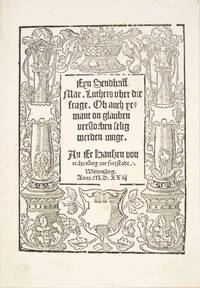
15233175Erfurt:: Stürmer 1523. FOURTH PRINTING. Quarto:. 20 x 14.5 cm. 8 pp. A4 Modern boards with a stamped Luther rose. With a narrow woodcut title border. A very fresh clean copy with an intricate title page border. All printings are rare. Luther wrote this letter in August 1522 to Hans von Rechenberg a strong supporter of the Reformation and a man who distinguished himself in battle against the Turks. There is no evidence that Luther knew von Rechenberg personally but the question that Luther addresses in the letter whether a person who dies without faith may be saved seems to have been one of personal concern to the addressee. Luther’s reply is quite direct and to the point: whether men like it or not Luther says God saves no one without faith for to do so would be contrary to his word. Furthermore faith does not seek to penetrate why God does not save without faith. Luther cites four passages of scripture: Mark 16:16 where Jesus says “Whoever does not believe will be condemnedâ€; Hebrews 11:6 which says “Without faith it is impossible to please Godâ€; John 3:6 “Whoever is not born anew of the Spirit and water cannot see the kingdom of Godâ€; and John 5:18 “Whoever does not believe is already judged.†Luther writes: “Now if God were to save someone without faith he would be acting contrary to his own words and make himself out to be a liar. Yes he would be denying himself and that is impossible. For St. Paul says in 2 Timothy 2:13 “God cannot deny himself.†As impossible as it is for divine truth to lie it is just as impossible for him to save someone without faith.†He continues: “It would be a completely different question to ask whether God could grant faith to a few at the moment of their death or after death and thereby save them through faith. Who would doubt that he could do this But no one can prove that he does do this. For we only read that he has already raised the dead and given them faith. No matter what he does whether he grants faith or not it is impossible for anyone to be saved without faith. Otherwise all preaching and the Gospel and faith itself would be futile false and deceptive since the entire Gospel makes faith necessary.†Benzing 1270 Stürmer], unknown books
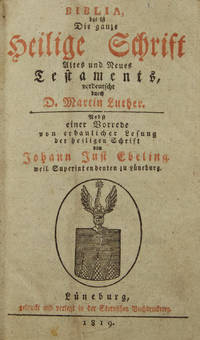
181935804Lüneburg: Der Sternschen Buchdruckerey 1819. Octavo. Full dark brown leather all edges yellow. 1f. title printed in black and red 9ff. Vorrede 1156 Old Testament 323 New Testament 9 Index pp.<br/><br/>Binding somewhat worn and rubbed; spine slightly defective. Very minor scattered foxing. 1819 issue of Ebeling's 1760 edition of Luther's Bible. Der Sternschen Buchdruckerey unknown books
1778LV2122aLeipzig:: Bey Christian Gottlob Hilscher 1778. 1778. Small 8vo. ii 131 1 pp. Engraved frontispiece of Luther by Bruhl engraved title-page and text head and tailpiece vignettes; modern glossy pastedowns and free end-papers. Quarter dark brown calf marbled boards gilt-stamped spine. Small inked shelf-number on verso title-page. Fine. Later edition of Schrockh’s "‘eminent’ biography of Luther" first published in 1773 Backus & Benedict p. 221. <br /><br /> "Schrockh. . .sympathized with Erasmus’ stand in the free-will controversy against Luther’s extreme determinism which says Schrockh the modern Protestant church does not feel committed to defend. . . .Schrockh stands by the narrower Lutheran definition of the Reformation. . . .In Planck and Schrockh despite their differences Protestantism and the Enlightenment remained in easy association" Mansfield. p. 46. <br /><br /> "The notion of Luther as the embodiment of the German Volksgeist for example could not but degenerate into that of simple patriotism or ‘Luther the German.’ On this view when Luther enjoined obedience to the secular authorities on the occasion of the peasants’ revolt he laid the groundwork for ‘respect for the authorities and for the inner peace of the state’—so says church historian Johann Matthias Schrockh 1733-1808. Indeed according to Schrockh in the intervening centuries all of Europe should have come to understand that the Protestant religion ‘is alone suited to the legitimate power and the true interests of the princes’ and that ‘all of this is without doubt Luther’s work’" Perkins pp. 69-70. <br /><br /> The frontispiece of Luther is fine example of German engraver Johann Benjamin Bruhl 1691-1763. <br /><br /> Schrockh "was an Austrian-German historian and literary scholar born in Vienna. He was a grandson to Pietist preacher Matthias Bel 1684-1749" Wikip. REFERENCES: Backus Irena & Philip Benedict Calvin and His Influence 1509-2009 Oxford: Oxford University Press 2011; Mansfield Bruce Man on His Own: Interpretations of Erasmus c. 1750-1920 Vol. 2 Toronto: University of Toronto Press 1992; Perkins Robert L. ed. For Self-examination and Judge for Yourself! Macon GA: Mercer University Press 2002. Bey Christian Gottlob Hilscher, 1778. hardcover books
1606D15188Strassburg: Theodosium Rihel 1606. Hardcover. Good. Pocket-sized 12mo 130 x 75mm. Pagination: 4 CCLXII 8 ff. Signatures: inserted 2 leaves A-Y12 Z11 lacking final blank stub but inserted five leaves. Old German Type. Each page printed within an elaborate woodcut border of masks putti vessels birds animals and scrolling ornament. Seventeenth-century full vellum stamped in blind with central lozenge of crucifixion front cover and ornament back cover large remnants of leather ties; outer edges somewhat soiled and worn binding a bit rubbed otherwise an excellent survival for its prospective use. An early owner has added several leaves at the front and rear upon which are transcribed several additional psalms and biblical verses Psalm 34 Jeremiah 3 Jeremiah 30 John 1:1 Corinthians 1:10 John 1:2. Other markings @ 1606 in this same hand on the first inserted leaf at front. By this date in the inscriptions This psalm booklet Dises Psalmen Büchlein and a man Carlo from Strassburg may be making corrections at time of early press. A later date on this leaf is 1776 along with an unknown monogram or printers mark quite reminiscent of Theodosius Rihels fl. 1555-1608 printers mark but with different letters S & K. <br/><br/>During a critical period of time for the church Martin Luther saw the Psalms not only as the central model to Christian prayer but as a key biblical book that would spark a revival and lay the scriptural foundation for the Protestant movement. Luther said find in it the Psalter also yourself. as well as God himself and all creatures Luthers Works 35:257. The Psalms were an early focus of Luthers translations and teaching at the University of Wittenberg; there he first published an exposition of the seven penitential psalms in 1517. In a later work Luther classified the psalms by theme; they belonged to groups pertaining to prophecy instruction comfort prayer and thanksgiving. This pocket-sized psalm book hearkens to Luthers famous statement that the Psalms are the Bible in miniature. The psalms were a strategic book of the bible for a nascent Lutheran and the early owner of this book seemingly poured over it and added layers of extra verse and interpretation in the blank spaces of the book. Scarce edition. OCLC locates editions published by Rihel but this 1606 printing is not among those located. This copy unique for its early German annotations and biblical additions. We surmise they may be intrinsic to an early Lutheran community in Strasbourg or related to the Strasbourgian printers themselves. Theodosium Rihel hardcover books
1933244000Berlin: Mann 1933. Limited. hardcover. near fine. Illustrated. Thin 8vo vellum-backed boards paper label front cover slipcase.Berlin: Gebr. Mann 1933. A near fine copy in a worn slipcase. Printed on untrimmed handmade paper.<br/><br/> One of 500 copies<br/><br/> Mann unknown books