348 résultats
17403828Halle: Johann Justinus Gebauer 1740-1753. First editions of the Walch edition of works of Martin Luther. Thick quartos 24 volumes. Bound in original full vellum with black and red titles frontispiece in volume 1and double frontispiece in volume 24 with separate portaits of both Luther and Walch. In very good condition with a light spot on the bottom spine where a former number was. An attractive set uncommon. This edition of Martin Luthers Works is important for Walchs valuable introductions and the inclusion of many other documents of the Reformation period. Johann Justinus Gebauer hardcover books
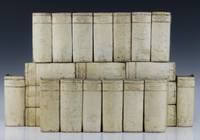
1926CNJL743Munich: Bremer Presse 1926-1928 1926. Limited Edition. Hardcover. Fine. Simons Anna. One of 365 copies folio size 5 volumes complete in German. An extraordinary publication by the Bremer Press of the "Martin Luther Bible". Translated by Luther directly from the Greek during his enforced sequestration in Wartburg Castle 1521-22 it was first published in 1545 and he continued to edit and refine his translation up to his death the following year. Translating directly from the Greek was a marked departure for the academics of the day who relied on the Latin Vulgate translation and used Latin for their studies with Greek seldom used or even taught. <br/><br/>Luther chose to translate from the Greek into the vernacular German language of the day making the scriptures accessible to everyday people and at the same time providing a vehicle for a more unified German language. The Bremer Press known for its interrelation of scholarship type design and book design has provided a version of the Luther Bible edited by Professor Carl von Kraus 1868-1952 Professor of German Philology at the Ludwig Maximilian University of Munich. n. b. above info from Wiki and Ransom.<br/><br/>___DESCRIPTION: Set of five volumes complete; Volume I: Die Bucher Mose; Volume II: Das Ander Teil des Alten Testaments; Volume III: Das Dritte Teil des Alten Testaments; Volume IV: Die Propheten; and Volume V: Das Neue Testament. The text is continuous with no chapter or verse indications save in the bottom margin of each page; each book of text is delineated with its own sectional title page each opens with a four- or five-line initial capital letter designed by Anna Simons. This set is bound in ivory tinted boards with the single word "Biblia" in gilt on the front black leather spines double raised bands single gilt rule at the head and tail "Biblia" and the volume number in gilt; top edges gilt fore- and bottom edges rough-cut; endpapers of light tan laid paper; in the style of the Bremer Press as with the Doves Press the interior is free of illustration or ornamentation the focus is on the integrity of design of the type and the overall work. Folio size almost 14" tall with the volumes unpaginated printed on Zanders hand-made paper special black-letter cut for this edition. Limited edition of 365 copies per Ransom with each volume in this set numbered differently Vol. I unnumbered Vol. II - no. 56 Vol. III - no. 142 Vol. IV - no. 300 and Vol. V - no. 289. All text in German.<br/><br/>___CONDITION: Fine as new the set appears never to have been used. Each volume has a strong square text block solid hinges perfectly straight corners with no rubbing the interiors are clean and bright and all volumes are entirely free of prior owner markings. The slipcases are very good with overall minor soiling and edgewear one of the five has a single split seam approximately 3 inches long.<br/><br/>___CITATION: Ransom Bremer Press no. 36.<br/><br/>___POSTAGE: Please note that due to the size and weight of this set additional postage will apply; we are happy to ship at cost to both domestic and international addresses please contact us for details.<br/><br/>___Swan's Fine Books is pleased to be a member of the ABAA ILAB and IOBA and we stand behind every book we sell. Please contact us with any questions you may have we are here to help. Bremer Presse [1926-1928] hardcover books
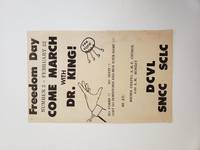
15872KING Martin Luther. "Freedom Day . . . Come March with Dr. King!" Printed flier. February 22 1965. 8 1/2" x 5 1/4" inches. This flier was issued to advertise the Freedom Day event planned for March 1st 1965 which protested the voter suppression tactics targeting African-American citizens of the US. In this demonstration prospective voters led by Martin Luther King Jr. and John Lewis signed an "appearance book" to indicate their attempt to register. It is illustrated with a shackled hand grasping for the key to freedom--"The Vote." This demonstration followed the first Freedom Day of January 18th 1965 in which King and Lewis led 500 prospective voters to the Selma courthouse for registration who were subsequently turned away. The Freedom Day voter registration efforts were among the events leading up to the famed March from Selma to Montgomery. "Bloody Sunday" transpired the very next week after the events of this flier in which peaceful participants in a Selma to Montgomery march for voting rights were met by Alabama state troopers who attacked them with nightsticks tear gas and whips after they refused to turn back. Some protesters were severely beaten and bloodied while others ran for their lives; The entire incident was captured on national television. As a direct result of the Freedom Day demonstrations and especially the horror of Bloody Sunday the Voting Rights Act was signed by President Lyndon B. Johnson on August 6 1965 with Martin Luther King Jr. and other civil rights leaders present at the ceremony. Toning minor foxing. unknown books
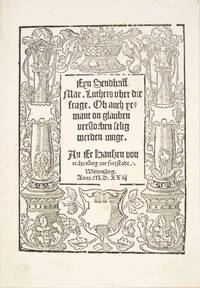
15233175Erfurt:: Stürmer 1523. FOURTH PRINTING. Quarto:. 20 x 14.5 cm. 8 pp. A4 Modern boards with a stamped Luther rose. With a narrow woodcut title border. A very fresh clean copy with an intricate title page border. All printings are rare. Luther wrote this letter in August 1522 to Hans von Rechenberg a strong supporter of the Reformation and a man who distinguished himself in battle against the Turks. There is no evidence that Luther knew von Rechenberg personally but the question that Luther addresses in the letter whether a person who dies without faith may be saved seems to have been one of personal concern to the addressee. Luther’s reply is quite direct and to the point: whether men like it or not Luther says God saves no one without faith for to do so would be contrary to his word. Furthermore faith does not seek to penetrate why God does not save without faith. Luther cites four passages of scripture: Mark 16:16 where Jesus says “Whoever does not believe will be condemnedâ€; Hebrews 11:6 which says “Without faith it is impossible to please Godâ€; John 3:6 “Whoever is not born anew of the Spirit and water cannot see the kingdom of Godâ€; and John 5:18 “Whoever does not believe is already judged.†Luther writes: “Now if God were to save someone without faith he would be acting contrary to his own words and make himself out to be a liar. Yes he would be denying himself and that is impossible. For St. Paul says in 2 Timothy 2:13 “God cannot deny himself.†As impossible as it is for divine truth to lie it is just as impossible for him to save someone without faith.†He continues: “It would be a completely different question to ask whether God could grant faith to a few at the moment of their death or after death and thereby save them through faith. Who would doubt that he could do this But no one can prove that he does do this. For we only read that he has already raised the dead and given them faith. No matter what he does whether he grants faith or not it is impossible for anyone to be saved without faith. Otherwise all preaching and the Gospel and faith itself would be futile false and deceptive since the entire Gospel makes faith necessary.†Benzing 1270 Stürmer], unknown books
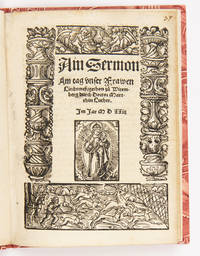
15233029<p>Augsburg: Melchior Ramminger 1523. </p><p>Price: $5500.00 </p><p>Quarto: 20 x 15 cm. 8 pp. Collation A4</p><p>One of five editions all printed in 1523.</p><p>Modern boards. A fine copy with a beautiful four-part title page border the lower register of which shows a stag hunt. There is also a small woodcut of the Virgin balancing on the crescent moon and holding the infant Christ.</p><p>A sermon for Lichtmeß Candlemas the feast of the presentation of the infant Jesus in the temple and the purification of Mary February 2. Jesus takes as his text Luke 2:22-39.<br /><br />For the complexities of Luther's evolving Mariology see Thomas O'Meara Mary in Protestant and Catholic Theology 1966. "Luther's attitude toward the theology of Mary and toward the devotion which a Christian should have to the Mother of God is a small-scale representation of his entire religious accomplishment. During any discussion of Luther and the Blessed Virgin we must keep uppermost in our minds that there was a development in his ideas a change more or less drastic in each aspect of Marian theology. This development has its beginning in Catholicism; it passes through contradictions struggles and uncertainties and terminates in a new Marian viewpoint one which Luther decided was Christocentric biblical unexaggerated and edifying."p. 123.</p><p>Benzing 1746; VD16 L-6084</p> Melchior Ramminger, books
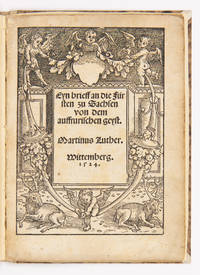
15243177Wittenberg:: Cranach and Döring 1524. FIRST EDITION. Quarto:. 21 x 15 cm. . 20 pp. A4 B2 C4 Bound in marbled boards. With an excellent woodcut title page by Lucas Cranach Luther 43c cut from a single block with putti cornucopiae architectural motifs and stags. A good copy light soiling a few stains. First edition of Luther’s response to the growing danger posed by the radical preacher Thomas Münzer who was ultimately executed the following year for leading the violent open revolt that came to be known as the Peasants’ War. In 1523 Thomas Münzer formerly the leader of the radical “Zwickau Prophets†began to radicalize the area of Allstedt where he was then pastor preaching that the ungodly were to be eliminated and the elect would establish a kingdom of Christ on earth and threatening the political rulers of the area with rebellion. In early 1524 as Münzer “grew bolder in his denunciation of the authorities and called for an elimination of the enemies of God†he divided the citizenry into military units in order to resist any outside interference in his activities. Münzer openly challenged and attacked Luther who was openly opposed to Münzer’ ministry of the elect as one of “our mad debauching pigs which are horrified by the windstorm the raging billows and by all the waters of wisdom.†In his “Letter to the Princes of Saxony Concerning the Rebellious Spirit†written in July 1524 in response to the recent violence and Münzer’s mystical theology Luther “appealed to the rulers to act before the incendiary suggestions of Münzer led to civil rebellion and open revoltâ€. Luther “distinguished two sides of Münzer’s behavior that of violence and that of precept. Only the subject of violence concerns the princes and to this subject he devotes almost his entire letter. Satan can here be seen at work in a new way and has shown us his hoofprint all too plainly –meaning Münzer says that one is not to leave it up to the Word but that it is time to resist the authorities with fists with the sacking of cloisters with the destruction of images. Luther demanded that the princes respond preventively by rigorous prohibitions. If the Allstedters wished to defend themselves and show their true colors let them do so in a public trial before whomever they choose. “Luther’s book is noteworthy not because he admonished them to suppress violence but much more because he drew boundaries for them to observe. They do not have to defend themselves against Münzer’s teaching: ‘Let them preach as confidently and as boldly as they are able and against whomever they wish…There must be sects and the Word of God must be under arms and fight…Let the spirits collide and fight it out. If meanwhile some are led astray let it be; such is war. Where there is battle and bloodshed some must fall and some are wounded. Whoever fights honorably will be crowned.’… “The princes became convinced that the disturbances might lead to rebellion and they summoned the leaders before them. The Allstedt council and Münzer were examined in Weimar at the beginning of August. To escape the impending verdict Münzer fled to Mühlhausen where later in the year he gained leadership over the city. He became a central figure in the Peasants’ Revolt and suffered death in May 1525 when the revolt was crushed.â€Bornkamm Luther in Mid-Career p. 152 ff. Benzing 1927; Kessler 553; Title border: Luther “Titeleinfassungen der Reformationszeit†43c Cranach and Döring, unknown books
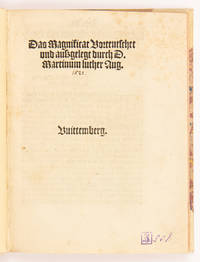
15213036<p>Wittenberg: Melchior Lotter 1521. </p><p>Price: $5600.00 </p><p>Quarto: 19 x 13 cm. 88 pp. a-l4</p><p>FIRST EDITION.</p><p>Modern marbled boards vellum spine and corners. A fine copy with contemporary marginalia in red and black. Provenance: Alain Moirandat Switzerland.</p><p>Luther wrote his "The Magnificat Translated into German and Explained" in two parts the first composed before his appearance at the Diet of Worms and the second part while he was in hiding in the Wartburg in May and June 1521. Given that Luther's vision of the church and of Mary's nature and place within Christianity were evolving and were to evolve much further over time and the fact that Luther left the Diet a changed man living in changed circumstances it is no wonder that Luther's exposition of the Magnificat has been the subject of numerous conflicting interpretations.<br /><br />In Albert Steinhaeuser's view the work "is a classical discussion of the place that the Virgin Mary occupies in the Protestant system. Although Luther regards her in one place as sinless and invokes her aid and intercession at the beginning and close of his work these are isolated instances; the whole tenor of the exposition is evangelical and as far removed from the Mariolatry of Rome as from an ultra-protestant depreciation of the Mother of our Lord. 'She does not want you to come to her but through her to God.' There is something very human and altogether unlike the radiant Queen of Heaven in the Mary who 'goes about her household tasks milking the cows cooking the meals washing pots and kettles sweeping out the rooms.' It is Luther's contribution to the German Madonna and the Weimar editors well compare this and similar passages of the Magnificat with Albrecht Durer's Marienleben a series of quaint woodcuts portraying the life of the Virgin 1503-10."<br /><br />But Hartmann Grisar one of the leading Catholic writers on Luther writes "Luther's 'Exposition of the Magnificat' has frequently been taken as a proof of Luther's great piety. It indeed contains many good thoughts even apart from those relating to Mary but in numerous passages the author uses his pen for a highly prejudiced vindication of his new teachings on the state of grace. It should also be borne in mind that the printers started on the book just before the Diet of Worms and that it was intended to attract and secure the support of the future rulers of the Saxon Electorate. Luther was also engaged at that time on his exceedingly violent screed against Catharinus in which he attempts to reveal the Pope in his true character as Antichrist. When after the Diet of Worms he continued his work on the Magnificat he was certainly in no mood to compose a book of piety on Mary. The result was that the book became to all intents and purposes a controversial tract which cannot be quoted as a proof of his piety or serenity of mind during those struggles. Luther's Magnificat is as little a serious work of edification and piety as his exposition of certain of the Psalms which appeared almost simultaneously and was also directed " against the Pope and the doctrine of men.".</p><p>VD16 L-5453; Benzing Luther 855; Kuczynski 1431</p> Melchior Lotter, books
17435689Germantown: Gedruckt bey Christoph Saur 1743. 4to 26.3 cm 10.375". 2 ff. supplied in facsimile 995 1 blank 277 1 pp. 1 f. <br><br>1743 saw the first complete Bible in a European language printed in the New World in of all places Germantown Pa. and in of all languages German. The colonial powers had granted monopolies for Bible printing to "home" publishers and their products were priced sufficiently low to discourage illegal printing by colonial printers which left it to German-Americans a people here as independent settlers not "colonists" to first print a Bible of their own. Christopher Saur or Sower as he Englished it was something of a renaissance man university educated and a physician and he used his connections in Germany to obtain the gift of the fraktur type used in this Bible. It was printed in an edition of 1200 copies and cost 18 shillings. Another complete American Bible did not follow until Saur's son also Christopher published a further edition in 1763.<br>Â Â Â Â Arndt lists three states for this edition of which this appears to be C based on the absence of a two-leaf addendum giving a short history of Bible translation that a buyer could choose to have bound in or not. <br>Â Â Â Â <br>Â Â Â Â Evans 512728; Sabin 5191; Arndt The First Century of German Language Printing in the United States of America 47C; Hildeburn 804; Rumball-Petre Rare Bibles 159; Darlow & Moule 4240; O'Callaghan 22; Wright Early Bibles of America 2444. Contemporary calf over bevelled boards; binding scratched and abraded with tears to spine leather hinges inside open. First two leaves lacking i.e. main title-page and preface and title-page supplied in facsimile. A printed poem has been affixed to the front pastedown over a strip of cloth. Ownership inscriptions in German in gothic cursive and English on endpapers. Pp. 12 with loss of part of margins some text and part of headpiece repaired with paper. Lightly age-toned with darker brown-spotting some waterstaining occasional dog ears and some holing or chipping in the margins some of the latter repaired with paper. The New Testament title-page is present. Gedruckt bey Christoph Saur hardcover books
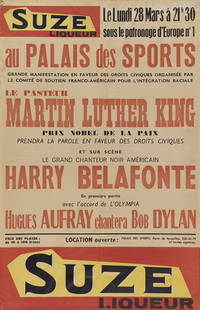
17914Used; Like New/Used; Like New. Poster for a March 28 1966 appearance by the Civil Rights leader together with singer Harry Belafonte at the Palais des Sports in Paris. Organized by the Comité de Soutien Franco-Américain pour l'Intégration Raciale the event featured a speech by King and music from Harry Belafonte and French singer Hugues Aufray sponsored by Suze Liqueur. Two-color poster with folding creases one tear to the right edge minimal wear and toning; overall very good. Sight size 14.5 x 22.5 inches 37 x 57 cm archivally matted and framed to an overall size of 20.5 x 26.5 inches.<br style="">In March 1966 King and Belafonte went to Europe for fundraising appearances on behalf of the Southern Christian Leadership Conference starting with the Palais des Sports in Paris on the 28th and closing in Sweden on the 31st. This poster for the French appearance is emblazoned with the logo of a sponsor Suze Liqueur and also cites the French-American Committee for Racial Integration as the organizing body. The opening act for the evening was the popular French folksinger Hugues Aufray doing a set of Bob Dylan covers followed by a set by Belafonte. Dr. King closed out the evening with a speech on civil rights touching on the war in Vietnam and American support for South African apartheid. The tour raised more than $100000 but drew the wrath of the American ambassador to France for airing American problems overseas. See Ross Hollywood Left and Right p. 220. We have traced no other copies of this poster at auction or elsewhere.<br style=""> unknown books
1963118239Boston: The Beacon Press 1963. First edition of this collection of interviews done by Kenneth B. Clark. Octavo original half cloth. Boldly signed by James Baldwin on the half-title page. Near fine in a near fine dust jacket. With a talk with Kenneth B. Clark and with a note about the interviews by Henry Morgenthau III. Bookplate. Interviews recorded for National Educational Television in May-June 1963. Conversations with James Baldwin Malcolm X and Martin Luther King with Kenneth B. Clark as the moderator. The Beacon Press hardcover books
1748D9092Nuremberg: In Verlegung der Johann Andrea Endterischen Handlung Endter MDCCLXVIII 1748. Hardcover. Very Good. Large format folio 424 x 274 x 125mm. 144 740pp. 2 512 480 16pp. Additional engraved title of architectural motif with heraldry of Saxe-Gotha-Altenberg and the flanking figures of Moses and Christ with their attributes in niches below signed by J. C. Clausener. Illustrated with 45 plates including title most of them full-page few double-page engravings depicting biblical scenes and prophet portraits as well as some double-page maps and plans temples and Holy Land maps most illustrations also signed by Clausener. With the rare double-page engraving in rear showing royalty and court members in a large reception hall Bischöffliche oder Fürstliche Saal during the Confessio which took place in Augsburg in 1530 under Charles V. This plate is usually missing. Persons and part of the architecture in hall are indicated on the actual plate with small numbers 1-47 opposite page lists each number with name and title of person depicted and explanations of parts of the architecture. Engraved titles and decorated initials throughout. Text in German. Gothic script. Contemporary blind-tooled pigskin over beveled boards with brass corner pieces and bosses clasps and catches restored; marginal soiling with age few dampstains or light wear not overwhelming the large work in the least engravings wholly intact with only minor folds or stains only map of Israel with wide marginal tear otherwise an excellent survival. Formerly in the Evangelical Lutheran Church in America early clippings of poetical quotations c.1910 found in hinge of first quire. <br/><br/>Endters Kurfürstenbibel of 1748 an influential Luther Bible with exceptional engravings produced by the Gotha court. First published in 1641 under the authorization of Duke Kurfürst Ernst I of Saxe-Gotha. This is the so-called Kurfürstenbibel or Elector Bible because some of the engravings show various Dukes from the 16th and 17th centuries. At the realization of this major project prominent Lutheran theologians such as Johann Gerhard Solomon Glassius and Johann Michael Dilherr among others contributed to the work. This Bible was published with a glossary and added in-text explanations of Luthers original translation for the enlightenment of ordinary people. For nearly two centuries from 1613 to 1792 the successful family of Endter of Nuremberg printed the text of Luthers Bible. Specifically the Kurfürstenbibel was produced from 1641 to 1758 in fourteen editions. Today the large-format folio expenditures are amongst the most commonly encountered family Bibles from the 17th but especially the 18th century. The Gotha courts significant pool of sources as well as favor of the market place in Nuremberg gave rise to such an important project. Large-format and heavyweight in every sense of the word it remains a visually stunning work with its numerous portraits of princes in woodcuts and engravings this Elector Bible treated both theological aspects as well as those of the courtly self-understanding. In Verlegung der Johann Andrea Endterischen Handlung [Endter], MDCCLXVIII hardcover books
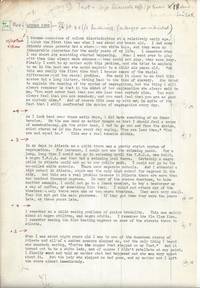
16360Martin Luther King Jr. King discusses color discrimination segregation equality police brutality Montgomery and his struggles in this pre-publication original typescript. Martin Luther King's interview with John Freeman was broadcast on 29 October 1961 in the BBC series 'Face to Face'. The present typescript of the interview is from the papers of the program's producer Hugh Burnett and is edited for publication as the section on 'The Rev LUTHER KING' in the book 'Face to Face Edited and introduced by Hugh Burnett' London: Jonathan Cape 1964. On two leaves stapled together. Published by Undated but prepared for publication in 1964. <br/><br/>In this remarkable typescript King talks about his mother's influence on King's beliefs: "I first became conscious of color discrimination at a very early age. I think the first time I was about six years old." King states relating how the white children next door never wanted to play. "Finally I went to my mother with this problem and she tried to explain to me in the best way she could explain to a child of six years old . She tried to explain to me the meaning of the system of segregation but the thing I will always remember is that in the midst of her explanation she always said to me "You must never feel that you are less than anybody else. You must always feel that you are somebody and you must always fee that you are as good as anybody else." King continues "On the one hand my mother taught me that should feel a sense of somebodiness on the other hand I had to go out and face the system which stared me in the face everyday saying "You are less than" "you are not equal to." King goes on "I remember as a child seeing problems of police brutality . in Montgomery Alabama we get no protection from law enforcement agencies." And yet King explains commitment to a moral ideal allows him to be courageous in the face of danger: I have been threatened many many times. There was a time that we received as many as thirty and forty threatening calls a day and of course I received numerous threatening letters .In Montgomery our home was bombed twice . We have had crosses burned on our lawn."<br/><br/>"I don't think anyone in a situation like this can go through it without confronting moments of real fear. But I have always had something that gave me an inner sense of assurance and an inner sense of security and in the final analysis even in moments of loneliness something ultimately came to remind me that in this struggle because it is basically right because it is a thrust forward to achieve something not just for negro people but something that will save the whole of mankind and when I have come to see these things I always felt a sense of cosmic companionship. So that the loneliness and the fear have faded because of a greater feeling of security because of commitment to a moral ideal. There have been times I have had to send my wife and family away for safety . my wife happens to be one of those very strong persons . I can remember a time when I sent her away for safety and a few days later she was back home because she wanted to be there." In fair condition lightly aged and worn. unknown books
176636853Halle: Waysenhaus 1766. 4to 22.2 cm; 8.75". 10 2 1079 1 308 4 pp. <br><br>This Bible was specifically designed and printed for the reader to annotate: the pages measure 8.5" x 6.75" and the text area only 5.5" x 2.875" leaving 1.5" to 2.25" of margin for notes on either side and 1" in the upper margin with 2" in the lower. => An early owner did just that not heavily but here and there in both the Old and New Testaments. It was owned by a member of an American scholarly and clerical family that had not one but two generations of association with the city of Halle which was a mecca and fount of the Pietism that drove so much of the early German religious migration to America.<br>Â Â Â Â Provenance: Signature of G. Henry Muhlenberg dated 1784 on the front free endpaper; later ownership signature of Jacob Strein 1814 on same. Gotthilf Heinrich Ernst Muhlenberg 17531815 was the son of Heinrich Melchior Muhlenberg one of the founders of the German Lutheran church in the U.S. and a pastor of Pietist background whose first post after completing his studies was a teaching position at the Francke Foundation's Historic Orphanage of which the Waysenhaus that printed this volume was the working press. His son born in Trappe PA and recorded above as owner of this book was sent to be educated in Halle starting in 1763 entering the University in 1769. After his return to Pennsylvania in 1770 he was ordained a Lutheran minister and later received a Doctor of Divinity degree from Princeton University while becoming known as a significant American botanist; in 1787 he was made the first president of Franklin College now Franklin & Marshall College. Strein was a fellow Lancaster County pastor.<br>Â Â Â Â => Of this scholar-serving production of this scholarly press in its hyper-scholarly city we find but three library copies reported all in Germany. <br>Â Â Â Â <br>Â Â Â Â Darlow & Moule 4251. Contemporary plain brown calf rebacked original spine retained with modest ruling at cover edges rubbed and abraded with offsetting to edges of first and last leaves from the leather; round plain spine with five raised bands and no label leather lost at top and bottom with rear joint opening and leather wanting to peel over spine generally. A little foxing with in a few signatures a bit more than that. => A good overall solid and clean copy of a Bible having multiple points of significance. Waysenhaus hardcover books
15564183Wittenberg:: Georg Rhau 1542 1556. Octavo:. 15 x 10 cm. I. a-h8; A-Z8 Aa4 lacking blank Aa4. II. A-L8 with blank L8 Bound in contemporary alum-tawed pigskin over wooden boards one clasp defective binding soiled and mildly worn and with small defects. The boards are ruled and tooled in blind signed and dated “IPN 1556â€. The contents are in excellent crisp condition one leaf working loose marginal tear in margin of leaf E5 no loss. With a historiated woodcut title border to the “Apologiaâ€. Woodcut coat-of-arms to verso of final leaf of the “Confessio†and fine woodcut initials in the Saxon Confession. Text of second work in Latin and German. With 16th c. notes on the f.f.e.p. This is the authorized text of the Augsburg Confession 1st ed. 1531 approved by Luther edited by and with the "Apologia" of Philip Melanchthon. It was printed by Georg Rhau who also printed the first editions both in Latin and German of the “Confessio†and “Apologiaâ€. The “Apologia†of this 1556 edition is dated 1542 see VD 16 ZV 31340. This edition was printed in the wake of the agreement reached in 1555 between the Lutheran princes and Charles V known as the Peace of Augsburg which granted Lutheranism legal status within the Holy Roman Empire. Bound into this copy is the 1553 Leipzig edition of the Saxon Confession which was drawn up by Melanchthon and intended for presentation at the Council of Trent; it presented the doctrinal status of the Lutheran Church of Germany as of 1552 and was the basis for the signing of the Peace of Augsburg. The Augsburg Confession: "On January 21 1530 the Emperor Charles V issued letters from Bologna inviting the German diet to meet in Augsburg on April 8 for the purpose of discussing and deciding various important questions. The far-seeing Landgrave of Hesse hesitated to attend the diet but the Elector John of Saxony who received the writ March 11 directed Luther Jonas Bugenhagen and Melanchthon to meet in Torgau and present a summary of the Protestant faith to be laid before the Emperor at the diet. This summary has received the name of the "Torgau articles". On April 3 the Elector and the reformers started from Torgau and reached Coburg on April 23. There Luther was left behind. The rest reached Augsburg May 2. On the journey Melanchthon worked on an "Apology" using the Torgau articles and sent his draft to Luther at Coburg who approved it. "The Emperor had ordered the confession to be presented to him on June 24. The evangelical princes however declared that they would not part with the confession until its reading should be allowed. The 25th was then fixed for the day of its presentation. In order to exclude the people the little chapel of the Episcopal palace was appointed in place of the spacious city hall. The two Saxon chancellors Bruck and Beyer the one with the Latin copy the other with the German stepped into the middle of the assembly and against the wish of the Emperor the German text was read. "Although the emperor prohibited the printing of the evangelical confession without his special permission during the diet six German editions and one in Latin were published. Their inaccuracy and incorrectness induced Melanchthon to prepare an edition to which he added the Apology. Thus originated the so-called 'editio princeps' of the Augustana and the Apology which was published in the spring of 1531." Schaff-Herzog "Melanchthon drafted the ‘Confession’ in both German and Latin using the Torgau Schwabach and Marburg Articles. The intention of the German Protestants was to present a single creed. Since they could not all agree on one several versions were presented to the Diet meeting at Augsburg. Of these it is the ‘Augsburg Confession’ that is remembered today; the others have long been forgotten. The presentation of the ‘Augsburg Confession’ was probably Melanchthon’s finest hour as a theologian. He had written a theological document that presented a reasonable compromise in the ongoing religious disputes in Germany. Luther himself said that he could never have ‘trod so lightly’ in treating such matters. The ‘Confession’ has come to be the standard Lutheran statement of faith and was included in the ‘Book of Concord’ of 1580."Kessler I. VD 16 ZV 31340; II. VD 16 C 4807 Georg Rhau, 1542, unknown books
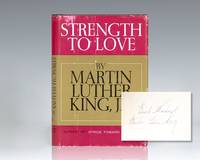
196398984New York: Harper & Row Publishers 1963. Early printing of Dr. King's second book of which Coretta Scott King noted "If there is one book Martin Luther King Jr. has written that people consistently tell me has changed their lives it is Strength to Love." Octavo original half cloth. Boldly signed by the author on the front free endpaper "Best Wishes Martin Luther King." Also laid in is an original photograph of Dr. King. Contemporary name to the pastedown near fine in a near fine dust jacket with light wear. Strength to Love was Martin Luther King's first volume of sermons published the same year in which he penned his Letter from a Birmingham Jail and joined the historic March on Washington and delivered his famous I have a dream speech. The following year he won the Nobel Peace Prize. King notes in the preface: "In these turbulent days of uncertainty the evils of war and of economic and racial injustice threaten the very survival of the human race. Indeed we live in a day of grave crisis. The sermons in this volume have the present crisis as their background; and they have been selected for this volume because in one way or another they deal with the personal and collective problems that the crisis presents." Coretta Scott King said about this book that it "best explains the central element of Martin Luther King Jr.' s philosophy of nonviolence: His belief in a divine loving presence that binds all life. By reaching into and beyond ourselves and tapping the transcendent moral ethic of love we shall overcome these evils." Harper & Row, Publishers hardcover books
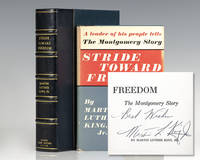
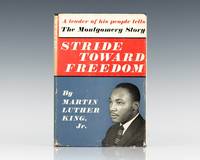
195899642New York: Harper & Brothers Publishers 1958. First edition of Dr. Martin Luther King's first book. Octavo original half cloth illustrated. Boldly signed by the author on the title page "Best Wishes Martin Luther King Jr." Near fine in a very good dust jacket. Housed in a custom half morocco clamshell box. Rare and desirable signed. Stride Toward Freedom is Dr. Martin Luther King Jr.'s account of the first successful large-scale application of nonviolence resistance in America is comprehensive revelatory and intimate. King described his book as "the chronicle of fifty thousand Negroes who took to heart the principles of nonviolence who learned to fight for their rights with the weapon of love and who in the process acquired a new estimate of their own human worth.'' Harper & Brothers, Publishers hardcover books
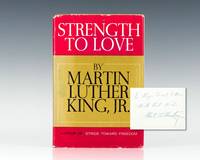
196341050New York: Harper & Row Publishers 1963. First edition of Dr. King's second book of which Coretta Scott King noted "If there is one book Martin Luther King Jr. has written that people consistently tell me has changed their lives it is Strength to Love." Octavo original half cloth. Presentation copy inscribed by the author on the front free endpaper "To Major Ernest D. Muse With Best Wishes Martin Luther King." Fine in a very good dust jacket with light rubbing and a few small closed tears. Housed in a custom half morocco clamshell box. Rare and desirable signed and inscribed by Dr. King. Strength to Love was Martin Luther King's first volume of sermons published the same year in which he penned his Letter from a Birmingham Jail and joined the historic March on Washington and delivered his famous I have a dream speech. The following year he won the Nobel Peace Prize. King notes in the preface: "In these turbulent days of uncertainty the evils of war and of economic and racial injustice threaten the very survival of the human race. Indeed we live in a day of grave crisis. The sermons in this volume have the present crisis as their background; and they have been selected for this volume because in one way or another they deal with the personal and collective problems that the crisis presents." Coretta Scott King said about this book that it "best explains the central element of Martin Luther King Jr.' s philosophy of nonviolence: His belief in a divine loving presence that binds all life. By reaching into and beyond ourselves and tapping the transcendent moral ethic of love we shall overcome these evils." Harper & Row, Publishers hardcover books
195830031New York: Harper & Brothers Publishers 1958. First edition of Dr. Martin Luther King's first book. Octavo original half cloth. Boldly signed by Martin Luther King Jr. on the front free endpaper. Review copy with the slip laid in near fine in a very good dust jacket with some fading to the spine and light wear. Housed in a custom half morocco clamshell box. First printings are uncommon signed. Stride Toward Freedom is Dr. Martin Luther King Jr.'s account of the first successful large-scale application of nonviolence resistance in America is comprehensive revelatory and intimate. King described his book as "the chronicle of fifty thousand Negroes who took to heart the principles of nonviolence who learned to fight for their rights with the weapon of love and who in the process acquired a new estimate of their own human worth.'' Harper & Brothers, Publishers hardcover books
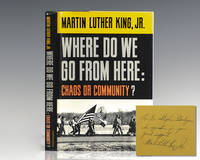
1967124490New York: Harper & Row Publishers 1967. First edition of King's "last grand expression of his vision" Cornel West. Octavo original half cloth illustrated with eight pages of black-and-white photogravures. Presentation copy inscribed by the author on the front free endpaper "To Dr. Stephen Goodyear In appreciation for your great support Martin Luther King Jr." Fine in a near fine dust jacket. Jacket design by Ronald Clyne. Jacket photograph of Martin Luther King Jr. by Bob Fitch. Where Do We Go from Here is Dr. King's analysis of the state of American race relations and the movement after a decade of U.S. civil rights struggles. ''With Selma and the Voting Rights Act one phase of development in the civil rights revolution came to an end'' he observed King 3. King believed that the next phase in the movement would bring its own challenges as African Americans continued to make demands for better jobs higher wages decent housing an education equal to that of whites and a guarantee that the rights won in the Civil Rights Act of 1964 and the Voting Rights Act of 1965 would be enforced by the federal government. Harper & Row, Publishers hardcover books
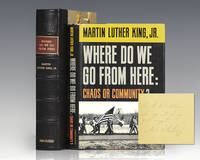
1967120468New York: Harper & Row Publishers 1967. First edition of King's "last grand expression of his vision" Cornel West. Octavo original half cloth illustrated with eight pages of black-and-white photogravures. Presentation copy inscribed by the author on the front free endpaper "To Mr. H.O. Wilson In appreciation for your great support Martin Luther King Jr." Fine in a near fine dust jacket. Jacket design by Ronald Clyne. Jacket photograph of Martin Luther King Jr. by Bob Fitch. Housed in a custom half morocco clamshell box. Where Do We Go from Here is Dr. King's analysis of the state of American race relations and the movement after a decade of U.S. civil rights struggles. ''With Selma and the Voting Rights Act one phase of development in the civil rights revolution came to an end'' he observed King 3. King believed that the next phase in the movement would bring its own challenges as African Americans continued to make demands for better jobs higher wages decent housing an education equal to that of whites and a guarantee that the rights won in the Civil Rights Act of 1964 and the Voting Rights Act of 1965 would be enforced by the federal government. Harper & Row, Publishers hardcover books
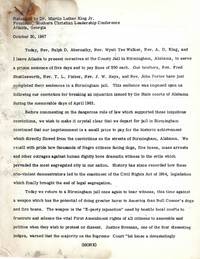
16099Dr. Martin Luther King Jr. Important and rare Civil Rights document from the original files of the SCLC the Civil Rights organization King founded after the Montgomery Bus Boycotts. First Edition. Dated October 30 1967 the day of King's return to Birmingham the locus of one of his most triumphant campaigns and also where his volunteers endured some of the greatest persecution. 4 mimeograph pages stapled upper left. 8.5" x 11" inches. After 4 years of court battles King must turn himself over to Birmingham authorities to serve a jail sentence resulting from violating an illegal injunction during his 1963 non-violent demonstrations"We depart for jail in Birmingham convinced that our imprisonment is a small price to pay for the historic achievement which directly flowed from the convictions on the streets of Birmingham." One copy of this statement is held by the archives of the King Center; and no other copies among institutional holdings or auction records. <br/><br/>In this moving speech King reminds his followers how Birmingham in 1963 united the Civil Rights Movement "We recall with pride how thousands of Negro citizens facing dogs fire hoses mass arrests and other outrages against human dignity bore dramatic witness to the evils which pervaded the most segregated city in our nation. History has since recorded how these non-violent demonstrators led to the enactment of the Civil Rights Act of 1964 legislation which finally brought the end of legal segregation." Birmingham in 1967 now brings the opportunity to make them aware of a new foe the "X-party injunction sic--meaning ex parte injunction used by hostile local courts to frustrate and silence the vital First Amendment rights of all citizens." But while the battle for civil rights had found its way to the courtroom it was still very much in the streets as well "We are witnessing an escalating disregard for constitutional freedom. In the last two weeks U.S. Marshals state troopers and local police have clubbed demonstrators in Washington Berkeley and Madison Wis.; police have dragged girls by the hair in Brooklyn Tear gas has scattered and routed protestors in Washington Berkeley and Oberlin Ohio and even the odious fire hoses of Bull Connor were callously deployed against college students at Oberlin. Student arrests in this short period are beginning to reach levels unknown in this country since Selma." As King presents himself to Birmingham authorities he reminds his followers of the true meaning of civil disobedience "we will not appeal nor will we seek to flee the punishment. It is the heart of civil disobedience that one accepts the consequences willingly and openly." And through his sacrifice King reminds them that they too may be called as brave soldiers to the cause "As we leave for Birmingham Jail today we call out to America: "Take heed. Do not allow the Bill or sic Rights to become a prisoner of war." <br/><br/>Period sources state King handwrote his speeches before handing them off to aides who would type a clean copy then mimeograph them for the press typically in a run of about 200 copies. Most if not all were distributed to the press and then lost. Today the only other original copy of this document is in the collection of the King Center. Like those in the King Center this document escaped destruction because it were never distributed but rather remained as the personal copy of King or his top staffers. This can be proven by the fact that all press copies were carefully inscribed with a copyright symbol © while King's copy brought with him to the podium and other internal copies remained blank. This press release spent decades in an SCLC filing cabinet where it was exposed to dampening on the left side but is otherwise untouched. It now presents in only fair condition with water staining and rust around the original staple which is still holding. Mark from previous paper-clipping upper left. Light grey water stains to left side of document and bottom left corner frayed. All text legible. The right side of the document was apparently more protected in its file and is in very good condition. It was gifted from the Estate of Thomas Offenburger to Stoney Cooks. Both Offenburger and Cooks worked with King at the SCLC with Offenburger as publicist and Cooks as a young Director of Student Affairs. King's return to Birmingham is a stunning moment in Civil Rights history preserved through this historic document. unknown books
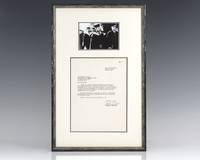
195182416Boston 1951. Typescript autograph letter signed by Dr. Martin Luther King Jr. requesting housing upon his acceptance to Boston University Graduate School. The letter dated June 15th 1951 and addressed to Dean Charles W. Alter Boston University Graduate School reads "Dear Dean Alter I have been accepted in Boston University Graduate School as a regular student and a candidate for the degree of Doctor of Philosophy in the field of Systematic Theology. I am now interested in finding living accommodations on the campus or at least very near by. A single room would be preferable. If such is possible I would appreciate having it reserved. I am also interested in applying for a graduate Fellowship. Please send me the necessary information at this point along with an application blank. Thanks in advance for your cooperation I am Sincerely yours Martin L. King Jr." King later recalled his experience with housing bias in 1951 Boston in an interview with the Boston Globe in 1965 "I remember very well trying to find a place to live. I went into place after place where there were signs that rooms were for rent. They were for rent until they found out I was a Negro and suddenly they had just been rented." Double matted and framed with a photograph of a young King. The entire piece measures 14 inches by 21.75 inches. This letter offers an extraordinary glimpse into the education of the great African-American Civil Rights leader exemplifying his own experiences with the systemic racism in 1950s American society. Martin Luther King Jr. first received recognition for his outstanding skills as a public speaker as a student at Booker T. Washington High School in Atlanta Georgia. He received early acceptance into the Liberal Arts program at the historically black Morehouse College at the age of 15 also in Atlanta and at age 18 decided to enter the ministry. After graduating from Morehouse in 1948 with a B.A. in Sociology King enrolled in Crozer Theological Seminary in Chester Pennsylvania where he graduated with a Bachelor's degree in Divinity in 1951. That same year he applied to Graduate School at Boston University where in June of 1955 he received his Ph.D. in Systematic Theology with a dissertation titled A Comparison of the Conceptions of God in the Thinking of Paul Tillich and Henry Nelson Wieman. While pursuing doctoral studies King worked as an assistant minister at Boston's historic Twelfth Baptist Church with Reverend William Hunter Hester a friend of King's father who became an important influence on King's later work. unknown books
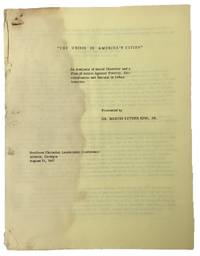
16101Dr. Martin Luther King Jr. "Crisis in America's Cities; An Analysis of Social Disorder and a Plan of Action Against Poverty Discrimination and Racism in Urban " First Edition unpublished mimeograph draft. 5 pages plus cover. King's nationwide call to action against urban poverty the most ambitious Civil Rights Campaign in the Northern United States culminating in the 1968 Fair Housing Act with significant differences from King's final speech. King authored this brief but influential treatise after riots spread through the urban north due to intense discrimination and poverty. "The white society did not move and Newark came after Watts and was followed by Detroit. We will have to make them move. We will have to remind them that in the 18th century Thomas Jefferson said 'I tremble for my country when I reflect that God is just.'" First Editions of the original speech made by King are extremely rare with only one known in the holdings of the King Center archives. This earlier draft held in the files of King's organization the SCLC is the only known draft of this speech in existence. <br/><br/> On August 15 King delivered what is probably the most fiery of his speeches entitled "The Crisis in American Cities." He pointed a finger at hypocrisy declaring "if the total slum violations of law by the white man over the years were calculated and compared with the lawbreaking of a few days of riots the hardened criminal would be the white man." The blame for the situation he placed upon "the policy makers of the white society.they created discrimination; they created slums; they perpetuate unemployment ignorance and poverty." With aching eloquence King declared that "Discrimination is the hellhound that gnaws at Negroes in every waking moment of their lives to remind them that the lie of their inferiority is accepted as truth in the society dominating them." His mission was to end the housing segregation that forced blacks into unsafe and unsanitary ghettos of the urban north. With tensions boiling over during the "long hot summer" of 1967 high unemployment discrimination and unsanitary an crowded living conditions led to riot after riot in cities across the urban north. King's message in "Crisis in America's Cities" was that love not hate was the answer to racial violence. <br/><br/>This speech was never formally published or collected but was released in small numbers of staple-bound 6 page copies with green covers and as a tri-fold printed pamphlet. The King Center Archives holds a single copy of the 6 page green variant. The copy here is an unknown earlier draft 5 pages plus a cover mimeographed all on yellow paper. This draft of "Crisis" is absent from institutional collections and auction records and it is possibly the only copy left in existence. While the theme and most content of this draft is the same as the final it is driven by emotion which is captured and organized by the time the speech reached its final form. Some cuts appear to be for clarity including a sentence on the first page which is lacking from the final draft and reads "After establishing the general cause of outbursts have an emotional content that is a reaction to the insults and depravity of the white backlash." Missing from this early draft is numbered list of points for introduction as well as numerous typos and typed over corrections which are visible through the mimeograph and differences in the distribution of paragraphs. <br/><br/>Period sources state King handwrote his speeches before handing them off to aides who would type a clean copy then mimeograph them for the press typically in a run of about 200 copies. Most if not all were distributed to the press and then lost. Today most documents from the SCLC files exist only in the collection of the King Center. Like those in the King Center this document escaped destruction because it were never distributed but rather remained as the personal copy of King or his top staffers. This can be proven by the fact that all press copies were carefully inscribed with a copyright symbol © while King's copy brought with him to the podium and other internal copies remained blank. This document spent decades in an SCLC filing cabinet where it was exposed to dampening on the left side but is otherwise untouched. It now presents in only fair condition with water staining and rust around the original staple which is still holding. Light grey water stains to left side of document and bottom left corner frayed. All text legible. The right side of the document was apparently more protected in its file and is in very good condition. It was gifted from the Estate of Thomas Offenburger to Stoney Cooks. Both Offenburger and Cooks worked with King at the SCLC with Offenburger as publicist and Cooks as a young Director of Student Affairs. King's mission was rewarded the year after "Crisis" by the passage of the Fair Housing Act of 1968 barring racial discrimination in real estate. Unfortunately King did not live to see it. King's indictment of government for causing urban suffering is extremely rare today with only one final draft Edition of "Crisis" in the King Center Archives and no copies of this early unpublished draft recorded anywhere. unknown books