167 résultats
1739ALDR0682Nürnberg, Lorenz Bieling für Friedrich Wilhelm Geyer 1739. 8°. Gest. Frontisp. (mit einer kl. Ansicht von Nürnberg), gest. Titel, Drucktitel (rot u. schwarz), 19 nn. Bll. (Vorrede Mörls u. Luthers, Augsburger Confession), 520 num. Bll.; gest. Titel (NT), 161 num. Bll. (einschl. Drucktitel u. Luthers Vorrede zum NT), 6 nn Bll. (Register). Mit e. Porträt v. Mörl auf Taf. (Nunzer sc.) u. zus. 118 (dav. 1 doppelbl.gr.) Kupfertafeln. Stummer Lederband d. Zeit auf 5 Bünden mit Streicheisenverz., umseitiger und randpunzierter Schnitt. Berieben, Rückenleder an beiden Kapitalen schadhaft, kl. Wappenstemp. auf Vorsatz, angeplatzter Falz laienhaft geklebt, verso Front. Eintrag (Bleistift) eines Vorbesitzer zu seiner Familiengeschcihte, durchgeh. mit Randläsuren u., Griffspuren. Vgl. Panzer. Geschichte d. Nürnbergischen Ausgabe der Bibel LXI, S. 215 f. (hier EA von 1725); Meusel. Verst. Teutsche Schriftsteller 217ff. - Reich illustrierte Oktav-Bibel "zum bequemen Gebrauch in Kirchen und Schulen bestimmt" (Pauser). Vorl. eine spätere Auflage der erstmals 1725 erschienen, kleinformatigen Bibelausgabe, welche auch als ?Mörlische? oder ?Mörl-Bibel? bezeichnet wurde. Gustav Philipp Mörl (1630-1750), Theologieprofessor, angesehener Prediger seiner Zeit und Bibliothekar an der Nürnberger Stadtbibliothek, wirkte ab 1703 an der St. Sebald-Kirche in Nürnberg. Die Tafeln meist ohne Angabe des Stechers. Einige 'Dehne fecit'.
173519585Altenburg, Richter, 1735. Gestochner Titel, typogr. Tit. in Rot u. Schwarz, 14 Bll., 119, 1388 SS., 26 Bll. Register Gr.-8°, dunkelbraunes Leder der Zeit, Vorderdeckel mit goldgepr. Aufdruck "J.G.S. 1755", Goldschnitt. Der schlichte Einband etwas berieben.
176336006Augsburg, Johann Georg Nicolaus Hillmer und Andreas Brinhaußer, 1763. 88 S. Mit 15 (statt 16) Kupfertafeln. Kl.-8° (16 x 10 cm). Pappe der Zeit mit Kleisterpapierbezug.
179246293ABTübingen, Heerbrandt 1792. Kl.-8°. XVI, 168, (8) S. Pappband der Zeit mit Rückenschild. Kanten berieben. durchgehend leiht stockfleckig, teils auch etwas gebräunt. 3 Besitzvermerke am Vorsatz.
175353654Wittemberg, Vidua Scheffler, 1753. 4to. Contemporary full calf with five raised bands to richly gilt spine. Edges of boards blindtooled. Boards slightly warped and with lsigns of wear. Internally very nice and clean with only a few scattered brownspots. A nice, tight, clean, and completely unrestored copy. Title-page printed in red and black. (4), 18, (6), CCLII, (2) pp. + two folded engraved plates.
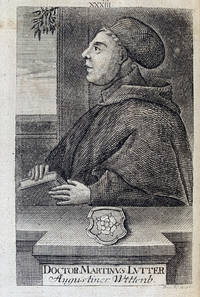
176820419Nürnberg Nuremberg: In Verlegung der Johann Andrea Endterischen Handlung 1768. Later edition. Hardcover. Very good. Three parts folio 17 3/4 x 12". 4: engraved title; main title 12: Preface to the 1736 Second Edition 2: Note to the Christian Reader on this New 1768 Edition 16: Preface to the 1640 i.e. 1641 Edition 2: List of Saxony's Electors pages 11 full-page engraved portraits of the Electors 1: full-page portrait of Martin Luther leaves 8: Short Introduction and Instruction Regarding the Holy Scriptures 2: Calendar 13: General Index 26: Name Index 11: Chronology 1: Personalities in the Maccabean and Herodian Eras 7: Explanations on the Old Testament 5: Charts of calandars weights money measures and distance in biblical times 4: Chronological Order of the Books of the Bible 7: Register/Table of the Old Testament 3: Martin Luther's Preface to the Old Testament; 740 Pentateuch; Former Prophets; Writings; 512 Latter Prophets and Apocrypha; 472 New Testament 473-480 Gospel Harmony 14: Creeds and Augsburg Confession pages. Text in German Gothic script; text within ruled borders marginal column for printed side notes; woodcut initials and ornaments; elaborate woodcut half titles in imitation of calligraphy at verso of initial text leaves for the second and third parts Prophets and New Testament. Complete with 48 copperplate engravings: 12 full-page portraits in the preleminaries Electors and Martin Luther; a full-page depiction of the construction of Noah's Ark; 27 full-page sectional illustrations 20 vignette compositions; 9 portraits of Prophets and Evangelists; 8 double-suite plates biblical lands from Egypt to Babylonia; Egypt and Canaan noting tribal allotments; Canaan in the New Testament era; Greece and Asia Minor with vignettes of the Temple; encampment of the Israelite tribes in the wilderness; bird's eye view of Jerusalem after Adrichem; view of Jerusalem in the New Testament era; Diet of Augsburg with legend.<br /> <br /> Contemporary calf lightly rubbed at extremities with some light scratching at rear board elaborately tooled in gilt depicting a neo-classical sanctuary on both boardsTetragrammaton in pediment on the front a cross in pediment on the rear; exquisite gauffered fore-edges ornamented in gilt against forest green wash depict a sunburst with architectural motifs; gilt turn-ins. Rebacked retaining original spine; endpapers renewed. 15 cm clean tear through text at leaf C4 in the New Testament reparable; final text leaf chipped at bottom edge not affecting text; tears at Diet of Augsburg plate and final text leaf expertly repaired at versos. Overall pages crisp and fresh with mild intermittent toning very occasional light stains and smudges and just a touch of damptstain at fore-edge in later leaves of the New Testament. A very good copy with clean plates in a beautiful magnificent binding complete with the folding plate of the Diet of Augsburg often lacking. Housed and protected in a modern custom red cloth slipcase.<br /> <br /> Final edition of the sumptuously illustrated Kurfürstenbibel Electors' Bible with a full apparatus of introductory and historical materials. Also known as the Weimar Bible it was compiled under the auspices of Ernst I Duke of Saxe-Gotha and Altenburg. Beginning in 1641 all editions were published by the prominent German printing dynasty of Endter. The maps views and illustrated divisional titles by Jacob van Sandrart and others made their first appearance in the edition of 1686. In this latest version the illustrated sectional titles are signed by Johann Chrisopher Claussner and most of the other views lack the signatures found in the 1686 edition. The earlier forewords by Salomon Glass ed. 1641 and Ernst Solomon Cyprian ed. 1736 are reprinted in the present edition.<br /> <br /> The preliminaries feature eleven full page engravings of Saxony's Electors from Friedrich III to Bernhard der Große followed by an engraved portrait of Martin Luther. Often lacking the final fold-out engraving depicts the Holy Roman Emperor and representatives of the German states in a large reception hall during the Diet of Augsburg. Participants are identified in the legend on the facing page. The conference was assembled by Charles V so that the Princes and Free Territories in Germany might explain their religious convictions in an attempt to restore religious and political unity in the Holy Roman Empire and rally support against the Turkish invasion. The consensus of the assembly is expressed in the Augsburg Confession the primary confession of faith of the Lutheran Church and one of the most important documents of the Reformation era. Written in both German and Latin the Confession was presented at the Diet of Augsburg on 25 June 1530; it is the fourth document contained in the Lutheran Book of Concord. References: Bibelsammlung Stuttgart E777; Delaveau & Hillard 16; Cf. Darlow & Moule 4217 note on ed. 1641; 4234 ed. 1736.<br /> <br /> Full title: Biblia Das ist die gantze Heilige Schrift Altes und Neues Testaments. Verdeutscht von Herrn Doctor Martin Luther: Und auf gnädigste Verordnung Des Durchlauchtigsten Fürsten und Herrn Herrn Ernsts Herzogen zu Sachsen Fülich Kleve und Berg von etlichen reinen Theologen dem eigentlichen Wort-Verstand nach erkläret wie hiervon weiter in der Vorrede gehandelt wird. daher über die gewöhnliche mit Fleiß verbesserte Biblische Register unter anderem zu finden ein Bericht von Vergleichung der Jüdischen und Biblischen Monden Maaß Gewicht Müntz und Elen mit den Unserigen: Sowohl auch eine Beschreibung der Stadt Jerusalem samt unterschiedlichen neuen Land-Tafeln und andern schönen Kupffer-Figuren und derselben Beschreibung: Welches alles dem Christlichen Leser zu mehrerm Verstand der Schrifft gute Anleitung geben kan. Zu Ende ist auch nebst den Christlichen Haupt-Symbolis die unveränderte Augspurgische Confession mit beygedruckt worden. Von neuem mit Fleiß übersehen durch fernere sowohl den Verstand als Lutheri Ubersetzung betreffende Anmerckungen erläutert auch mit einer kurzen Anweisung zur Erklärung der Heil. Schrift und andern Einleitungen vermehret. Mit königl. polnischem und Chur-Fürstl. Sächsischem Privilegio. In Verlegung der Johann Andrea Endterischen Handlung hardcover
171275089[Basel, Joh. G. König] 1712 In-folio, pleine basane brune, dos à nerfs reliure postérieure, 17 ff. de table - 504 - 188 - 164 - 228 sur 240 pp. Texte sur deux colonnes, encadrement. Nombreuses figures dans le texte, lettrines et culs-de-lampe. Brunissures marginales, lég. humidité éparse, petites attaques de ver. Bon exemplaire. Sans le titre.
1763079333Germantown PA: Christopher Sower Christoph Saur 1763. Second edition. Leather Bound. pp. 992; 277 1. Thick 4to. Contemporary calf over reverse-bevelled wooden panel with plain spine showing 5 prominent raised bands and remains of clasps to foredge. Old leather band attached across spine head presumably for reinforcement. Copious family history notes to front pastedown some tide marks closed tears and the like throughout; p. 173 of NT shows corner torn off and laid in last page tattered and only laid-in with some loss to edges; binding remarkably sound text complete but end-matter and front free endpaper missing. Second edition of the earliest bible in a European language to be printed in America. Text printed in double columns in Gothic font. Family correspondance and photo laid in. Darlow & Moule 4240: "On Saur's death in 1758 he was succeeded by his only son who bore the same name. Christoph Saur the younger enlarged the business and in 1763 issued a second quarto edition 2000 copies of the Bible. In 1776 he had just completed a third edition 3000 copies when the outbreak of the American War of Independence interrupted the work and nearly the whole of the unbound sheets were used to make cartridges." Sabin 5192. OCLC 2996651. Christopher Sower [Christoph Saur] unknown
1791SBLB0571Lüneburg, Stern 1791. 190 S., großteils mit Leerblättern durchschossen, Lederband d. Zt., umlauf Goldschnitt, Ecken berieben, eberes Kap. abgerieben u. rissig. Der Hannoversche Landeskatechismus in einer sehr frühen Ausgabe, die 1. Auflage erschien 1790. - Auf den Leerblättern zahlreiche sachkundige Annotationen von alter Hand. ADB XVI,692.
1740784Halle: Waysenhause 1740. Leather. Very Good. Biblia Das Ist: Die Gantze Heil Schrift Altes und Neues Testaments Nach der Teutschen Uebersetzung D. Martin Luthers. 8.25 x 5 in. 8vo. Full brown-black calf. 5 raised bands and blindstamped tapered band tooling. All edges gilt with decorative gauffering. Boards rubbed chipping to spine foot otherwise binding is sturdy and sound. Marbled pds with some browning at edges lacking both front and rear free endpapers. Title page printed in black and red with previous owner's name in ink to top edge. Some soiling scattered to mostly clean text block. All text in German. Waysenhause unknown
1778LV2122aLeipzig:: Bey Christian Gottlob Hilscher 1778. 1778. Small 8vo. ii 131 1 pp. Engraved frontispiece of Luther by Bruhl engraved title-page and text head and tailpiece vignettes; modern glossy pastedowns and free end-papers. Quarter dark brown calf marbled boards gilt-stamped spine. Small inked shelf-number on verso title-page. Fine. Later edition of Schrockh's "'eminent' biography of Luther" first published in 1773 Backus & Benedict p. 221. <br /><br /> "Schrockh. . .sympathized with Erasmus' stand in the free-will controversy against Luther's extreme determinism which says Schrockh the modern Protestant church does not feel committed to defend. . . .Schrockh stands by the narrower Lutheran definition of the Reformation. . . .In Planck and Schrockh despite their differences Protestantism and the Enlightenment remained in easy association" Mansfield. p. 46. <br /><br /> "The notion of Luther as the embodiment of the German Volksgeist for example could not but degenerate into that of simple patriotism or 'Luther the German.' On this view when Luther enjoined obedience to the secular authorities on the occasion of the peasants' revolt he laid the groundwork for 'respect for the authorities and for the inner peace of the state'—so says church historian Johann Matthias Schrockh 1733-1808. Indeed according to Schrockh in the intervening centuries all of Europe should have come to understand that the Protestant religion 'is alone suited to the legitimate power and the true interests of the princes' and that 'all of this is without doubt Luther's work'" Perkins pp. 69-70. <br /><br /> The frontispiece of Luther is fine example of German engraver Johann Benjamin Bruhl 1691-1763. <br /><br /> Schrockh "was an Austrian-German historian and literary scholar born in Vienna. He was a grandson to Pietist preacher Matthias Bel 1684-1749" Wikip. REFERENCES: Backus Irena & Philip Benedict Calvin and His Influence 1509-2009 Oxford: Oxford University Press 2011; Mansfield Bruce Man on His Own: Interpretations of Erasmus c. 1750-1920 Vol. 2 Toronto: University of Toronto Press 1992; Perkins Robert L. ed. For Self-examination and Judge for Yourself! Macon GA: Mercer University Press 2002. Bey Christian Gottlob Hilscher, 1778. hardcover
175353654Wittemberg Vidua Scheffler 1753. 4to. Contemporary full calf with five raised bands to richly gilt spine. Edges of boards blindtooled. Boards slightly warped and with lsigns of wear. Internally very nice and clean with only a few scattered brownspots. A nice tight clean and completely unrestored copy. Title-page printed in red and black. 4 18 6 CCLII 2 pp. two folded engraved plates. <br/><br/><em>The exceedingly rare first edition of the first published biography of Aldus Manutius including "the first real attempt at an Aldine bibliography" Grolier Aldus. This legendary publication constitutes not only the earliest but also one of the most important sources on Aldus and his publications. Written by Christian Gottlieb Unger 1671-1719 presumably in the early 1700'ies it circulated in manuscript-form for decades until 1753 when Samuel Luther Geret German theologian lawyer and politician took upon himself to edit the manuscript and have it published. Renouard mentions a 1729-edition but this is a ghost See "Grolier Aldus Manutius: No. 135".Grolier Aldus Manutius: No. 135.Renouard pp. iv-v. </em> hardcover
1715WRCLIT66991Cassel i.e. Kassel: In Verlegung Jacob Estienne . 1715. 32630183 leaves evidently lacking a terminal blank. Thick quarto. Contemporary brown calf raised bands spine gilt extra side panels with plain gilt rules a.e.g. gilt decorated floral endsheets. Engraved pictorial extra- title and engraved portrait of Carolus I Landgraf von Hersfeld by Joseph Montalegre. Text in double columns. Crown of spine snagged with resulting tears at crowns of joints a bit rubbed occasional mild tidemarks and light foxing but a good sound copy. An uncommon edition of the Luther Bible with an extended dedication by the publisher to Carolus I Landgraf von Hersfeld and extensive introductory matter on the history of Luther's text. Not in Darlow & Moule and OCLC/Worldcat only locates one copy of an edition under Estienne's imprint dated 1735. In Verlegung Jacob Estienne .. hardcover books
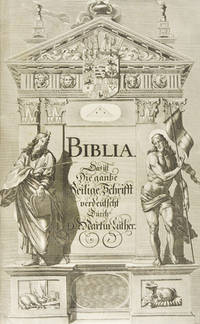
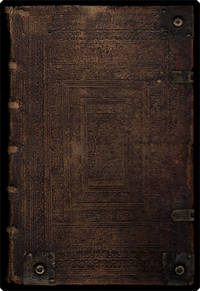
1748D9092Nuremberg: In Verlegung der Johann Andrea Endterischen Handlung Endter MDCCLXVIII 1748. Hardcover. Very Good. Large format folio 424 x 274 x 125mm. 144 740pp. 2 512 480 16pp. Additional engraved title of architectural motif with heraldry of Saxe-Gotha-Altenberg and the flanking figures of Moses and Christ with their attributes in niches below signed by J. C. Clausener. Illustrated with 45 plates including title most of them full-page few double-page engravings depicting biblical scenes and prophet portraits as well as some double-page maps and plans temples and Holy Land maps most illustrations also signed by Clausener. With the rare double-page engraving in rear showing royalty and court members in a large reception hall Bischöffliche oder Fürstliche Saal during the Confessio which took place in Augsburg in 1530 under Charles V. This plate is usually missing. Persons and part of the architecture in hall are indicated on the actual plate with small numbers 1-47 opposite page lists each number with name and title of person depicted and explanations of parts of the architecture. Engraved titles and decorated initials throughout. Text in German. Gothic script. Contemporary blind-tooled pigskin over beveled boards with brass corner pieces and bosses clasps and catches restored; marginal soiling with age few dampstains or light wear not overwhelming the large work in the least engravings wholly intact with only minor folds or stains only map of Israel with wide marginal tear otherwise an excellent survival. Formerly in the Evangelical Lutheran Church in America early clippings of poetical quotations c.1910 found in hinge of first quire. <br/><br/>Endters Kurfürstenbibel of 1748 an influential Luther Bible with exceptional engravings produced by the Gotha court. First published in 1641 under the authorization of Duke Kurfürst Ernst I of Saxe-Gotha. This is the so-called Kurfürstenbibel or Elector Bible because some of the engravings show various Dukes from the 16th and 17th centuries. At the realization of this major project prominent Lutheran theologians such as Johann Gerhard Solomon Glassius and Johann Michael Dilherr among others contributed to the work. This Bible was published with a glossary and added in-text explanations of Luthers original translation for the enlightenment of ordinary people. For nearly two centuries from 1613 to 1792 the successful family of Endter of Nuremberg printed the text of Luthers Bible. Specifically the Kurfürstenbibel was produced from 1641 to 1758 in fourteen editions. Today the large-format folio expenditures are amongst the most commonly encountered family Bibles from the 17th but especially the 18th century. The Gotha courts significant pool of sources as well as favor of the market place in Nuremberg gave rise to such an important project. Large-format and heavyweight in every sense of the word it remains a visually stunning work with its numerous portraits of princes in woodcuts and engravings this Elector Bible treated both theological aspects as well as those of the courtly self-understanding. In Verlegung der Johann Andrea Endterischen Handlung [Endter], MDCCLXVIII hardcover
1761039A71Cansteinsche Bibelanstalt Zu finden im Wysenhause Orphan House Halle: . 1761 pp. 16 1079; 308 4. 8vo. 220 mm. German text. Double column. Title printed in red and black. Very slight worming. Some foxing. All edges comb marbled. Worn sueded full leather binding. Early German ms. on front fly. Also an inserted slip of paper that may indicate that this was owned by Samuel Reinke and early Moravian pastor in York PA. Hardbound. Good. The Luther translation edited by Baron Carl Hildebrand von Canstein 1667-1719. Canstein was a German aristocrat who became friends with the Pietists Philipp Spener and August Hermann Francke in 1691. They convinced him to establish a Bible Institute for the purpose of using stereotype printing to reduce the price of German bibles and to promote bible study in Germany. The orphanage at Halle became a great center of German religious printing especially Pietist. SE 2 /3. Hardcover. (Cansteinsche Bibelanstalt) Zu finden im Wysenhause (Orphan House), Halle: . hardcover
1729220R58Johann George und Christian Gottfried Cotta Tubingen: . 1729 Two volumes in one. pp. 24 1248; 8 582 80 80. OUR COPY HAS THREE FOLDING MAPS OR VIEW PLATES one of which is torn but repairable. No frontis plates. Old testament title page printed in red and black. Some leaves stained. Engraved vignettes at the top of two leaves. German black letter text. Large folio. 440 mm. After several print editions of the Luther Bible in Wurttemberg appeared the publishing house of Johann Georg Cotta in satisfied a need for comprehensively annotated bible that served Orthodoxy and PIETISM with this bible in 1729. It is a massive Annotated German Bible based on the Martin Luther 1483-1546 version; with New Testament edited by Johann Christian Klemm 1688-1754; and the whole further annotated by Christoph Matthaus Pfaff 1686-1760. Original decorated full leather binding over oak boards. Some loss of leather on the front board about 2 x 8". Seven of eight large early decorative brass corners. No clasps. Front board loose. Binding generally worn but still interesting. Most editions of this bible have a New Testament dated 1730. Ours is 1729. Perhaps this explains why there are no frontis plates. Please ask about shipping costs on this very large book. PRICE JUST REDUCED! M27 Language: eng. Hardcover. Good. Johann George und Christian Gottfried Cotta, Tubingen: . hardcover
1747005ADD54Gedruckt und Verlegt durch Johann Brandmuller Basel: 1747. 1747 pp. 4 468 168 126 2 216. Engraved title loose and chipped with much loss. Printed title also loose and chipped but with only slight loss. Other leaves torn mostly at the top margins with slight loss. This effects about a third of the pages. The New Testament is illustrated with a series of small woodcuts. Small Folio. 295 mm. Early full leather binding. The front board is detached. but on the positive side I am reasonably certain the the binding is American. Though not in optimal condition this edition is apparently VERY scarce. Biblia Germanica. PRICE JUST REDUCED! M27-28 Language: eng. Hardcover. Fair. Gedruckt und Verlegt durch Johann Brandmuller, Basel: 1747. hardcover
1729002ADD54In Verlegung Johann Andrea Endters Endters Nurnberg: 1729. 1729 Two volumes in one. pp. 94 1181 Text of the Augsberg Confession - pp. 1190-1204 Engraved plates including full page standing portraits of the Electors. Over 140 wood engraved text illustrations. Title page printed in red and black with vignette; head- and tailpieces; decorative initials; double column text within line border. Folio. 400 mm. Called The Elector Bible for the portrait plates of the The Prince-Electors or simply Electors of the Holy Roman Empire. These princes and kings were the members of the electoral college of the Holy Roman Empire and had the power to name and elect the Holy Roman Emperors. The Prince-electors or simply Electors of the Holy Roman Empire German: Kurfurst pl. Kurfursten Latin: Princeps Elector were the members of the electoral college of the Holy Roman Empire having the function of electing the Holy Roman Emperors. This edition is also referred to as the Dilherr Bible due to Johannes Michael Dilherr 1604-1669 who edited of the Augsburg Confessions appended at the rear. Biblia Germanica. PRICE JUST REDUCED! M27-28 Language: eng. Hardcover. Very Good. In Verlegung Johann Andrea Endters (Endters), Nurnberg: 1729. hardcover
1798014ADD54Bey und in Verlag Emmanuel Thurneysen Basel: 1798. 1798 Three volumes in one. 32 24 688; 120; 4 280. Folio. 410 mm. Title printed in red and black. New Testament has special title page; Apocrypha has caption title. Twelve large wood engravings several signed 'Isnard'. Double columned bible texts within ruled borders with notes. Numerous decorative vignettes. Bound in the original alum-tawed vellumized pigskin over wooden boards elaborately tooled in blind. Eight original highly decorated brass corner bosses and center brasses. Remains of the decorated clasps. Boards and flyleaf are detached. Bookplate on flyleaf: Presented To David B. Seidel By His Brother Jacob B. Seidel on Dec. 20th AD 1889. This Bible was extremely popular with the early German Americans. PRICE JUST REDUCED! Biblia Germanica. M27-28 C 2 Language: eng. Signed by Authors. Hardcover. Good. Bey und in Verlag Emmanuel Thurneysen, Basel: 1798. hardcover
1748D9092Nuremberg: In Verlegung der Johann Andrea Endterischen Handlung Endter MDCCLXVIII 1748. Hardcover. Very Good. Large format folio 424 x 274 x 125mm. 144 740pp. 2 512 480 16pp. Additional engraved title of architectural motif with heraldry of Saxe-Gotha-Altenberg and the flanking figures of Moses and Christ with their attributes in niches below signed by J. C. Clausener. Illustrated with 45 plates including title most of them full-page few double-page engravings depicting biblical scenes and prophet portraits as well as some double-page maps and plans temples and Holy Land maps most illustrations also signed by Clausener. With the rare double-page engraving in rear showing royalty and court members in a large reception hall Bischöffliche oder Fürstliche Saal during the Confessio which took place in Augsburg in 1530 under Charles V. This plate is usually missing. Persons and part of the architecture in hall are indicated on the actual plate with small numbers 1-47 opposite page lists each number with name and title of person depicted and explanations of parts of the architecture. Engraved titles and decorated initials throughout. Text in German. Gothic script. Contemporary blind-tooled pigskin over beveled boards with brass corner pieces and bosses clasps and catches restored; marginal soiling with age few dampstains or light wear not overwhelming the large work in the least engravings wholly intact with only minor folds or stains only map of Israel with wide marginal tear otherwise an excellent survival. Formerly in the Evangelical Lutheran Church in America early clippings of poetical quotations c.1910 found in hinge of first quire. <br/><br/>Endters Kurfürstenbibel of 1748 an influential Luther Bible with exceptional engravings produced by the Gotha court. First published in 1641 under the authorization of Duke Kurfürst Ernst I of Saxe-Gotha. This is the so-called Kurfürstenbibel or Elector Bible because some of the engravings show various Dukes from the 16th and 17th centuries. At the realization of this major project prominent Lutheran theologians such as Johann Gerhard Solomon Glassius and Johann Michael Dilherr among others contributed to the work. This Bible was published with a glossary and added in-text explanations of Luthers original translation for the enlightenment of ordinary people. For nearly two centuries from 1613 to 1792 the successful family of Endter of Nuremberg printed the text of Luthers Bible. Specifically the Kurfürstenbibel was produced from 1641 to 1758 in fourteen editions. Today the large-format folio expenditures are amongst the most commonly encountered family Bibles from the 17th but especially the 18th century. The Gotha courts significant pool of sources as well as favor of the market place in Nuremberg gave rise to such an important project. Large-format and heavyweight in every sense of the word it remains a visually stunning work with its numerous portraits of princes in woodcuts and engravings this Elector Bible treated both theological aspects as well as those of the courtly self-understanding. In Verlegung der Johann Andrea Endterischen Handlung [Endter], MDCCLXVIII hardcover books
17435689Germantown: Gedruckt bey Christoph Saur 1743. 4to 26.3 cm 10.375". 2 ff. supplied in facsimile 995 1 blank 277 1 pp. 1 f. <br><br>1743 saw the first complete Bible in a European language printed in the New World in of all places Germantown Pa. and in of all languages German. The colonial powers had granted monopolies for Bible printing to "home" publishers and their products were priced sufficiently low to discourage illegal printing by colonial printers which left it to German-Americans a people here as independent settlers not "colonists" to first print a Bible of their own. Christopher Saur or Sower as he Englished it was something of a renaissance man university educated and a physician and he used his connections in Germany to obtain the gift of the fraktur type used in this Bible. It was printed in an edition of 1200 copies and cost 18 shillings. Another complete American Bible did not follow until Saur's son also Christopher published a further edition in 1763.<br>Â Â Â Â Arndt lists three states for this edition of which this appears to be C based on the absence of a two-leaf addendum giving a short history of Bible translation that a buyer could choose to have bound in or not. <br>Â Â Â Â <br>Â Â Â Â Evans 512728; Sabin 5191; Arndt The First Century of German Language Printing in the United States of America 47C; Hildeburn 804; Rumball-Petre Rare Bibles 159; Darlow & Moule 4240; O'Callaghan 22; Wright Early Bibles of America 2444. Contemporary calf over bevelled boards; binding scratched and abraded with tears to spine leather hinges inside open. First two leaves lacking i.e. main title-page and preface and title-page supplied in facsimile. A printed poem has been affixed to the front pastedown over a strip of cloth. Ownership inscriptions in German in gothic cursive and English on endpapers. Pp. 12 with loss of part of margins some text and part of headpiece repaired with paper. Lightly age-toned with darker brown-spotting some waterstaining occasional dog ears and some holing or chipping in the margins some of the latter repaired with paper. The New Testament title-page is present. Gedruckt bey Christoph Saur hardcover books
176636853Halle: Waysenhaus 1766. 4to 22.2 cm; 8.75". 10 2 1079 1 308 4 pp. <br><br>This Bible was specifically designed and printed for the reader to annotate: the pages measure 8.5" x 6.75" and the text area only 5.5" x 2.875" leaving 1.5" to 2.25" of margin for notes on either side and 1" in the upper margin with 2" in the lower. => An early owner did just that not heavily but here and there in both the Old and New Testaments. It was owned by a member of an American scholarly and clerical family that had not one but two generations of association with the city of Halle which was a mecca and fount of the Pietism that drove so much of the early German religious migration to America.<br>Â Â Â Â Provenance: Signature of G. Henry Muhlenberg dated 1784 on the front free endpaper; later ownership signature of Jacob Strein 1814 on same. Gotthilf Heinrich Ernst Muhlenberg 17531815 was the son of Heinrich Melchior Muhlenberg one of the founders of the German Lutheran church in the U.S. and a pastor of Pietist background whose first post after completing his studies was a teaching position at the Francke Foundation's Historic Orphanage of which the Waysenhaus that printed this volume was the working press. His son born in Trappe PA and recorded above as owner of this book was sent to be educated in Halle starting in 1763 entering the University in 1769. After his return to Pennsylvania in 1770 he was ordained a Lutheran minister and later received a Doctor of Divinity degree from Princeton University while becoming known as a significant American botanist; in 1787 he was made the first president of Franklin College now Franklin & Marshall College. Strein was a fellow Lancaster County pastor.<br>Â Â Â Â => Of this scholar-serving production of this scholarly press in its hyper-scholarly city we find but three library copies reported all in Germany. <br>Â Â Â Â <br>Â Â Â Â Darlow & Moule 4251. Contemporary plain brown calf rebacked original spine retained with modest ruling at cover edges rubbed and abraded with offsetting to edges of first and last leaves from the leather; round plain spine with five raised bands and no label leather lost at top and bottom with rear joint opening and leather wanting to peel over spine generally. A little foxing with in a few signatures a bit more than that. => A good overall solid and clean copy of a Bible having multiple points of significance. Waysenhaus hardcover books
17102802Nürnberg: In Verlegung der Johann Andrea Endters Seel Sohn & Erben 1710. Folio 39 cm 15.38". Frontis. 32 ff. 1181 1 pp. 11 -1 ff.; 1 plt. illus. <br><br>Aside from its importance in the religious tradition Luther's translation of the Bible is probably the most important single text for the formation of Modern German. Like other Luther Bibles this one contains his prefaces to the books of the Bible including his theologically significant Preface to the Epistle to the Romans. It is also supplemented by the Augsburg Confession of which sadly the last leaf is absent here.<br>Â Â Â Â In this printing a fine engraved title-page shows an angel delivering Luther's translation of the Old Testament to a Church still in bondage to the requirements of the old Law. A similar sectional title-page depicting God the Father Jesus Christ and allegorical figures of the sacraments of Baptism and Communion comes before the New Testament. Six special pairs of leaves bound in at various places each offer a first page containing an engraving of biblical figures and three following pages containing their biographies. A woodcut vignette of the unusual triple arms of the city of Nürnberg appears on the title-page; a number of chapters are adorned at head with one-third page woodcut illustrations set in neat borders; and the books typically open with typographically appealing two-column "headers." The text is in a handsome and relatively legible fraktur.<br>Â Â Â Â The size decoration and overall composition of the volume along with its faults especially the manner in which which pages are worn suggest a history as a lectern Bible in a Lutheran Church.<br>Â Â Â Â Binding: This copy is bound in ornately blind-tooled and -stamped alum-tawed pigskin over wooden boards the front cover with three of its original etched corner bosses and with its two etched clasp-catches. Bosses of back cover no longer present remnants of clasps. A martial portrait is centered on each cover; unfortunately these are now so worn that they are no longer identifiable. Perhaps they belong to the electors of Saxony who safeguarded the Lutheran faith in its infancy.<br>Â Â Â Â Provenance: Ownerhship signature of Ludwig Buehl Philadelphia 1852. Binding as above. Covers abraded and worn some scraping to back upper board leather peeling back from fore-edge of front cover and opening at ends of joints most notably at bottom of front one. Front free endpaper with inked ownership note in German dated Philadelphia 1852. Frontispiece with a fore-edge chip not into image and tears in from bottom margin and at gutter with small loss to plate area at bottom inner corner. A number of pages with tears extending into text a few places with chips to bottom outer corners with loss of words but not of sense. Scattered foxing with occasional darker small stains. Last leaf of Confession NOT Bible lacking. => Despite faults a grand volume both usable and inspiring. In Verlegung der Johann Andrea Endters Seel, Sohn & Erben hardcover books
173412183Amsterdam Voor het Lutherse Weeshuis by Anthony en Hendrik Bruyn 1734. 3 parts in 1 volume engraved titlepage 8 918 2 253 1 292 p. 8°. Richly gilt calf binding. An elaborate gilt floral centrepiece on both covers surrounded by 2 gilt borders. Inner panel with gilt roll-tooled floral border with alternating carnation tulip and anemone and with abundantly flowering corner fleurons pointing inwards and outwards outer border consists of 2 more modest double gilt fillet borders surrounding a chain of interlocked hearts and dots the space between inner and outer border is filled by a pattern of 2 gilt joined stamped flowers in the centre followed by a gilt anemone and then by a star shaped ornament consisting of sm. flower surrounded by 4 tulips pointing outward richly gilt spine with red morocco letter piece all edges gilt and gauffered. Spine vaguely creased otherwise a fine binding by an unidentified binder. Amsterdam, Voor het Lutherse Weeshuis by Anthony en Hendrik Bruyn unknown
178411768Minden Johann Augustin Enax 1784. frontispiece 14 944 284 4 p. Contemporary blind-stamped gauffered Leather 8°. Fine copy containing the Old and New Testament and the Apocrypha. With nicely gauffered text block beautiful decorated endpapers and an old manuscript on the first free endpaper. Minden, Johann Augustin Enax hardcover