Windchief, Sweeney; San Pedro, Timothy,Biblio.com

941 résultats
33768651like new. unknown
30838008-nnew. unknown
30838008like new. unknown
SKU0507331Routledge 2019-01-16. Paperback. Good. Textbook May Have Highlights Notes and/or Underlining BOOK ONLYNO ACCESS CODE NO CD Ships with Emailed Tracking Routledge paperback
17692010VALENCIA: Benito Motnfort 1769. Primera edición.- 8º.- 2 tomos.- I: 8 hojas.- XXXII.- 184 páginas.- II: 2 hojas.- 228 páginas. La numeración romana corresponde a una extensa carta de Gregorio Mayans i Ciscar. Palau 293318 Benito Motnfort unknown
176981147Valencia: Benito Monfort 1769. Benito Monfort unknown
19494261Port-Louis - Ile Maurice: Éditions Esclapon 1949. Jouvancourt Limited Edition. Hardcover. Outer Case : Fair / Inner Case Text and Lithographs : Very Good to Near Fine. Huges de Jouvancourt. No. 24 from an edition 250 copies. The colophon and publishers ad insert both state that the lithograph stones were destroyed after printing. A series of unbound signatures in a cloth backed case with a paper spine label folio size 16 inches tall pp. 12 132 8 illustrated w. head and tailpieces 13 full page lithographs inc. the internal case front cover and frontis - 11 being signed in pencil by Jouvancourt. Text in French. The prints and text are contained in an inner case with an original lithograph on front cover and all signatures remain untrimmed and unbound as issued. The outer case is worn and slightly bowed near bottom corner with soil stains and some discoloration hinges cracked lacks original ties from fore-edge label is chipped ; inner case is clean with a few small spots and a small crack to joint at foot of lower cover text with an occasional spot of soil or closed tear to leaf extremities - not affecting prints. Huges de Jouvancourt has created a beautiful set of prints to illuminate this edition of a classic French love story. "Paul et Virginie sometimes known in English as Paul and Virginia is a novel by Jacques-Henri Bernardin de Saint-Pierre first published in 1788. The novel's title characters are friends since birth who fall in love. The story is set on the island of Mauritius under French rule then named Île de France. Written on the eve of the French Revolution the novel is recognized as Bernardin's finest work. It records the fate of a child of nature corrupted by the artificial sentimentality of the French upper classes in the late eighteenth century. Bernardin de Saint-Pierre lived on the island for a time and based part of the novel on a shipwreck he witnessed there." wiki. Éditions Esclapon hardcover
1140378554New. Brand new and still unused unknown
2738130267.Gpaperback. Good. Access codes and supplements are not guaranteed with used items. May be an ex-library book. paperback
101931690X.Ghardcover. Good. Access codes and supplements are not guaranteed with used items. May be an ex-library book. hardcover
1019321946.Gpaperback. Good. Access codes and supplements are not guaranteed with used items. May be an ex-library book. paperback
63-6681Los Angeles CA: Pacific Coast Development Bureau 1914. Letter-Sized Page Signatures & Stamps on Pacific Coast Development Bureau Letterhead Good with loss marginal tears perforations staining.Provenance: Letters and Autographs from a Who's Who in California 1914 - 1917 to the author Ellis A. Davis regarding Davis' Commercial Encyclopedia of the Pacific Southwest California Nevada Utah Arizona. Sold by Cherokee Book Shop to Frederick Ruffner Jr. the founder of Gale Research Detroit. Los Angeles, CA: Pacific Coast Development Bureau, [1914]. unknown
2738123430.Gpaperback. Good. Access codes and supplements are not guaranteed with used items. May be an ex-library book. paperback
1799018678New York: H. Caritart 1799. Book. Fine. Hardcover. 1st Edition. Recently rebound with a cloth spine and marbilized boards binding rates fine with interior moderately foxed. . H. Caritart Hardcover
179922135NY: Re-Printed for H. Caritat Bookseller Stationer & Librarian By M.D. & W.A. Davis 1799. First American edition. The original calf is worn rear cover detached but present. Previous owner's inscription reads "John West's book which cost one dollar bought at Hartford May 1814" and containg his bookplate. Additional later West family names present browning and scattered foxing. Full-Leather. Good. Re-Printed for H. Caritat, Bookseller, Stationer & Librarian, By M.D. & W.A. Davis Hardcover
1955150609065Image Books Doubleday 1955-01-01. Mass Market Paperback. New. Image Books (Doubleday) paperback
19072255London: J. M. Dent @ Co 1907. Second edition. Second edition. Arts and Crafts binding in full red-brown morocco with attractive linear gilt patterning and four clusters of leaf motifs on each cover gilt decorated spine. Binding is signed in rear dentelle “WNL.†Fine. J. M. Dent @ Co unknown
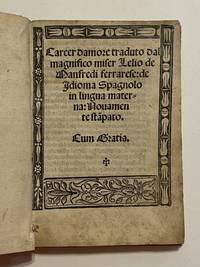
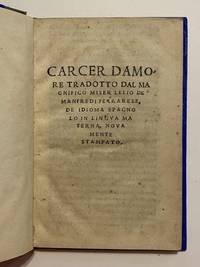
15184543Venice: Georgio de Rusconi 1518. Very good. Small 8vo 145 x 97 mm. 48 ff. Collation: A-F8 COMPLETE some soiling traces of damp in outer margins of D1-F8 for which SEE IMAGES. Old 18th-century vellum. In excellent unsophisticated condition. ITALIAN POST-INCUNABLE EDITION OF THE CARCEL DE AMOR THE MOST IMPORTANT SPANISH NOVEL OF COURTLY LOVE. <br /> <br /> Written in the late 15th century the work is a key example of the "star-crossed lovers" romance tradition. It combines allegory with chivalric narrative while its epistolary form intensifies the themes of miscommunication and emotional crisis. Widely popular it was quickly translated and circulated across Europe as is attested by this Italian translation published in Venice in 1518. The story continues to be celebrated for its emotional intensity and its refined articulation of courtly love.<br /> <br /> The romance was first translated from the Spanish into Italian by Lelio de Manfredi of Ferrara in 1514 and represents a moment when literature language and print culture intersected across political and cultural borders. For years the story was reshaped and redistributed in Renaissance Europe and contributed to a shared literary tradition. On the title-page of our edition we find only Manfredi's name and the dedicatee is Isabella d'Esta his former pupil. The translator has added his own closing epistle to the Carcel de Amor which praises Isabella; the author's name Diego de San Pedro is nowhere to be found.<br /> <br /> The Carcel de amor is told almost entirely through letters speeches and monologues rather than dialogue. It centers on Leriano a young nobleman in love with Laureola daughter of the King of Macedonia. His condition is figured as an allegorical "PRISON OF LOVE" and he communicates with her only through a mediator. A rival Persio sometimes Theseus/Perseus accuses Laureola of having an affair leading to her imprisonment. Leriano rescues her and kills his rival but Laureola ultimately rejects him in a letter. In despair he chooses to starve himself to death but not before delivering a speech in praise of women.<br /> <br /> CATALOGUER'S NOTE: Italian translations of the Carcel de Amor "Carcer Damore" are uncommon. We have located just three copies of ANY Italian language post-incunable edition at auction in the last century:<br /> <br /> 1518: sold at Ader Paris 2024<br /> 1521: sold at Sotheby's London 1970<br /> 1518: sold through Quaritch Catalogue 494 1934.<br /> <br /> EDIT16 CNCE 66997. Georgio de Rusconi unknown
15254542Venice: Gregorio di Gregorii 1525. Very good. Small 8vo 143 x 95 mm. 44 ff. Collation: A-E8 F4 COMPLETE title-page with light toning fols. A1-2 with unimportant wormholes in blank gutter margin. Very attractive late 19th- or early 20th-century blue embossed boards gray cloth spine. In excellent condition the paper crisp and fresh. ITALIAN POST-INCUNABLE EDITION OF THE CARCEL DE AMOR ONE OF THE MOST ENDURING OF ALL LATE MEDIEVAL ROMANCES. <br /> <br /> Written in Spanish in the late 15th century the work is a key example of the "star-crossed lovers" romance tradition. It combines allegory with chivalric narrative while its epistolary form intensifies the themes of distance miscommunication and emotional crisis. Widely popular it was quickly translated and circulated across Europe as is attested by this Italian translation published in Venice in 1525. The story continues to be celebrated for its emotional intensity and its refined articulation of courtly love.<br /> <br /> The romance was first translated into Italian by Lelio de Manfredi of Ferrara in 1514 and represents a moment when literature language and print culture intersected across political and cultural borders. For years the story was reshaped and redistributed in Renaissance Europe and contributed to a shared literary tradition. On the title-page of our edition we find only Manfredi's name and the dedicatee is Isabella d'Esta his former pupil. The translator has added his own closing epistle to the Carcel de Amor which praises Isabella; the author's name Diego de San Pedro is nowhere to be found.<br /> <br /> The Carcel de amor is told almost entirely through letters speeches and monologues rather than dialogue. It centers on Leriano a young nobleman in love with Laureola daughter of the King of Macedonia. His condition is figured as an allegorical "PRISON OF LOVE" and he communicates with her only through a mediator. A rival Persio sometimes Theseus/Perseus accuses Laureola of having an affair leading to her imprisonment. Leriano rescues her and kills his rival but Laureola ultimately rejects him in a letter. In despair he chooses to starve himself to death but not before delivering a speech in praise of women.<br /> <br /> CATALOGUER'S NOTE: Italian translations of the Carcel de Amor "Carcer Damore" are uncommon. We have located just three copies of ANY Italian language post-incunable edition at auction in the last century:<br /> <br /> 1518: sold at Ader Paris 2024<br /> 1521: sold at Sotheby's London 1970<br /> 1518: sold through Quaritch Catalogue 494 1934. <br /> <br /> EDIT16 CNCE 44982. See. Gregorio di Gregorii unknown
15374403Venice: Francesco Bindoni & Mapheo Pasini compagni 1537. 8vo 145 x 94 mm. 48 leaves. Italic types. Large title woodcut of the prison of love in flames 19 woodcut text illustrations printed from 13 blocks most showing two scenes; initial spaces with guide letters unrubricated. 19th-century green straight-grained morocco sides with double fillet border enclosing central gold-blocked arms of Gómez de la Cortina his gilt crowned ciphers in the corners gilt edges. Provenance: Joaquin Gómez de La Cortina 1st Marquis de Morante 1808-1868 supralibros & bookplate; with Quaritch their collation note at end; sold in 1996 to Kenneth Rapoport bookplate. <br /> <br /> Lelio Manfredi’s Italian translation of the Carcel de amor 1st ed. 1492 was among the most popular sentimental romances of its time. Many wept over the thwarted love of the noble Leriano and Laureola heir to the throne of Macedonia. Captive in an allegorical tower of love communicating with his beloved only through mediators the hero eventually renounces her in order to preserve her honor threatened by a rival’s false aspersions. There are duels and battles Leriano stops eating and finally dies after shredding and swallowing her letters. The tragedy touched a nerve and dozens of editions appeared in Spain as well as translations into Italian French English Catalan and in the 17th century German. Few remembered the true author whose name is omitted from most of these editions.<br /> <br /> One of several Castilian romances that were widely adapted and translated into other western European languages the Carcel de amor was the only one to appear first in print and to be consistently illustrated. It permeated the European reading public. The tale is told through letters and monologues rather than dialogue and much has been written about its hybrid forms and elaborate rhetoric “a reflection of vernacular humanism and a fictional tour de force of rhetorical precepts†Francomano p. 10 and about its literary sources and later influence or lack of it: While many scholars note its influence on the development of later European Renaissance fiction through its use of epistolary exchanges and of a narrative voice L’autore who acts as intermediary as well as its tragic ending and exploration of class differences between the lovers one commentator has called it “a dead-end in the history of literature†A. West: “In general the Prison of Love is a book of vestiges: of ways of believing that no longer obtain of customs that already were dying out of a manner of writing soon to be eclipsed by the realism of the picaresque novel.â€<br /> <br /> The humanist Lelio Manfredi d. 1528 translated the work into Italian at the request of Isabella d’Este to whom the printed editions are dedicated the first appearing in Venice in 1514. Eight more editions of his translation are recorded by USTC all but one Venetian the last in 1546. This edition is the third of four recorded editions by the partners Fr. Bindoni & Maffeo Pasini who specialized in vernacular literature and devotional works. <br /> <br /> The title woodcut used in the Bindoni and Pasini editions is a close copy of woodcuts from earlier Venetian editions see for example an anonymously published Spanish edition from 1523 Sander 6729 not in USTC whose title is reproduced in the Heredia catalogue vol. 2 no. 2468. Its iconography dates to the earliest Spanish editions as does that of the small primitive text woodcuts which relate to the text and are based on the more elaborate cuts from the Spanish incunable editions cf. Deyermond. Blind copying was the order of the day: note the anachronism of a cheaply printed edition of the 1530s retaining blank initial spaces with guide letters to be filled by nonexistent rubricators or illuminators who by this late date would only have been hired to embellish costly imprints or luxury manuscripts. <br /> <br />  I locate two US holdings of this edition UCLA and Folger and six holdings of other editions of Manfredi’s translation. <br /> <br /> USTC 854438; EDIT-16 CNCE 66994; Sander 6732 note; Palau 293388; Brunet V 112. Not in Essling. Cf. Alan Deyermond “The Woodcuts of Diego de San Pedro's Cárcel de Amor 1492-1496â€Â Bulletin hispanique 2002 104-2: 511-528; Emily Francomano The Prison of Love: Romance Translation and the Book in the Sixteenth Century Toronto 2018; Adrian West “On Translating Diego de San Pedro's The Prison of Love†Asymptote Oct. 2012 online. Francesco Bindoni & Mapheo Pasini, compagni unknown
0332730395.Ghardcover. Good. Access codes and supplements are not guaranteed with used items. May be an ex-library book. hardcover
1021629790.Gpaperback. Good. Access codes and supplements are not guaranteed with used items. May be an ex-library book. paperback
1020271108.Ghardcover. Good. Access codes and supplements are not guaranteed with used items. May be an ex-library book. hardcover
1020264640.Ghardcover. Good. Access codes and supplements are not guaranteed with used items. May be an ex-library book. hardcover
1021627089.Gpaperback. Good. Access codes and supplements are not guaranteed with used items. May be an ex-library book. paperback