(Bible English)Biblio.com
120 résultats
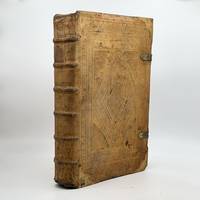
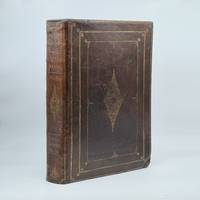
1604372251London: Robert Barker 1604. Text in Roman type in two columns. Titles within woodcut borders woodcut illustrations head and tail-pieces. 4 190; 117 i.e. 127; 128-187 i.e 197 omitting 129 as issued and other errors in pagination; 121 11 leaves. Complete with the leaf signed Ai preceding the general title. Bound with preceding the Bible: The Booke of Common Prayer with the Psalter or Psalmes of Dauid. Title in red and black within woodcut border. 46 leaves complete. ESTC S93831. Bound with following the Bible: The Whole Booke of Psalmes. 10 70pp only. Lacking terminal three signatures. 4to. Early mottled calf rebacked brass corner pieces and hinges lacks clasps upper cover detached marbled endpapers gilt edges. Provenance: William James signature and inscription dated 1663 on leaf preceding the general title; Frances Garway inscription on brass plate on covers dated 1701; Thomas Bever armorial bookplate inscriptions on endpaper circa 1748; Francis Hutchinson Synge; Arthur John Snow Paget inscription dated 1851 General Theological Seminary bookplate. Text in Roman type in two columns. Titles within woodcut borders woodcut illustrations head and tail-pieces. 4 190; 117 i.e. 127; 128-187 i.e 197 omitting 129 as issued and other errors in pagination; 121 11 leaves. Complete with the leaf signed Ai preceding the general title. Bound with preceding the Bible: The Booke of Common Prayer with the Psalter or Psalmes of Dauid. Title in red and black within woodcut border. 46 leaves complete. ESTC S93831. Bound with following the Bible: The Whole Booke of Psalmes. 10 70pp only. Lacking terminal three signatures. 4to. An excellent example of the Geneva Bible with Tomson's revised New Testament and Junius' Revelation. The principal Bible of 16th-century Protestantism and the Geneva Bible was used by Shakespeare Oliver Cromwell John Knox John Donne and John Bunyan. This edition contains the famous reading "breeches" in Genesis Chapter III verse 7 which first appeared in 1579. Although Barker's imprint on title of this edition reads "Printer to the Queenes most excellent Majestie" the colophon reads "Printer to the Kings most excellent Maiestie" as James I had ascended in March 1603. Darlow & Moole 209; ESTC S159; Herbert 274; STC 2190 Robert Barker unknown
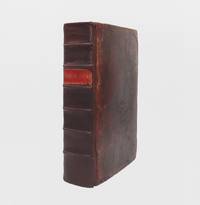
1609371891Geneva: Pierre de la Rouière 1609. In two columns. 28 184 283 1 84 203 1; 8 186 2 134 2pp. Folio 15 x 9-1/2 inches. Contemporary pigskin covers blocked in gilt and blind remnants of paper label on the spine gauffered edges lacks bosses and hinges and clasps worn at extremities and bottom of spine. Provenance: Johann Georg Feuchter of Jura-Weickersroda inscription on pastedown that the bible was purchased at an August 6 1728 auction for 4 florins and 30 groschen; General Theological Seminary blindstamp. In two columns. 28 184 283 1 84 203 1; 8 186 2 134 2pp. Folio 15 x 9-1/2 inches. Edited with introduction by Benito Arias Montanus 1527-1598 Spanish orientalist and editor of the Antwerp Polyglot a reprint of Plantin's similar edition. Darlow & Moole 5113 OT and 4662 NT Pierre de la Rouière unknown
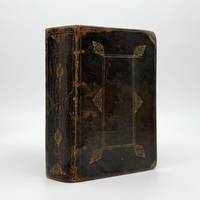
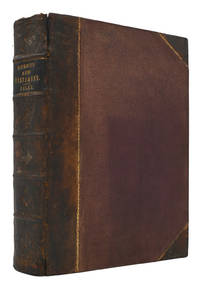
1638371697London: Robert Barker Printer to the Kings most Excellent Majestie and by the Assignes of John Bill 1638. A-F8 G4; A-3K8; A-F8 G4. 8vo. Early black morocco tooled in gilt marbled endpapers a.e.g. GTS bookplates at front and rear. Autograph ownership signatures with several additional textual annotations. A few small interior tears with vernacular repairs. 2D2 torn with loss. A-F8 G4; A-3K8; A-F8 G4. 8vo. Includes Robert Barker's 1638 editions of the Book of Common Prayer and the Holy Bible both Old and New Testaments plus Apocrypha along with the 1637 edition of Thomas Sternhold's Whole Book of Psalms printed by G.M. for the Companie of Stationers in London all designated "Cum privilegio." Text in two columns with printed glosses. Three discrete ownership signatures of Richard Jacob are present - two on the versos of the title pages for the Old and New Testaments and one facing the title page for the Whole Book of Psalms - along with several autograph annotations and vernacular repairs. Robert Barker, Printer to the Kings most Excellent Majestie, and by the Assignes of John Bill unknown
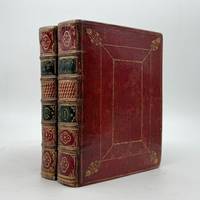
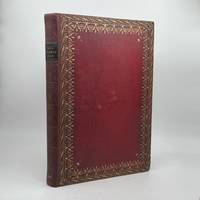
1653371930London: Roger Daniel 1653. Title in red and black. Engraved printer's device on the title state B. Text in two columns. 8 1279 1 pp. 4to 7-3/8 x 5-3/8 inches. Eighteenth century red morocco panelled in gilt spines gilt with black morocco lettering pieces marbled endpapers gilt edges. Provenance: Viscount Palmerston bookplate; General Theological Seminary bookplate. Title in red and black. Engraved printer's device on the title state B. Text in two columns. 8 1279 1 pp. 4to 7-3/8 x 5-3/8 inches. The rare first printing in England of the Septuagint the earliest translation of the Hebrew Old Testament into Greek the scarce printing in quarto format. The text is derived from the Sixtine text and edited by John Biddle 1615-1662 the Unitarian controversialist who was imprisoned by the Parliamentary Commissioners for his religious views. <br /> <br /> "Roger Daniel's version of the text of the Sixtine edition was prepared for the use of the scholars at Westminster School. This appeared in 1653 and was edited by the Socinian John Biddle. Its publication may have owed something to the interest in the Septuagint generated by Codex Alexandrinus and the frustration produced by the failure of Young's attempts to edit it" S. Mandelbrote "English Scholarship and the Greek Text of the Old Testament" p. 87.<br /> <br /> A rare issue from the same setting as the octavo edition imposed in quarto without rules separaring the columns. Wing 2nd ed. B2718A; ESTC R12599; Darlow & Moule 4692 Roger Daniel unknown
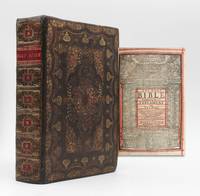
1655354139London: E.T. For a Society of Stationers 1655. WITH A CONTEMPORARY FORE-EDGE BY LEWIS of flowers centering on a quotation within a wreath "Blessed is he that word faded" and signed Lewis fecit 1656.". 12mo 169 x 115 mm. Contemporary black goatskin elaborately tooled in gilt small central oval onalys of calf at center of a large rectangular onlaid panel spine in 7 compartments with 6 raised bands red morocco lettering piece in one. Laid into full green pebbled morocco drop box. WITH A CONTEMPORARY FORE-EDGE BY LEWIS of flowers centering on a quotation within a wreath "Blessed is he that word faded" and signed Lewis fecit 1656.". 12mo 169 x 115 mm. With a most unusual contemporary watercolor painting on the fore edge of the book displaying a design of flower and acorns surrounding a central green wreath which encloses the following inscription: "March 13 1665 Martha White Order my Aedes in thy Word ps: 119 " According to Webber in 1001 Fore-edge Paintings p. 12 the earliest date on a fore-edge painting by Lewis is a 1651 Bible now in NYPL dated 1653 on fore-edge and similarily depicts flower animals and a motto. VERY EARLY AND RARE<br /> <br /> Signed by the London firm of Stephen and Thomas Lewis the earliest known bindery to paint both the firm's name and a year directly on the fore-edge paintings. Their fore-edges were typical of the time featuring elements from nature such as flowers animals or birds and they incorporated ofdten a wreath as here with a quote from Scriptures. This copy is additionally enhanced by its contemporary ownership by a woman reader. Provenance: contemporary ownership inscriptions of Martha Reyner "Martha Reyner her Booke with the price 0-18" front flyleaf and "Martha Thompson Her Book Ano Domini 1705 et Praetorum huius drawing of a bird." In a fleece-lined green morocco folding case. Rebacked with original spine laid down top headband partly frayed one nick to leather on front cover some slight fading of gilt E.T. For a Society of Stationers unknown
1638371824Cambridge: Thomas Buck and Roger Daniel 1638. Large paper copy. Ruled in red throughout. Roman letter in two columns. Engraved title page within architectural border featuring Biblical characters a vignette of the 'Last supper' and printer's device. 12 642 151 3 202pp. Bound with preceding the Bible: The Book of Common Prayer. 104pp. And with following the Bible: Whole Book of Psalmes. 8 1 2-90 10 pp. Folio 17 x 11 inches. Contemporary black morocco gilt covers panelled with roll tool borders and central arabesque design in gilt flat spine gilt with marching morocco labels gilt edges minor wear at joints lower corners bumped. Provenance:Webb early inscription on the front pastedown; Maggs Brothers item 827 in unidentified mid-20th century catalogue clipping laid in; General Theological Seminary bookplate. Large paper copy. Ruled in red throughout. Roman letter in two columns. Engraved title page within architectural border featuring Biblical characters a vignette of the 'Last supper' and printer's device. 12 642 151 3 202pp. Bound with preceding the Bible: The Book of Common Prayer. 104pp. And with following the Bible: Whole Book of Psalmes. 8 1 2-90 10 pp. Folio 17 x 11 inches. This edition contains the first major revisions of the King James version standardising the use of italics and altering several readings. "This remained the standard text until the publication of Dr. Paris' Cambridge edition of 1762" Herbert.<br /> <br /> A lovely example bound in contemporary English black morocco and measuring 430x280mm is considerably larger than the dimensions cited by Darlow & Moole 402 375x234 mm and Darlow & Moole 403 for a "large thick paper" copy 397x270 mm. Bible: Herbert 520; Darlow & Moule 402 and 403; ESTC S123371; STC 2nd ed 2331. Common Prayer: Griffiths 1638:2; STC 2nd ed. 16410; ESTC S902. Psalms: STC 2nd ed. 2682; ESTC S122380 Thomas Buck and Roger Daniel unknown
1607372868Sanctii Gervasii Saint-Gervais Geneva: Sumptibus Caldorianae Societatis 1607. O.T. and N.T. title pages with printer's device of Fama; each part of O.T. with sectional title parts 2-4 paginated consecutively. 1 vols. Folio. Old calf boards ruled in gilt. Rebacked with morocco spine label. Some paper flaws at end. Portrait of William Lupton 1676-1726 dated 1727 frontispiece to his Sermons on front pastedown. Cloth slipcase and folding box. O.T. and N.T. title pages with printer's device of Fama; each part of O.T. with sectional title parts 2-4 paginated consecutively. 1 vols. Folio. The Junius-Tremellius Bible with Theodore de Beze's translation of the New Testament. This was for many years the standard Latin Bible favored by Protestants.<br /> <br /> Uncommon OCLC records fewer than 20 locations with interesting English provenance.<br /> <br /> William Slater or Slatyer 1587-1647 whose Psalmes or songs of Sion: turned into the language of a strange land 1631 "was on 9 July 1631 ordered to be burned. Summoned before the court of high commission on 20 October Slatyer confessed that he had 'added thereunto a scandalous table to the disgrace of religion and to the encouragement of the contemners thereof'; judging from an annotated copy of the work dated 1642 this probably consisted of a list of popular tunes to which the psalms might be sung" ODNB He was also editor of The Psalmes of David in 4 languages 1643 "a high quality edition containing both words and music the latter principally by Thomas Ravenscroft". Not in Darlow & Moule; Bibles imprimées 976 locates a copy with later Genevae imprint. Provenance: William Slater his Latin ownership signature; W.A. Copinger; General Theological Seminary gift of Cornelius Vanderbilt and Dean Augustus Hoffman bookplates and blindstamps Sumptibus Caldorianae Societatis unknown
1663256261V.p. Venice Leipzig London Amsterdam 1663. Folio and smaller. Generally fine mounted in card folders. Folio and smaller. The collection includes the following printed leaves:<br /> 1 Bible. Greek. Venice 1518. From the Aldine Greek Bible the editio princeps of the complete Bible in Greek Darlow & Moule 4594. Book of Malachi folio 326.<br /> 2 Bible. German. Leipzig 1541. From a pirated edition suppressed at Luther's request on account of its errors Darlow & Moule 4204 note. Isaiah chapter 48.<br /> 3 Walton's Polyglot Bible. London 1655. The great London Polyglot published in 6 volumes from 1655 to 1657. Darlow & Moule 1446. From vol. I the Pentateuch: Leviticus chapter 18 in Hebrew Samaritan Latin Greek Arabic Syriac.<br /> 4 Walton's Polyglot Bible. London 1657. Darlow & Moule 1446. From vol. V New Testament: Paul's Epistle to the Romans chapter 9 in Latin Greek Ethiopic Arabic Syriac.<br /> 5 Bible. Dutch. Amsterdam Elzevier 1663. States General version Darlow & Moule 3321. Leviticus folio 55. unknown
16017682Londini London: Impensis G.Bishop. 1601. Folio pp. xlii 378 381-914 10. 20th-century half sheep pebbled cloth boards spine divided by raised bands black morocco label. Title-page trimmed and mounted final leaf also mounted a few smaller repairs to early leaves small wormhole in blank margin some foxing and occasional light marginal dampstaining. Spine rather rubbed and darkened and sometime furbished worn at ends and joints just starting to crack at head. The second edition of Fulke’s tendentious and influential comparison of the Douay-Rheims and Bishops’ translations of the New Testament with his notes and commentary intended to refute the arguments on which the former version was based. Fulke’s work with the two texts in parallel columns the Catholic in roman type and the Church of England version in italic sold better in England than the Douai Bible ever had bringing its language to a wider readership and becoming indirectly responsible for its influence on the coming King James version. ESTC S107069. Impensis G.B[ishop]. hardcover
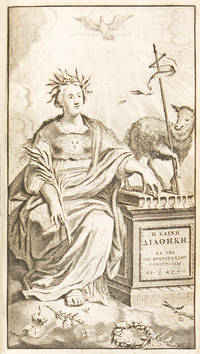
1642371830Paris: Ek basilikēs typographias Imprimerie Royale 1642. Engraved title by by Claude Mellan engraved head and tail pieces and initials. 2 453 3 pp. Extra-illustrated with a later English printed "Abbreviations and Connexions" leaf inserted after the title. Folio 15-1/2 x 10-5/8 inches. Late eighteenth or early nineteenth century red morocco gilt marbled endpapers gilt edges. Neatly rebacked. Cloth slipcase and chemise. Engraved title by by Claude Mellan engraved head and tail pieces and initials. 2 453 3 pp. Extra-illustrated with a later English printed "Abbreviations and Connexions" leaf inserted after the title. Folio 15-1/2 x 10-5/8 inches. Known as the Mazarin edition "since it appeared under the auspices of the great Cardinal" D&M it is the first edition of the Greek New Testament from the Imprimerie Royale founded just two years prior.<br /> <br /> Inserted before the engraved title page is a partly-printed certificate of the Collegium Mazarinaeum awarding this volume as a prize in Rhetoric to Philippus Matthaeus Guillot dated MDCC in manuscript i.e. 1700 and signed by the college's master P.-J. Le Chapelier Pierre-Jean le Chapelier de Mauron abbé de Ste Marie de Boquen in Brittany with the trace of a seal below. The College Mazarin or College des Quatre-Nations was established by bequest of Cardinal Mazarin 1602-1661 and opened its doors to students in 1688. Darlow & Moule 4687. Provenance: Philippus Matthaeus Guillot certificate his signature at foot of title engraving; Montagu Barton armorial bookplate; John Horatio Nelson gift inscription dated 1841; General Theological Seminary bookplate perforated stamp Ek basilikēs typographias [Imprimerie Royale] unknown
1639255527Lugduni Batavorum i.e. Leiden: ex officina Elseviriorum 1639. First edition. 12 43 5 966 86 pp. Printer's device on title-page. Text in Greek and Latin. 1 vols. Folio. Contgemporary panelled calf skillfully rebacked preserving original backstrip later marbled endsheets corners restored rear joint cracked but sturdy minor staining to covers; internally apart from slight dampstaining to inner margins quite clean and crisp. First edition. 12 43 5 966 86 pp. Printer's device on title-page. Text in Greek and Latin. 1 vols. Folio. Heinsius' massive commentary on the New Testament and one of his major achievements. The second part Aristarchus Sacer is his commentary on the Gospel according to John first published by the Elzeviers in 1627 and here slightly revised and enlarged. ex officina Elseviriorum unknown
1698255818Amsterdam: Ex Officina Westeniana 1698. 3rd Leusden edition. Additional engraved title-page and 2 folding engraved maps the Holy Land and the Mediterranean. 337 1. colophon; 142 1 pp. 8vo signatures alternating in 8s and 10s. 18th-century red morocco covers with gilt-rolled bordersgilt-tooled and -lettered spine multi-colored Dutch pastedowns without free endpapeers. a.e.g. Head of spine starting otherwise quite attractive. 3rd Leusden edition. Additional engraved title-page and 2 folding engraved maps the Holy Land and the Mediterranean. 337 1. colophon; 142 1 pp. 8vo signatures alternating in 8s and 10s. D & M doesn't mention the two fine engraved maps found in this copy; nor the separately printed COMPENDIOLUM 1699 with Leusden's useful concordance of all Greek words found in the New Testament. The Dutch Calvinist philologist Johann Leusden 1624 - 1699 was one of the foremost Biblical experts of his time. His edition of the Greek New Testament first appeared in 1675; this 1698 edition is quite scarce in the US and very rare with the Compendiolum. Darlow & Moule 4718a "Apparently the earlies Greek New Testament to bear the name of the publisher Henricus Wetstenius"; OCLC: 64158458 Ex Officina Westeniana unknown
1653255179Londoni: Excudebat Rogerus Daniel: prostat autem venale apud Joannem Martin & Jacobum Allestrye sub signo Campanae in Cometerio D. Pauli 1653. The first edition of the Septuagint printed in England. 8 1279 1; 186 2 pp. plus terminal blank. 1 vols. 4to signed in 8's 195 x 143mm. Old vellum titled and dated in manuscript on the spine. Terminal leaves slightly soiled two ownership inscriptions on front endsheets and small Lincoln's Inn release/sale stamp vellum a bit handsoiled occasional modest foxing and dusting along upper margins but a very good copy. The first edition of the Septuagint printed in England. 8 1279 1; 186 2 pp. plus terminal blank. 1 vols. 4to signed in 8's 195 x 143mm. The first edition of the Septuagint printed in England with the Scholia the scarce printing in quarto format. The text is derived from the Sixtine text and edited by John Biddle 1615-1662 the Unitarian controversialist who was imprisoned by the Parliamentary Commissioners for his religious views. <br /> The SCHOLIA . has a separate title-leaf register and pagination. The same setting was imposed in both quarto and octavo formats the latter with rules separating the columns of text. In regard to institutional representation the edition in quarto is much more uncommon than that in octavo: ESTC locates 4 copies of the quarto printing in North America as opposed to 19 of the octavo printing. Occasionally Daniel's reprint of the New Testament is bound up with the octavo printings to form a complete Bible. Brunet cites that format but notes the sale of a copy on "Gr. Pap." presumably a copy in this format. Over the last 35 years ABPC records sale of one copy in quarto 1999 and four in octavo. ESTC R12599 & R236817; Wing B2718 octavo edition only; Darlow & Moule 4692; Brunet I:863 Excudebat Rogerus Daniel: prostat autem venale apud Joannem Martin & Jacobum Allestrye, sub signo Campanae in Cometerio D. Pauli unknown
169718733Regensburg: C. Weigel 1697. Hardcover. Very good-. Four volumes small quarto 19.7 by 14.8 cm. Captions in Latin biblical book and chapter and German biblical book chapter and verses with quote. Copperplate engravings throughout: 1 title 175 plates; 1 title 225 plates; 1 title 288 plates; 148 plates. Total = 836 unnumbered plates 3 engraved title pages. Uniformly bound in contemporary sheep with ruled borders; spines with raised bands blindstamped ornaments and letterpress titles on heavy paper labels. Lacks fourth volume title page. Covers rubbed/lightly worn at extremities; slight loss to labels; light almost exclusively marginal foxing throughout all volumes; dampstains in first volume affecting first seven plates and top margin through first third of the volume else a very good copy with clean plates.<br /> <br /> Second printing of this pictorial Bible Bilderbibel published by the engraver and art dealer Christoph Weigel 1654-1725. The grand biblical story from the Seven Days of Creation to the Vision of a New Jerusalem here unfolds in 836 beautifully engraved plates. The designs were chiefly drawn by Johann Jacob von Sandrart 1655-1698 and Georg Christoph Eimmart the Younger 1638-1705. The engravings were made by Elias Christian Heiss J. U. Kraus L. Heckenauer and Weigel himself among others. Weigel had earlier collaborated with J. J. von Sandrart on the Passio Domini Nostri Iesu Christi Neo-coelatis Iconibus Expressa Augsburg 1693 a pictorial Gospel harmony depicted in 100 engraved plates.<br /> <br /> Christoph Weigel first trained as a goldsmith and later apprenticed to his cousin Erhart Weigel a famous instrument maker in Jena. He journeyed to Augsburg in 1693 where he learned the art of engraving from Andreas Wolfgang and later from Matthäus Küsel. His published works tended to serve didactic and edification purposes including illustrated chronicles and a compendium of notable political events of the early eighteenth century. Among his notable cartographic works is the Descriptio orbis antiqui in XLIV tabulis exhibita A Description of the Ancient World in 44 Maps - Nürnberg 1720. <br /> <br /> The Biblia Ectypa was first published in a large folio format at Augsburg in 1695 with four engraved plates appearing on each leaf. In 1697 the plates were re-issued at Regensburg in two formats: a smaller oblong folio with two plates per leaf and a quarto with a single plate per leaf. Wildly successful the Biblia Ectypa enabled Weigel to establish his own print publishing company in Nürnberg where he was soon joined by his younger brother Johann Christoph Weigel and worked closely with the prominent map publisher Johann Baptist Homann.<br /> <br /> Annotations: Plates numbered by hand in black ink at top corner though sometimes slightly out of order with occasional corrrections in the first two volumes. An old German hand has noted a correct count for each volume at the rear endleaf e.g. Enthält 288 Küpfern.<br /> <br /> A notably complete set of this uncommon edition lacking only the fourth title page. The total count of 836 engraved illustrations is confirmed via the online catalogue Das Verzeichnis der im deutschen Sprachraum erschienenen Drucke des 17. Jahrhunderts VD17. References: Paul Johannes Rée "Weigel Christoph" in: Allgemeine Deutsche Biographie 41 1896 pp. 464-465 Online-Version; Thieme-Becker XXV 227-228; VD17 23:659088P vol. 1; 23:659089W vol. 2; 23:659091S vol. 3; 23:659092Z vol. 4. C. Weigel hardcover
162718927Frankfurt: Matthaeus Merian 1627. First edition. Hardcover. Very good. Matthaeus Merian. Oblong folio leaves: 20.6 by 31.2 cm; plates: 10 to 11.5 by 14.5 to 15.5 cm. Engraved titlepage borders without letterpress; 231 of 233 engraved plates printed on the rectos with no printed text depicting biblical scenes from the Old and New Testaments lacks Gen. XIX: Lot and his daughters after the destruction of Sodom and Gomorrah; Exod. VIII & IX: The plague of frogs. Recent marbled calf lightly rubbed at extremities bordered in blind; gilt-tooled spine with raised bands gilt lettering pieces. Occasional light stains and smudges especially at the outermost leaves and almost entirely restricted to the blank margins; old mostly marginal repairs and reinforcement of tears to about 30 leaves Matt. IV plate with loss of about 10 words of manuscript text. Protected by wide margins the plates are clean fresh and bright with relatively few minor blemishes. Housed and protected in a custom luxurious modern leather clamshell box.<br /> <br /> Rare suite of biblical illustrations printed before letter perhaps as proofs comprising 231 of 233 engraved plates from the Icones Biblicae of Matthaeus Merian the elder 1593-1650. The engravings are printed on large paper and lack any printed text. They are preceded by a leaf of the engraved title borders to the first part in which the central cartouche which would have contained a letterpress title and imprint is here blank. Neat manuscript annotations appear throughout: atop each engraving is a brief title along with a notation of the biblical book and chapters; beneath each engraving are six-lines of rhyming verse in German; at the top corners are leaf numbers in Arabic numerals. All are penned in black ink in the same old cursive German hand. The engraved title leaf is not included in the manuscript foliation. The first three leaf numbers and several others among the first 23 leaves are obscured by wear or later marginal repairs. The foliation ends at leaf 233 and is discontinuous where one would expect to find numbers 15 and 38 corresponding to the missing plates noted above. As noted by Wütrich only four of the 233 plates are signed by Merian all in the New Testament series. Each of these signed plates appears in our suite: Matthaei I. - page 7; Johannis VIII. - page 65; Matthaei XXVII. - page 101; Apocalyps. IX. - page 145 header titles and page numbers from the first edition.<br /> <br /> The first editions were published at Frankfurt in four parts between 1625 and 1627. The Pentateuch series was published in 1625. The second part illustrating the Old Testament books from Joshua to Kings appeared in 1626. These first two series were published under the name of Merian's father-in-law the printer and bookseller Johann Theodor de Bry 1561-1623 whose heirs retained title to the business. The third part illustrates the remainder of the Old Testament and Apocrypha; the fourth the New Testament. These last two parts were published in 1627 under the engravers's own name. Verses in Latin German and French accompany each plate in the three Old Testament series the French verses being omitted in the 1627 New Testament series.<br /> <br /> While the eminent Swiss draughtsman and engraver Matthaeus Merian is best known for his topographical depictions of the German speaking lands which appeared in the Theatrum Europaeum his novel selection of biblical stories and innovative stylistic approach revealed in the present series of plates proved highly influential ushering in a new age of copperplate engraving in Bible illustration. Merian broke with the century-long tradition of woodcuts which had accompanied countless editions of Luther's German Bible. Even as he drew on the Bible illustrations of Jost Amman Hans Holbein Virgil Solis and Tobias Stimmer Merian greatly expanded the traditional iconographic and compositional repertoire. The Old Testament alone contains 23 prints depicting stories that had never before been the subject of an engraver. While earlier New Testament woodcuts focused on the Book of Revelation Merian now provided a rich series of plates to illustrate the Gospels and Acts of the Apostles as well.<br /> <br /> Merian had an obvious preference for crowd scenes and battles along with some of the novelistic features of the Old Testament such as Jacob's lentil dish Solomon and Shulamit in the Song of Songs or the apocryphal story of the Dragon in Babylon. Merian sometimes provides local color from his home town of Basel as in his depiction of Solomon's Temple Consecration in which despite the baroque redesign the Basel Cathedral with the old choir is easily recognizable. The costumes and gestures of Merian's biblical characters display a baroque fantasy of the ancient Near East as reflected in the theater of his day; in depicting cities and buildings however Merian generally prefers to follow contemporary models. In individual cases such as Bathsheba's Bath he succumbed to the temptation as an engraver and artist to show off his skills in a magnificent fashionable palace and garden complex. All-in-all Merian's engravings initiated a development in Bible illustration "that led further and further away from the didactic Reformation purpose of Bible pictures to purely artistic-representational purposes and finally ended in the well-known pathos of the German Romantic Nazarenes" Schmidt.<br /> <br /> In the first few decades after their appearance these Bible plates were widely copied throughout Europe especially in the Netherlands and France Poortman. The first folio Bible to use Merian's copper plates to illustrate the text was published by the heirs of Lazarus Zetzner at Strasbourg in 1630. Subsequent editions of the "Merian Bible" were published at Frankfurt where Merian had taken over his father-in-law Johann de Bry's business. For over a century as Merian's heirs continued to publish new editions this would become "the most widespread German illustrated Bible in southern Germany Basel and Alsace primarily in wealthy households" Schmidt. After the demise of the Merian publishing house in 1727 the bookseller Philip Heinrich Hütter acquired the copper plates which he used to illustrate a Catholic Bible edition published at Frankfurt in 1740 Poortman.<br /> <br /> A very notable instance of transposing Merian's biblical engravings into another context occurs in the famous and oft-reprinted Amsterdam Haggadah the ritual for the Jewish Passover meal first published in 1695. The engravings were made by Abraham ben Jacob a former Protestant preacher who converted to Judaism. Introducing skills he had earlier acquired when working outside the Jewish community Abraham ben Jacob "widened the scope of Jewish book illustration" Rosenau and introduced new elements into the traditional iconography of the Haggadah. "He chose many of the same incidental scenes as had appeared in the Venice Haggadot 1599-1604 but he drew them afresh basing his work on the biblical pictures in the Icones Biblicae by Matthew Merian" EJ. Among them was the image of the Temple of Solomon in Jerusalem. As Merian used a wide variety of prototypes Rosenau suggests that the two free-standing columns Jachin and Boaz depicted at the front porch of the Temple in Merian's engraving and Abraham ben Jacob's adaptation may have ultimately been derived from the woodcuts which accompany Estienne's Bible Paris 1540 based upon the scholarship of Franciscus Vatablus.<br /> <br /> In Das druckgraphische Werk von Matthaeus Merian d. Ae. 1993 L. H. Wüthrich describes a "Spezialausgabe ohne Drucktext" complete with 233 biblical engravings located in Darmstadt at the Hessische Landesbibliothek 31/643. This "separate edition without text or a series of proofs" which he describes has three notable features: 1 an undated first edition title page of the second part Pars II of the Old Testament which has been "corrected. by crossing out or shaving" to read "Pars I"; 2 the first edition title page of the New Testament series dated 1627; 3 an engraving of the The Fall of Man probably after Johann Theodor de Bry which later appears in Gottfried's Chronicle part 1 1629/1630 but which differs from that found in most copies of the first edition Wütrich 1a. The copies containing this plate after de Bry Wütrich 1aa. were likely printed in 1626. Further research perhaps locates only one other suite of Merian plates without text at the Herzog August Bibliothek Wolfenbüttel catalogued under two call numbers: the Old Testament series dated 1626-1627 comprising 157 leaves including an engraved title A: 30.1 Geom. 2 "Ausg. ohne Text von Ps. 1 und 2." = VD17 23:289608V and the New Testament series dated 1627 comprising 78 leaves including an engraved title A: 30.1 Geom. 3 "Ausg. ohne Text" = VD17 23:655618H. The catalogue entry for the Old Testament series references Wütrich's "Spezialausgabe ohne Drucktext." Surprisingly the key images provided for this entry illustrate the same three notable features of the "Spezialiausgabe" which Wütrich located at Darmstadt !. Our suite of plates is provided with a single blank engraved title leaf the one used for the first series of the Old Testament plates which lacks any letterpress. The third plate which depicts the Fall of Man is here in Merian's style and is the image more commonly found in the first printings Wütrich 1a.<br /> <br /> In the first edition of the Icones Biblicae the title page notes "Mit Versen und Reymen in dreien Sprachen geziert und erkläret Durch Johann Ludwig Gottfried" decorated and described with verses and rhymes in three languages by Johann Ludwig Gottfried. In the first three parts of Icones Biblicae Gottfried's German verses are in four lines with a rhyme scheme of ABBA. In the fourth part the New Testament the German verses are modified to six lines with a rhyme scheme of AABCCB. The manuscript verses in German which accompany each of the 231 plates in our suite differ from both of these formats being composed in six lines of iambic hexameter with a rhyme scheme of ABABCC. To give a sense of how these versions differ the four lines of the German printed verses which accompany the first plate The Creation may be compared with the following transcript of the written verses which describe this scene in our set.<br /> <br /> in the first edition of Merian's Bilderbibel<br /> <br /> Im Anfang Gott Erschuff den Himmel und die Erden<br /> Die Wasser und das Meer das Liecht der Sternenschein<br /> Die Vögel Fisch Gewürm alle Thier groß und klein<br /> Warauß sein Gütigkeit und Kraft erkant mag werden.<br /> <br /> the hand of anonymous versifier<br /> <br /> Im Anfang schuff der Herr den Himmel und die Erden<br /> Das Licht die Sonn den Mond die Sternen und das Meer<br /> Gras Bäume Laub und Kraut und was genannt mag werden<br /> Von Thieren Vögel Fisch in ihrem grosen Heer<br /> Nur durch ein einig Wort: Ich kan hieraus erkennen<br /> O Gott! dein ew'ge Krafft und dich den Schöpffer nennen.<br /> <br /> Watermark: flambeau surrounded by garland<br /> <br /> Provenance: laid-in typed description on a half-sheet bearing the early twentieth-century letterhead of Harry A. Levinson Rare Books: "There appears to be no record of another such copy of proofs before letter." References: L. H. Wüthrich Das druckgraphische Werk von Mattaeus Merian d. Ae. Basel: Bärenreiter 1993 vol. 3 p.16: "Spezialausgabe ohne Drucktext;" Enc. Jud. 2nd ed. 8:215; W. C. Poortman Bijbel en Prent 's-Gravenhage 1986 2:56-59; H. Rosenau Vision of the Temple London: Oresko 1979 pp. 135; 146f. Ph. Schmidt Die Illustration der Lutherbibel Birsfelden/Basel 1977 pp. 304-329; VD17 23:289608V and 23:655618H. [Matthaeus Merian] hardcover
163249165Paris: J. Wuensel 1632. First edition. Hardcover. Nearly Fine. Octavo. Collation: á4 é4 A-T4 = 84 leaves. 16 149 i.e. 145; error in pagination: pp. 81-84 skipped in numbering sequence register continuous 7 pp. Woodcut title page vignette; head- and tail-pieces initials. Contemporary limp vellum. Title a bit dusty and lightly stained else a nearly fine clean copy.<br /> <br /> Rare first edition by the French jurist Edmond Mérille 1579-1647 of these notes on the passion accounts in each of the four Gospels: John Matthew Mark and Luke.<br /> <br /> Provenance and annotations: Entry at title copy from the library of the Oratorians. Errors corrected throughout per errata at a4 verso in an an old hand. J. Wuensel hardcover
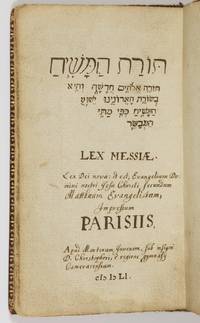
1700557661700. Very good-. Small octavo 14.1 by 8.5 cm. Manuscript in black and brown ink; 18-20 lines per page; text in vocalized Hebrew. 6 title and editor's preface 146 12 blank 10 notes. Lacks the first leaf which has been supplied in manuscript by a later owner. 19th-century limp morocco rubbed at extremities gilt dentelles marbled endleaves. Faint dampstain along bottom margin occasional smudges and mild stains else very good with crisp text.<br /> <br /> Early modern transcription of the Hebrew version of the Gospel of Matthew published in 1551 at Paris by Martin le Jeune with notes at the rear likely the work of a student. This edition was prepared by Jean Cinqarbres Quinquarboreus; 1514-1587 who jointly held the chair of King's Professor of Hebrew Literature at the University of Paris with Jean Mercier d. 1570. Lapide describes this as a "literal" edition and notes that the learned French bibliographer and father of the Oratory Jacques Le Long regarded it as the "true and authentic Gospel of Matthew." Like many of the surviving copies it lacks the Appendix which comprised the Seven Penetential Psalms Psalm CXIX Daniel's Prayer and the Ten Commandments. Apart from minor formatting changes e.g. breaks between chapters the text appears to be a faithful copy including vowel points and some of the additional cantillation marks the printed marginalia new Hebrew page numbers and Cinqarbres's dated preface. As the original version contains only 17 lines of text per page the transcription is not a page-for-page copy. Here the copiest appears quite fastidious in providing appropritate new catchwords! The Latin portion of the title however differs notably from the original which reads: Sanctum Domini nostri Iesu Christi Hebraicum Evangelium secundum Matthaeum.<br /> <br /> "In 1537 Sebastian Münster published his Hebrew version of the Gospel of Matthew at Basel the first printed edition of the New Testament in the so-called 'mother tongue of the evangelist' as he states in his preface" Lapide. Like the Paris edition of Hebrew Matthew upon which the present copy is based Münster entitled his version Torat ha-Mashiah The Teaching of the Messiah. While Münster's version of Matthew was long believed to be based on the 14th-century Hebrew translation by the Jewish polemicist Shem Tov ben Isaac ibn Shaprut more recent scholarship has called this attribution into question. "There are medieval Hebrew forms of Matthew that most scholars think of as retroversions from the Greek of canonical Matthew often made to serve in arguments between Christians and Jews. However some claim that these texts are a guide to the original Hebrew of Matthew French scholars like J. Carmignac and M. Dubarle have contributed to this thesis. Still other scholars think they can reconstruct the original Hebrew or Aramaic underlying the whole or parts of the Greek text of canonical Matthew on the assumption that the original was in Semitic. The vast majority of scholars however contend that the Gospel we know as Matthew was composed originally in Greek and is not a translation of a Semitic original" Brown.<br /> <br /> Provenance and annotations: The copiest has added notes following the main text comprising a Seder shel Miqra / Ordo Bibliorum in which the tripartite division of the Scriptures according to Jewish tradition is described. Then follows several pages of Hebrew terminology with biblical references and definitions in Latin. Along with one or two references to rabbinic literature an erudite reference to the Passover Haggadah notes Rabbi Judah's grouping of the ten plagues into three acronyms.<br /> <br /> At the head of the leaf inserted after Cinqarbres' preface is the note "When I bought this Mss. the first chapter from verse one unto verse 14 and part of verse 15. I filled in the missing verses. May. 18th. 1901. Llewellyn Saunderson 10 De Vesse Terrace Kingstown Co. Dublin" References: R. Brown Introduction to the New Testament 1997 p. 210; P. Lapide Hebrew in the Church Grand Rapids 1984 see Chap. IV "Modern Christian Hebraica" esp. pp. 53-58. Cf. Adams B1890 wanting the appendix; Darlow & Moule 5095: An independent edition of Shem Tob's version see no. 5088 which notes: The editor S. Münster obtained an imperfect MS. copy of St. Matthew's Gospel in Hebrew which had been made as early as 1385 for polemical purposes by Shem Tob b. Shaprut a Jew of Tudela in Castile. He revised and completed this for the press Basel: H. Petri 1537 adding a Latin translation of the Hebrew.; Delaveaux & Hillard 4644 noting Ibn Shaprut as the ulitmate source; Le Long/Masch 2 1781 p. 10. Schwarzfuchs Paris 212. Steinschneider 6591.26 under Münsterus.<br /> <br /> Full title noting original imprint: תורת המשיח תורת ××œ×”×™× ×—×“×©×” ×•×”×™× ×‘×©×™×¨×ª ×”××“×•× ×™× ×• ישוע המשיח כפי מתי המבשר <br /> Lex Messiae. Lex Dei nova: id est Evangelium Domini nostri Iesu Christi secundum Matthaeum Evangelistam Impressum Parisiis: apud Martinum Iuvenem sub insigni D. Christophori è regione gymnasii Cameracensium M.D.LI. 1551. unknown
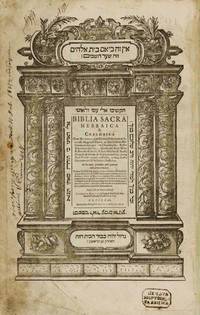
161948847Basel: Ludwig König 1619. First editions. Hardcover. Good. Seven parts in two volumes folio biblical texts and commentary in four parts continuously foliated; two supplemental sections each with separate foliation; Tiberias 1620 with separate pagination here bound after the second part - Vol. 1: 6 title and prelims 1-228 1 sect. title 234-441 1 blankff.; 6 sect. title and prelims 2 blank 114 2 blankpp. Vol. 2: 442-946; 8 Targum Yerushalmi; last leaf unfoliated; 67 Masora 1 blankff. Largely arranged in two columns of biblical texts in square font surrounded by commentaries in rabbinic Rashi font; text reads from right to left. This copy with collective Latin title surrounded by biblical quotations in Hebrew set within elaborate woodcut architectural borders. Hebrew sectional titles set within the same woodcut borders for the second and fourth parts with a plain letterpress half-title for the Five Megillot. The third sectional title for the Latter Prophets is lacking as are the Ashkenazi Haftarot readings not found in all copies. Apart from these lacks the Rabbinic Bible collates complete despite numerous errors in foliation throughout as per the detailed notes in Prijs Die Basler hebräischen Drucke. Opening word of each biblical book set in large one-third to one-half page cartouche vignettes with elaborate woodcut borders and surrounding letterpress Hebrew text. Main Latin title dated 1619 with the editor's Latin preface to the reader appearing at the verso. Jewish date chronogram for the second section Former Prophets dated 5378 1618/1619. Early twentieth-century black cloth boards worn at extremities gilt-lettered spine. Title moderately soiled re-inforced at gutter; neat old repairs to corners and fore-edge of title and next three leaves; old Russian stamp at bottom margin title manuscript entry in Russian along fore-edge dated 1837; intermittent mild to moderate marginal dampstains largely confined to corners and embrowning throughout both volumes somewhat more heavily in the first especially throughout Tiberias; top right corner of the opening leaf in vol. 2 repaired with loss of about 12 words surrounding title cartouche recto and some text in 9 lines of the commentary at the verso. Overall a good set with a notable chain of provenance. <br /> <br /> Sixth Rabbinic Bible in Hebrew: Mikra'ot Gedolot edited by Johann Buxtorf I 1565-1629 professor of Hebrew at the University of Basel and the foremost Christian Hebraist of his era with the assistance of the Jewish scholars Abraham Braunschweig who served as the principal corrector and Mordechai Gumplin of Posen. This was "a truly audacious undertaking for his time" Burnett From Christian Hebraism to Jewish Studies as no Christian scholar had yet attempted to edit the entire biblical corpus including the Aramaic versions Targumim and masoretic notes. Based mainly on the third Rabbinic Bible published by Daniel Bomberg at Venice in 1546-1548 the editor has carefully incorporated elements from two other Venetian editions. At the verso of the Latin title Buxtorf provides a detailed bibliographical excursus on the earlier Venetian editions and offers a tribute to Bomberg's industry by reprinting the colophon of the second Venetian Rabbinic Bible 1524-1525 at the conclusion of the masoretic appendix with text by the Hebrew grammarian and lexicographer Elijah Levita 1468 or 1469-1549 and a new introduction by Abraham Braunschweig. The design of the sectional titles and separate book title vignettes closely model those of the Venetian editions. "Buxtorf did not plan simply to reprint one of the existing Venice editions but rather to assemble the best features of them all into one work" and "to provide theologians with what he considered the most important tools for interpreting the Old Testament" Burnett. Buxtorf served in an official capacity as Basel's Hebrew censor charged with the oversight of all Jewish printing in the city and insuring that "no 'blasphemies' or slurs against Christians or Christianity appear in any book printed in Basel" Burnett. He carefully edited the Jewish commentaries in the Rabbinic Bible in accordance with this mandate "and removed many words and phrases which had escaped the attention of earlier censors" Burnett. <br /> <br /> The Rabbinic Bible contains the vocalized Masoretic text of the Hebrew Scriptures with accents and a vocalized Targum an Aramaic paraphrase of the biblical text: Onkelos for the Pentateuch; Jonathan b. Uzziel for the Prophets; and Targum Hagiographa for the Writings. The Hebrew and Aramaic versions are printed in square characters and presented in facing columns at the center of each page. The Jerusalem Targum of the Pentateuch appears as an appendix. In addition to the Aramaic paraphrases the Rabbinic Bible includes a massive scholarly apparatus of biblical commentaries by Rashi Ibn Ezra Baal ha-Turim Jacob b. Asher R. David Kimchi Radak R. Levi b. Gershon Ralbag Saadia Gaon and R. Isaiah along with the Masora a corpus of critical notes on the external form of the Biblical text compiled by Jewish scholars from late antiquity through the medieval era. As frequently occurs a copy of Buxtorf's work on the textual history of the Hebrew Bible Tiberias the 1620 first edition is bound-in. This work was made possible by the publication in 1538 of Elijah Levita's Masoret ha-Masoret a commentary on the Masora which Buxtorf translated into Latin for his own private use in 1593. "Buxtorf was concerned with the integrity of the consonantal text and the origin and integrity of the vowel points and accents of the Hebrew Bible from the very beginning of his scholarly career" and while he had earlier published a long excursus on the age of the vowel points and accents in his 1609 Thesaurus Grammaticus "Tiberias is Buxtorf's fullest and most impressive work on the history of the biblical text" Burnett. Intended as a reference work for Christian students and scholars interested in studying the Masora Buxtorf was also keen to refute the view advanced by Levita that the Hebrew vowel points were early medieval innovations. Our folio version of Tiberias was intended to accompany the Rabbinic Bible and has the same architectural borders at the title. König also published a quarto edition in the same year but only the folio version includes a critical commentary on the Masora in which Buxtorf proposes various corrections to the Masoretic notes. <br /> <br /> As noted at the title Buxtorf's faithful study and tireless labor studio fido et labore indefesso yielded notably long-lasting results: "The Basel rabbinical Bible became a standard tool for research among Christian scholars and would remain so. until the end of the nineteenth century" Burnett. A vast array of early modern scholars including Protestants like Johannes Drusius and John Selden as well as Roman Catholics like Robert Bellarmine and Andreas Masius owned a copy or two of the Rabbinic Bible. "Johannes Buxtorf's thoroughly censored "Christian" version of the Rabbinic Bible Basel 1618-19 only made it easier for Hebraists to own copies of their own" Burnett Christian Hebraism in the Reformation Era p.163.<br /> <br /> A note on the date of publication: "The actual printing began between the mid-August and mid-September of 1618. According to the colophon production ended on the 24 of Ab 5379 = August 4 1619 but since this date also appeared on the colophon of the Bomberg Biblia rabbinica edition of 1524-25 reprinted unchanged in the 1546-48 and 1568 editions it is suspect. Prijs suggested that the probable completion date was sometime during Ab of 5379 between July 12 and August 10 of 1619" Burnett. <br /> <br /> Provenance: from the library of acclaimed theologian and biblical scholar Brevard Childs with his entry at the free endpaper in the second volume. The earlier bookplate of judge Samuel Heller with his motto in Hebrew: Mi-kol melamdai hiskalti from all my teachers I have learned appears at the front paste-down. An old blue ink-stamp in Hebrew characters makes occasional appearances the text: Bet ha-Midrash ha-Gadol Minsk The Great Synagogue of Minsk. A Russian entry dated 1837 appears at the fore-margin of the main title along with an old ink stamp in Russian at the bottom margin the last word of which reads "Rabbina" References: Biblia Sacra: Burnett 7. Cowley 87. Darlow & Moule 5120 bound with the 1665 second edition of Tiberias cf. 5093. Davidson Otsar ha-shirah vol.1 p.406 no.8954. Prijs 219. Steinschneider 423 423b. VD17 23:675325G. S. Burnett Christian Hebraism in the Reformation Era Leiden: Brill 2012 p.163. Tiberias: Burnett 111. Prijs 222a. For detailed analyses of both works see: S. Burnett From Christian Hebraism to Jewish Studies Leiden: Brill 1996 pp.169-239 chaps. 6 & 7.<br /> <br /> Full Latin title: Biblia Sacra Hebraica & Chaldaica cum Masora quae critica Hebraeorum sacra est Magna & Parva ac selectissimis Hebraeorum interpretum commentariis Rabbi Salomonis Jarchi R. Abrahami Aben Esrae R. Davidis Kimchi R. Levi Gerson R. Saadie Gaon R. Jeschajae & Notis ex authore quem Baal Turim vocant collectis quibus textus grammaticè & historicè illustratur. In his nunc primum post quatuor editiones Venetas textus Chaldaicus qui Targum dicitur à deformitate punctationis & pravitate vocum innumeratum vindicatus; loca in Masora transposita deficientia pugnantia numeris depravata subsidio diversorum exemplarium & Concordantiarum Hebraicarum quantum fieri potuit reposita restituta & conciliata sunt ut in praefatione amplius declarabitur. Studio fido & labore indefesso Johannis BuxtofI linguae sanctae in Academia Basileensi Professoris Ord. Basileae: Sumptibus & typis Ludovici König 1619.<br /> <br /> Collation vol. 1 Rabbinic Bible: ital.a6 a-z8 A-E8 F4 G-Z8 Aa-Hh8 Ii9 Ii10 blank; 1 blank :3 1 blank A-N4 O5.<br /> <br /> Collation vol. 2 Rabbinic Bible: Kk-Rr8 Kk1 lacks Ss6 Tt10 Vv-Zz8 AA-PP8 QQ-TT6 VV9 VV10 blank XX-ZZ8 Aaa-Nnn8 Ooo3 Ooo4 blank PppTtt8 Vuu3 Vuu4 blank Xxx-Zzz8 AAaa-EEee8 8 A-G8 H6 I5 I6 blank. Ludwig König hardcover
161952679Basel: Ludwig König 1619. First edition in part. Hardcover. Good. Eight parts in three volumes folio biblical texts and commentary in four parts continuously foliated; three supplemental sections each with separate foliation; Tiberias 1655 with separate pagination here bound after the Haftarot - Vol. 1: 6 title and prelims 1-228 1 sect. title 234-441 1 blank ff. Vol. 2: 1 sect. title 442-705 3 blank 707 sect. title-837 1 blank ff. Vol. 3: 839 half-title-881 1 blank 883-946; 8 Targum Yerushalmi; last leaf unfoliated; 67 Masorah 1 blank; 1 title 2-36 Haftarot ff.; 8 title and prelims 108pp. Despite the gap in foliation between the first and second parts and numerous errors in foliation throughout the Rabbinic Bible collates complete with all blanks noted in Prijs Die Basler hebräischen Drucke and the Haftarot bound at the end. Largely arranged in two columns of biblical texts in square font surrounded by commentaries in rabbinic Rashi font; biblical texts read from right to left. This copy with collective Hebrew title surrounded by biblical quotations in Hebrew set within elaborate woodcut architectural borders; brief preface in Hebrew by Abraham Braunschweig at the verso. Hebrew sectional titles set within the same woodcut borders for the three other biblical sections and the Haftarot with a plain letterpress half-title for the Five Megillot. Opening word of each biblical book set in large one-third to one-half page cartouche vignettes with elaborate woodcut borders and surrounding letterpress Hebrew text. Main title Jewish date chronogram = 5378 1618-1619. Near-contemporary half calf over speckled boards worn and rubbed; spines with raised bands gilt morocco lettering pieces and old paper labels heavily faded. About two-thirds of the text embrowned ranging from minimal to moderately heavy; worm tracing in a 1- by 2-inch section at leaves 541-553 affecting text. A good complete set notably containing the Ashkenazi Haftarot readings not found in all copies.<br /> <br /> Sixth Rabbinic Bible in Hebrew: Mikra'ot Gedolot edited by Johann Buxtorf I 1565-1629 professor of Hebrew at the University of Basel and the foremost Christian Hebraist of his era with the assistance of the Jewish scholars Abraham Braunschweig who served as the principal corrector and Mordechai Gumplin of Posen. This was "a truly audacious undertaking for his time" Burnett as no Christian scholar had yet attempted to edit the entire biblical corpus including the Aramaic versions Targumim and masoretic notes. Based mainly on the third Rabbinic Bible published by Daniel Bomberg at Venice in 1546-1548 the editor has carefully incorporated elements from two other Venetian editions. At the verso of the Latin title Buxtorf provides a detailed bibliographical excursus on the earlier Venetian editions and offers a tribute to Bomberg's industry by reprinting the colophon of the second Venetian Rabbinic Bible 1524-1525 at the conclusion of the masoretic appendix with text by the Hebrew grammarian and lexicographer Elijah Levita 1468 or 1469-1549 and a new introduction by Abraham Braunschweig. The design of the sectional titles and separate book title vignettes closely model those of the Venetian editions. "Buxtorf did not plan simply to reprint one of the existing Venice editions but rather to assemble the best features of them all into one work" and "to provide theologians with what he considered the most important tools for interpreting the Old Testament" Burnett. Buxtorf served in an official capacity as Basel's Hebrew censor charged with the oversight of all Jewish printing in the city and insuring that "no 'blasphemies' or slurs against Christians or Christianity appear in any book printed in Basel" Burnett. He carefully edited the Jewish commentaries in the Rabbinic Bible in accordance with this mandate "and removed many words and phrases which had escaped the attention of earlier censors" Burnett. <br /> <br /> The Rabbinic Bible contains the vocalized Masoretic text of the Hebrew Scriptures with accents and a vocalized Targum an Aramaic paraphrase of the biblical text: Onkelos for the Pentateuch; Jonathan b. Uzziel for the Prophets; and Targum Hagiographa for the Writings. The Hebrew and Aramaic versions are printed in square characters and presented in facing columns at the center of each page. The Jerusalem Targum of the Pentateuch appears as an appendix. In addition to the Aramaic paraphrases the Rabbinic Bible includes a massive scholarly apparatus of biblical commentaries by Rashi Ibn Ezra Baal ha-Turim Jacob b. Asher R. David Kimchi Radak R. Levi b. Gershon Ralbag Saadia Gaon and R. Isaiah along with the Masora a corpus of critical notes on the external form of the Biblical text compiled by Jewish scholars from late antiquity through the medieval era. As frequently occurs a copy of Buxtorf's work on the textual history of the Hebrew Bible Tiberias the 1655 revised edition is bound-in. This work was made possible by the publication in 1538 of Elijah Levita's Masoret ha-Masoret a commentary on the Masora which Buxtorf translated into Latin for his own private use in 1593. While "Buxtorf was concerned with the integrity of the consonantal text and the origin and integrity of the vowel points and accents of the Hebrew Bible from the very beginning of his scholarly career." While he had earlier published a long excursus on the age of the vowel points and accents in his 1609 Thesaurus Grammaticus "Tiberias is Buxtorf's fullest and most impressive work on the history of the biblical text" Burnett. Intended as a reference work for Christian students and scholars interested in studying the Masora Buxtorf was also keen to refute the view advanced by Levita that the Hebrew vowel points were early medieval innovations. Our folio version of Tiberias was intended to accompany the Rabbinic Bible and has the same architectural borders at the title. König also published a quarto edition in the same year but only the folio version includes a critical commentary on the Masora in which Buxtorf proposes various corrections to the Masoretic notes. <br /> <br /> As noted at the title Buxtorf's faithful study and tireless labor studio fido et labore indefesso yielded notably long-lasting results: "The Basel rabbinical Bible became a standard tool for research among Christian scholars and would remain so. until the end of the nineteenth century" Burnett. A vast array of early modern scholars including Protestants like Johannes Drusius and John Selden as well as Roman Catholics like Robert Bellarmine and Andreas Masius owned a copy or two of the Rabbinic Bible. "Johannes Buxtorf's thoroughly censored "Christian" version of the Rabbinic Bible Basel 1618-19 only made it easier for Hebraists to own copies of their own" Burnett Christian Hebraism in the Reformation Era p.163.<br /> <br /> A note on the date of publication: "The actual printing began between the mid-August and mid-September of 1618. According to the colophon production ended on the 24 of Ab 379 = August 4 1619 but since this date also appeared on the colophon of the Bomberg Biblia rabbinica edition of 1524-25 reprinted unchanged in the 1546-48 and 1568 editions it is suspect. Prijs suggested that the probable completion date was sometime during Ab of 379 between July 12 and August 10 of 1619" Burnett. References: Biblia Sacra: Burnett 7. Cowley 87. Darlow & Moule 5120 like our copy bound with the 1665 second edition of Tiberias cf. 5093. Davidson Otsar ha-shirah vol.1 p.406 no.8954. Prijs 219. Steinschneider 423 423b. VD17 23:675325G. S. Burnett Christian Hebraism in the Reformation Era Leiden: Brill 2012 p.163. Tiberias: Burnett 114. Prijs 272a. For detailed analyses of both works see: S. Burnett From Christian Hebraism to Jewish Studies Leiden: Brill 1996 pp.169-239 chaps. 6 & 7. Ludwig König hardcover
166954822London: Printed by His Majesties Printers 1669. Hardcover. Good. Two works the first in two parts small folio 30 by 18.5 cm. 273; 75 ff. Engraved collective title separate letterpress title for the Psalms half-title for The Form and Manner of Making. Bishops etc. calendar printed in red and black printed marginalia; full title for the metrical Psalms musical scores. Texts in black letter Gothic. Contemporary reversed calf suede expertly rebacked retaining original backstrip with new gilt morocco lettering piece. Marginal dampstain and erosion at 20 leaves with slight loss at fore-margin calendar leaf C4 recto; mild dampstain at top gutter in later leaves; library stamp at bottom margin leaves N2/N3 in the metrical Psalms. Good or better complete copies of both works.<br /> <br /> Early edition of what still remains the authoritative version of the Book of Common Prayer comprising the official liturgy of the Anglican Communion and other historically related Christian churches. The first prayer book published in the wake of the English Reformation appeared in 1549 during the reign of Edward VI. That work was revised in 1604 during the reign of James I and again in 1662 during the reign of Charles II. While revision and supplementation has continued into the present era the 1662 edition of which the present copy is essentially an early reprint remains authoritative as the official prayer book of the Church of England.<br /> <br /> Despite the discrepancy in dates which appear on the title pages of the present edition the Book of Common Prayer and the Psalms of David comprise a single publication as noted at the collective title and confirmed by the signatures. The metrical Psalms by Sternhold and Hopkins often bound with the Book of Common Prayer is a separate work. <br /> <br /> Provenance: Bookplate of the Royal Institution of South Wales noting the gift of Col. W.L.C. Morgan RE Bryn Briallu November 1898. Early owner's entry of "Alice: Jervoise" at top of contents leaf A2.<br /> <br /> Signatures: pi1 A-B6 C4 D6 E8 F-Z6 Aa-Xx6 Yy8 = 273 leaves / A-M6 N3 = 75 leaves. References: ESTC R36533; R172902.<br /> <br /> Full titles and imprints: 1 part 1 The Book of Common-Prayer And Administration Of the Sacraments And Other Rites & Ceremonies Of the Church According to the Use Of the Church of England Together with the Psalter or Pslams of David Pointed as they are to be Sung or Said in Churches: and the Form & Manner of Making Ordaining & Consecrating of Bishops Priests and Deacons. London: Printed by His Majesties Printers Cum Privilegio. MDCLXIX 1 part 2 - The Psalter or Psalms of David after the Translation of the Great Bible Pointed as they are to be Sung or Said in Chruches. London Printed by the Assigns of John Bill and Christopher Barker Printers to the Kings most Excellent Majesty. Anno Dom. 1676. 2 - The whole Book of Psalms. Collected into English Meeter By Thomas Sternhold John Hopkins and others: Conferred with the Hebrew with apt Notes to Sing them withall. London Printed by William Godbid and Andrew Clark for the Company of Stationers 1677. Printed by His Ma[jes]ties Printers hardcover
1633005521Amsterdami: Guiljelmun Blaeu Willem Janszoon BLAEU 1571-1638 1633. Hardcover. Very Good. 32mo - over 4 - 5" tall. VG 1633. In full contemporary black boxed calf corners repaired. Rebacked retaining original spine raised bands no title. Internally engraved t.p. with allegorical figures of apostles and evangelists 2 3-454 pp 6 marbled endpapers ink names to ffep tp & versos Mau Vaughan. Ch Williams Wynne. Robert Grey. 10559 cms. signatures: A-2F6. Bibles Paris 3719; Bibelsammlung Stuttgart C245; Darlow & Moule 4681. A Greek Testament without preface or notes. "The editor according to Reuss must have taken as the basis of this text Beza's third major edition emending it in places by the help of other editions especially R. Stephanus' second edition" D. & M. Text not divided into verses but with verse numbers in the margin. <br/> <br/> Guiljelmun Blaeu (Willem Janszoon BLAEU 1571-1638) hardcover
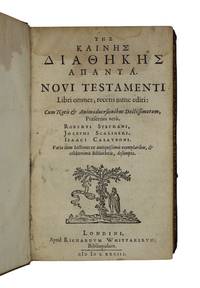
1633AQ26478Londini i.e. Leiden: Apud B. and A. Elzevir for Richardum Whittakerum 1633. 8 459pp 13. First four words of title transliterated from the Greek. Printed in double columns. Eighteenth-century gilt-tooled brick-red morocco. Lightly rubbed and marked. Early manuscript quotation in the original greek from Ephrem the Syrian to FFEP; in what appears to be the same hand as the ownership inscriptions 'Rob: Hawkesworth / His Book / 1709' to verso of title page and head of p.1. Preliminaries a little dampstained at head. Later armorial bookplate to FEP of the Gaddesden library with pencilled shelf marks to front blank fly-leaf. A Greek Testament printed at least in part at the Elzevir press for London bookseller Richard Whittaker fl.1618-49 with the device of the former on the title page. The text is near identical to the Elzevir's own second edition of the Greek New Testament printed the same year apart from as noted by Darlow and Moule 'four passages in three of which it adopts readings found in H. Stephanus' edition of 1576'. Richard Whittaker had previously printed an edition in 1622 with a different text though the same supplementary material appears here. The house of Elzevir reissued some copies under their own imprint in 1641. ESTC S90878 Darlow and Moule 4680 STC 2798.5. 8vo. Apud [B. and A. Elzevir for] Richardum Whittakerum unknown
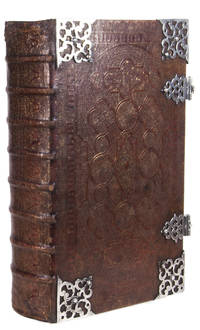
1663ABC_48446Leiden 1663. Large folio 44.5 x 28 cm. widow and heirs of Johannes Elzevier Contemporary elaborately gold-tooled red morocco over bevelled wooden boards sewn on 8 supports with corresponding raised bands on the spine with grand silver fittings with the hallmarks of an unknown silversmith dated on the inside of one of the clasps "1665" gold-tooled board edges and turn-ins. Further with gilt painted and elaborately gauffered and decorated edges; the fore edge shows the coat-of-arms of Jeremias de Bont with some floral decorations these floral decorations can also be found on the top and bottom edges. The boards show a very intricate gold-tooled symmetric design of ribbons with small geometric stamps and with ornamental curling stamps - better known as "petit fers" - within the different parts of the bigger pattern. The binding contains 4 ornamental corner pieces on each board and two catch plates front board and two hinge plates back board connected by two decorated massive silver clasps engraved on the inside "Ieremias de Bont top and "1665" bottom. With 3 letterpress title-pages the first in red and black and each with the same Elzevier woodcut tree device with non solus a complete series of 6 double-page engraved maps the Nicolaes Visscher maps 5 published ca. 1657 and including the world map added ca. 1663 without the engraved title-page as usual. Further with numerous woodcut initials and tailpieces. 3 parts in 1 volume. 22 "368" = 370; 13 "167" = 168; 2 77 ll. The first Dutch "States Bible" to be printed in roman type printed by the famous Leiden printers publishers and booksellers Elzevier. The present copy in the splendid binding was made for a high official within the Dutch Republic Jeremias de Bont. His family's coat-of-arms can be found on the gauffered painted and gilt fore edge and Jeremias' name is engraved in the inside of the top silver clasp the bottom one shows a date "Anno 1665". The "States Bible" is the first officially authorized translation of the Bible into Dutch the Statenvertaling commissioned during the Synod of Dordrecht 1618-1619. The States General of the United Provinces of the Netherlands were asked to pay for it hence its name. The translation was completed in 1635 and approved authorized and published in 1637 in Leiden. For the present 1663 edition the Elzeviers followed the text of the 1657 revised and corrected edition. In a sense it could be seen as a revolutionary publication even though it still is an authorised version of the Bible; the present copy contains the live signature of a Leiden city clerk - as usual - to indicate its authorization. The decision to set the main text in roman type rather than the conventional gothic textura was unprecedented in such publications and not only contributed to the spread of roman type in Dutch-language printed matter generally works in Latin were often set in roman more than a century earlier but also contributed to the prolonged popularity of the authorised translation itself and of the present edition.The present copy is illustrated with 6 double-page maps published by Nicolaes Visscher; this series includes 5 maps of Jerusalem and the Holy Land published ca. 1657 and 1 world map published ca. 1663 as usual all in their first state.Jeremias de Bont -1687 was 17th-century politician in the Dutch Republic. He was a member of the "Vroedschap van Gorinchem" in/since 1674 city council of Gorinchem in the present-day province of South Holland burgomaster in Gorinchem in 1679 and 1681-1683 and member of the Dutch "Raad van State" Council of State of Holland on behalf of the city of Gorinchem.We thank dr. J. Storm van Leeuwen for his in-depth analysis of the present binding. Through his findings we know that the present binding is contemporary to the work 1663 and judging by the style of the decorations possibly produced by a German binder in the Netherlands Amsterdam or The Hague. In his research Storm van Leeuwen came across 3 other bindings in the same style and all produced around the 1660s. These bindings cannot be ascribed to a hitherto known 17th-century Dutch bindery thus - for ease of reference - Storm van Leeuwen named the bindery after the present binding: "De-Bont Binderij".With the signature of J. van der Werve a city clerk below the coat of arms of the city of Leiden on the verso of the first title-page below the privileges. The binding shows slight signs of wear browned and foxed throughout the edges are slightly dust-soiled but still showing the highly detailed decorations. Without the engraved title-page as usual. Otherwise in good condition a splendidly bound copy for Jeremias de Bont of the famous Elzevier Dutch States Bible.l Bijbel tentoonstelling statenvertaling Amsterdam 1937 105; Darlow & Moule II 3321; Delaveau & Hillard Bibles imprimées 1200; Le Long Boekzaal der Nederduytsche Bybel p. 821; STCN 840822693; Willems 884; for the maps: Poortman & Augusteijn Kaarten in Bijbels 27-pp. 179-185; for Jeremias de Bont and his positions within Gorinchem: C. van Zomeren Beschryvinge der stadt van Gorinchem en landen van Arkel Gorinchem Teunis Horneer 1755; for the De Bont family: De Nederlandsche Leeuw 40 1992 cols 121-122 "Bondt de". ABE CAT Bibles Sermons & Psalmbooks hardcover
16632167Leiden: widow and heirs of Johannes Elzevier 1663. Richly gold-tooled black goatskin morocco ca. 1725 over bevelled wooden boards sewn on 6 double cords each board with a double frame cornerpieces and large lozenge centrepiece all built up from hundreds of impressions of about 40 tools including a birds-in-vines roll for the inner frame with large built-up cornerpieces inside and smaller ones outside the centrepiece with a quartered square central field each quarter with a courant running stag and with a small 6-pointed sun with a face in the centre each of the 7 spine compartments with a double frame of double fillets with small fleurs-de-lis as cornerpieces the 2nd and 3rd with the title and volume number and each of the others with a centrepiece 4 cornerpieces and 2 small fleurs-de-lis; richly gold-tooled turn-ins gilt edges headbands in yellow and reddish-gold the so-called STAG BINDERY Rotterdam. From the collection of Hendrik Adriaan or Hendricus Hadrianus vander Marck ca. 1667-1726. Large folio 44.5 x 28 cm. The Elzevier Bible with an engraved allegorical frontispiece 3 letterpress title pages the general title page in red and black the others for the New Testament and Apocrypha each with the same Elzevier woodcut tree device Rahir M. 9. Picart's wholly engraved print-Bible with an allegorical frontispiece a half-title and 209 finely engraved Bible scenes 29 double-page by Gerard Hoet Bernard Picart etc. Further with a series of 6 double-page engraved plates namely 5 maps plus a plan of Jerusalem all by Nicolaas I Visscher. Below the privilege from the city of Leiden the city secretarys clerk Jacob vander Werve has authenticated the book by stamping the Leiden coat of arms and signing his name below it. 3 volumes bound as 2 with the prints and maps bound in. The famous and magnificent 1663 Elsevier edition of the 1637 authorized Dutch States translation of the Bible Old and New Testament plus the Apocrypha the only early edition of the Dutch States translation with the text in roman type instead of the traditional textura gothic. With Picart's folio print-Bible Figures de la Bible 1720 the most sumptuous pictorial bible published in the Netherlands here in the rare first edition published by the artist himself and the series of 6 maps and plans by Nicolaas I Visscher 1618-1679. The prints and maps are inserted in the relevant places in the Old Testament New Testament and Apocrypha with the New Testament and Apocrypha bound together to make the second volume. The whole is most luxuriously and splendidly produced and bound by the so-called "stag bindery" active in Rotterdam at least 1693-1743 the most important eighteenth-century bindery in Rotterdam and . one of the most distinguished Dutch workshops in the first half of that century Storm van Leeuwen IIA p. 432. A truly unique piece combining the best of all aspects of Dutch book production Elzevier's printing excellent presswork Picart's engravings and a binding by a Rotterdam workshop undoubtedly the equal of Magnus.Storm van Leeuwen notes that the book comes from the library of the great Dutch book collector Hendrik Adriaan vander Marck ca. 1667-1726 though we do not find it in the 1727 auction catalogue of his library. It descended to the Tjeenk Willink collection. In very good condition with some of the inserted prints and maps slightly browned and an occasional minor marginal defect. The bindings with a few minor scratches a few scuffs on the board edges and the spines slightly worn but still very good most of the tooling fine. Magnificent set complete with the two integral blank leaves.l Biblia sacra 1663.B.dut.JElwidandheirs.a; Bijbel-tentoonstelling 1914 no. 653; Darlow & Moule 3321; Poortman Bijbel en prent I p. 154; Rahir 885; STCN 840822693; Willems 884; for the print-Bible: Poortman II pp. 140-145; STCN 274059983 4 copies; for the maps: Poortman & Augusteijn chapter 27 maps 118-123; for the binding: Jan Storm van Leeuwen Dutch decorated bookbinding L805 & vol. IIA p. 433 438 ill. fig. 178. widow and heirs of Johannes Elzevier, hardcover
16603641Amsterdam: widow of Paulus Aertsz. van Ravesteyn 1660. 18th-century black so-called sharkskin over bevelled wooden boards ca. 1770 sewn on 8 double supports with 8 large silver corner-pieces and 2 large silver clasps with catchplates and anchorplates all with matching stamped relief decoration scallop shells/fans scrollwork and fields of suares with crosses at the intersections or diamonds with 's at the intersections gilt and gauffered edges. The silver furnishings bear Amsterdam city hallmarks with year letter C crown above XXX above C and master's mark DF. Rebacked with most of the original backstrip mounted on the spine. Large folio 47.5 x 32 cm. With an integral engraved general title page architectural portico with a book above illuminated by the sun the crowned arms of the States General below and a large biblical scene at the foot: Elijah and the ravens alluding to Van Ravesteyn's name 2 letterpress title pages for the New Testament and Apocrypha each with Van Ravesteyn's woodcut device Elijah and the ravens a divisional title for the Prophets 6 double-page engraved maps by Nicolaas Visscher I including a world map and a plan of Jerusalem and 336 Bible-illustrations 6.5 x 10 cm by Claes Jansz. Visscher after Matthäus Merian on 42 numbered single-page plates plate size 35 x 24 cm with 8 illustrations per plate. Further with 9 woodcut tailpieces one at the end with a different Van Ravesteyn device inserted in the middle plus dozens of repeats about 50 woodcut decorated initials at least 8 series the 36 mm series opening most books of the Bible having 2 different blocks for at least some letters plus more than a hundred repeats. Set in textura types with incidental roman. The maps and illustrations coloured by an early hand with extensive use of gold. 3 parts in 1 volume. Extra-illustrated large folio edition of the Dutch Statenbijbel States Bible with 6 maps and 336 illustrations hand-coloured the translation officially authorized by the Dutch Reformed Church and published with a privilege from the States General of the Dutch Republic. The 1619 Synod of Dordrecht established a committee to prepare the new translation and leading Dutch scholars worked on it for nearly twenty years before Paulus Aertsz. van Ravesteyn ca. 1586-1655 published the first edition in 1637. The 6 maps and the engraved illustrations were produced to be inserted into Van Ravesteyn's folio editions. The series of 336 illustrations by Claes Jansz. Visscher with eight to one leaf are engraved by Cornelis Danckerts. With some browning but still generally in good condition and with large margins. The binding has been rebacked as noted and the "sharkskin" on the boards has some cracks and wear but the silver furnishings and gauffered edges are well-preserved. A stunning large States Bible with 6 maps and 336 illustrations coloured by an early hand with extensive gold.l Poortman Bijbel en prent I p. 233 cf. pp. 147 151; STCN 094500975 9 copies; cf. Darlow & Moule 3315 1657 ed.; for the maps: Poortman & Augusteijn 27.1-6 all in first states; the prints not in Hollstein; Poortman Bijbel en prent; for the zilver furnishings: Voet Amst. zilversmeden 448-449. widow of Paulus Aertsz. van Ravesteyn, hardcover