(BINDINGS - PEASANT). BIBLE IN GERMANBiblio.com

6 582 résultats
1768ST12938Zurich: David Gessner 1768. 169 x 94 mm. 6 1/2 x 3 3/4". 272 64 214 of 215 pp. <br/> CONTEMPORARY PAINTED AND BLIND-TOOLED VELLUM DECORATED IN AN ELABORATE AND QUAINT STYLE covers with black and red starburst at center in a lobed red and green frame stamped with stars and tulips yellow cornerpieces stamped with a floral design smooth spine painted red and tooled in blind with flowers Dutch gilded endpapers all edges gilt. ◆Covers faintly soiled extremities lightly rubbed one leaf with two-inch portion torn away at fore margin costing small parts of five closely spaced staves of music occasional foxing of no great consequence; with some serious condition issues internally but an extremely pleasing example of a binding representing German folk art of the period.<br/> <br/> Although lacking the final leaf of text this volume is of considerable interest as an expertly made and decorated so-called "Peasant Binding" a colorful binding style that began in Hungary and spread through Germany the Netherlands and Scandinavia in the 18th century. The use of the word "peasant" in this context is a reference to the obvious influence of folk art on this decoration rather than to the clientele for which it was intended. Bibles prayer books and hymnals in the brightly painted and exuberantly decorated vellum bindings were popular wedding gifts among the bourgeoisie who were both literate and sufficiently affluent to afford such luxuries. David Gessner unknown
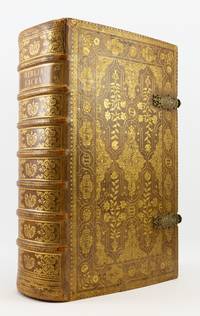
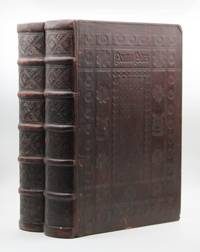
1768ST19422Nuremberg: Johann Andrea Endterischen 1768. 460 x 295 mm. 18 1/4 x 11 1/2". 17 p.l. 11 48 2 2 3-8 3 9-190 2 191-740 pp.; 512 pp.; 2 2 3-190 2 191-480 18 pp. Three parts bound in one volume. <br/> STRIKING CONTEMPORARY SMOOTH CALF LAVISHLY GILT in the entrelac style covers with frame and compartments formed by gilt-ruled strapwork and filled with floral designs and lace-like ornaments of massed volutes and small tools raised bands spine compartments with central bouquet of pomegranate and flowers with massed floral tools on either side gilt lettering brass clasps featuring images of King David and St. Paul gilt-tooled turn-ins marbled endpapers all edges gilt and gauffered with pomegranates and flowers older repair to front joint alongside top compartment. Extra engraved title page woodcut headpieces and historiated initials 47 engraved plates comprised of: copperplate portraits of Luther and 11 Electors; 11 section titles each with 11 vignettes; nine full-page engraved depictions of Moses the Prophets and the Evangelists; seven full-page plates engraved with 12 vignettes six double-page maps and two double-page engravings. Front pastedown with ornate heart-shaped bookplate of Adam Melchior Dæumer dated 1784. ◆Two-inch crack to head of rear joint a bit of rubbing to joints and extremities a handful of quite minor dark spots to boards isolated trivial smudges or stains internally other insignificant imperfections but still a fine specimen--THE CONTENTS EXCEPTIONALLY CLEAN BRIGHT AND FRESH and the remarkable binding entirely solid and bright with gilt.<br/> <br/> This is an especially pleasing copy of the last and most extensive edition of the very popular and sumptuously illustrated Weimar Electors' Bible offered here in an impressive contemporary binding. Known as the "Kurfürstenbibel" because of its portraits of the Electoral Princes called "Kurfürsten" in German it was originally prepared for Ernst I Duke of Saxe-Gotha and Altenburg as a celebration of Martin Luther's Bible translation. Editions were issued by the Endters one of the prominent German printing families beginning in 1641. In addition to portraits of Luther and the Protestant princes of Germany the present edition contains the maps views and illustrated half-titles by Jacob van Sandrart and others first used in the edition of 1686. Our copy contains four maps and views not found in other copies of this edition showing the eastern Mediterranean and Palestine as well as both a map and a view of Jerusalem. The size of our volume puts a great strain on the binding which has nevertheless stood the test of time remarkably well. The overall decoration is exuberant the delicate gauffering lovely and the original straps remarkably well preserved. Johann Andrea Endterischen unknown
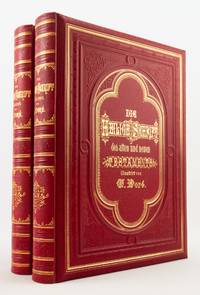
1877ST20670Stuttgart: Edward Hallberger ca. 1877. Fourth Edition. 430 x 315 mm. 16 3/4 x 12 1/4". Two volumes. Translated into German by Dr. Joseph Franz Allioli. <br/> PUBLISHER'S SPLENDID RED CLOTH VERY ELABORATELY STAMPED IN GILT AND BLIND covers with bevelled edges thick and thin gilt-rule border enclosing ornate blind-stamped frame large central oval containing a lobed gilt frame with gilt lettering inside spine divided into blind-stamped panels by decorative and plain gilt rules two large panels with gilt lettering and volume number original cloth hinges white moiré paper endpapers all edges gilt. IN THE ORIGINAL PRINTED GRAY DUST JACKETS jacket of second volume with small very expert repairs at bottom and the original black cardboard clamshell boxes solidly reinforced with black tape. WITH 230 DRAMATIC PLATES BY GUSTAVE DORÉ. Volume I with four leaves for recording family members marriages births and deaths each with a decorative frame all unused. Malan "Doré" p. 85. Isolated spots of minor foxing due to paper content one cover of the very rarely seen dust jackets with red offsetting from the frame on the cover but AN UNSURPASSABLE COPY--clean fresh and bright internally the bindings and jackets IN SPARKLING CONDITION.<br/> <br/> This is a time-capsule copy of perhaps the most popular illustrated Bible ever issued and one of the very few Bibles which has always been known by the name of its illustrator. According to his biographer the artist was excited by the "almost endless series of intensely dramatic events" he would get to portray; the results originally created for the 1866 Grand Bible of Tours are so evocative that the critic Bouchot called them "the terror of frail readers." Doré 1832-83 makes remarkable use of light shadow and composition to convey the full range of splendor horror pathos and ecstasy contained in the Scriptures. Because he was so prolific it is estimated that he made more than 100000 designs in his lifetime Doré inevitably had his detractors but Ray says simply that he was "one of the greatest of all illustrators." Taine says that "every imagination appeared languid in comparison with his. For energy force superabundance originality sparkle and gloomy grandeur I know of only one equal to his--that of Tintoretto." The Doré Bible was translated into at least 24 languages; ours is the German version by Catholic theologian Joseph Franz Allioli 1793-1873. According to Malan "The Roman Catholic Church has never diminished its praise of these illustrations." And these illustrations endured in many Catholic and Protestant Bibles especially during the last third of the 19th century but actually until the present. The Bible was such a cultural phenomenon that Mark Twain even mentioned it in “Tom Sawyer†as a motivating prize for students to learn Scripture. The Bible’s success prompted Doré to reinterpret his illustrations in huge paintings that were displayed at Doré Gallery in London. Malan says that the exhibition “was considered the greatest collection of religious paintings in the world." The boxes that were issued with our set have clearly weathered some blows over the years but they did their job perfectly as the volumes they protected hardly seem to have been opened in their lifetime and their dust jackets even considering the minor repair are also in a breathtaking state of preservation. Edward Hallberger unknown
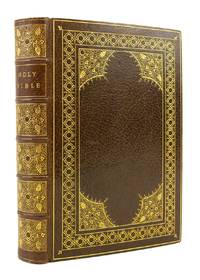
1890ST16866bCambridge: Printed by C. J. Clay & Sons at the University Press ca. 1890. 203 x 133 mm. 8 x 5 3/8". 998 pp. <br/> MOST ATTRACTIVE HAZEL BROWN CRUSHED MOROCCO GILT BY STOAKLEY LATE HAWES stamp-signed on verso of front free endpaper covers framed by gilt rules and guilloche tooling central panel with delicately tooled cornerpieces featuring grapevines on a stippled background raised bands spine compartments densely gilt with grapevine motif turn-ins with richly gilt frame leather hinges all edges gilt gutter at front flyleaf expertly reinforced with tissue. With presentation inscription on front flyleaf: "Herbert Gardner Travers / from his Godmother / A. S. Burn / August 1891"; below this the ink-inscribed record of the recipient's marriage and the births of his children. Spine gently and uniformly sunned a shade lighter two hardly noticeable small abrasions to rear cover offsetting from turn-ins to free endpapers as almost always but still a fine copy in a remarkably handsome binding with few signs of use.<br/> <br/> The appealing binding on this treasured family Bible was created in Cambridge by Vere Stoakley who took over the workshop of J. Hawes on that craftsman's death in the late 1880s; he signed his work "Stoakley Late Hawes" to acknowledge this connection. The firm specialized in academic bindings to supply scholars from the university and continued in business until the 1920s. The present binding clearly is much more elaborate and beautiful than a simple scholar's binding and this is because it was a special gift presented to a beloved godson probably for his christening. Recipient Herbert Gardner Travers 1891-1958 grew up to be a decorated World War I flying ace who was awarded the Distinguished Service Cross for his five aerial victories. After the Great War he worked in the airplane industry as a test pilot and flying instructor then became a commercial pilot in 1935. He returned to the Royal Air Force at the outset of World War II and was an acting squadron leader. As recorded on the flyleaf of his Bible he married Hermia Edith Margaretta Fraser in August 1919 and over the next 12 years they welcomed children Daphne 1920 Eva 1921 Elizabeth 1924 Christina 1926 and Edward 1931. Printed by C. J. Clay & Sons at the University Press unknown
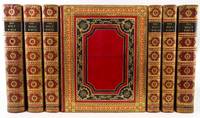
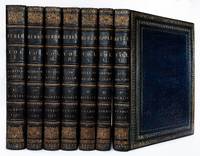
1800ST20221aLondon: T. Bensley for T. Macklin final volume Bensley for T. Cadell & W. Davies 1800 for the six volumes of the Bible 1816 for the Apocrypha. First Printing of this Edition. 480 x 385 mm. 19 x 15 1/8". One leaf in the Apocrypha 3P2 comprising two prologues of Ecclesiasticus invisibly inserted from another copy. Seven volumes comprising the regular Bible in six volumes and the Apocrypha usually not included as a seventh volume. <br/> ABSOLUTELY MAGNIFICENT CONTEMPORARY RED NEOCLASSICAL-STYLE STRAIGHT-GRAIN MOROCCO SUMPTUOUSLY GILT AND ONLAID WITH BLUE BY GEORG FRIEDRICH KRAUSS done for Prince Albert Casimir Duke of Saxe-Teschen with repeated "AST" monogram covers with very elaborate frames incorporating 11 plain and decorative gilt rules four onlaid borders of blue morocco and very elegant swirling foliate ornamentation around the central scalloped panel six pairs of raised bands each pair flanking a recessed gilt and blue metope and pentaglyph rule very handsome spine compartments with blue fan-shaped cornerpieces and central gilt-decorated blue medallions within sunburst gilt collars turn-ins with Greek key pattern in gilt striking endleaves of turquoise and green watered silk the Apochrypha endleaves slightly different. With more than 100 allegorical headpieces and tailpieces and some 70 SPLENDID LARGE-FOLIO-SIZE COPPER PLATES after Fuseli Reynolds West and others most plates printed before letters. Tissue guards perhaps later. Herbert 1442 and 1651. First volume with about 30 leaves noticeably foxed the majority of plates offset onto previous and following pages consistent inoffensive offsetting of text on facing pages other trivial imperfections but still a very impressive copy internally with the luxurious paper used for the text both fresh and clean and the engravings richly impressed and with very little foxing. Some unimportant scuffing and rubbing to the leather but all defects minor THE MAGNIFICENT BINDINGS REMARKABLY WELL PRESERVED the heavy volumes completely solid with only insignificant signs of use and THE MOROCCO AND LAVISHLY GILT DECORATION EXTREMELY BRIGHT. AN ALTOGETHER MEMORABLE COPY.<br/> <br/> The most prodigious form of Scripture in English ever published the Macklin Bible was often put into ornate bindings especially by London binders like Staggemeier and his contemporaries. But however much other sets may glisten the present magnificent example surely stands at or near the front of the line as one of the most lavishly decorated and arresting copies in existence. Its decorative extravagance also testifies to the fact that Macklin's publication was sufficiently admired outside of England to warrant the finest workmanship and the expenditure of great sums of money on artistic resources. The very large and bold type the fine Whatman paper and the series of engravings by some of the most celebrated artists of the period make this an item that is already very desirable. Like the Boydell "Shakespeare Gallery" also printed by Bensley our Macklin Bible is a vast picture book with illustrations that are grand both in size and emotional impact. But it is of course the bindings here that matter the most. Francesco Piranesi is generally given credit for inventing the Neoclassical style when he designed volumes presented to Gustavus III of Sweden during this monarch's visit to Rome in 1783-84. Quickly popular the Neoclassical style was imitated and developed by Staggemeier & Welcher in London by F. W. Standlander in Stockholm and by Georg Friedrich Krauss in Vienna. Krauss was the most prominent Continental binder working in this style of the day and Saxe-Teschen was perhaps his most important client. Products of the Krauss bindery have passed through some of the most distinguished collections over the years particularly those of Fürstenberg and Schäfer; and his bindings have consistently brought remarkable sums of money at auction. It is sufficient to say that the present group of bindings represents the most impressive collection of decorative volumes we have ever offered for sale. The collector for whom these bindings were originally executed Duke Albert of Saxe-Teschen 1738-1822 was the son of Friedrich August II of Saxony and the son-in-law of the empress Maria Theresa. After providing important military and civil service to the Habsburg empire he retired to Vienna in 1795 and afterward devoted himself to the fine arts. He founded the Albertina which now houses the greatest collection of prints in the world and he put together a great library distinguished by the highest taste and most exacting standards. The present copy has the additional distinction of containing what amounts to an extra volume: the Macklin Bible however it is bound most often appears in the marketplace without the Apocrypha appearing here as Volume VII which was not issued until 16 years after the others. It is also of some interest that the bindings of our seven volumes were decorated in an entirely uniform fashion as a close inspection shows something not typical of a set with volumes published so many years apart. The non-uniform endleaves in the final volume here may have resulted from the fact that given the physical size of the books the binder simply ran out of the cloth he had used for lining the first six volumes. The present set was offered though unsold at Sotheby's in 2003 with an estimate of £40-50000 approximately $64000-80000 and in 2005 for £30-40000 approximately $54000-72000. T. Bensley for T. Macklin [final volume Bensley for T. Cadell & W. Davies] unknown
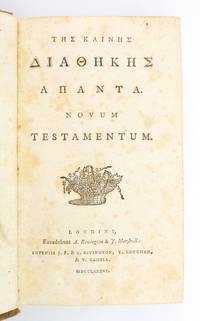
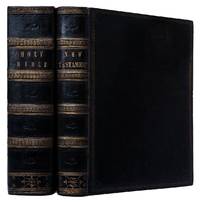
1786ST20133London: Excudebant A. Rivington & J. Marshall: Impensis J. F. & C. Rivington T. Longman & T. Cadell 1786. 175 x 105 mm. 7 x 4 1/4". 368 pp. 1 leaf ads. <br/> Contemporary brown "school cloth" rough linen raised bands. Front flyleaf with owner inscription of John Cutler dated Sept 21 1789 four lines of Latin doggerel threatening anyone who steals the book with hanging and two large copperplate trials of Cutler's signature. ESTC N63834. Not in Darlow & Moule. A little fraying at top and bottom of joints light foxing and toning throughout due to paper quality a couple of small ink stains but a surprisingly appealing copy the text extremely clean and the unsophisticated makeshift binding--remarkably--with no significant wear.<br/> <br/> This is an almost startling survival: an 18th century New Testament in Greek in its original utilitarian binding preserved in condition far better than what could be anticipated given the audience of generally uncareful pupils for which it was intended. Considering the usual depredations of school children the rough school cloth should have been worn to shreds long ago but against the odds it has fortuitously escaped hard use and now gives us a glimpse of an important element of the English schoolroom very close to its original condition. One particularly delightful aspect of our copy is the flamboyant declaration of ownership by a pupil called John Cutter who inked his name no fewer than four times in different styles and with calligraphic flourishes across the flyleaf. Cutter's neatly penned book curse threating any would-be thieves with hanging may have helped to preserve the book as it now exists. In fact there are few signs of use by any owner rightful or unlawful. The leaves are free from any markings and the insubstantial binding appears to have rarely left the shelf. Excudebant A. Rivington & J. Marshall: Impensis J. F. & C. Rivington, T. Longman, & T. Cadell unknown
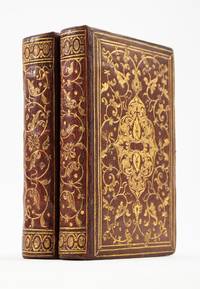
1568ST20921Lutetia Paris: Robert Estienne II 1568. 128 x 87 mm. 5 x 3 1/2". Two volumes. <br/> LOVELY CONTEMPORARY RED MOROCCO GILT covers with large central azured arabesque surrounded by curling vines with azured leaves smooth spines with similar vines head and foot of spines with egg-and-dart roll similar to one used by Claude de Picques second volume with faint blind lettering to spine all edges gilt perhaps with some minor early restorations but if so then done with such care as to preclude certainty. Housed in modern suede-lined calf-backed clamshell boxes with magnetic closures. Printer's device on titles and final page decorative initials and headpieces. Front pastedown of volume I with ex-libris of Georgios Arvanitidis. Renouard 171:1; Schreiber 239; Darlow & Moule 4633; Adams B-1670. See: Verron "Les Reliures de l'Entrée de Charles IX à Paris 1572 . . . réalisées par Claude Picques" in Bulletin du Bibliophile 2014 no. 2 pp. 282-98. Just a touch of rubbing to extremities front hinge of second volume open but everything quite tight text with occasional mild browning small spots trivial smudges or tiny worm trails but A BEAUTIFUL COPY clean and fresh internally and the bindings tight and lustrous with very bright gilt<br/> <br/> With exceptional visual appeal these two precious volumes shining with gilt and containing the Greek New Testament from the renowned Estienne family of printers are of special interest because of their typography their bindings and their provenance. With the expressed goal of printing Greek texts from manuscripts in the royal library at Fontainebleau François I established the post of royal printer in Greek in 1539 appointed Robert Estienne I 1503-59 to the position in 1542 and commissioned the renowned Claude Garamond to cut a new Greek font for this project. To design the type the King called on his own celebrated calligrapher Angelo Vergecio who produced in collaboration with Garamond three different sizes of what came to be called the Royal Types or "grecs du roi." According to Schreiber "These cursive Greek types are universally acknowledged as the finest ever cut." In 1548 and 1549 Robert Estienne issued the press' first Greek Testament known as the "O mirificam" edition for the opening of the dedication to the king in 16mo or "pocket" format using the smaller font of Garamond's "grecs du roi." In 1550 Robert a Protestant moved to Geneva while his son Robert II 1533-70 a Catholic remained in Paris and took over as the royal printer in Greek. Our 1568 Testament--the only one issued by the son--is a reprinting of the "O mirificam" edition but expanded with the critical apparatus from the 1550 folio edition issued by the father. Schreiber notes that our edition is interesting from a typographical point of view as it contains an even more minute version of the already small grecs du roi type for the Table of Chapters. The exceptionally pretty volumes are done in the style of royal binder Claude Picques fl. 1539-78 and employ a decorative roll very similar to one that appears on the spine of the vellum bindings Picques did for "L'Entrée de Charles IX à Paris" 1572. Our volumes once graced the library of Constantinople collector Georgios Arvanitidis 1876-1953 whose library included a number of Estienne Greek editions. They were later in the distinguished library of Frederick B. Adams 1910-2001 director of the Pierpont Morgan Library from 1948-69 and then president of the prestigious Association Internationale de Bibliophilie from 1974-83. And they were featured in the celebrated 1929 Gumuchian catalogue of 398 historically exceptional bindings as item #71. Robert Estienne II unknown
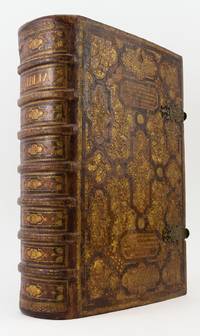
1720ST19425Nuremberg: J. A. Endter 1720. 433 x 278mm. 17 x 11". 68 p.l. first blank 1-664 1-904 pp. 8 leaves. <br/> ONCE SPECTACULAR AND STILL REMARKABLY IMPRESSIVE CONTEMPORARY GERMAN CALF ELABORATELY GILT WITH A PAINTED BROWN STRAPWORK DESIGN OVER REVERSE BEVELLED WOODEN BOARDS two cartouches on each cover with four- or five-line quotations from the Bible initials "J A B" and "D B" and the date "1726" on upper cover the strapwork forming geometric compartments filled with gilt foliate and floral sprays accented with small putti raised bands spine gilt in compartments with central strapwork lozenge containing gilt flower surrounded by foliage two brass and probably later leather clasps dramatic endpapers of green and gilt decorated paper edges gilt and gauffered in ornate lily pattern some expert restoration at spine ends and at top and bottom of joints. With woodcut initials and tailpieces additional engraved title page 11 engraved portraits of the Dukes of Saxony engraved portrait of Luther by Kilian after Sandrart missing an additional portrait of Luther and 28 engraved plates and plans seven of them double-page. ◆Paint and gilt somewhat rubbed other signs of use to the binding but the once-magnificent binding quite sound and still very very striking. Occasional minor foxing stains and thumbing N5 with five-inch curving tear into text no loss two plates with old six- to seven-inch tears into image one mended on verso with discolored cellotape a handful of other minor tears but still a pleasing copy internally generally quite clean and fresh.<br/> <br/> At 5 1/4" thick and with a lavish overall decorative design this is a memorable specimen of a German post-fanfare binding very likely produced as a wedding gift for the couple whose initials appear on the cover. Support for this supposition resides in the binding's quotations from German Scripture traditionally used at Lutheran weddings: Genesis 2:18 "And the Lord God said It is not good that the man should be alone; I will make him a helpmeet for him" and Colossians 3:14 "But above all these things clothe yourselves in love which is the bond of perfection". A perfect family Bible for a young couple of high degree this handsomely illustrated edition is known as the "Kurfürstenbibel" because of its portraits of the Electoral Princes called "Kurfürsten" in German. Such a Bible was originally prepared for Ernst I Duke of Saxe-Gotha and Altenburg as a celebration of Martin Luther's Bible translation. The Endters one of the prominent German printing families issued several printings of it beginning in 1641 and continuing to the end of the 18th century. In addition to portraits of Luther and the Protestant princes of Germany it contains the maps views and illustrated half-titles by Jacob van Sandrart and others first used in the edition of 1686. Although it bears some small signs of use the binding remains an object of imposing beauty. J. A. Endter unknown
19520083231New York: A. Colish 1952. Limited ed. Hardcover. Very Good/Slipcase. Signed by the printer A. Colish on the front blank. Number 108 450 copies. 1952. Hardcover slim 12mo. red leather gilt title. Very Good in original slipcase. Leather scuffed at spine ends hinges and raised bands. Ownership stamp of calligrapher Arnold Bank on the front blank above author's inscription; slim horizontal abrasion to front pastedown from bookplate removal. Slipcase with slight loss to paper along openings; small piece of bottom panel missing; bottom panel expertly strengthened. A beautifully printed book. A. Colish hardcover
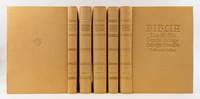
1926ST16973Munich: Bremer Presse 1926-28. ONE OF 365 COPIES. 360 x 250 mm. 14 1/4 x 10". Five volumes. Edited by Carl von Kraus. <br/> VERY FINE TAN MOROCCO BY WERNER G. KIEßIG stamp-signed with his "K" mark at foot of lower cover upper covers lettered in blind lower cover with small round book stamp of former owner Martin Wandersleb smooth spines divided into panels by blind rules blind-stamped titling marbled endpapers leather hinges top edges black other edges untrimmed. In the original brown dust jackets with paper title labels to spines. Housed in the original slightly worn matching marbled paper slipcases. With titles and initials drawn by Anna Simons. Front pastedown with bookplate of Martin Wandersleb. Eyssen 88; Ransom p. 257. ◆One or two faint spots of foxing one small marginal smudge but A CHOICE COPY with no signs of use inside or out.<br/> <br/> This is a superb copy of the signal achievement of the Bremer Presse in a restrained but impressive binding produced by Berlin master bookbinder Werner G. Kießig. Printed on Zander handmade paper with a typeface specially cut by Louis Hoell and initials designed by Anna Simons this set was issued to celebrate the 400th anniversary of the completion of the Lutheran Bible. Rodenberg tells us that this work had for years been the highest goal of the press and Eyssen proclaims "a better and more textually reliable re-creation of this national monument is hardly conceivable." Colin Franklin noted in "The Private Presses" that the Gutenberg Museum in Mainz described the Bremer Presse as "the Queen of the Private Presses." According to Ransom the press offered the Bible in three different bindings: in boards for $310 in vellum for $420 and in morocco for $470. Because she was a woman Anna Simons 1871-1951 was barred from studying at the Prussian Arts and Crafts School so she travelled to England to learn from Edward Johnston at the Royal College of Art. Johnston's biographer Priscilla Johnston writes "She was one of the best students Johnston ever had and certainly one of those who exercised the greatest influence afterwards for she disseminated his teaching throughout Germany where it was perhaps more fruitful even than in England." She designed some 1400 initials and title pages for the Bremer Press. <br /> <br /> Binder Werner G. Kießig 1924-2014 apprenticed with German master binder Kurt Grünewald and studied with Bruno Scheer before attaining the rank of Meister in 1948. Although he lived in East Germany for much of his career his status as a master craftsman afforded him more freedom than usual--to exhibit internationally and to join organizations like Meister der Einbandkunst MDE and Designer Bookbinders. He was the preferred bookbinder for volumes produced by Wolfram Benda's Bear Press. From the 1970s on Kießig signed his bindings with the stamp of a "K" in a stylized book designed by Herbert Prüget.<br /> <br /> Our bindings also bear the stamp of former owner Martin Wandersleb 1924-2005 designed by Otto Rohse. The bookplate designed for this bibliophile and theologian by the artist Gerhard Marcks is on the front pastedown. This set was also part of the collection of Hamburg collector Barbara Achilles d. 2010 who put together an impressive library of private press books. Bremer Presse unknown
1816052003London: British & Foreign Bible Society 1816. First Edition. Softcover. Fair Condition/No Dust Jacket. 8vo. Covers missing 1st and last pages little worn some age toning & light foxing but most pages are clean and tight. Inked inscription on title page "Presented to the Boston Athenaeum by Alden Bradford Esq. June 1817." Report is 70 pages followed by the Correspondence of 276 pages. Size: 8vo. xxiv 346 12. Quantity Available: 1. Shipped Weight: 2 pounds or less. Category: Religion & Theology; History. Pictures of this item not already displayed here available upon request. British & Foreign Bible Society paperback
1803BOOKS027294IPhiladelphia: Mathew Carey. Very good copy in full leather. 1803. 1st thus. leather. 4to 1077 72 pp. Printed by Thomas & George Palmer for Mathew Carey November 7th 1803 OT & July 25th 1803 NT Full title reads as follows: "The Holy Bible: Containing the Old and New Testaments: Together with the Apocrypha: Translated out of the Original Tongues and with the former translations diligently compared and revised By the Special Command of King James I of England. With Marginal Notes and References. To which are added an index; an alphabetical table of all the names in the Old and New Testaments with their significations; tables of Scripture weights measures and coins; John Brown's Concordance &c. &c. &c. Embellished with ten maps and twenty historical engravings." All maps &engravings present; frontsipiece folding map badly wrinkled torn & with an ink stain; text and plates with significant foxing. Title page torn horizontally across the middle of the page & with edge wear and a stain. Front board detached. Possibly missing blank pages at beginning & end. Bound in full brown leather; spine in six compartments with five raised bands and contrasting maroon leather title label . Mathew Carey hardcover
166954822London: Printed by His Majesties Printers 1669. Hardcover. Good. Two works the first in two parts small folio 30 by 18.5 cm. 273; 75 ff. Engraved collective title separate letterpress title for the Psalms half-title for The Form and Manner of Making. Bishops etc. calendar printed in red and black printed marginalia; full title for the metrical Psalms musical scores. Texts in black letter Gothic. Contemporary reversed calf suede expertly rebacked retaining original backstrip with new gilt morocco lettering piece. Marginal dampstain and erosion at 20 leaves with slight loss at fore-margin calendar leaf C4 recto; mild dampstain at top gutter in later leaves; library stamp at bottom margin leaves N2/N3 in the metrical Psalms. Good or better complete copies of both works.<br /> <br /> Early edition of what still remains the authoritative version of the Book of Common Prayer comprising the official liturgy of the Anglican Communion and other historically related Christian churches. The first prayer book published in the wake of the English Reformation appeared in 1549 during the reign of Edward VI. That work was revised in 1604 during the reign of James I and again in 1662 during the reign of Charles II. While revision and supplementation has continued into the present era the 1662 edition of which the present copy is essentially an early reprint remains authoritative as the official prayer book of the Church of England.<br /> <br /> Despite the discrepancy in dates which appear on the title pages of the present edition the Book of Common Prayer and the Psalms of David comprise a single publication as noted at the collective title and confirmed by the signatures. The metrical Psalms by Sternhold and Hopkins often bound with the Book of Common Prayer is a separate work. <br /> <br /> Provenance: Bookplate of the Royal Institution of South Wales noting the gift of Col. W.L.C. Morgan RE Bryn Briallu November 1898. Early owner's entry of "Alice: Jervoise" at top of contents leaf A2.<br /> <br /> Signatures: pi1 A-B6 C4 D6 E8 F-Z6 Aa-Xx6 Yy8 = 273 leaves / A-M6 N3 = 75 leaves. References: ESTC R36533; R172902.<br /> <br /> Full titles and imprints: 1 part 1 The Book of Common-Prayer And Administration Of the Sacraments And Other Rites & Ceremonies Of the Church According to the Use Of the Church of England Together with the Psalter or Pslams of David Pointed as they are to be Sung or Said in Churches: and the Form & Manner of Making Ordaining & Consecrating of Bishops Priests and Deacons. London: Printed by His Majesties Printers Cum Privilegio. MDCLXIX 1 part 2 - The Psalter or Psalms of David after the Translation of the Great Bible Pointed as they are to be Sung or Said in Chruches. London Printed by the Assigns of John Bill and Christopher Barker Printers to the Kings most Excellent Majesty. Anno Dom. 1676. 2 - The whole Book of Psalms. Collected into English Meeter By Thomas Sternhold John Hopkins and others: Conferred with the Hebrew with apt Notes to Sing them withall. London Printed by William Godbid and Andrew Clark for the Company of Stationers 1677. Printed by His Ma[jes]ties Printers hardcover
1807344244New York: Collins Perkins and Co 1807. Hardcover. Good. Second edition. Thick quarto. Complete as issued with separate title pages for the New Testament Ostervald's Notes and Brown's Concordance all dated 1806 10 illustrated plates and two folding maps. Contemporary full calf morocco spine label marbled endpapers. The binding is worn the front marbled free endpaper and two front fly leaves are detached else good or better with scattered foxing. An early Collins's Bible from New York with a six-page family record bound between the Old and New Testaments containing a manuscript genealogy of the Barber family spanning the years 1743-1836. John E. Barber was a banker from Massachusetts and member of the prominent Barber family of Norfolk County. The genealogy includes pencil notes by John E. Barber at the end of the record and on three sheets of stationary laid in. The record also includes members of the Carey Orne and Whiting families. According to a note laid in by Barber the Bible was found in the Carey House at Medway Massachusetts and it contains the oldest known record of the Barber family. Scarce with very pleasing illustrated plates and a notable provenance. Collins, Perkins, and Co hardcover
1790H4975Philadelphia & Berwick: Printed by and for John Taylor 1790. Hardcover. fair. Despite the general title page and the NT title page being Berwick/John Taylor extremely likely the Philadelphia printing with a cancel title page the first folio Bible and first illustrated Bible printed in the US. The bibliography on this is complex: the earliest copies were issued with a Philadelphia title page but as this came out in subscribed parts over the course of two years 1788-1790 those sent out before late May of 1790 would likely have had a Philadelphia title page and those sold after that date would have a false UK title page as does our copy; the Congressional rule called for strict oversight of the printing of any Bible in the United States to get around this the publishers of this Bible substituted a phony UK title page. This conforms to Hills no 16 The English Bible in America by Margaret Hills; see also Sabin 12929. Measuring 16.5 x 10.5 in original leather binding with red morocco spine label fair condition at best binding heavily worn boards detached and worn along edges contents good: minor institutional marks include bookplate withdawal stamps embossed stamp of institution in four places text good to very good has 28 plates including frontispiece. Toning and minor stains to pages contents generally very good. A few plates have marginal spotting and stains the plate of the Crucifixion has 3 inch repaired tear extending down into the margin but not the image and the frontispiece has two marginal tears quite reparable. Large chunk from the last plate in Acts taking away the top two inches of the upper right corner of the image. Contents generally good to very good as are the plates. We've done absolutely no repairs or restoration in order to give buyers the opportunity to bind it as they see fit. Housed in specially sized cardboard clamshell box. One of the great rarities in US Bible printing and a high point in early American printing. Printed by and for John Taylor hardcover
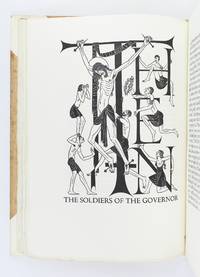
1931ST20201Waltham St. Lawrence: Golden Cockerel Press 1931. No. 352 OF 500 COPIES the first 12 on vellum. 343 x 241 mm. 13 1/2 x 9 1/2". 1 p.l. 268 2 pp 1 leaf colophon. <br/> Original white half pigskin and buckram sides by Sangorski & Sutcliffe stamp-signed on front pastedown raised bands top edge gilt other edges untrimmed. ILLUSTRATED THROUGHOUT with four large wood engravings on section titles and scores of striking large and small woodcut illustrations decorative elements and initials BY ERIC GILL. Printed on Batchelor handmade paper. The front pastedown with the engraved armorial bookplate of Albert and Constance Ramsay-Cohn the bookplate of Louis W. Black and the bookplate of "Downsland Court Ditchling Sussex." Chanticleer 78; A Century for the Century 26. Buckram boards somewhat freckled as usual very faint printer's smudges in one margin otherwise A VERY FINE COPY the pigskin--almost always found soiled and/or damaged--quite clean and pleasing and virtually pristine internally.<br/> <br/> This is an especially appealing copy of the chief work produced by one of the foremost English private presses. One of Eric Gill's outstanding achievements as an illustrator and one of the Golden Cockerel Press' great books the "Four Gospels" has been called by Franklin the finest of all private press books printed between the wars. The success of the work has much to do with Gill's ability to create a harmonious integration of woodcut illustration and typography his Golden Cockerel typeface one of the most important ever cut specifically for private use is introduced here. At the same time that the work achieves an aesthetic balance it also takes risks with the emotional nature of the woodcuts and with its unjustified page layout. As Franklin observes Gill's "pictures beautifully explain their letters as leaves spring from branches. This work is a wonderful extension of typography." Founded in 1920 with the intention to print fine editions of important well-known books as well as new literary works of merit from young authors the Golden Cockerel Press was purchased in 1924 by the illustrator and wood-engraver Robert Gibbings. "Under his direction" says Cave the Press was "transformed into the principal vehicle for the renaissance of wood-engraved book illustration" up until the beginning of World War II. In addition to doing wood engravings himself Gibbings employed a stable of eminent artists including among others Gill John Nash John Farleigh David Jones Eric Ravilious and Blair Hughes-Stanton. Our copy has been owned by two notable collectors and scholars of illustrated books. An early owner was British art historian Albert Mayer Cohn who wrote the catalogue raisonné of George Cruikshank's work. Later the volume passed into the hands of Boston collector Louis W. Black whose Aldine-related bookplate was designed by celebrated wood-engraver Leonard Baskin 1922-2000. Regarding the other bookplate here we have been unable to trace exactly who resided at Downsland Court in Ditchling but it is worth noting that Gill's Sussex artist's community was centered in Ditchling where he lived from 1907-24; it is certainly possible that our copy belonged to someone associated with this group. Golden Cockerel Press unknown
a66202Oxonii 1763 Typographeo Clarendoniano. Printed by John Baskerville. In Greek. Octavo 676pp. full leather with mounted leather spine label. Fairly Good front cover held on by binding string rear board cracked along outer hinge spine label chipped. Text bright and clean. Scarce Greek Bible in usable condition. . hardcover
1633005521Amsterdami: Guiljelmun Blaeu Willem Janszoon BLAEU 1571-1638 1633. Hardcover. Very Good. 32mo - over 4 - 5" tall. VG 1633. In full contemporary black boxed calf corners repaired. Rebacked retaining original spine raised bands no title. Internally engraved t.p. with allegorical figures of apostles and evangelists 2 3-454 pp 6 marbled endpapers ink names to ffep tp & versos Mau Vaughan. Ch Williams Wynne. Robert Grey. 10559 cms. signatures: A-2F6. Bibles Paris 3719; Bibelsammlung Stuttgart C245; Darlow & Moule 4681. A Greek Testament without preface or notes. "The editor according to Reuss must have taken as the basis of this text Beza's third major edition emending it in places by the help of other editions especially R. Stephanus' second edition" D. & M. Text not divided into verses but with verse numbers in the margin. <br/> <br/> Guiljelmun Blaeu (Willem Janszoon BLAEU 1571-1638) hardcover
1933ST15997Montgomeryshire Wales: Gregynog Press 1933. No. 37 OF 250 COPIES one of 110 in this binding accompanied by three additional plates on Japon EACH ONE OF 12 SIGNED BY THE ARTIST. 390 x 255 mm. 15 1/4 x 10". 15 leaves. <br/> Fine original dark slate blue Oasis morocco device in blind on front cover blind titling on front cover and spine. In the original paper slipcase somewhat worn and browned but sound. Wood engraved title with device and 21 wood engravings in the text five of them full-page chapter openings by Blair Hughes-Stanton and WITH THREE ORIGINAL SIGNED WOOD ENGRAVINGS ON JAPANESE VELLUM--"The Man Mourns I" 5/12 "The Man Mourns II" 4/12 and "Destruction" 5/12--attractively matted. Printed in blue and black on Japanese vellum; with an additional half-page engraving from chapter I laid in. Harrop 29; De Zilverdistel Cat. II 29; Hughes-Stanton 21. ◆A breath of fading to the spine negligible signs of wear to the binding but a fine copy with only trivial condition issues and the additional engravings pristine.<br/> <br/> This is in Harrop's words "one of the most spectacular books to come from this or any other press" our copy with the bonus of three limited edition wood engravings from the work signed by the artist. "Lamentations" was designed and illustrated by Blair Hughes-Stanton 1902-81 who studied at the school of Leon Underwood at Hammersmith and had a long and productive career producing sophisticated woodcuts as an avant-garde artist. Although he was encouraged to make his expressive sometimes even savage images look more like those of Eric Gill he resisted and successfully established his unique personal style as an illustrator. The three extra engravings here are excellent examples of his dramatic emotional technique; "The Man Mourns I and II" effectively convey overwhelming grief while "Destruction" inspires a feeling of impending doom. From 1930 through 1933 Hughes-Stanton worked for the Gregynog Press in Wales helping to design text layout providing woodcut illustrations and designing bindings. The press was founded in 1922 by two spinster sisters Gwendoline 1882-1951 and Margaret 1884-1963 Davies using a substantial inheritance from their industrialist grandfather; it produced 42 works between 1923 and 1942 eight of them in Welsh. Cave says that the books printed by the Gregynog Press "more than bear comparison with the work of any other private press" and "in the design and execution of bindings the Gregynog Press was far superior to any the Doves Press included.". Gregynog Press unknown
1914353913Leipzig: Insel Verlag 1914. No. 208 of 300 copies limitation leaf at end of each volume. Photolithographic facsimile of the 42-line Bible printed in colors with gilt ornamental incipit pages book headings and red and blue initials and headlines throughout. 2 vols. Folio. Publisher's full blindstamped brown calf after the original binding on the Fulda Landesbibliothek copy. Finely rebacked preserving original spines. No. 208 of 300 copies limitation leaf at end of each volume. Photolithographic facsimile of the 42-line Bible printed in colors with gilt ornamental incipit pages book headings and red and blue initials and headlines throughout. 2 vols. Folio. The first and finest facsimile of the great landmark of printing history the Gutenberg Bible reproduced from the Berlin copy now in the Universitätsbibliothek at Tubingen with some leaves in the first volume reproduced from the Landesbibliothek copy at Fulda. Insel Verlag unknown
170536556Amsterdam & Utrecht: H. Boom Joh. II van Waesberge Goethals Ger. Borstius Joh. Wolters Fr. Halma W. van de Water & W. Broedelet 1705. Third Edition . Hardcover - as published. Engraved title page in red & black plus four additional engraved title pages for each of the four parts into which the text is divided: 1 Genesis - Deuter.; 2 the Prophetae antiores; 3 the Prophetae posteriores; and 4 Hagiographa. Text is in Hebrew with the preliminaries and preface by van der Hooght & others as well as the printed marginalia in Latin. This is actually the third editon edited & revised by van der Hooght of the famous Hebrew Bible originally published by Joseph Athias in 1661. Thick octavo; a.e.g. Some light worming to end leaves pastedown & rear board; lacking rear front fly leaf & front rear fly leaf. Also first engraving detached. Spine is dry and rubbed along raised bands 5 panels with some light wear to edges & joints; head of spine is torn but without loss; rubbed label in 2nd panel present & readable; some worming at head of spine; small gouge on back board. A very nice internally clean tight copy of a scarce title. H. Boom, Joh. II van Waesberge, Goethals, Ger. Borstius, Joh. Wolters, Fr. Halma, W. van de Water, & W. Broedelet hardcover
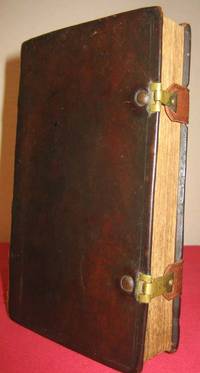
179534103Germantown PA: Michael Billmeyer 1795. Hardcover. 16mo. Original full calf with metal clasps and straps present and functional. 537pp 5pp. Overall very good. Binding a bit edgeworn but attractive; front/rear flyleaves are replacements; text block moderately age toned with mild occasional foxing. Tight and nice second printing of this noted "New Testament" entirely in German first published in 1787 issued from the press of the well-known Philadelphia printer 1752-1837. The printing office/home in which this was printed still stands today; it was built in 1730 purchased by Billmeyer in 1789 and is supposedly the site from which George Washington directed his Continental Army forces in the Battle of Germantown. When Billmeyer and his father-in-law set up their Lutheran press in the 1780s they acquired the surviving equipment of the renowned Philadelphia printer Christopher Saur Jr. whose press the British had destroyed in 1777. The straps are perhaps not original but all brass clasp parts are original and handsome -- and it still clicks firmly closed. Despite mild wear an exceptional copy. Michael Billmeyer hardcover
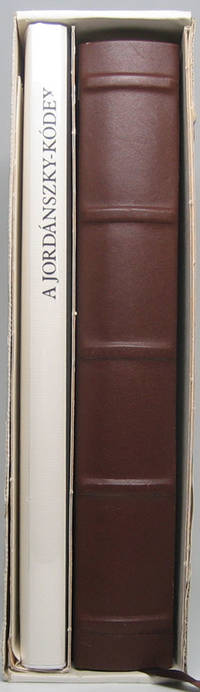
198449312Budapest: Helikon Kiado 1984. Hardcover. 4to. Full brown blind-embossed calf with raised bands and with ornate brass cornerpieces centerpieces and clasps. Ca. 400pp. Extensive full-color illustrations and marbled endpapers sewn-in brown satin page marker. Near fine. Housed in as-issued rustic white cardboard slipcase with large color pictorial label. Very good. Handsome full facsimile of this medieval illuminated manuscript of circa 1516-1519 the earliest surviving translation of the Bible into Hungarian named after an 18th century bishop who owned the manuscript. Rediscovered in recent centuries in three parts and eventually reunited the complete manuscript today resides in the Basilica at Esztergom Hungary. Also housed in this slipcase as issued is the volume "A Jordánszky-Kódex: Magyar Nyelvu Bibliafordítás a XVI. Század Elejérol 1516-1519: Az Esztergomi Foszékesegyházi Könyvtárban orzött Mss. II. 1 Jelzetu Kódex Szövegének Olvasata" a 4to volume cream paper over boards with gilt lettering in pictorial dust jacket of 237pp containing the text of the Jorandszky Codex. Laid into this are two fine small 8vo explanatory pamphlets 18pp 34pp by Csapodi Csaba. Helikon Kiado hardcover
63481London and New York: The London Printing and Publishing Company Limited c.1860. Two vols. Folio. 364x 24cm. titlepp.4xxviiimisboundxxiv1144; title460167Apocrypha461--524xxxii. Contemporary full black calf with ticket of Geo. Harrison Binder and Paper Ruler of West Hartlepool sides with greek key gilt borders spines with gilt greek key decorated raised bands marbled endpapers a.e.g. Profusely illustrated including engraved frontispieces and title pages numerous full page steel engravings and three folding maps. Family Register of George and Isabella Graainger of West Hartlepool to June 1867. Marginal dampstain to prelim. 2 leaves of vol.2 New Testament binding a little scuffed occasional spotting etc. to contents generally very good. London and New York: The London Printing and Publishing Company, Limited, [c.1860]. hardcover
57837London: Printed for Thomas Macklin by Thomas Bensley 1800. 7 vols. Large folio 47.25 x 38 cm. Contemporary blue straight-grain morocco by C. Meyer sides ruled in gilt with decorative fillet and roll borders spine with raised bands and gilt in compartments brown coated endpapers all edges gilt and with some gauffering. Engrave title and 70 full-page engraved plates after Fuseli Reynolds Kauffman Hamilton West etc. plus numerous vignette head- and tail-pieces. Ex libris Gaddesden Library with their armourial bookplate to front-pastedown of each volume. Joints to volume one with professional restorations occasional light offsetting and spotting generally a fine example of this landmark edition of the bible. The most prodigious form of scripture in English ever published the Macklin Bible features large and bold type fine Whatman paper and a series of engravings by some of the most celebrated artists of the time. Macklin announced his plan to produce a lavishly illustrated luxuriously produced folio Bible in 1789 and he spent the next 11 years making his dream a reality though it proved a costly endeavour. He paid Reynolds £500 for his Holy Family and William Sharp £700 for its engraving. The average cost for 45 of the Bible's other engravings was £220 and the total cost of the publication was an estimated £30000 approximately £4500000 in today's money. His efforts paid off: "the subscription list for 703 copies at £46 1s. apiece was headed by the King the Queen and the Prince of Wales" DNB. Macklin died just five days after the last engraving was finished and did not see his masterpiece become one of the most acclaimed English Bibles. "The Macklin Bible endures as the most ambitious edition produced in Britain often pirated but never rivalled" DNB. A further volume of the Apocrypha was published in 1816. London: Printed for Thomas Macklin by Thomas Bensley, 1800. hardcover